
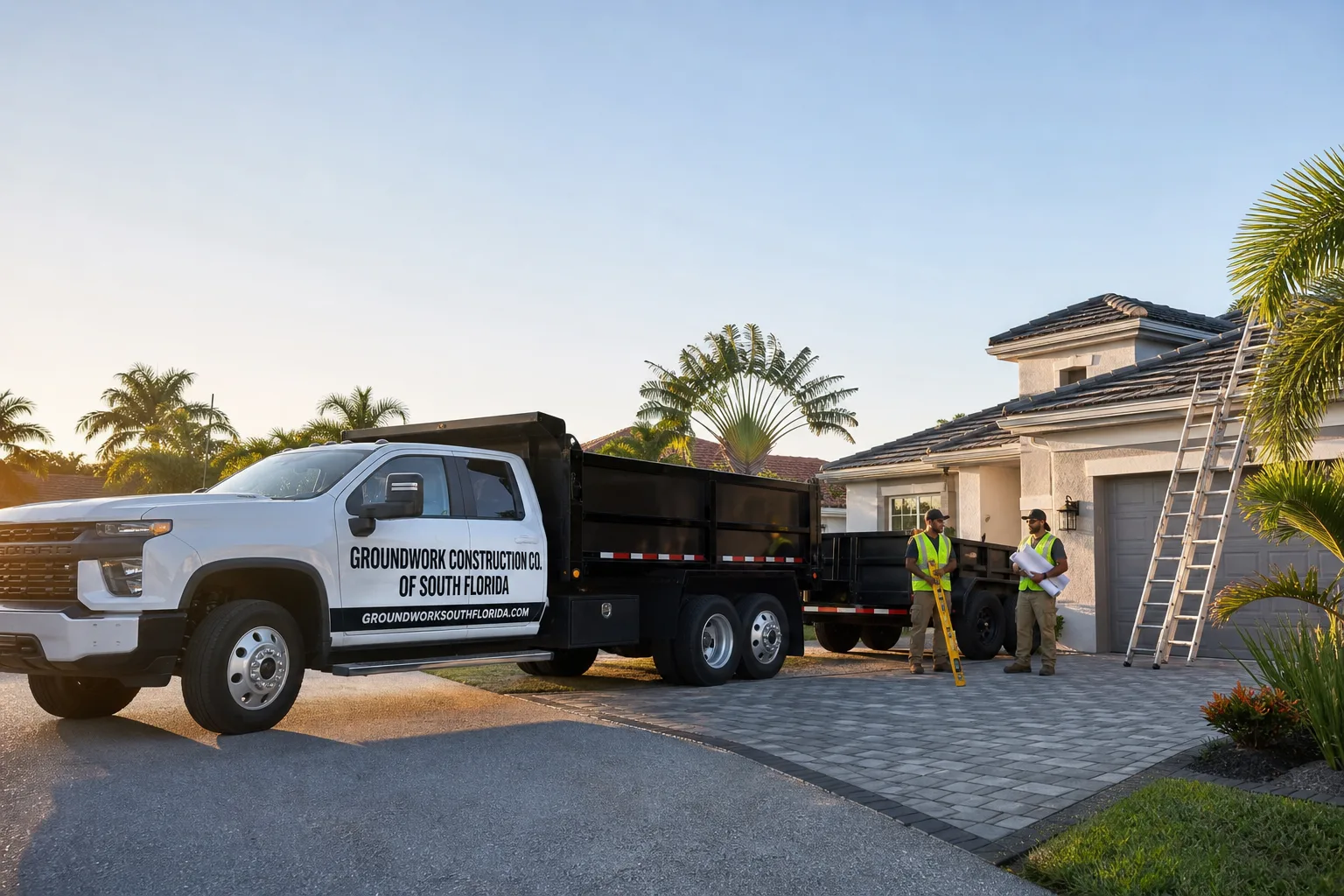
What Does ADU Site Prep & Utilities Cost and Include in Palm Beach?
ADU Site Prep & Utilities in Palm Beach typically runs $45,000-$130,000 depending on whether you’re tying into existing infrastructure or building from raw ground, and most projects we handle in the 33480 ZIP take 4-8 weeks before the foundation crew can start. That range covers soil prep, utility rough-ins, demo of existing hardscape or outbuildings, and the infrastructure that sits between your main house and the new unit. Call (844) 665-0162 and we’ll walk your property to give you a written, line-item estimate - no charge for the site visit.
We’re Groundwork Construction Co., and we’ve learned that Palm Beach’s barrier-island conditions turn what looks like straightforward groundwork into a job where salt-air corrosion, ARCOM design review, and 1920s-era utility layouts all have to be solved before the first concrete truck arrives. This page covers exactly what that prep phase looks like, what you’ll decide, and what moves the price.
How We Handle ADU Site Prep & Utilities - Stage by Stage
Every ADU Site Prep & Utilities job in Palm Beach follows a fixed sequence, but the timeline stretches or compresses based on how quickly ARCOM releases its approval and whether we hit the town’s monthly submittal deadline. Here’s how we break it down:
Stage 1: Site survey and utility locate (Days 1-3)
We mark every existing line - water, sewer, gas, electric, irrigation - and confirm depths against the as-builts on file with the Town of Palm Beach. On Mizner-era estates, those records are often hand-drawn from the 1930s, so we verify with electronic locating and soft-test potholing. You’ll decide here whether to keep the existing septic or tie into municipal sewer if it’s available on your street.
Stage 2: ARCOM documentation and pre-permit package (Weeks 2-6)
We produce fully rendered elevation drawings, material samples, and a landscape plan showing how the ADU sits within the estate’s sight lines. The Architectural Commission meets monthly; miss their submittal window and the project waits four more weeks. We handle this coordination in-house, but you need to approve the renderings before we file - that’s your decision point.
Stage 3: Demolition and rough excavation (Days 1-5 after permit release)
Existing guest cottages, detached garages, or pool houses come down. We haul off debris and cut to grade, accounting for Palm Beach’s high water table. On properties near the Intracoastal, we sometimes hit saturated sand at 18 inches and have to switch to a muck-out with geotextile stabilization - this is where soil conditions drive cost more than any other single factor.
Stage 4: Utility rough-in and trenching (Days 6-15)
Water, sewer or septic, gas, and electric get trenched from main to pad. We use PVC Schedule 40 for drainage lines, copper or PEX for domestic water, and direct-burial THHN in conduit for electrical. In Palm Beach’s salt-air zone, we specify brass or stainless valves and boxes - galvanized hardware corrodes through in 3-4 years here, half the inland lifespan. You’ll choose between overhead or underground electric service; underground costs more upfront but preserves the estate’s clean rooflines that ARCOM cares about.
Stage 5: Pad prep, compaction, and pre-slab inspection (Days 16-20)
We bring in engineered fill, compact to 95% standard Proctor, and install vapor barrier plus termite pretreatment. The Town building department inspects before the foundation contractor takes over. At this handoff, your ADU Site Prep & Utilities phase is complete, and the vertical build begins.
The Material and System Choices You’ll Make
ADU Site Prep & Utilities isn’t a single-spec job. The decisions you make here lock in performance and maintenance costs for decades, especially in Palm Beach’s coastal exposure. These are the real trade-offs we walk homeowners through:
- Water service: Copper Type L vs. PEX-A. Copper lasts 50+ years and handles the pressure fluctuations common in older Palm Beach mains, but it’s 40% more expensive and requires skilled soldering in tight trench conditions. PEX-A is flexible, faster to install, and resists freeze cracking (relevant for unconditioned utility chaseways), but UV degradation means it can’t sit exposed even briefly. Most estate owners choose copper for the main run and PEX for interior branch lines.
- Electrical conduit: PVC vs. rigid galvanized steel. PVC is standard and cost-effective, but in Palm Beach’s salt air we see UV-degraded conduit bodies fail at the 10-year mark. Rigid galvanized steel with corrosion-resistant coating adds $800-$1,500 to a typical trench run but eliminates that replacement cycle. We recommend steel for any exposed riser or above-grade penetration.
- Drainage and sewer: PVC Schedule 40 vs. cast iron. PVC is the default for buried lines - it’s what we use on 80% of jobs. Cast iron dampens sound in occupied spaces and handles higher temperatures if you’re running a kitchen grease line, but it’s heavy, expensive, and the rubber couplings degrade faster in our salt-air environment. We spec cast iron only where code requires it or where the ADU sits directly above a finished basement or wine cellar.
- Gas line: CSST (corrugated stainless steel tubing) vs. black iron. CSST installs faster and flexes around obstructions, which matters when we’re threading between mature banyan roots and existing pool plumbing. Black iron is cheaper per foot but requires threaded joints every 10 feet and cathodic protection in coastal zones. For Palm Beach, we default to CSST with an additional bonding wire to satisfy the 2023 Florida Building Code update.
- Pad preparation: Standard crushed concrete base vs. geogrid stabilization. Standard base works for well-drained sites with native sandy soils. Where we hit organics or high water table - common on the eastern side of the island near the Atlantic - we lay a biaxial geogrid between lifts of structural fill. This adds $2,500-$4,000 but prevents differential settlement that cracks slab-on-grade foundations. If your property sits on fill from the 1920s original construction, we almost always recommend geogrid.
What ADU Site Prep & Utilities Costs in Palm Beach, FL
| Component | Typical Range |
|---|---|
| Site survey and utility locate | $1,200 - $2,800 |
| ARCOM documentation and rendering | $3,500 - $7,500 |
| Demolition and haul-off | $4,000 - $12,000 |
| Rough excavation and grading | $6,500 - $18,000 |
| Water and sewer rough-in | $5,500 - $14,000 |
| Electrical trench and service | $4,500 - $11,000 |
| Gas line installation | $2,500 - $6,500 |
| Pad prep, fill, and compaction | $5,000 - $13,000 |
| Permits, inspections, and fees (Town of Palm Beach) | $3,500 - $8,500 |
| Total ADU Site Prep & Utilities | $45,000 - $130,000 |
Five variables push you to the high or low end of that range. First, existing structure demo - removing a 400-square-foot guest cottage with asbestos tile runs $12,000+; clearing a paver patio is $4,000. Second, utility distance - every foot of trench between your main house and the ADU pad adds linear cost; we’ve done 180-foot runs across Mizner estates where the main panel sits at the opposite end of the property. Third, municipal vs. septic sewer - if you’re on septic and the Health Department requires a new drain field, add $8,000-$15,000. Fourth, soil conditions - saturated sand or organics trigger geogrid, dewatering, or both. Fifth, ARCOM complexity - landmark-designated properties require material match samples that can cost $2,000-$5,000 just to produce for review.
Our written estimates itemize each of these components. What’s not included: landscape restoration beyond rough grade, pool or fountain relocation, and any interior work in the main house. We flag those exclusions upfront so there’s no surprise.
What Palm Beach Specifically Does to This Job
Palm Beach isn’t Palm Beach County, and contractors who treat them the same miss deadlines that cost homeowners months. The Town’s Architectural Commission - ARCOM - operates independently with its own design standards governing massing, materials, and color. Every exterior element of your ADU, from the utility riser boxes to the pad elevation, has to harmonize with the Mediterranean Revival or Spanish Colonial vocabulary of the original estate. That means we can’t spec standard gray PVC electrical boxes where they’ll be visible; we use bronze or custom-painted enclosures that read as intentional design choices.
The salt-air exposure is equally specific. Sitting between the Atlantic and the Intracoastal, every fastener, junction box, and valve we install faces corrosion from both directions. We’ve replaced galvanized hangers that failed in three years on estates near South Ocean Boulevard. Now we default to 316 stainless or marine-grade aluminum for any above-grade hardware, and we specify epoxy-coated rebar for any concrete that will be exposed to salt spray. The 2002 Florida Building Code wind-speed requirements for this coastal exposure zone also mean impact-rated utility penetrations - not standard boots - which adds cost but passes inspection the first time.
The housing stock itself shapes our approach. Poured concrete slabs from the 1920s often lack vapor barriers, and original cast-iron sewer lines are at end of life. When we’re trenching across these properties, we budget for the unexpected: a collapsed clay line, a undocumented pool equipment pad, a banyan root mass that redirects our entire utility path. Homeowners on Home Additions & ADU in Palm Beach projects learn quickly that the groundwork phase is where the real detective work happens.
Many clients pairing an ADU with interior updates also ask about Small & Partial Kitchen Remodels in Palm Beach or Full Bathroom Remodeling in Palm Beach - we coordinate those scopes so the utility rough-ins align, not conflict.
Serving Palm Beach, FL - Our Local Coverage Area
We’re based in the Palm Beach area and know this community well. Use the map below to see our service coverage - if you’re nearby, we can almost certainly help.
Frequently Asked - ADU Site Prep & Utilities in Palm Beach
Most jobs run 4-8 weeks from our first site visit to the pre-slab inspection, but ARCOM review can add 1-3 months if we miss their monthly submittal window or if they request material revisions. We track the commission’s calendar and file two weeks ahead of deadline to protect your timeline. Call (844) 665-0162 and we’ll confirm the current ARCOM schedule for your property.
The Town of Palm Beach issues a single building permit for the ADU that covers all phases, but the site prep and utility rough-ins trigger separate inspections - typically utility locate verification, trench depth, and pad compaction - before the foundation inspection. We pull the permit and schedule all inspections as part of our scope; you don’t hire a separate expeditor.
Sometimes, but rarely on Mizner-era estates. Original 1920s-1940s electrical panels are often maxed out at 100 amps, and adding an ADU subpanel requires a service upgrade that our electrical trench connects to. Water lines are more forgiving - we can often tee off the main with adequate pressure - but sewer capacity depends on your original pipe diameter and slope. We test both during the Stage 1 survey and tell you definitively before you commit.
The floor is about $45,000 for a flat, well-drained site with existing utilities close to the pad location, no demo, and standard materials throughout. That assumes PVC drainage, PEX water service, overhead electric, and no ARCOM material-match complications. Every variable above that baseline - distance, demo, soil, landmark status - adds from there. We’ll tell you where your property sits after the first site visit.
Our workmanship on ADU Site Prep & Utilities carries a one-year warranty covering installation quality, compaction, and leak-free utility connections. Material warranties run longer - PVC pipe manufacturers typically guarantee 50 years against defect, and we use name-brand products that carry those terms. The warranty does not cover settlement from undocumented soil conditions or damage from third-party excavation after our handoff. We document everything with photos and test reports so there’s a clear baseline.
Get Your Palm Beach Property Assessed
ADU Site Prep & Utilities in Palm Beach demands a contractor who knows the difference between town and county permitting, who specs for salt-air survival, and who won’t waste your month missing an ARCOM deadline. We’re Palm Beach contractors who handle this phase as part of a full Home Additions & ADU build - one point of accountability from groundwork to finish. Call (844) 665-0162 to schedule a free on-site estimate. Raymond Estevez or a senior project manager will walk your property, flag the specific conditions that affect your timeline and budget, and email you a written, line-item proposal within 48 hours.
Written by Raymond Estevez, Owner at Groundwork Construction Co., serving Palm Beach and South Florida.