
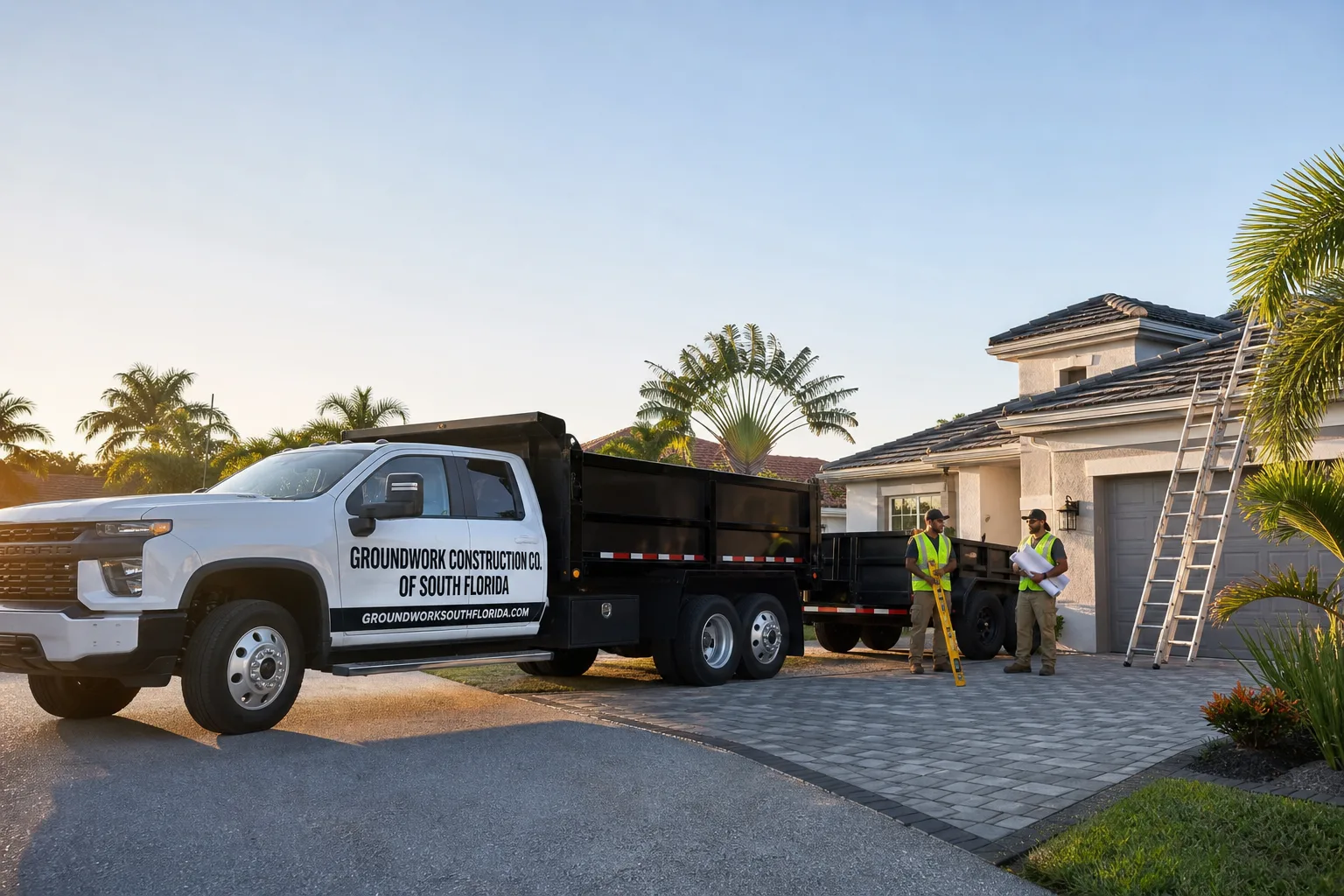
What Does Backsplash, Tile & Flooring Installation Cost and Involve in Homestead?
Backsplash, tile, and flooring installation in Homestead typically runs $800-$2,500 for the backsplash portion alone, with full kitchen flooring adding $2,000-$6,500 more depending on material and square footage. Most jobs we handle in ZIPs 33031 through 33034 take 3-5 days from demo to grout cure, with tile selection and layout approval being the two decisions that slow things down if they happen late. Call (844) 665-0162 and we’ll walk through your exact layout and give you a written estimate with line-item pricing.
How We Handle Backsplash, Tile & Flooring From First Measurement to Final Grout
Day one is always protection and demo. We mask cabinets, cover countertops with masonite, and pull existing flooring or backsplash with dust containment running. In Homestead’s post-Andrew CBS homes, we often find original builder-grade ceramic that’s been poorly bonded to painted drywall or slab with no isolation membrane. That comes out, and we inspect the substrate. Concrete slabs get checked for moisture vapor emission, drywall gets evaluated for integrity behind the stove and sink. If we’re doing both backsplash and floor, we sequence floor first to protect the vertical work. Homeowner decision needed: confirm tile layout direction and any accent strip placement before we cut.
Day two is prep and layout. Floors get self-leveling compound where the slab has settled, common in the 33033 and 33034 subdivisions built on former agricultural land with organic muck layers beneath. Walls get cement board or waterproof membrane in wet areas. We snap chalk lines and do a dry layout to avoid sliver cuts at door jambs and corners. This is where the job gets saved or ruined. Homeowner decision needed: approve the dry layout and confirm grout color, which reads very differently under Homestead’s bright southern light than it does in a showroom.
Day three is setting. We use polymer-modified thinset appropriate for the tile weight and substrate. Large-format porcelain, which we’re seeing more of in newer Homestead builds near Campbell Drive and SW 312th Street, demands 1/2-inch notched trowels and back-buttering every piece. Mosaics and subway tiles go faster but need more frequent alignment checks. We work section by section, cleaning as we go. Day four is grout and initial cure, with epoxy grout for backsplashes in heavy-cooking households and standard sanded grout for most floors. Homeowner decision needed: none, but keep foot traffic off floors and avoid splashing the backsplash for 24 hours.
Day five is seal, caulk, and final walk. Natural stone gets penetrating sealer. We silicone all changes of plane, cabinet-to-tile junctions, and inside corners. Then we do the walk with you, checking lippage with a straightedge and grout consistency. We leave you with care instructions and a packet with your tile brand, lot number, and leftover pieces for future repairs.
The Material and Layout Choices That Actually Change Your Kitchen
- Subway ceramic vs. large-format porcelain: Classic 3-by-6 subway tile runs $3-$8 per square foot and suits traditional kitchens in Homestead’s older post-Andrew subdivisions like those along SW 137th Avenue. Large-format porcelain, 12-by-24 or larger, starts around $6 per square foot and carries through contemporary spaces with fewer grout lines to clean. The trade-off: subway is forgiving of slightly wavy walls; large-format telegraphs every imperfection and demands a flatter substrate, which may add prep cost.
- Natural stone vs. engineered quartz tile: Marble, travertine, and limestone backsplashes bring warmth but need sealing every 12-18 months in Homestead’s humidity. Engineered quartz tile, including options from Cambria, offers similar visual depth without the porosity. Stone runs $15-$40 per square foot installed; quartz tile lands closer to $25-$50. For flooring, stone is rare in kitchens here due to etching from citrus and acidic cooking.
- Sheet vinyl or LVP vs. porcelain or ceramic floor tile: Luxury vinyl plank at $4-$8 per square foot installs fast and feels warmer underfoot, but it doesn’t have the thermal mass that helps cool Homestead homes in August. Porcelain floor tile at $6-$15 per square foot stays cooler, lasts decades, and handles the tracked-in sand from Keys weekends better. The catch: tile demands a level slab; LVP tolerates more substrate irregularity.
- Grout color and width: Matching grout disappears the grid and emphasizes the tile itself. Contrasting grout, especially with subway layouts, becomes a design feature. In Homestead’s bright kitchens, we steer clients away from pure white grout on floors, it shows every grain of sand. Medium gray or warm taupe ages better.
- Accent bands, niches, and special cuts: A herringbone backsplash field or a mosaic accent behind the range adds 15-30% to labor. Niche shelving in a tile shower adjacent to the kitchen (common in open-plan Homestead homes) requires waterproofing detail that extends timeline by half a day.
What Backsplash, Tile & Flooring Costs in Homestead, FL
| Component | Typical Range |
|---|---|
| Backsplash installation (material + labor) | $800-$2,500 |
| Kitchen floor tile installation | $2,000-$6,500 |
| Combined backsplash + flooring project | $3,500-$8,500 |
| Substrate repair/leveling (if needed) | $400-$1,200 |
Four factors push you to the high or low end of these ranges. First, existing condition: tile over tile saves demo cost but often fails sooner; proper removal and prep adds $400-$1,200 but protects your investment. Second, material grade: imported Italian porcelain commands premium over domestic ceramic, and the gap widens with freight to South Florida. Third, layout complexity: a straight stack is faster than herringbone, which is faster than a custom mosaic mural. Fourth, plumbing or electrical relocation: if your new backsplash layout exposes old outlets that need moving, or if you’re shifting a pot-filler location, that trades coordination adds labor and permit scope. Fifth, permit requirements: Miami-Dade requires permits for flooring replacement that involves subfloor work or any plumbing/electrical modification, and the inspection schedule can add 3-5 days to calendar time even if not to active labor.
Our written estimates itemize tile, labor, prep, and permit costs separately. What they don’t include: appliance disconnect/reconnect, cabinet modifications, or countertop removal unless we bid those as part of a full Kitchen Remodeling in Homestead scope. Many homeowners doing backsplash and flooring also ask about Vanities, Tile & Fixtures in Homestead for a coordinated bathroom update, or pair the kitchen work with a Tub-to-Shower Conversion in Homestead to consolidate trades and minimize disruption.
Why Homestead’s Building History Changes How We Approach This Work
Homestead’s housing stock is almost entirely post-Hurricane Andrew, built between 1993 and 2010 to Miami-Dade High-Velocity Hurricane Zone standards. That means CBS construction, hip roofs, and impact-rated openings, but it also means builder-grade finishes were the norm to keep costs down after the rebuild. In neighborhoods like those east of Krome Avenue and south of Campbell Drive, we regularly find original kitchen floors laid directly on slab with no moisture barrier and backsplashes glued to painted drywall with mastic that degrades in the humidity.
The Miami-Dade NOA product approval system affects us directly. Any thinset, membrane, or waterproofing product we use must carry a Miami-Dade Notice of Acceptance. Contractors who work north of the county line often bring materials that are fine for Broward or Palm Beach but get red-tagged here. We source through local distributors who maintain NOA-compliant inventory specifically for the South Dade market.
Soil conditions in western Homestead, toward the Redland and the 33031 ZIP, include expansive marl and organic deposits that shift with the wet season. We’ve seen slab heave create tile cracks in kitchens within five years of installation. When we work in those areas, we recommend crack-isolation membrane as standard, not optional, and we moisture-test every slab regardless of age. The alternative is callbacks we don’t want and you don’t deserve.
Permitting runs through Miami-Dade County for most of Homestead, but the jurisdictional line sits right at the city limits. Projects in the Keys-adjacent fringe sometimes trigger Monroe County requirements with different elevation and flood-proofing rules. We handle the permit pull and inspection scheduling either way, but the timeline varies, and we flag that upfront.
Serving Homestead, FL - Our Local Coverage Area
We’re based in the Homestead area and know this community well. Use the map below to see our service coverage - if you’re nearby, we can almost certainly help.
Frequently Asked - Backsplash, Tile & Flooring in Homestead
Most backsplash and flooring projects in Homestead take 3-5 active work days, with permit approval adding 3-7 calendar days if subfloor or plumbing work is involved. Call (844) 665-0162 for a timeline based on your specific layout and material choice.
Permits are required in Miami-Dade County when flooring replacement involves subfloor repair, leveling compound over 1/4 inch, or any electrical or plumbing relocation. Pure surface replacement with no substrate modification often does not require permitting, but we verify scope with the building department before starting. We pull permits as part of our standard process when they’re needed.
Yes, in most cases we can install backsplash tile with countertops in place, using precision cutting and careful protection of the existing surface. The exception is when the countertop overhang or edge profile prevents proper tile termination, or when the existing backsplash was installed as a continuous unit with the counter. We evaluate this during measurement and tell you before you commit.
Glazed porcelain and glass tile are the most humidity-resistant options for Homestead kitchens, as they absorb essentially zero moisture and won’t support mold growth behind the surface. Natural stone is beautiful but requires more vigilant sealing in this climate. We discuss your cooking habits and ventilation before recommending a specific material.
Our tile installation workmanship is backed by a one-year warranty covering settling, adhesion failure, and grout integrity under normal use. Manufacturer warranties on the tile itself, which range from 10 years to lifetime depending on brand and grade, transfer directly to you. We provide both warranty documents at project closeout.
Get Your Homestead Kitchen Started
Backsplash, tile, and flooring in Homestead is what we do. One call to (844) 665-0162 gets you a free on-site estimate with Raymond Estevez or a member of our Kitchen Remodeling crew. We’ll measure, show you material samples from our curated brand portfolio, and deliver a written quote with line-item pricing. No deposit required to schedule. We cover Homestead and the full South Dade area from our Fort Lauderdale base.
Written by Raymond Estevez, Owner at Groundwork Construction Co., serving Homestead since our founding.