
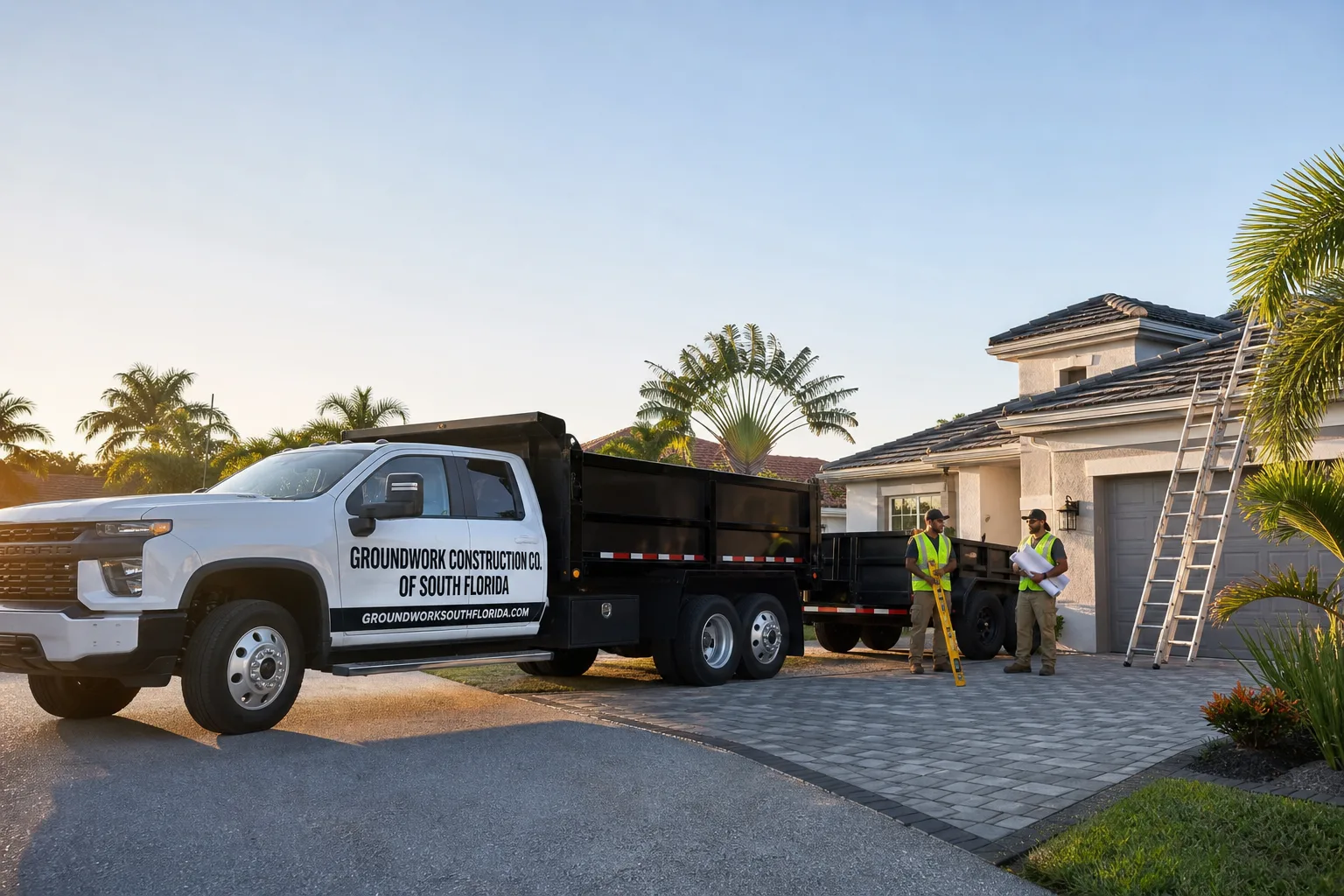
Asphalt Driveways & Resurfacing in The Crossings, FL: Timeline, Cost, and What to Expect
Asphalt driveways & resurfacing in The Crossings typically runs $3,500-$9,000 for new paving and $2,500-$6,500 for resurfacing an existing driveway, with most jobs completed in 2-4 days depending on prep work and weather. Call (844) 665-0162 for a free on-site estimate and we’ll walk your specific driveway, check drainage, and give you a written quote with a clear start date.
The Crossings sits on some of the trickiest ground in Miami-Dade County. That flat, low-lying terrain near the Everglades fringe means water tables rise fast during wet season, and the oolitic limestone of the Miami Rock Ridge lurks just below the surface. We’ve jackhammered through that rock on more than one driveway prep job in this ZIP code. It changes how we bid, how we schedule, and what equipment we bring. Homeowners here need a crew that prices the ground honestly, not one that hits you with a change order after the first shovel strike.
How we approach asphalt driveways & resurfacing from first call to final roll
We break every asphalt job into five clear stages. You’ll know what’s happening, what you’re deciding, and how long each phase takes before we start.
Stage 1: Site walk and scope lock (Day 1, 60-90 minutes)
We visit your property, measure the existing driveway or planned footprint, and photograph drainage patterns. In The Crossings, we’re specifically checking whether your driveway ties into original 1980s stormwater management or if runoff has carved new channels through the sandy topsoil. We flag buried sprinkler lines, shallow electrical runs, and that limestone shelf. You decide at this stage: new construction or resurfacing, and whether you want us to handle the permit or if your HOA is managing it. We leave with enough information to build a fixed-price estimate, not a guess.
Stage 2: Permit and material spec (2-5 business days)
Miami-Dade requires a paving permit for any new driveway or expansion, and resurfacing over 25% of the surface typically triggers review too. We submit the application with engineered drawings showing cross-slope and drainage compliance. Meanwhile, you choose your asphalt mix: standard hot-mix for most residential driveways, or polymer-modified asphalt if you’re dealing with heavy vehicle loads or want extended crack resistance in our summer heat. This is also when we confirm the base depth, usually 6-8 inches of compacted limerock in The Crossings, though limestone proximity sometimes lets us shave that.
Stage 3: Demolition and prep (1-2 days)
Old asphalt comes out with a skid-steer and breaker attachment. If we’re hitting rock within the first foot, we switch to hydraulic hammers. We grade for drainage, typically 1% cross-slope minimum to move water toward the street or swale. In The Crossings, we often find original driveways were poured thin with minimal base, so the prep phase runs longer than the asphalt lay itself. You don’t need to be home, but we do need clear access and any vehicles moved 24 hours ahead.
Stage 4: Base and paving (1-2 days)
We lay and compact the aggregate base in lifts, testing density as we go. Then the asphalt arrives hot, we pave in two lifts for residential work, and roll to 92% density minimum. Edge restraint goes in where the driveway meets landscaping. The surface needs 24-48 hours before vehicle traffic, longer if we’re in a July heat wave.
Stage 5: Final inspection and sealant schedule (Day 4-5)
Miami-Dade inspects for drainage compliance and surface integrity. We walk you through curing timelines and recommend sealcoating at 6-12 months, then every 3-5 years after. You’ll get our maintenance sheet specific to The Crossings’ sun exposure and rainfall patterns.
The material and configuration choices that change your driveway
Not all asphalt is the same, and the spec you choose matters more in South Florida’s UV and rain cycle than in cooler climates. Here’s what we actually quote:
- Standard hot-mix asphalt (HMA): The baseline for residential driveways, typically 2.5-3 inches compacted thickness over aggregate base. Holds up 15-20 years with proper maintenance. Best value for typical single-family homes in The Crossings with standard vehicle loads. Surface texture is medium-coarse for traction.
- Polymer-modified asphalt (PMA): Rubber or plastic polymers added to the binder for greater flexibility and crack resistance. Costs 15-25% more than standard HMA, but performs better where tree roots press from the swales common in older The Crossings lots, or where heavy trucks occasionally service the property. We recommend this for driveways longer than 80 feet where thermal expansion stress concentrates.
- Perpetual pavement design: A multi-layer system with a flexible bottom, strong middle, and durable surface. Overkill for most homes, but appropriate if you’re converting a driveway to RV or commercial vehicle access, or if you’re building out a new detached ADU in The Crossings and need the drive to handle construction traffic plus permanent use.
- Resurfacing vs. full replacement: Resurfacing adds 1.5-2 inches of new asphalt over a structurally sound base. Works if your existing driveway has surface cracking but no alligator patterns, no base failures, and drainage that still functions. In The Crossings, we see a lot of 1980s-era drives that were under-based originally, so we reject about 30% of resurfacing candidates after probe testing. Honest assessment saves you from a 3-year failure.
- Edge treatment and drainage integration: You choose between standard asphalt edges, Belgian block or concrete curb for definition, or integration with a broader driveway & pavers project if you’re doing walkways or a courtyard simultaneously. Drainage can be surface flow, trench drain across the apron, or tie-in to existing underground systems.
What asphalt driveways & resurfacing costs in The Crossings, FL
| Scope | Price Range | Typical Size |
|---|---|---|
| New asphalt driveway paving | $3,500-$9,000 | 400-800 sq ft |
| Driveway resurfacing | $2,500-$6,500 | 400-800 sq ft |
| Driveway replacement (full) | $5,000-$14,000 | 400-800 sq ft |
| Driveway sealing | $250-$700 | 400-800 sq ft |
Five factors push your job toward the high or low end of these ranges:
1. Existing condition and base integrity. A driveway with sound drainage and stable base needs only grading and paving. One with saturated subgrade, failed base, or tree root intrusion needs excavation, new aggregate, and geotextile fabric. In The Crossings, we find original 1980s drives often lack adequate base depth, pushing jobs toward replacement rather than resurfacing.
2. Proximity to limestone shelf. When we hit that Miami Rock Ridge within the excavation zone, we price hydraulic breaking or rock sawing separately. It’s not optional, and we won’t bury it in a contingency you never see. We probe during the site walk and tell you before you sign.
3. Drainage complexity. Simple sheet flow to the street is standard. Tying into underground storm systems, adding trench drains, or regrading swales adds material and labor. The Crossings’ flat terrain often requires active drainage solutions that steeper lots don’t.
4. Asphalt grade and thickness. Standard HMA at 2.5 inches over 6 inches base is our typical spec. Step up to polymer-modified or increase to 4 inches, and material costs rise proportionally.
5. Permit scope and HOA coordination. Miami-Dade’s paving permit runs $200-$400 for most residential jobs, but if your HOA in The Crossings requires architectural review or specific color/material approvals, we build that timeline into the project. Some communities here still operate under original covenants from the 1980s development.
Our written estimates include all labor, materials, equipment, permit fees, and disposal. They do not include landscaping restoration beyond the paved edge, sprinkler repair if we strike lines, or sealcoating at the 6-12 month mark.
Why The Crossings changes how we bid this job
The Crossings isn’t like newer Miami-Dade developments with engineered fill and predictable geology. This community was built fast in the 1980s on raw Everglades-edge land, and the construction shortcuts of that era show up in driveways now.
We most often work on single-story and two-story CBS homes built between 1978 and 1995, many with original driveways that were poured to minimum spec. The concrete block construction means homes are durable, but the original site work was sometimes thin. We’ve pulled out asphalt drives in The Crossings that had 3 inches of base over native sand, no geotextile, and drainage that simply pooled against the garage slab. That garage slab, by the way, often sits close to the seasonal water table, so any water intrusion from a failed driveway pitch becomes a real problem.
The permitting environment matters too. Miami-Dade’s post-Hurricane Andrew building culture means inspectors are thorough on drainage and surface water management. A driveway that sheds toward the house, or that dumps into a neighbor’s yard, won’t pass. We design for compliance from the first sketch, not after a failed inspection.
And that limestone. Crews throughout The Crossings know the sound of a bucket tooth hitting rock after six inches of digging. We price for it when our probe indicates it’s likely, and we’ve built relationships with equipment operators who can break rock fast without tearing up your yard. Homeowners sometimes ask why our bid runs higher than a quote from a crew that didn’t probe. The answer is usually in the change order they haven’t received yet.
If you’re considering a broader exterior update, many homeowners pair driveway work with junior ADU & interior conversion in The Crossings to add rental income or multigenerational space, or coordinate through our driveway & pavers crew for integrated hardscaping.
Serving The Crossings, FL - Our Local Coverage Area
We’re based in the The Crossings area and know this community well. Use the map below to see our service coverage - if you’re nearby, we can almost certainly help.
Frequently asked - asphalt driveways & resurfacing in The Crossings
Most jobs finish in 2-4 days from mobilization to final roll, with permit approval adding 2-5 business days beforehand. Limestone breaking or drainage rework can extend that by a day or two. Call (844) 665-0162 and we’ll give you a firm schedule after the site walk.
Yes, Miami-Dade requires a permit for new driveway construction and for resurfacing that exceeds 25% of the surface area. We handle the application, engineered drawings, and inspection scheduling as part of our standard process. The permit fee is included in your written estimate.
Resurfacing works if the base is stable, drainage functions, and cracking is superficial. We probe-test during the site walk, and we reject about 30% of resurfacing candidates in The Crossings due to under-built original bases. If we recommend replacement, it’s because resurfacing would fail within 3-5 years.
Our price covers demolition if needed, base preparation and compaction, asphalt supply and installation, edge restraint, permit fees, and disposal. It does not include landscaping repair beyond the pavement edge, sprinkler line repair, or sealcoating at 6-12 months. We’ll itemize everything in writing before you commit.
We warranty workmanship for one year against defects in installation, including drainage failures attributable to our grading. Material defects are covered by the asphalt supplier’s standard terms. Proper maintenance, including sealcoating at 6-12 months and every 3-5 years thereafter, is required to maintain surface integrity. We provide a maintenance schedule specific to your driveway’s exposure and use.
Get your free estimate for asphalt driveways & resurfacing in The Crossings
Call (844) 665-0162 to schedule a free on-site estimate. We’ll walk your driveway, probe the base, check drainage, and give you a written quote with a fixed price and start date. No deposit required to get on the schedule. Raymond Estevez and our The Crossings crew handle every phase in-house, from permit to final roll.
Written by Raymond Estevez, Owner at Groundwork Construction Co., serving The Crossings and South Florida.