
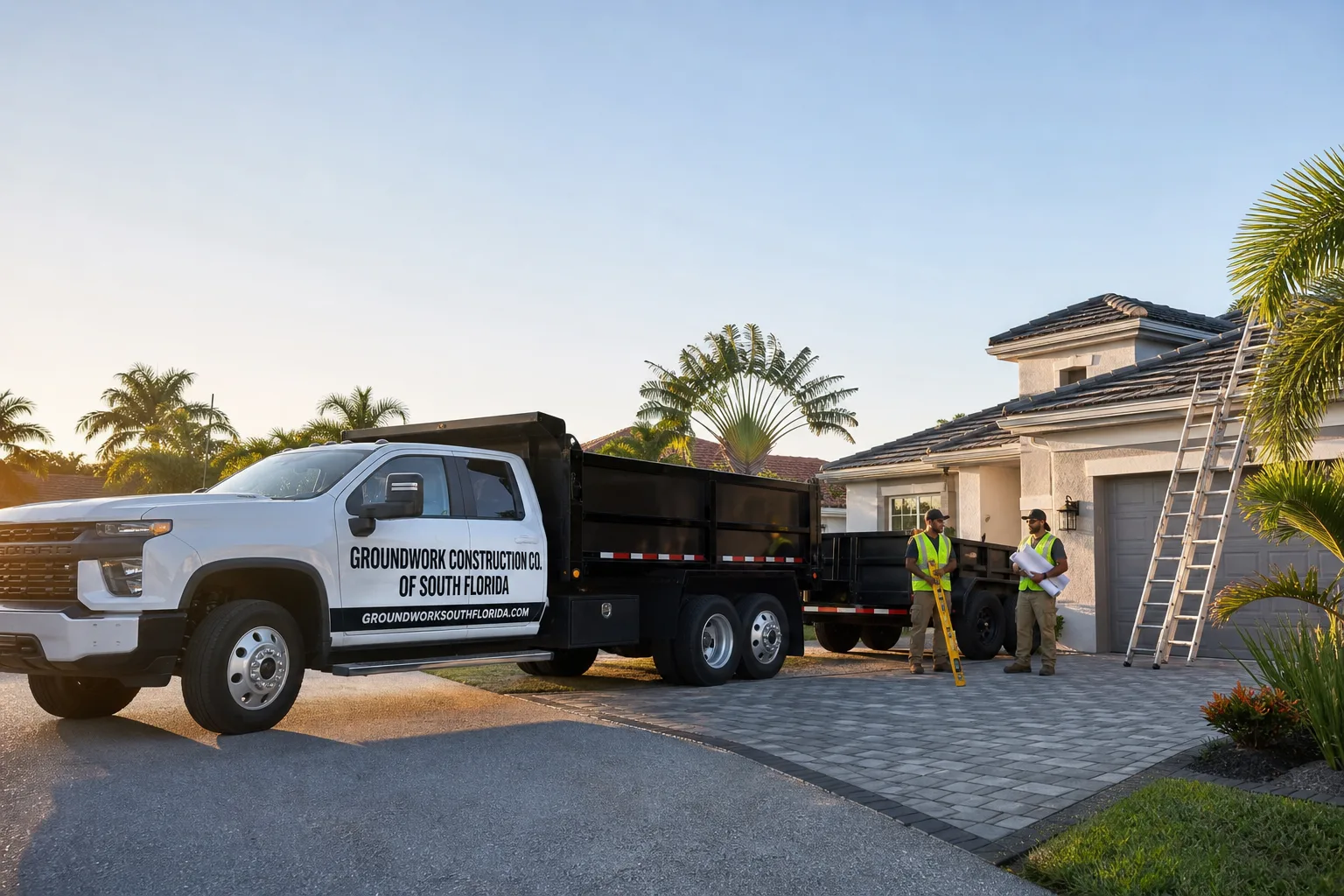
ADU Site Prep & Utilities in Country Walk, FL - What’s Actually Involved
ADU site prep and utilities in Country Walk covers clearing and grading your lot, trenching for water, sewer, and electrical service, and bringing dedicated connections to a new detached unit or garage conversion. Most jobs we handle in the 33196 area run 3 to 6 weeks from first shovel to final utility sign-off, with costs typically falling between $45,000 and $130,000 depending on whether we’re tapping existing mains or running entirely new lines across a larger acreage lot. Call (844) 665-0162 and we’ll walk your property to give you a written, itemized estimate - no charge for the site visit.
How We Handle ADU Site Prep & Utilities From First Mark to Final Hookup
We break this job into five distinct stages so you know what’s happening, who’s showing up, and what decision we need from you before we can move forward. Here’s how it actually plays out on a typical Country Walk property.
Stage 1: Utility Locate and Site Survey (Days 1-3)
Before anything gets dug, we pull Miami-Dade utility locates for gas, electric, water, and telecom lines, then survey your lot for elevation, drainage flow, and the shallow limestone shelf that’s common in this part of unincorporated Miami-Dade. You’ll need to decide during this stage whether the ADU will tie into your home’s existing meter and septic or run independent service - that choice determines our trenching path and permit package. If your property sits on one of the larger half-acre plots common near the western edge of Country Walk, independent service often makes more sense for resale and rental flexibility.
Stage 2: Demolition and Rough Clearing (Days 4-8)
We remove any existing structures, stumps, or hardscape in the build zone, then haul off debris. On post-Andrew rebuilds, we sometimes find old footings or abandoned septic tanks from previous structures that weren’t properly decommissioned. Those have to be located and handled before we can certify the pad. Homeowner decision point: do you want us to grade the entire build pad now, or leave room for future driveway or patio extension? We flag the choice because it affects our equipment schedule.
Stage 3: Excavation, Trenching, and Rock Work (Days 9-18)
This is where Country Walk’s geology gets real. The Miami oolitic limestone layer typically sits 12 to 18 inches below grade here, so standard trenching equipment often bogs down. We bring in rotary hammer attachments or compact jackhammer rigs to cut utility trenches through the rock, which adds time but prevents the drainage failures we’d see if we tried to work around it. During this stage you’ll choose your pipe and conduit specs - PVC versus HDPE for water, direct-bury versus conduit for electrical - and we’ll rough in sewer lateral, water main tap, and electrical trench to the ADU footprint.
Stage 4: Foundation Prep, Drainage, and Backfill (Days 19-25)
With utilities roughed in, we compact the build pad, install perimeter drainage if your lot sits low or holds water during the wet season, and backfill trenches with engineered fill rather than native rock fragments. The drainage call matters in Country Walk: properties near the canal system or with minimal backyard slope can pool water against a new slab if we don’t grade for positive flow. You’ll sign off on the pad elevation and drainage plan before we pour or set the ADU foundation.
Stage 5: Final Utility Connections and Inspection (Days 26-35)
We coordinate with Miami-Dade Water and Sewer, FPL, and the county building department for sequential inspections - plumbing pressure test, electrical rough, and final utility release. Miami-Dade inspectors in this district are thorough on hurricane-zone tie-ins; they check that exterior electrical disconnects meet HVHZ wind-load requirements and that sewer laterals have proper cleanout access. Once we pass, the ADU shell or prefab unit can be set. This stage’s length depends heavily on inspection scheduling, which we coordinate but don’t control.
The Material and System Choices That Change Your Build
ADU site prep and utilities isn’t a one-spec job. The choices below are the ones we walk through with Country Walk homeowners, with the honest trade-offs of each.
- Water service: tap existing meter versus independent meter. Tapping your home’s meter costs less upfront but caps total flow capacity; independent meter adds $3,500-$6,000 but gives rental-meter flexibility and avoids pressure drop during simultaneous use. For ADUs intended as long-term rentals, we typically recommend independent.
- Sewer: gravity lateral versus grinder pump system. If your lot sits below the county sewer main elevation - common on some of the flatter interior blocks in Country Walk - a grinder pump station runs $4,000-$7,500 installed but avoids the excavation depth that would otherwise be needed. Gravity is simpler and cheaper if grade allows.
- Electrical: overhead drop versus underground service. FPL’s overhead drops are faster to schedule and cost less to install, but they’re vulnerable to hurricane damage and can conflict with mature oak canopies. Underground adds trenching cost but keeps lines protected and your yard clear. On post-Andrew rebuilds with existing underground service, matching the original method usually streamlines permitting.
- Foundation type: monolithic slab versus stem wall with crawl. Monolithic is faster and cheaper for flat pads; stem wall with crawlspace adds $8,000-$15,000 but protects mechanicals from flooding and makes future plumbing access easier. Given Country Walk’s high water table, we discuss this seriously with every homeowner.
- Drainage: simple swale versus French drain with catch basin. Swales work on sloped lots; French drains with hard-pipe discharge handle flat or poorly draining properties but need periodic maintenance. We specify based on your specific lot survey, not a default.
What ADU Site Prep & Utilities Costs in Country Walk, FL
For a typical Country Walk property, ADU site prep and utilities runs between $45,000 and $130,000. That’s a wide range because the job changes significantly based on five factors:
| Cost Driver | Low-End Scenario | High-End Scenario |
|---|---|---|
| Lot size and utility run length | Compact lot, 30-foot trench to existing tie-ins | Acreage property, 150+ foot run across rock |
| Rock excavation depth | Limestone at 18 inches, minimal hammer work | Shallow rock at 12 inches, extensive rotary cutting |
| Service independence | Shared meter, existing sewer lateral | Independent water, sewer, and electrical with new transformer |
| Foundation and drainage spec | Monolithic slab, swale drainage | Stem wall, perimeter drain, pump station |
| Permit scope and HVHZ upgrades | Post-Andrew structure, current code compliance | Pre-Andrew home triggering mandatory structural upgrades |
Our written estimates itemize each of these line items separately, so you see where your money goes. We don’t lump “site work” into a single opaque number. What’s typically included: all excavation, trenching, rock work, utility rough-in to the ADU footprint, foundation pad prep, drainage, backfill, and permit coordination. What’s typically separate: the ADU structure itself, final landscaping, and any driveway or walkway extension beyond the build pad perimeter. Call (844) 665-0162 for an exact quote on your lot - estimates are free.
Why Country Walk Properties Make This Job Different
Country Walk isn’t a generic Miami-Dade job site, and pretending otherwise gets permits rejected or foundations failed.
The community’s split-era housing stock - original late-1970s CBS construction alongside post-Hurricane Andrew rebuilds to HVHZ standards - means we verify your home’s build era before we design any utility tie-in. On surviving pre-Andrew homes, Miami-Dade inspectors almost always mandate hurricane strap or clip upgrades at the rafter tails when we pull an ADU permit, because the county treats any addition as a trigger to bring the existing structure’s roof-to-wall connections up to current code. We’ve seen homeowners surprised by this; we build it into our initial assessment so you’re not staring at a change order mid-project.
The shallow Miami rock and high seasonal water table are equally non-negotiable. In Country Walk, we routinely hit limestone within the first foot of excavation. Standard backhoe trenching stops there. We budget for rotary or jackhammer methods from the start, and we design drainage systems that account for water that simply has nowhere to go during the wet season. The alternative - a foundation that heaves or a utility trench that becomes a seasonal pond - isn’t one we’ll build.
Permitting through Miami-Dade’s unincorporated district office also means navigating product approvals that exceed standard Florida code. Every electrical disconnect, every plumbing fitting, every window or door that eventually goes into the ADU needs Miami-Dade County Notice of Acceptance or Florida Product Approval with HVHZ rating. We handle that documentation as part of our Home Additions & ADU in Country Walk process, but the site prep stage is where we start collecting it.
Homeowners in this area often pair their ADU groundwork with interior upgrades to the main house, and our Small & Partial Kitchen Remodels in Country Walk or Full Bathroom Remodeling in Country Walk crews can coordinate timing so you’re not juggling multiple contractors across overlapping projects. As a Home Additions & ADU team serving Country Walk, we manage the sequencing so site prep finishes before interior demo begins.
Serving Country Walk, FL - Our Local Coverage Area
We’re based in the Country Walk area and know this community well. Use the map below to see our service coverage - if you’re nearby, we can almost certainly help.
Frequently Asked - ADU Site Prep & Utilities in Country Walk
Most jobs finish in 3 to 6 weeks, with rock excavation and Miami-Dade inspection scheduling being the two variables that push timelines toward the longer end. Call (844) 665-0162 and we’ll give you a realistic schedule based on your lot conditions and current permit queue.
In Miami-Dade’s unincorporated areas, site prep and utility rough-in are covered under the master ADU building permit, but water and sewer taps require separate coordination with Miami-Dade Water and Sewer Department. We handle both permit tracks as part of our project management.
Sometimes, but not always. If your existing service panel has capacity and your water meter can handle the additional load, we can tap in place. If not, we’ll need to upgrade the main service or meter, which we identify during our initial site survey and include in the estimate.
The lowest-cost path is a compact lot with deep soil over rock, shared water and sewer service, and an existing electrical panel with spare capacity. That combination can land near the $45,000 end of our range. The moment we hit shallow limestone, need independent services, or trigger HVHZ structural upgrades, costs move upward. We quote each scenario honestly so you can decide what trade-offs make sense.
We warranty our excavation, grading, and utility rough-in workmanship for one year, with the specific pipe, conduit, and drainage materials carrying their own manufacturer warranties. Foundation and structural elements are covered under the broader project warranty. We put this in writing in every contract - no verbal promises.
Ready to Move Forward on Your Country Walk ADU?
We’ll walk your property, assess the rock depth and utility path, and deliver a written, itemized estimate for ADU site prep and utilities with no obligation. Call (844) 665-0162 to schedule your free site visit. Raymond Estevez or a senior member of our crew will meet you on-site, answer your questions, and outline the exact sequence for your lot.
Written by Raymond Estevez, Owner at Groundwork Construction Co., serving Country Walk and South Florida homeowners since our founding.