
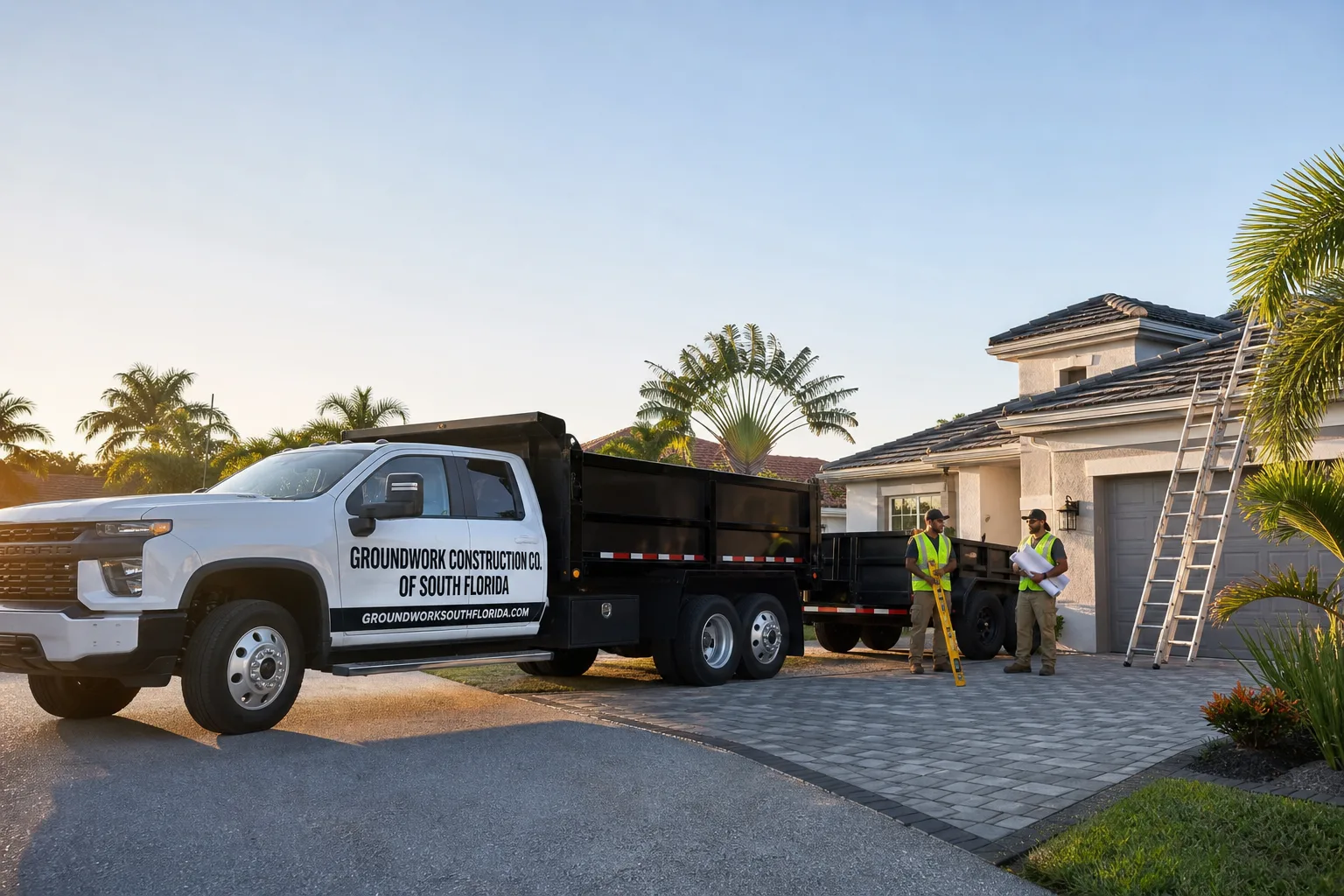
Paver Driveways in Miami Shores: What to Expect, Timeline, and Cost
A professionally installed paver driveway in Miami Shores typically runs $7,000-$18,000 and takes 5-10 business days from demolition to final compaction, assuming Architectural Review Board approval is already in hand. Most homeowners in the village need that ARB sign-off first, which adds 4-6 weeks if your contractor misses the monthly submission window. Call (844) 665-0162 and we’ll walk you through whether your project needs ARB review or qualifies as routine maintenance.
We’ve learned the hard way that Miami Shores doesn’t work like the rest of Miami-Dade. The village’s ARB meets on a fixed monthly schedule, and a contractor who submits plans a day late waits another full month. That single calendar quirk has cost less-experienced crews entire seasons. Our team schedules backward from ARB deadlines, not forward from your start date.
How We Install a Paver Driveway in Miami Shores
Every paver driveway we build follows five distinct stages. Here’s what happens, what you’ll need to decide, and how long each phase takes.
Stage 1: Site Evaluation and ARB Documentation (1-2 weeks)
We measure your existing driveway, photograph the approach from the street, and document how the finished project will read against your home’s facade. In Miami Shores, this isn’t busywork - the ARB wants to see material samples, color palettes, and a clear statement that the new driveway respects the Mediterranean Revival or Spanish Colonial Revival character of the neighborhood. You’ll decide on paver style and color at this stage; we bring physical samples from Belgard, Unilock, Tremron, and Techo-Bloc to your door. We also flag any underground utilities, drainage conflicts, or sprinkler lines that need relocation before excavation begins.
Stage 2: Demolition and Base Excavation (1-2 days)
We remove the existing surface - whether it’s cracked concrete, old asphalt, or a previous paver installation that’s failed. Excavation depth depends on what’s underneath. Most Miami Shores homes from the 1930s-1950s sit on compacted coral rock or sandy fill that drains well but shifts if disturbed. We excavate 8-12 inches below finished grade, then compact the native soil with a plate compactor before bringing in aggregate. If we hit original cast iron drainage or undocumented electrical during demo, we stop and coordinate with the appropriate trade - another reason the single-source model matters on these older properties.
Stage 3: Base Installation and Grading (1-2 days)
We lay and compact a crushed limestone aggregate base in two lifts, typically 6-8 inches total depth. Proper slope is critical here: Miami Shores sits less than a mile from Biscayne Bay, and summer sheet flooding is common on flat lots. We grade for 1-2% runoff toward the street or a French drain system, never toward the house. The base gets saturated and compacted to 95% standard Proctor density - a specification we verify, not guess. You’ll sign off on the grading before we proceed; changing slope after pavers are laid means starting over.
Stage 4: Edge Restraint, Bedding Sand, and Paver Laying (2-4 days)
Concrete or aluminum edge restraints lock the field in place. We screed a 1-inch bedding sand layer, then lay pavers in your chosen pattern - herringbone for driveways that see daily vehicle traffic, basketweave or running bond for lighter-use approaches. Our crew cuts pavers with a wet saw for clean edges against existing walkways, garage aprons, or mature oak roots that we work around rather than remove. In Miami Shores, we regularly see homeowners who want to preserve root systems from decades-old laurel oaks; we adjust the layout and use flexible permeable joints rather than fight the tree.
Stage 5: Compaction, Joint Sand, and Final Inspection (1 day)
We vibrate-compact the finished surface, sweep polymeric sand into joints, and compact again. The polymeric sand hardens when misted, locking pavers against each other and resisting weed growth and ant colonization - both persistent issues in South Florida’s climate. We do a final walkthrough with you, verify drainage with a hose test, and document the completed work for your records and any future ARB inquiry.
The Paver Options You’ll Actually Choose Between
Not all pavers suit every Miami Shores property. Here are the real trade-offs our clients weigh:
- Concrete pavers (standard grade): The most common choice. Cost-effective, available in dozens of colors and textures, and manufactured to ASTM C936 standards for strength and absorption. The honest downside: surface color can fade slightly over 8-12 years of intense UV exposure, and the most budget-friendly lines offer limited edge-chamfer detailing. Best for homeowners who want a clean, updated look without dominating the home’s historic character.
- Concrete pavers (premium/textured): Thicker face mix, more pronounced surface texture, and tighter dimensional tolerances. Brands like Belgard’s Bergerac or Unilock’s Brussels Block mimic aged cobblestone or tumbled granite. The texture hides minor staining from oak leaf tannins or irrigation hard water - a genuine advantage in Miami Shores’ mature-canopy neighborhoods. Costs 30-50% more than standard grade.
- Permeable pavers: Open-graded base and wider joints allow rainwater to percolate through rather than run off. Required by Miami-Dade stormwater regulations for some new impervious surface additions, and strongly worth considering if your lot has documented drainage issues or sits below the street grade. The base is deeper (typically 14-18 inches), so excavation costs run higher. We often recommend these for properties near Biscayne Bay where tidal flooding compounds rainfall events.
- Clay brick pavers: Genuine fired clay, not concrete dyed to look like brick. The color is through-body, so wear only reveals more of the same material. Matches the historic authenticity of Miami Shores’ 1930s-1950s housing stock better than any concrete alternative. The trade-off: higher material cost, more limited local inventory, and a softer surface that requires more frequent joint maintenance. We source these when the ARB or homeowner specifically requests material continuity with original construction.
- Porcelain pavers: Relatively new to the driveway market. Extremely low absorption, stain-resistant, and available in large formats that read more like poured stone. Best for modern architectural homes in the village, though the ARB has questioned whether large-format porcelain reads as “appropriate” for strict Mediterranean Revival contexts. We present this option with that caveat upfront.
Joint sand choice matters too. Standard silica sand is cheapest but washes out and requires annual top-offs. Polymeric sand adds $0.50-$1.50 per square foot but locks joints for 5-7 years. For driveways with oak canopy coverage, we typically specify polymeric - the tannin staining is easier to manage when joints aren’t constantly eroding.
What Paver Driveways Cost in Miami Shores, FL
| Project Scope | Typical Range |
|---|---|
| Standard concrete paver driveway (1-car, ~400 sq ft) | $7,000-$10,500 |
| Standard concrete paver driveway (2-car, ~600 sq ft) | $10,000-$14,000 |
| Premium or permeable paver driveway (2-car) | $13,000-$18,000 |
| Clay brick paver driveway (2-car) | $14,000-$18,000+ |
| Existing driveway demolition and haul-away | Included in above |
Five variables push any paver driveway toward the high or low end of these ranges:
- Existing surface condition. A thin, cracked concrete slab comes out easily. Thick reinforced concrete, old asphalt over concrete, or a previous paver installation with excessive base material adds demolition hours and disposal tonnage.
- Base repair needs. If we find saturated, organic, or improperly compacted soil beneath the old driveway, we excavate deeper and import engineered fill. This adds $1,500-$4,000 depending on depth and volume.
- Drainage infrastructure. Simple sloping to the street is standard. Adding a French drain, catch basin, or connection to your existing storm system adds materials and labor.
- Material grade and pattern complexity. Herringbone in standard concrete pavers is straightforward. Intricate borders, fan patterns, or multi-size layouts increase cutting time and waste factor.
- ARB and permit timing. Not a direct material cost, but a real project cost. A six-week ARB delay pushes your usable season back and may require re-mobilization if weather intervenes.
Our written estimates include demolition, base materials, pavers, edge restraint, bedding and joint sand, compaction, and final cleanup. What’s typically separate: sprinkler repair, tree root pruning by an arborist, or modifications to underground drainage that the village requires beyond the driveway footprint itself.
What Miami Shores Homes Specifically Do to This Job
Miami Shores isn’t a municipality where you pour concrete and move on. The village’s Architectural Review Board operates one of the most rigorous design-review processes in Miami-Dade County, and paver driveways - being visible from the public right-of-way - almost always require ARB approval before the building permit office will even accept an application.
The housing stock here shapes everything we specify. Most homes were built between the 1930s and 1950s using hollow clay tile or early concrete block with stucco exteriors and barrel tile roofs. That construction predates modern hurricane strapping, and the original foundations weren’t designed for today’s vehicle loads. We regularly see driveways that have settled because the original base was merely compacted soil, not engineered aggregate. When we excavate, we’re not just removing a failed surface - we’re often correcting 70-90 years of incremental settlement.
The salt-laden air from Biscayne Bay, less than a mile to the east, accelerates corrosion of any metal components. We specify Miami-Dade NOA-approved edge restraints and fasteners even though pavers themselves aren’t structural - the village’s inspectors know the difference, and we’ve had installations flagged for non-compliant hardware that would pass inland.
Then there’s the ARB calendar itself. The board meets monthly on a fixed schedule. Miss the submission deadline by a day, and your project sits for four weeks. Contractors who work Miami Shores sporadically often discover this only after they’ve promised a start date. We maintain a running ARB submission calendar and schedule your pre-application meeting before we ever talk about breaking ground.
Homeowners sometimes ask whether a paver driveway can be part of a larger exterior update. It can, and often is - many clients pair this work with Driveway & Pavers in Miami Shores projects that include walkways or patio connections. Others are expanding their home’s footprint and want the driveway to read as part of a cohesive site plan. For those clients, we coordinate with our Driveway & Pavers crew and our ADU Design & Permitting in Miami Shores team, or explore whether a Garage Conversion ADU in Miami Shores makes sense for their property. One contractor, every phase - the driveway isn’t an afterthought to the larger project, and the larger project isn’t an afterthought to the driveway.
Serving Miami Shores, FL - Our Local Coverage Area
We’re based in the Miami Shores area and know this community well. Use the map below to see our service coverage - if you’re nearby, we can almost certainly help.
Frequently Asked - Paver Driveways in Miami Shores
The physical construction takes 5-10 business days, but most homeowners need to add 4-6 weeks for ARB approval if the project hasn’t already been through design review. We schedule your ARB submission before we commit to a construction start date, so you’re never waiting on paperwork after demolition begins. Call (844) 665-0162 and we’ll check the next available ARB deadline for your street.
Yes, and in nearly all cases you’ll need ARB approval first. The village requires Architectural Review Board sign-off for any exterior modification visible from the public right-of-way before the building department will issue a permit. “Like-for-like” replacement in identical materials sometimes qualifies for administrative approval without a full ARB hearing, but we verify that pathway during your initial consultation rather than assume it.
Usually, yes - if the lines are properly located and sleeved before excavation. We use utility locating services and hand-dig test pits near known irrigation or drainage lines. If your system has undocumented repairs or runs directly through the driveway footprint, we may need a licensed irrigation contractor to relocate heads or main lines before we set base. We flag this possibility during site evaluation, not mid-project.
Resurfacing or patching an existing concrete or asphalt driveway costs less upfront but rarely lasts more than 3-5 years in Miami Shores’ climate and soil conditions. A new paver driveway at $7,000-$18,000 typically carries a 20-25 year functional lifespan with periodic joint maintenance. For most homeowners planning to stay in the home, pavers are the lower lifetime cost - and the only option that satisfies ARB aesthetic requirements for visible exterior work.
We warranty our installation workmanship, including base preparation, grading, and compaction, for a period we document in your written contract. Paver manufacturers warranty their products against defects in manufacturing; specific terms vary by brand and product line. The warranty that matters most in Miami Shores, though, is the one implicit in proper ARB compliance - a driveway that gets flagged post-installation for aesthetic non-conformance can require costly revision. We prevent that by submitting accurate documentation and material samples upfront.
Get a Free On-Site Estimate for Your Miami Shores Paver Driveway
We’ll walk your property, confirm whether your project needs ARB review, and give you a written estimate with material options from our paver portfolio. No pressure, no templated quote - just specific numbers for your specific driveway. Call (844) 665-0162 or request a visit online. Raymond Estevez and our Driveway & Pavers team handle the compliance, the build, and the follow-through.
Written by Raymond Estevez, Owner at Groundwork Construction Co., serving Miami Shores and South Florida.