
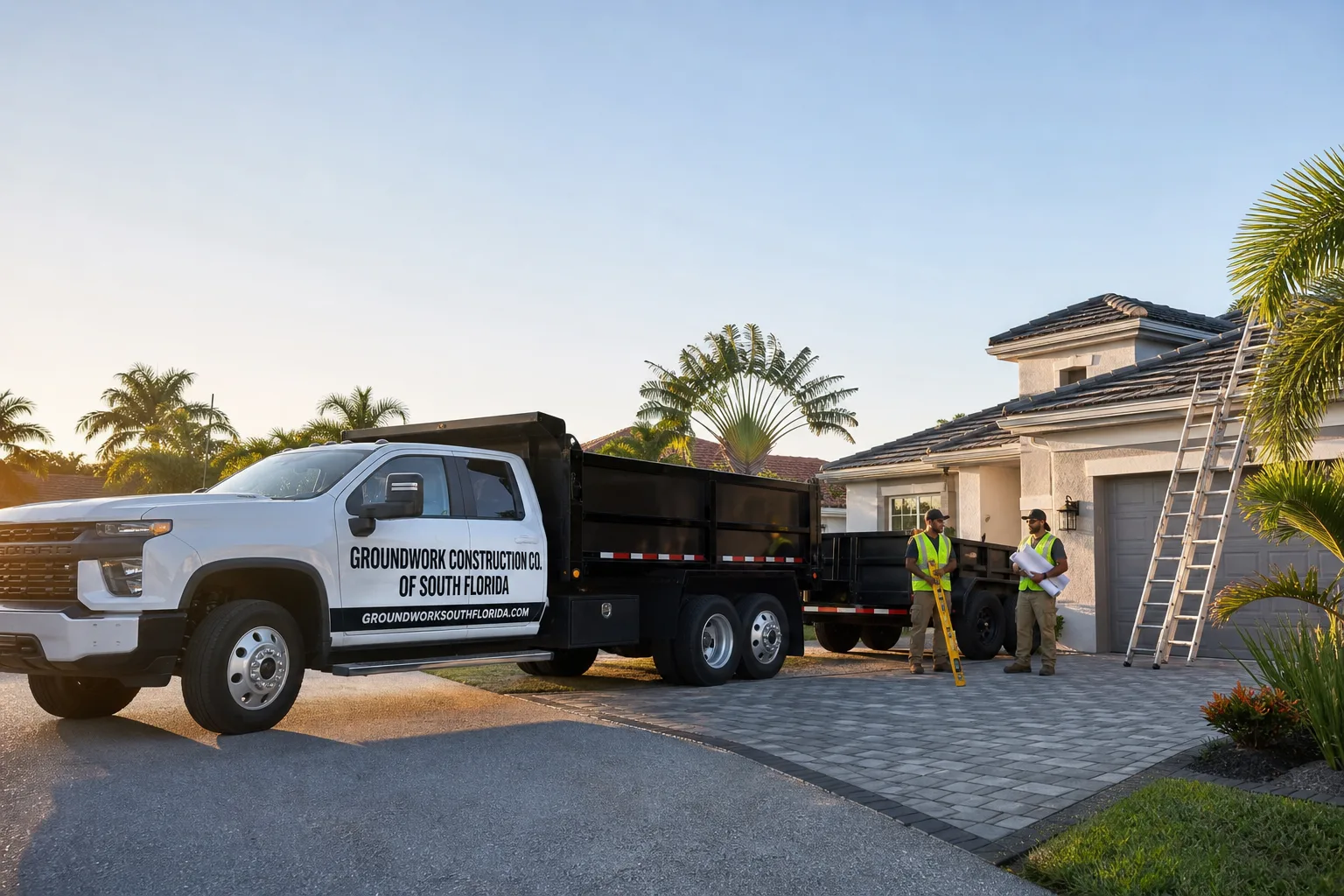
What Does ADU Site Prep & Utilities Cost and Involve in Cutler Bay?
ADU Site Prep & Utilities in Cutler Bay typically runs $45,000-$130,000 and spans 4-8 weeks before the structure goes up, depending on whether we hit limestone bedrock and how much existing utility rerouting your property needs. Most Cutler Bay homeowners call us at (844) 665-0162 after they’ve got plans in hand but before breaking ground, which is exactly the right sequence. The job covers everything from site clearing and rough grading to trenching water, sewer, and electrical service, plus the concrete foundation or stem walls that’ll sit beneath your ADU.
How We Handle ADU Site Prep & Utilities, Start to Finish
We break this into five distinct phases so you know what’s happening when, and what you’ll need to decide before we move forward.
Phase 1: Site survey and utility locate (2-4 days). Before a shovel touches dirt, we pull Miami-Dade utility maps and send a private locator to mark existing lines. In Cutler Bay’s older neighborhoods off Old Cutler Road and near Lakes by the Bay, we’ve found abandoned septic tanks, undocumented irrigation lines, and old copper water service that county records missed. You’ll decide here whether to cap and abandon old utilities or reroute them for future use.
Phase 2: Rough clearing and grade prep (3-5 days). We strip topsoil, remove any existing hardscape, and establish drainage fall. If your lot sits in a FEMA AE zone, which covers much of Cutler Bay south of SW 184th Street, this is where we calculate whether we need engineered fill to reach base flood elevation. That decision locks in your stem-wall height and directly affects material quantities.
Phase 3: Excavation and footing trenches (4-10 days, highly variable). This is where Cutler Bay gets interesting. The Miami Rock Ridge limestone can appear anywhere from 6 inches to 2 feet below grade. We’ve jackhammered solid rock for days on ranches near Goulds Park, while jobs closer to Biscayne Bay hit muck and required dewatering instead. You’ll choose between standard spread footings or a monolithic slab-on-grade if rock makes pier drilling impractical. We bring in a geotechnical report if your soil borings suggest voids or shallow bedrock.
Phase 4: Underground utilities and rough-ins (5-8 days). We trench water, sewer, and electrical from your main house or municipal tap to the ADU footprint. In Cutler Bay’s 1960s-1980s housing stock, the original 3/4-inch water service and cast-iron sewer often can’t handle the additional load. You’ll decide whether to upsize the main or run a dedicated line. For electrical, most ADUs need a 200-amp subpanel minimum, which means evaluating your existing service capacity.
Phase 5: Foundation pour and final grade (3-5 days). We set rebar with proper concrete cover, pour the slab or stem walls, and backfill with compaction. Given Cutler Bay’s salt-air corrosion risk, we spec hot-dipped or stainless hardware and minimum 3-inch concrete cover on all embedded steel. Final grade establishes positive drainage away from both structures before we hand off to the framing crew.
This sequence is part of a full Home Additions & ADU in Cutler Bay project, and getting it right upfront prevents the change orders that derail budgets later.
The Material and System Choices You’ll Face
Every ADU Site Prep & Utilities job in Cutler Bay involves decisions that affect durability, cost, and future maintenance. Here’s where homeowners typically pause:
- Foundation type: monolithic slab vs. stem wall with elevated fill. A standard 4-inch slab on grade runs less, but in Cutler Bay’s flood zones, an elevated stem wall with compacted fill inside gets you above base flood elevation and satisfies Miami-Dade’s HVHZ requirements. The trade-off is $8,000-$20,000 in additional material and labor, plus the long-term insurance and resale benefits of compliant elevation.
- Concrete mix design: standard vs. sulfate-resistant with corrosion inhibitor. Given the brackish groundwater and salt-air exposure near Biscayne Bay, we typically spec a 4,000 PSI mix with Type II cement and a corrosion-inhibiting admixture. Standard 3,000 PSI concrete saves roughly 15% upfront but risks spalling where rebar sits too shallow or water tables fluctuate seasonally.
- Utility trenching method: open cut vs. directional bore. Open cutting through Cutler Bay’s limestone is slow and disruptive but lets us inspect every inch of pipe bedding. Directional boring preserves existing landscaping and hardscape but costs 40-60% more and requires clear utility corridors. We recommend open cut for short runs under 50 feet, bore for longer pulls under established driveways or mature oak canopies.
- Water and sewer pipe material: PVC vs. CPVC vs. PEX. For underground mains, we use PVC Schedule 40 or C900 for its crush resistance against shifting limestone. Inside the ADU, PEX-B or PEX-A offers freeze protection and simpler routing, though Cutler Bay’s climate makes freeze risk minimal. CPVC works for budget-conscious projects but becomes brittle after 20-25 years in UV-exposed chase ways.
- Electrical service: overhead drop vs. underground lateral. FPL’s standard overhead service to a new meter pedestal costs less initially, but underground lateral protects against hurricane wind damage and satisfies most Cutler Bay HOA aesthetic requirements. The underground option adds $2,500-$5,500 depending on trench length and conduit size.
Our Home Additions & ADU crew specs these details in writing before we move dirt, so you’re not making pressured decisions mid-project.
What ADU Site Prep & Utilities Costs in Cutler Bay, FL
| Component | Typical Range |
|---|---|
| Site clearing and rough grade | $3,500-$8,000 |
| Excavation (standard soil) | $4,000-$9,000 |
| Rock excavation / jackhammering | $6,500-$18,000 |
| Foundation (slab on grade) | $12,000-$28,000 |
| Elevated stem wall with fill | $20,000-$48,000 |
| Water/sewer trench and tie-in | $4,500-$12,000 |
| Electrical service and subpanel | $5,000-$14,000 |
| Permits, surveys, geotechnical | $3,500-$9,500 |
| Total typical range | $45,000-$130,000 |
Five factors push you toward the high or low end of that range. First, limestone depth: every foot of solid rock we hit adds equipment rental and labor hours that standard bids don’t account for. Second, existing utility capacity: if your 1960s-era home needs a new 400-amp service or sewer upsize to accommodate the ADU, that’s a separate trade call before our work begins. Third, flood zone designation: AE-zone properties require engineered fill and taller stem walls that A-zone or X-zone lots skip. Fourth, distance from house to ADU footprint: a detached unit 80 feet from the main structure trenches more pipe and wire than an attached garage conversion. Fifth, soil stability: loose fill or organic muck near the bay requires over-excavation and replacement with structural fill, adding $5,000-$15,000.
A written estimate from Groundwork includes all labor, equipment, materials, permits, and disposal. It does not include FPL service upgrade fees, private well or septic abandonment (if applicable), or landscape restoration beyond basic seed and straw. We itemize these exclusions so there’s no surprise.
Why Cutler Bay’s Geography Changes This Job
Cutler Bay isn’t like building in Fort Lauderdale or even Homestead. The Miami Rock Ridge runs directly beneath this town, and we’ve had crews switch from excavators to pneumatic jackhammers within the first two hours of breaking ground on properties near SW 216th Street and 87th Avenue. Out-of-area contractors who bid Cutler Bay jobs using standard South Florida soil assumptions routinely blow their budgets before the first slab is poured. We’ve seen it happen on adjacent lots where the low bidder walked off mid-project.
The High-Velocity Hurricane Zone designation matters here too. Every exterior product that touches your ADU, from the foundation anchors up, needs a Miami-Dade Notice of Acceptance. That includes the J-bolts securing your sill plate, the impact-rated windows you’ll install during framing, and the roofing fasteners. We source through brands like Andersen, Pella, and PGT, all of whom maintain active NOAs for their HVHZ-rated lines. A contractor unfamiliar with this requirement might spec a perfectly good product that fails inspection because it lacks the right Florida Product Approval.
The housing stock tells its own story. Most Cutler Bay homes were built between 1960 and 1985, before Hurricane Andrew rewrote the code. That means original roof-to-wall connections are often toe-nails rather than metal straps, and flood vents are missing or improperly sized. When we tie a new ADU into these older structures, we frequently upgrade the primary residence’s connections to meet current standards, a scope item that doesn’t appear on greenfield ADU estimates.
Homeowners often pair this groundwork phase with interior work on the main house. If you’re already trenching utilities and pulling permits, it makes sense to consider Small & Partial Kitchen Remodels in Cutler Bay or Full Bathroom Remodeling in Cutler Bay under the same project umbrella and single permit cycle.
We cover Cutler Bay and surrounding southern Miami-Dade communities including Cutler Ridge, Lakes by the Bay, Goulds, and East Perrine.
Serving Cutler Bay, FL - Our Local Coverage Area
We’re based in the Cutler Bay area and know this community well. Use the map below to see our service coverage - if you’re nearby, we can almost certainly help.
Frequently Asked - ADU Site Prep & Utilities in Cutler Bay
Most jobs run 4-8 weeks from site survey to foundation completion, though limestone excavation can extend that to 10 weeks. Weather delays are less about rain and more about dewatering when the water table rises after storms. Call (844) 665-0162 and we’ll assess your specific site conditions for a tighter timeline.
Yes, Miami-Dade County requires building permits for all excavation, foundation work, and utility connections, plus separate plumbing and electrical permits for the rough-ins. The HVHZ designation triggers additional structural inspections that standard Florida jurisdictions don’t require. We pull and manage all permits as part of our scope.
Sometimes, if your main house has adequate service capacity and the ADU sits close enough for gravity sewer. More often, we need to upsize the water main, add a sewer ejector pump for distant or elevated ADUs, or install a dedicated electrical subpanel. We evaluate this during Phase 1 before any excavation begins.
Expect an additional $6,500-$18,000 for rock excavation compared to standard soil conditions, depending on footprint size and rock depth. We flag this risk in our initial estimate with a line-item allowance, then adjust based on actual conditions once we probe. Call (844) 665-0162 for a site-specific assessment and exact quote, estimates are free.
Groundwork warrants foundation and utility workmanship for the period specified in your construction agreement, with material warranties passing through from manufacturers. Concrete typically carries a 1-year workmanship warranty, while PVC pipe and electrical components carry manufacturer warranties of 10-25 years depending on product line. We document all warranty transfers at project closeout.
Ready to Break Ground on Your Cutler Bay ADU?
Call (844) 665-0162 to schedule a free on-site estimate for ADU Site Prep & Utilities in Cutler Bay. Raymond Estevez or a senior project manager will walk your property, probe for limestone depth, assess existing utility capacity, and deliver a written, itemized estimate within 48 hours. No deposit required to schedule, and we only move dirt after you’ve approved every line item.
Written by Raymond Estevez, Owner at Groundwork Construction Co., serving Cutler Bay since our South Florida founding.