
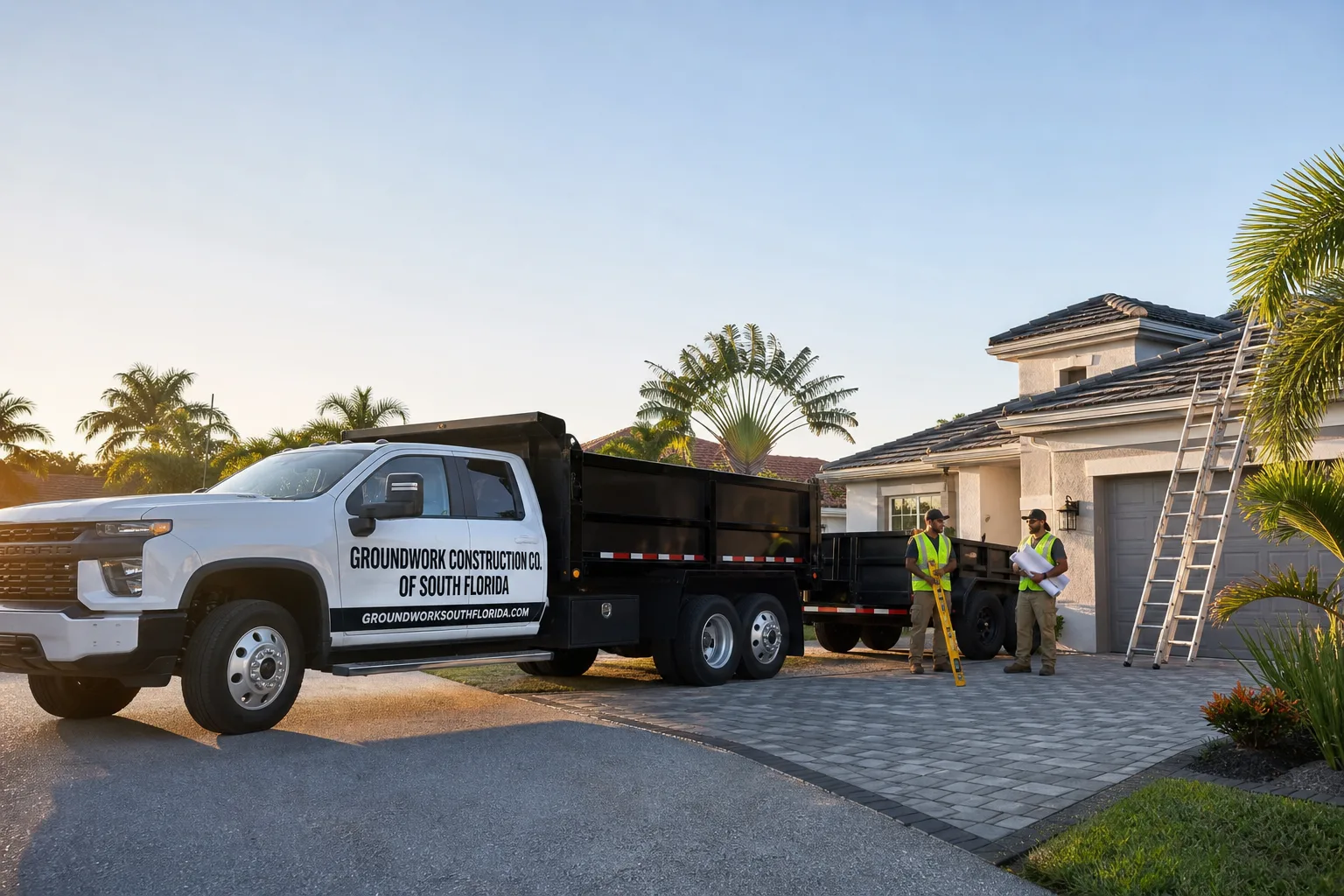
ADU Site Prep & Utilities in Delray Beach - What’s Involved and What It Costs
ADU site prep and utilities in Delray Beach covers everything from clearing your lot and grading for drainage to running new electrical, water, and sewer lines to the accessory dwelling unit footprint. Most Delray Beach projects we handle take 4 to 8 weeks for the full prep and rough-in phase, depending on whether we’re working east of Federal Highway with coastal setback requirements or in the master-planned communities west of town with HOA pre-approval layers. Call (844) 665-0162 for a free on-site estimate - we’ll walk your property and give you a written scope with a realistic timeline.
How We Handle ADU Site Prep & Utilities - Stage by Stage
Every ADU site prep and utilities job in Delray Beach follows a clear sequence. We’ve learned that skipping a step or getting the permit order wrong - especially on the barrier island - adds months, not days.
Stage 1: Site survey and utility locate (Days 1-3)
Before anything moves, we pull a private utility locate and compare it against Palm Beach County’s water and sewer maps. In Delray Beach’s older east-side neighborhoods, we’ve found abandoned septic tanks from the 1960s that never got properly decommissioned, plus unmapped irrigation lines that’ll flood your trench if you hit them blind. You’ll decide here whether we’re tying into existing mains or running new service laterals - a choice that typically adds $3,500-$8,000 if the city main needs upsizing for dual-meter service.
Stage 2: Demolition and rough clearing (Days 4-8)
Old sheds, concrete pads, invasive Brazilian pepper roots - we remove it all and haul to the county facility on North Congress Avenue. If your property sits on the barrier island in 33483, we’re also managing dune vegetation buffers per FDEP guidelines. Homeowner decision point: whether to salvage any existing hardscape for reuse in the ADU patio or driveway. We see a lot of homeowners in Tropic Isle and Lake Ida neighborhoods opt to repurpose old poured concrete as rip-rap for shoreline stabilization.
Stage 3: Grading and drainage engineering (Days 9-14)
Delray Beach’s flat terrain means water doesn’t leave on its own. We grade for positive flow toward street drains or swales, and in FEMA AE zones east of A1A, we build up the pad to meet base flood elevation. This is where you’ll choose between standard site grading or a raised stem-wall foundation system - the latter runs 15-25% more but buys you living space if the ADU floods. Our crew works with engineered fill and compaction testing; Palm Beach County inspectors require a density test before any slab pour.
Stage 4: Underground utilities rough-in (Days 15-28)
We trench for electrical conduit, water main, sewer lateral, and any gas line if you’re running propane or natural gas to the ADU. In Delray Beach’s salt-air environment, we spec schedule 80 PVC for electrical and copper with dielectric unions for water - standard steel nipples corrode through in under 10 years here. You’ll pick your electrical service size at this stage: 100-amp is standard for a 1-bedroom ADU, but if you’re adding an electric vehicle charger or tankless water heater, we rough in 200-amp to the pad. This decision locks in your panel and meter-base specs.
Stage 5: Inspections and pad readiness (Days 29-35, variable)
We call for sequential inspections: rough grading, underground utilities, and final pad certification. In Delray Beach, the June-September wet season slows everything - inspectors get backed up, and afternoon thunderstorms halt concrete pours. We’ve learned to pour before 10 a.m. and keep poly sheeting on standby. Once the pad passes, you’re ready for framing or prefab delivery. That’s the handoff to the next phase of your Home Additions & ADU in Delray Beach project.
The Spec Choices That Shape Your ADU Site Prep & Utilities Job
Every decision below affects your final number and how the ADU performs long-term. We lay out the trade-offs honestly - there’s no single right answer, only the right fit for your property and budget.
- Foundation type: monolithic slab vs. raised stem wall. A monolithic slab pours footing and floor in one shot, saving 10-14 days and roughly $4,000-$7,000 on a typical Delray Beach ADU pad. But if you’re in a flood zone or want enclosed storage underneath, the stem wall is worth the premium. We’ve built both on the barrier island; the stem wall also gets you above the storm-surge line that FEMA maps for 33483.
- Electrical service: overhead drop vs. underground lateral. Overhead is cheaper by $1,500-$3,000, but Florida Power & Light’s coastal wind-loading requirements mean taller, beefier poles that many homeowners find ugly. Underground lateral costs more upfront but survives hurricanes intact - we’ve never had to rebuild an underground service after a storm, but we’ve replaced three overhead drops in Delray Beach since 2022.
- Water line material: copper Type L vs. PEX-A. Copper holds up to Delray Beach’s chlorinated municipal water and won’t degrade in UV if any section runs above grade. PEX-A is faster to install and 20-30% less expensive, but it requires insulation if it passes through any attic space, and some HOAs in the western master-planned communities specifically prohibit visible PEX. We carry both and install per your community’s CCRs.
- Sewer connection: gravity vs. grinder pump. If your ADU sits below the street sewer invert, you’ll need a grinder pump station - add $2,800-$5,500 for the basin, pump, and alarm system. Gravity connections are simpler and quieter, but they’re not always possible on the low-lying lots near the Intracoastal. We evaluate this on every Delray Beach site visit; it’s not a guess.
- Drainage: French drain vs. catch basin system. French drains work for sandy, well-draining soils like we find in much of 33446 and 33447. East of the waterway, where the water table sits higher and soils are more compacted, we spec surface catch basins with solid pipe to the street. The catch basin system runs $800-$1,500 more for a typical ADU footprint but prevents the soggy-yard callbacks we see every wet season.
What ADU Site Prep & Utilities Costs in Delray Beach, FL
For a typical ADU site prep and utilities job in Delray Beach, expect $18,000-$42,000 before the foundation slab or prefab pad is complete. This range assumes a standard 400-800 square foot ADU footprint with municipal water and sewer available at the street.
| Cost Variable | Low-End Scenario | High-End Scenario |
|---|---|---|
| Site clearing and grading | $3,500-$6,000 (flat, clear lot) | $8,000-$14,000 (dense vegetation, debris, fill required) |
| Underground utilities rough-in | $6,000-$10,000 (short runs, gravity sewer) | $14,000-$22,000 (long lateral, grinder pump, 200-amp service) |
| Foundation pad (monolithic slab) | $5,500-$9,000 | $11,000-$16,000 (stem wall, elevated, engineered fill) |
| Permits and fees | $1,200-$2,500 | $4,000-$7,500 (CCCL, flood cert, dual-meter fees) |
| Drainage and erosion control | $800-$1,500 | $3,500-$6,000 (catch basin system, sod restoration) |
Five factors push you toward the high end: (1) barrier island location requiring FDEP Coastal Construction Control Line permits and FEMA elevation certificates; (2) existing structures or hardscape that must be demolished and hauled; (3) need for a grinder pump or electrical service upgrade; (4) HOA architectural review requirements in western communities like Mizner’s Dream or Valencia Palms; and (5) wet-season scheduling that compresses the work window and adds protective measures.
Our written estimates include all labor, materials, permits, and inspection scheduling. What typically sits outside this scope: landscape restoration beyond basic sod, fencing reinstallation, and any interior finishes or appliances - those come under your broader Home Additions & ADU build contract.
What Delray Beach Specifically Does to This Job
Delray Beach isn’t a single construction environment - it’s three distinct regulatory and physical zones, and your ADU site prep and utilities strategy has to match where you build.
On the barrier island in ZIP 33483, every project east of A1A triggers the FDEP Coastal Construction Control Line process. We’ve watched contractors lose entire seasons because they submitted the city permit first, not realizing the DEP review clock doesn’t start until Delray Beach accepts your application. The correct sequence - DEP CCCL determination letter, then city submittal, then FEMA elevation certificate if you’re in AE - adds 60-90 days before groundbreaking. We sequence these submittals on every coastal job; it’s not optional, and it’s not fast.
The salt-air exposure here is real and measurable. Standard zinc-plated fasteners show red rust within 18 months on oceanfront properties. Our specs call for stainless steel or hot-dipped galvanized hardware on all exposed connections, and we use copper or coated conduit for underground electrical - inspectors in Palm Beach County’s coastal zone are flagging PVC-only electrical runs more aggressively than they did five years ago. The wind-load requirement is equally concrete: 170+ mph ultimate design speed means your ADU’s roof-to-wall connectors follow an engineered schedule, and every opening needs impact-rated glazing or approved shutters. That affects where we place the electrical meter and how we route conduit - you can’t run unprotected service cable where a flying projectile might strike.
West of the waterway, in ZIPs 33446 and 33447, the challenge flips from coastal regulators to HOA architectural review boards. Communities like The Bridges and Seven Bridges require pre-approval of site plans, material palettes, and construction staging before Palm Beach County will issue a permit. We’ve learned to package the HOA submission and the permit drawings simultaneously, so neither sits idle. The soils are better-draining here, but the utility runs are often longer - lots are deeper, and the ADU typically sits at the rear property line, 80-120 feet from the street connection.
Homeowners in Delray Beach often pair their ADU groundwork with interior updates to the main house. If you’re expanding your footprint, you might also be rethinking the kitchen or adding a bathroom - our Small & Partial Kitchen Remodels in Delray Beach and Full Bathroom Remodeling in Delray Beach crews coordinate with the site prep team so you’re not scheduling multiple contractors across the same property.
Wherever you build in Delray Beach, the local conditions shape the job more than most homeowners expect. A site prep plan that works in Boca Raton’s inland sections fails here without accounting for flood zones, salt air, or HOA layers.
Serving Delray Beach, FL - Our Local Coverage Area
We’re based in the Delray Beach area and know this community well. Use the map below to see our service coverage - if you’re nearby, we can almost certainly help.
Frequently Asked - ADU Site Prep & Utilities in Delray Beach
Most projects run 4 to 8 weeks from first shovel to pad-ready, but barrier island jobs with FDEP Coastal Construction Control Line permits add 60-90 days of pre-construction regulatory time before we break ground. Wet-season pours between June and September can stretch the schedule by another 1-2 weeks due to afternoon thunderstorm delays. Call (844) 665-0162 and we’ll map your specific timeline based on your ZIP and property conditions.
Yes - you’ll need a City of Delray Beach building permit for the foundation and rough utilities, plus Palm Beach County utility connection permits for water and sewer. East of A1A, add the FDEP CCCL determination and possibly a FEMA elevation certificate. West of town in HOA communities, architectural review board approval comes before any government permit. We handle all submittals and inspections as part of our scope.
Sometimes, but rarely for a fully independent ADU. Most Delray Beach properties need at least a new water lateral and dedicated electrical meter to meet code for a separate dwelling unit. If your main house has spare electrical capacity and the ADU sits close to existing plumbing, you might save $4,000-$7,000 on utility runs - we’ll verify this during your free site evaluation.
Location relative to the Intracoastal Waterway. Barrier island properties face the CCCL/FEMA permit stack, elevated foundation requirements, and salt-air material upgrades. Inland properties in 33446 and 33447 typically see lower base costs but longer utility runs and HOA pre-approval fees. The physical condition of your lot - vegetation density, existing hardscape, undocumented underground structures - runs a close second.
Our workmanship warranty covers all grading, drainage, underground utilities, and foundation pad work for one year from final inspection, with extended material warranties on specified components like grinder pumps and electrical panels per manufacturer terms. We don’t warranty against flood damage exceeding the designed base flood elevation or against homeowner modifications after handoff. Everything’s spelled out in your written contract before work begins.
Ready to Get Your Delray Beach ADU Site Prepped Right?
Call (844) 665-0162 for a free on-site estimate. Raymond Estevez or a senior project manager will walk your property, flag the specific regulatory and physical conditions that affect your lot, and deliver a written scope with line-item pricing and a realistic timeline. No deposit required to get started - just a conversation about what your ADU needs to stand on solid ground in Delray Beach.
Written by Raymond Estevez, Owner at Groundwork Construction Co., serving Delray Beach since our founding in South Florida.