
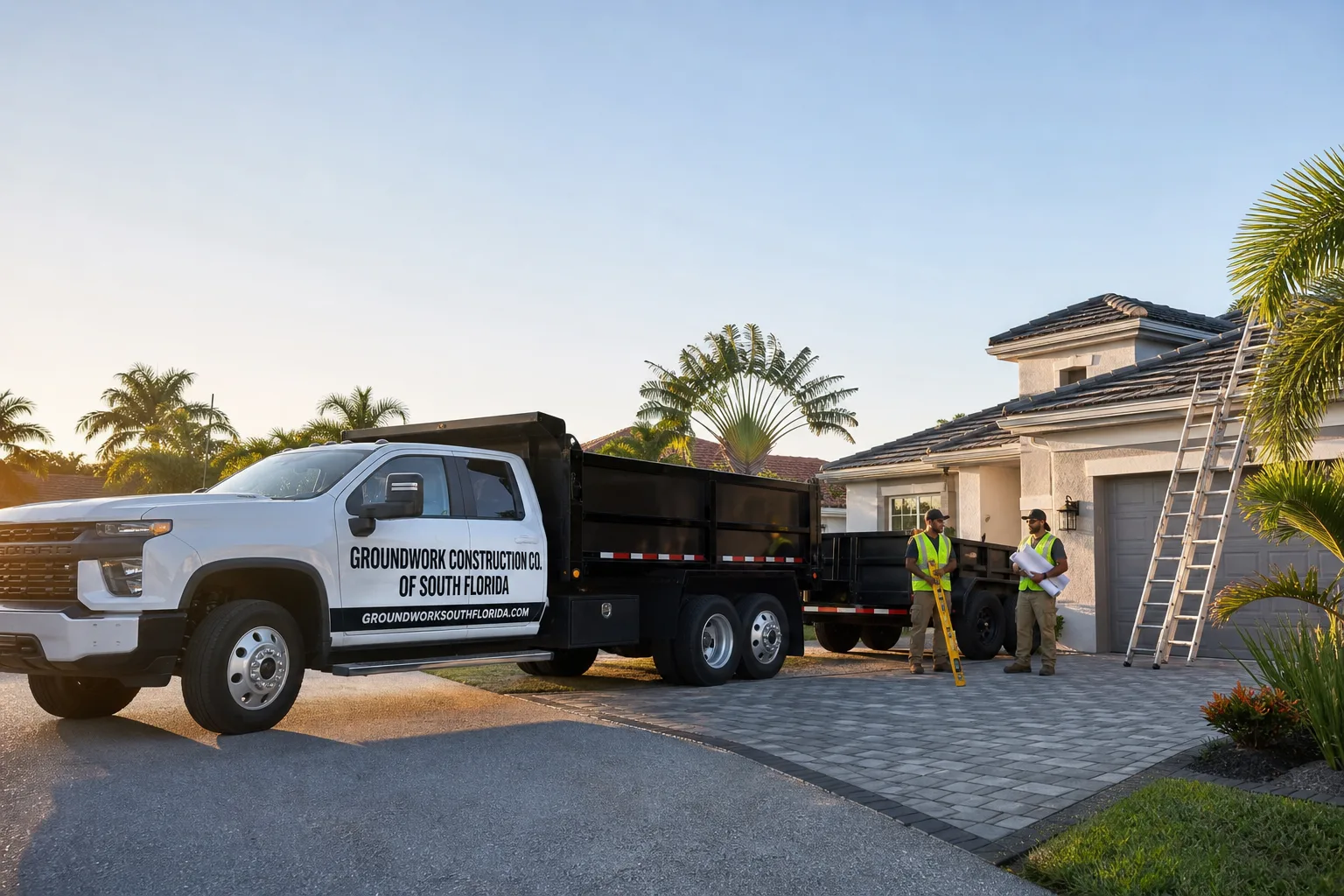
What ADU Site Prep & Utilities Costs and Involves in Miami
ADU site prep and utilities in Miami typically runs $45,000-$130,000 for the full groundwork package, including demolition, grading, foundation prep, and the utility rough-ins that connect your new unit to city water, sewer, and electrical. Most projects we handle in Miami take 4 to 8 weeks for this phase alone, depending on whether we’re cutting into existing slab, relocating mature trees, or running new lateral lines through Coral Gables’ narrow lots. Call (844) 665-0162 and we’ll walk your property with you to identify exactly what’s needed before the first permit gets pulled.
This work sits at the very front of any Home Additions & ADU in Miami project, and it determines everything that follows. Get the grading wrong or undersize the sewer lateral, and you’re looking at change orders during framing. That’s why our Home Additions & ADU crew treats this phase as its own discipline, with dedicated site superintendents who only handle prep and utility work.
How We Handle ADU Site Prep & Utilities - Stage by Stage
We’ve refined this into five distinct stages after years of building in Miami’s limestone substrate and salt-air conditions. Here’s what actually happens, and what you’ll need to decide at each point.
Stage 1: Survey, utility locate, and tree assessment (3-5 days)
Before anything moves, we pull the property survey, call 811 for underground utility marking, and assess any protected trees. In Coconut Grove and Coral Gables, heritage oak roots can dictate where your foundation goes more than the building footprint itself. You’ll decide here whether to relocate, bridge over, or redesign around significant root systems. We also flag any easements that restrict where sewer laterals can run.
Stage 2: Demolition and rough grading (5-10 days)
Existing sheds, old concrete pads, and failed asphalt come out. For the CBS homes common in Miami’s 1940s-1970s housing stock, we often find original flat-roof additions or patio slabs that were never properly permitted. We haul to certified recyclers and rough-grade to establish positive drainage away from both structures. You’ll choose whether to repurpose demolished concrete as fill base or pay for off-site disposal.
Stage 3: Foundation prep and soil stabilization (7-14 days)
Miami’s porous limestone and shallow water table mean standard trenching and below-grade waterproofing often fail. We frequently specify elevated stem-wall foundations with integrated drainage mats rather than slab-on-grade, especially in flood-prone blocks where king tides push water up through the substrate. You’ll decide between a raised floor system with crawl space access or a thickened edge slab with perimeter drainage. This choice alone can swing your budget $8,000-$15,000.
Stage 4: Utility rough-in and lateral connections (10-20 days)
Water, sewer, and electrical service get trenched from the main structure or street connection to the ADU footprint. In older Miami neighborhoods, original clay sewer laterals and galvanized water lines must be replaced to modern PVC and copper or PEX. We coordinate with Miami-Dade Water and Sewer directly for tap permits. You’ll specify electrical amperage - 100-amp service for a studio, 200-amp for a two-bedroom with full kitchen - and whether you want future-ready conduit for EV charging or solar tie-in.
Stage 5: Inspection, backfill, and pad readiness (3-5 days)
All rough work passes city inspection before we backfill with compacted structural fill and prep the final pad for framing. We leave the site clean, graded, and ready for the next contractor. You’ll receive marked-up as-builts showing exact utility locations, which saves headaches when Small & Partial Kitchen Remodels in Miami or Full Bathroom Remodeling in Miami follow in the main house.
The Spec Choices You’ll Make for ADU Site Prep & Utilities
Every decision below affects durability, cost, and how the space performs in Miami’s climate. We lay out the honest trade-offs so you’re choosing, not guessing.
- Foundation type: Elevated stem wall vs. thickened slab - Stem walls cost more upfront but eliminate the hydrostatic pressure failures we see in slab-on-grade builds after major rain events. They also allow access for future plumbing repairs without concrete demolition. Thickened slabs work on higher, well-draining lots and save roughly $8,000-$12,000 on a typical 500-square-foot ADU footprint.
- Water line material: Copper Type L vs. PEX-A - Copper resists Miami’s aggressive water chemistry and lasts 50+ years, but it’s 40% more expensive and requires more joints. PEX-A from reputable manufacturers handles expansion better in our heat cycles and installs faster, though UV exposure during construction requires protection. We typically spec copper for the main lateral and PEX for interior distribution.
- Electrical service: Overhead drop vs. underground - Underground service eliminates hurricane wind exposure and meets newer Miami-Dade aesthetic requirements in Coral Gables and parts of Coconut Grove. It adds $2,500-$4,500 in trenching and conduit. Overhead drops remain common in older neighborhoods and cost less, though they’re increasingly restricted by utility hardening mandates.
- Drainage strategy: French drain perimeter vs. integrated sump - French drains handle the moderate, sustained rainfall typical of Miami’s wet season. In low-lying blocks or where the water table sits at 2 feet, we specify a sump pit with battery backup. The sump adds $1,800-$3,200 but prevents the foundation moisture intrusion that destroys ADU flooring and invites mold.
- Backfill and compaction: Native soil vs. engineered fill - Native limestone spoil compacts adequately on stable lots and costs nothing. Engineered structural fill, specified for fill depths over 24 inches or where organic material was removed, guarantees compaction density and carries a geotechnical report. Budget $1,200-$2,800 for engineered fill on challenging sites.
What ADU Site Prep & Utilities Costs in Miami, FL
| Component | Typical Range |
|---|---|
| Full ADU site prep & utilities package | $45,000-$130,000 |
| Demolition and haul-away | $3,500-$12,000 |
| Foundation prep (elevated stem wall) | $18,000-$45,000 |
| Utility rough-in (water/sewer/electrical) | $12,000-$38,000 |
| Soil stabilization and drainage | $4,500-$18,000 |
| Permits, tap fees, and inspections | $4,000-$12,000 |
Five factors push any Miami ADU site prep job toward the high or low end of that range:
1. Existing structure condition. A clear backyard with grass and a fence comes out cheap. Removing a failed garage, old pool, or unpermitted addition with asbestos roofing adds demolition days and hazardous material handling.
2. Utility relocation distance. Tapping at the street and running 80 feet of lateral is straightforward. Extending 200+ feet through mature landscaping, across neighboring easements, or under existing driveways multiplies trenching cost.
3. Foundation elevation required. Flood zone designation determines minimum finished floor height. AE zones in parts of Allapattah and Brownsville require more fill and taller stem walls than X-zone lots in Coral Gables.
4. Material grade selections. Copper laterals, upgraded electrical panels, and engineered fill add real cost but eliminate the callbacks and premature failures that cheap specs guarantee in this climate.
5. Permit scope and Miami-Dade NOA compliance. The county’s separate product approval system means we source only NOA-certified structural fasteners, windows, and doors. Products approved elsewhere in Florida often fail inspection here, forcing costly substitutions mid-project.
A written estimate from Groundwork includes all labor, materials, permits, and disposal for the stages above. It does not include landscaping restoration, final paving, or the ADU construction itself - those are separate phases with their own contracts.
What Miami Specifically Does to This Job
Miami-Dade County’s Notice of Acceptance system isn’t a formality. It’s a parallel building code that every contractor working here must navigate, and out-of-county crews routinely fail inspections because they assume Florida statewide approval suffices. A structural fastener, impact window, or roofing assembly legal in Fort Lauderdale or Broward can be code-illegal here. We maintain a current NOA database and source exclusively through Miami-Dade-approved suppliers, which adds procurement lead time but eliminates the red-tag delays that derail schedules.
The housing stock we most often work around was built between the 1940s and 1970s - CBS construction through Little Havana, Flagami, and Overtown with original flat roofs, jalousie windows, and rebar actively corroding from salt-air exposure. Any permit pull triggers structural assessment requirements, and we regularly find spalled concrete and compromised tie beams that must be addressed before the ADU foundation can be tied in. This isn’t scare tactics; it’s the reality of building adjacent to structures that have weathered 50+ years of coastal moisture.
Then there’s the water table. Miami Limestone is essentially a sponge, and in many blocks the water sits 24 inches below grade. Conventional below-grade waterproofing designed for drier Florida markets fails here because hydrostatic pressure comes from below, not just surface drainage. Our foundation specs account for this with integrated drainage planes and, where necessary, sump systems. Homeowners who’ve watched a neighbor’s new addition flood during a king tide understand why we don’t shortcut this.
Serving Miami, FL - Our Local Coverage Area
We’re based in the Miami area and know this community well. Use the map below to see our service coverage - if you’re nearby, we can almost certainly help.
Frequently Asked - ADU Site Prep & Utilities in Miami
Most projects run 4 to 8 weeks from survey to pad-ready, though Coral Gables and Coconut Grove tree protections or Miami-Dade Water and Sewer tap scheduling can extend this. Call (844) 665-0162 and we’ll check current tap availability for your address.
Yes - Miami requires distinct permits for demolition, foundation, plumbing rough-in, and electrical service, each with its own inspection sequence. We bundle these through our expediter and schedule inspections in the order the city requires to avoid re-inspection fees.
Sometimes, if your main house has adequate service capacity and the ADU sits close enough for code-compliant lateral runs. More often, we find original galvanized water lines or undersized sewer laterals that must be upgraded to handle the additional load. Our survey identifies this before you commit.
A thickened-edge slab with PEX water lines, overhead electrical, and native soil backfill hits the lowest practical price point. We don’t recommend cutting below this - the foundation and utility work is buried and permanent, and failures are exponentially more expensive than doing it right initially.
Groundwork warranties our workmanship on foundation prep and utility rough-ins for the period specified in your contract. Manufacturer warranties apply to specific materials - copper pipe, electrical panels, drainage membrane - and vary by product line. We register all warranties in your name and provide documentation at project closeout.
Ready to Get Your Miami ADU Project Out of the Ground?
Call (844) 665-0162 to schedule a free on-site estimate for ADU site prep and utilities in Miami. Raymond Estevez or a senior site superintendent will walk your property, flag the specific conditions that affect your foundation and utility routing, and deliver a written estimate with line-item pricing within 48 hours. No deposit required to book the walkthrough.
Written by Raymond Estevez, Owner at Groundwork Construction Co., serving Miami since our founding.