
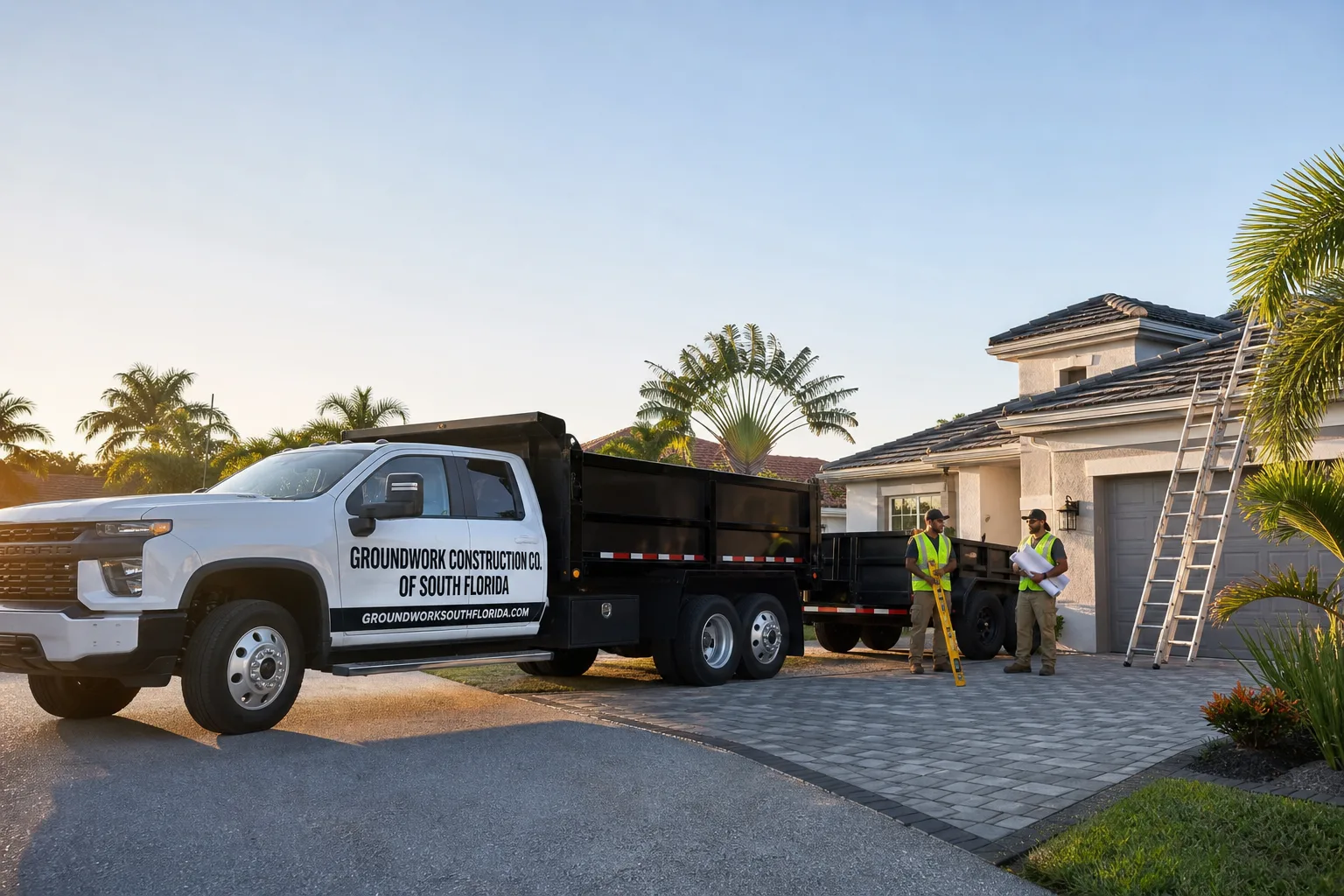
ADU Site Prep & Utilities in West Miami - What’s Actually Involved
ADU site prep and utilities in West Miami covers the ground-up work that happens before any walls go up: clearing and grading the build site, trenching for sewer and water lines, running electrical service and gas if needed, and pouring the foundation or pad. Most jobs we handle in the 33144 area take 3 to 6 weeks from breaking ground to passing rough-in inspections, with the full sequence stretching longer if we’re connecting to aging galvanized plumbing or upgrading an outdated electrical panel. For a typical West Miami ADU site prep and utilities package, homeowners should plan for $45,000-$130,000 depending on what’s already on the property and what the existing home needs. Call (844) 665-0162 and we’ll walk your lot to give you a precise number.
How We Handle ADU Site Prep & Utilities From Dirt to Rough-In
We’ve learned that splitting this job into clear stages keeps surprises off the table. Here’s exactly how we sequence ADU site prep and utilities on West Miami properties, and what you’ll need to decide at each point.
Stage 1: Site Survey and Utility Locate (Days 1-3)
Before anything gets touched, we pull permits with West Miami’s building department and call for underground utility locates through Sunshine 811. On these tight 0.4-square-mile lots, water mains, sewer laterals, and electrical feeds often run in unexpected places between neighboring CBS homes built in the 1950s and 60s. We mark the full build envelope, note any tree roots or old concrete slabs from prior additions, and photograph the existing conditions. You’ll decide right here whether we’re connecting to city sewer or exploring a septic alternative (rare in West Miami, but worth confirming if you’re on a corner lot with unusual frontage).
Stage 2: Demolition, Clearing, and Grading (Days 4-8)
We remove whatever sits on the build site: old sheds, deteriorating concrete pads, or the remnants of previous homeowner projects. West Miami’s flat limestone base means we rarely hit dramatic elevation changes, but we do hit shallow groundwater quickly on any excavation deeper than 18 inches. Our crew brings in a small dewatering pump if needed, then grades for positive drainage away from both the new ADU and your existing home’s foundation. You’ll choose whether to save and repurpose any existing concrete as fill, or haul it off entirely.
Stage 3: Trenching and Rough Utility Installation (Days 9-18)
This is where the real coordination happens. We trench from your main house to the ADU location, typically 30 to 60 feet on these compact lots. For water, we run copper or PEX - PEX is more common now for its flexibility during hurricane-season ground shifts, though some homeowners prefer copper for longevity. Sewer lines get PVC with proper slope and cleanout access. Electrical trenching runs separate, with conduit sized for 100-amp or 200-amp service depending on whether your ADU will have a full kitchen and laundry. If you’re adding gas for a tankless water heater or range, that’s a third trench. West Miami’s building department requires pressure tests on water lines and camera inspection on sewer before backfill, so we schedule those before moving on. You’ll confirm fixture locations inside the ADU at this stage, since reversing a pipe run after backfill costs thousands.
Stage 4: Foundation or Pad Pour (Days 19-25)
With utilities stubbed and tested, we form and pour. Most West Miami ADUs sit on monolithic slab-on-grade - the standard for South Florida’s high water table and termite concerns. We specify 3000 PSI concrete minimum with vapor barrier and rebar grid, and we tie the slab rebar into the footing rebar per Miami-Dade HVHZ requirements. If your soils show unusual settling (we’ve seen this near older fill areas), we may recommend a slight grade beam or helical pier. You’ll choose your floor finish strategy here: stained concrete, tile-ready subfloor, or raised sleeper system for engineered flooring.
Stage 5: Rough-In Inspection and Dry-In Prep (Days 26-35+)
West Miami’s inspectors know these streets personally, but the office runs lean. We coordinate the mandatory sequence: plumbing rough-in first, then electrical rough-in, then mechanical if applicable. Each must pass before the next gets scheduled, and no insulation or exterior envelope work can proceed until the full rough-in sequence clears. Because Miami-Dade’s HVHZ rules require third-party product approvals on every window, door, and roofing component, we submit NOA documentation with our inspection requests to avoid delays. You’ll receive photo documentation of each passed inspection before we proceed to framing.
This entire sequence is part of a full Home Additions & ADU in West Miami project. Our Home Additions & ADU crew coordinates directly with our West Miami field teams so nothing gets lost between trades.
The Material and System Choices That Shape Your ADU Site Prep
Every decision below affects your final number and how the build performs through South Florida’s wet seasons. Here’s what we actually present to homeowners:
- Water service line: Copper vs. PEX-A. Copper runs 40-60% more in material cost but carries a 50+ year track record in aggressive soils. PEX-A (the expansion-fitting type, not crimp) installs faster and handles ground movement better, though it requires accessible shutoff points and can’t sit in direct sunlight before burial. Most West Miami jobs use PEX-A for the main run with copper stub-outs at each building.
- Sewer line: PVC Schedule 40 vs. SDR 35. Schedule 40 has thicker walls and higher crush resistance - worth it if your trench runs under a driveway or paver path. SDR 35 saves roughly 25% on material and meets code for standard burial. We default to Schedule 40 on any line that might see vehicle loading.
- Electrical conduit: PVC vs. rigid galvanized. PVC is standard for underground runs in South Florida’s corrosive soils. Rigid galvanized costs more but protects against accidental dig-ins if your ADU sits near a fence line or future hardscape. We spec rigid on any run under 12 inches of cover.
- Foundation type: Monolithic slab vs. stem wall with crawl. Monolithic slab is faster, cheaper, and termite-resistant - the overwhelming choice here. Stem wall with a minimal crawl space adds $8,000-$15,000 but allows future plumbing access and slightly better flood resilience. Given West Miami’s high water table, a true crawl space is rarely practical; we only recommend stem wall if your specific lot shows unusual drainage patterns.
- Electrical service size: 100-amp vs. 200-amp. A 100-amp subpanel handles a basic studio ADU with mini-split and electric water heater. Step to 200-amp if you’re planning a full kitchen with electric range, dryer, and potential EV charger. The upgrade difference is roughly $2,500-$4,500 in trenching, conduit, and panel costs, but undersizing now means a costly redo later.
Homeowners often pair ADU groundwork with interior updates to the main house. If you’re modernizing while utilities are accessible, our Small & Partial Kitchen Remodels in West Miami and Full Bathroom Remodeling in West Miami teams can sequence their rough-in alongside the ADU work.
What ADU Site Prep & Utilities Costs in West Miami, FL
| Component | Typical Range |
|---|---|
| Site clearing and grading | $3,500-$8,000 |
| Water and sewer trenching/connection | $6,000-$15,000 |
| Electrical service trenching and panel | $4,500-$12,000 |
| Foundation (monolithic slab) | $12,000-$28,000 |
| Permits, inspections, dewatering | $3,500-$9,000 |
| Total typical package | $45,000-$130,000 |
Five factors push you toward the high or low end of that range. First, distance from main house to ADU - every extra 10 feet of trenching adds labor, material, and dewatering risk. Second, existing utility condition: if your home still has galvanized supply lines or a Federal Pacific electrical panel, we’re upgrading the main house to protect the ADU, and that work sits outside the base package. Third, foundation complexity - a simple rectangle on level ground vs. stepped footings on a lot with drainage issues. Fourth, permit scope: West Miami’s independent building department charges separately for plumbing, electrical, and building permits, and each requires its own inspection sequence. Fifth, timing within the hurricane calendar - jobs starting in August or September often face inspection delays as staff rotates through storm-priority re-inspections.
A written estimate from us itemizes each of these components separately. What’s typically not included: landscaping restoration beyond basic sod or seed, fence rebuilds, and any main-house interior finishes. We flag these exclusions upfront so you’re not bridging gaps later.
Why West Miami Properties Make This Job Different
West Miami’s identity as one of Florida’s smallest incorporated cities creates a permitting environment unlike anywhere else in Miami-Dade. The building department serves roughly 6,000 residents in under half a square mile, which means inspectors genuinely know the housing stock - they recognize the 1950s CBS homes on SW 5th Street, the 1960s ranch-style blocks near SW 8th Street, and the repeated patterns of original galvanized plumbing and ungrounded electrical that show up in pre-1970s construction. That familiarity helps when questions arise, but the office’s small staff also means inspection scheduling has less flexibility than in larger cities. A single inspector out sick can push your rough-in sequence back several days.
The bigger complexity is the dual-layer code environment. West Miami issues its own permits and conducts its own inspections, but every product and system must satisfy Miami-Dade’s High-Velocity Hurricane Zone standards - the strictest in the nation. Every window, door, roofing component, and structural connector needs a Miami-Dade Notice of Acceptance (NOA). We’ve seen out-of-area contractors arrive with perfectly good materials that simply lack HVHZ approval, forcing costly substitutions mid-job. Our team verifies NOA status before anything hits your lot.
The housing stock itself drives most of the surprises. These post-WWII CBS homes were built solid but not to modern standards. Original flat roofs with built-up tar and gravel are often past service life. Electrical panels may be 60-amp Zinsco or Federal Pacific units that can’t safely handle an ADU subpanel. Galvanized water supply lines corrode from the inside, reducing flow just when you’re adding a second kitchen and bath. We catch these during our initial site survey and build the upgrades into the scope, not as change orders later.
Groundwater is the silent variable. West Miami sits on the same flat limestone plain as all of South Florida, with the water table typically 3 to 6 feet below grade. Any footer excavation, even for a modest slab, may require dewatering. We budget for this possibility in every estimate rather than treating it as an unexpected extra.
Serving West Miami, FL - Our Local Coverage Area
We’re based in the West Miami area and know this community well. Use the map below to see our service coverage - if you’re nearby, we can almost certainly help.
Frequently Asked - ADU Site Prep & Utilities in West Miami
Most jobs run 3 to 6 weeks from breaking ground to passed rough-in inspections, with foundation pour typically happening in week 3 or 4. Delays usually come from West Miami’s small inspection staff scheduling around the mandatory Miami-Dade HVHZ sequence, or from discovering outdated electrical or plumbing in the main house that must be upgraded before the ADU can connect. Call (844) 665-0162 and we’ll give you a realistic timeline based on your specific lot and the current permit queue.
Yes - West Miami’s building department issues distinct permits for building, plumbing, electrical, and sometimes mechanical work, each with its own fee and inspection schedule. The building permit covers the foundation and structure, while plumbing and electrical permits cover the utility trenching and rough-in. Miami-Dade County does not issue these permits for West Miami properties; you must go through the city directly, though county HVHZ product-approval rules still apply to every material.
You won’t move the main house’s plumbing or electrical if they’re in good condition, but you will almost certainly need to upgrade the main panel or service line to handle the additional load. On West Miami’s 1950s-1970s homes, we regularly find 60-amp or 100-amp main panels that can’t safely accept an ADU subpanel, or galvanized supply lines with insufficient pressure for a second dwelling. Our site survey identifies what’s adequate and what needs upgrading before we quote.
The lowest-cost path is a compact ADU close to the main house on a level lot with modern utilities already in place: minimal trenching, standard monolithic slab, PEX water lines, PVC sewer, and 100-amp electrical service. Costs climb when we hit long distances, groundwater requiring dewatering, outdated panels or plumbing needing replacement, or stepped foundations on poorly draining lots. The $45,000 end of our range assumes favorable conditions; most West Miami jobs land in the $65,000-$95,000 zone once real site conditions are factored.
We warranty our workmanship on foundation, utility installation, and connections for a period specified in your contract, with manufacturer warranties running on specific materials like PEX pipe or electrical panels. The foundation itself carries standard structural coverage per Florida construction law. Because we’re a single-source contractor handling every phase, there’s no finger-pointing between trades if an issue arises - one call to Raymond Estevez’s team resolves it. For exact warranty terms on your project, call (844) 665-0162 and we’ll review them line by line before you sign.
Get a Free On-Site Estimate for ADU Site Prep & Utilities in West Miami
We’ll walk your lot, check your existing utilities, and give you an itemized estimate with real numbers - no placeholder pricing, no pressure. Call (844) 665-0162 to schedule. Raymond Estevez or a senior project lead will meet you on-site, answer your questions about West Miami’s permit process, and map out exactly what your property needs from breaking ground to passing rough-in.
Written by Raymond Estevez, Owner at Groundwork Construction Co., serving West Miami since our founding.