
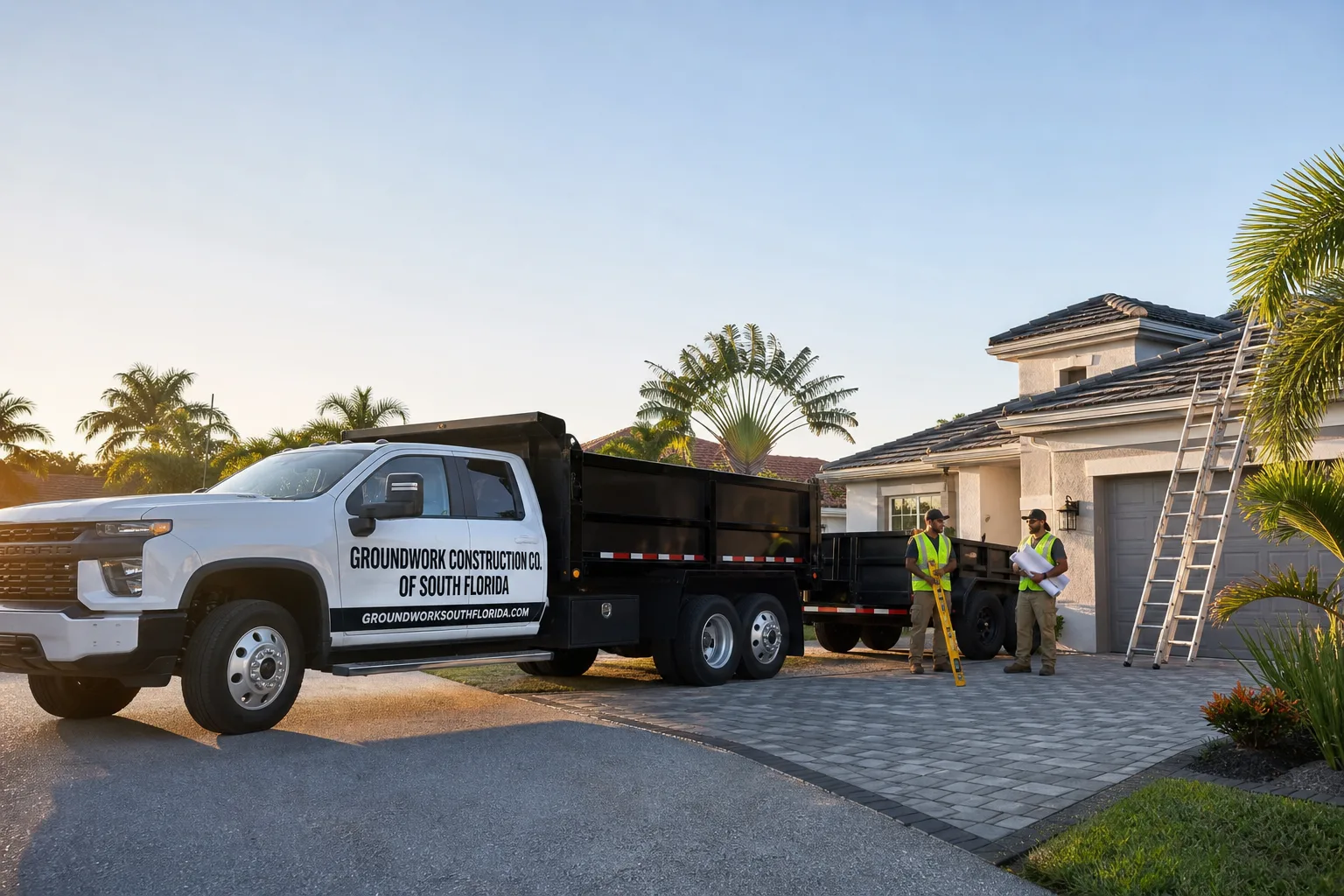
Asphalt Driveways & Resurfacing in Coral Terrace - Cost, Timeline, and What to Expect
Asphalt driveways and resurfacing in Coral Terrace typically run $3,500-$9,000 for new paving and $2,500-$6,500 for resurfacing an existing driveway, with most jobs completed in 2-4 days once permitting clears. Because Coral Terrace sits in unincorporated Miami-Dade County, every project must pass Miami-Dade County Building Department plan review and inspection under High-Velocity Hurricane Zone standards. Call (844) 665-0162 and we’ll walk you through whether your existing surface can be resurfaced or needs full replacement.
How We Handle Asphalt Driveways & Resurfacing From Start to Finish
We’ve learned that homeowners in Coral Terrace want to know exactly when their driveway will be out of commission and what decisions they’ll need to make before we show up. Here’s how asphalt driveways and resurfacing actually unfolds.
Stage 1: Site evaluation and measurement (Day 1, 1-2 hours)
We measure your existing surface, check drainage slope, and identify what’s underneath. Coral Terrace’s shallow water table means we look for signs of pooling or sub-base saturation that could undermine new asphalt within a few years. You’ll decide at this stage whether to expand the footprint, adjust the apron where it meets the street, or keep the existing layout. We also flag any utility boxes, sprinkler heads, or drainage channels that need protection or relocation.
Stage 2: Permitting and product approval (3-10 business days, homeowner does nothing)
Because Coral Terrace falls under Miami-Dade County’s jurisdiction, we submit to the County Building Department, not a city office. Asphalt driveways and resurfacing here requires a building permit when the work exceeds 25% of the driveway area or involves structural changes to the approach. We handle the HVHZ product-approval documentation for any base materials and edge restraints. If your home is in an HOA with design-review requirements, we coordinate that submittal in parallel.
Stage 3: Demolition and base prep (Day 1-2 of construction, 4-8 hours)
We saw-cut the edges cleanly, remove the old asphalt or failed surface, and haul it off. Then we grade the sub-base for proper runoff. Coral Terrace’s afternoon thunderstorms from June through October mean we schedule this stage for morning starts and keep tarps ready. If we hit saturated limestone or standing water close to the surface, we’ll discuss whether adding a geotextile fabric or additional aggregate base is warranted. That decision affects both cost and longevity.
Stage 4: Base compaction and asphalt placement (Day 2-3, weather-dependent)
We lay and compact the aggregate base to Miami-Dade spec, then bring in the asphalt paver. For residential driveways in Coral Terrace, we typically specify a 2.5-3 inch compacted lift of hot-mix asphalt over 4-6 inches of processed stone base. The asphalt goes down at 275-300°F and gets compacted while hot. You’ll want to stay off it for 24-48 hours. We schedule this stage with a clear weather window, because rain on fresh asphalt compromises the bond and triggers a redo.
Stage 5: Striping, sealing recommendation, and final inspection (Day 3-4)
We edge the perimeter, check grade with a laser level, and schedule the county inspector. Sealing happens 6-12 months later, after the asphalt has fully cured and off-gassed. We’ll leave you with a maintenance schedule tailored to South Florida’s UV exposure and your specific traffic load.
The Material and Spec Choices You’ll Actually Decide On
Not all asphalt is the same. Here are the trade-offs we walk Coral Terrace homeowners through:
- Standard hot-mix vs. polymer-modified asphalt: Standard mix costs less upfront and performs adequately for typical two-car residential traffic. Polymer-modified asphalt, with additives like SBS (styrene-butadiene-styrene), resists rutting and thermal cracking better under South Florida’s intense sun and heavy rain cycles. It adds roughly 15-25% to material cost but extends service life from 15 years toward 20-25 years.
- Base depth and aggregate type: A 4-inch crushed limestone base handles normal passenger vehicles. If you’re parking a work truck, RV, or plan to store heavy equipment, we recommend 6-8 inches with larger stone gradation. Deeper base adds $800-$1,800 depending on driveway size, but prevents the alligator cracking we see when thin bases meet heavy loads on Coral Terrace’s soft limestone substrate.
- Surface course thickness: We typically specify 2.5 inches compacted for residential driveways. Some contractors quote 2 inches to hit a lower price point, but that thinner surface shows wear faster under Florida’s thermal cycling. The 0.5-inch difference matters more here than in cooler climates.
- Drainage configuration: Your existing driveway may shed toward the garage, the street, or a side yard. Regrading for proper slope adds labor but prevents the standing water that accelerates asphalt deterioration. In Coral Terrace’s flat terrain, getting drainage right is often the difference between a 10-year surface and a 20-year one.
- Expansion joints and edge restraint: Concrete curbs or paver borders contain the asphalt and prevent edge crumbling. We can match this work to a larger Driveway & Pavers in Coral Terrace project if you’re updating the full approach.
What Asphalt Driveways & Resurfacing Costs in Coral Terrace, FL
| Scope | Typical Range |
|---|---|
| New asphalt driveway (standard residential, 2-car) | $3,500-$9,000 |
| Resurfacing over sound base | $2,500-$6,500 |
| Driveway replacement (full demo, new base) | $5,000-$14,000 |
| Driveway sealing (maintenance, later) | $250-$700 |
Five factors move your number within these ranges:
1. Square footage and shape complexity: A straightforward rectangle costs less per square foot than a curved approach or a driveway wrapping around an existing oak that you’re preserving. Coral Terrace’s older lots often have mature trees that constrain the layout.
2. Existing surface condition: Resurfacing requires a stable base. If your current driveway has widespread alligator cracking, potholes, or base failure, we need to excavate and rebuild. That jumps you from the resurfacing range to replacement pricing.
3. Base requirements: Soft or saturated subgrade means deeper excavation, geotextile fabric, or additional aggregate. The shallow water table in Coral Terrace’s 33155 ZIP triggers this more often than homeowners expect.
4. Material grade: Polymer-modified asphalt and deeper lifts add material cost but reduce lifecycle cost. We quote both so you can decide based on how long you plan to stay in the home.
5. Permit scope and drainage redesign: Simple resurfacing of a sound driveway may not need full permitting. Any change to the approach, apron, or drainage path triggers Miami-Dade County review and adds both time and permit fees.
Our written estimates itemize labor, materials, permit fees, and haul-off separately. Site conditions that we can’t fully assess until excavation, such as buried debris or unexpected utility conflicts, get noted as potential change-order items with unit pricing upfront.
What Coral Terrace Specifically Means for This Job
Coral Terrace’s unincorporated status changes how asphalt driveways and resurfacing get done. There’s no city building department to call. Every permit routes through the Miami-Dade County Building Department, and every product and method must meet High-Velocity Hurricane Zone standards. That doesn’t just apply to roofs and windows. It means the base materials, edge restraints, and drainage systems we specify for your driveway carry product-approval numbers that out-of-area contractors sometimes don’t know to check.
The housing stock here reinforces why this matters. Most homes in the 33155 corridor were built between the 1950s and 1970s as concrete block structures with flat roofs and terrazzo floors. Their original driveways were poured during an era with no HVHZ requirements and minimal drainage engineering. We regularly find that the original asphalt or concrete approach has settled unevenly because it was laid over uncompacted fill, or because the underground drainage from the roof’s interior scuppers runs directly beneath the driveway slab. An out-of-area crew might pour new asphalt over that without tracing the drainage path. We don’t, because we’ve seen county inspectors fail jobs when hidden drains get covered or disrupted.
The climate adds another layer. Coral Terrace’s position atop Miami limestone with a water table sometimes within 3-4 feet of the surface means summer thunderstorms can saturate a job site between morning and afternoon. We schedule asphalt placement for dry windows, protect the base with geotextile if rain interrupts work, and never seal-coat during humid months when moisture gets trapped in the pavement structure.
Homeowners here often pair driveway work with larger exterior updates. If you’re expanding your home’s footprint, our New Detached ADU in Coral Terrace work and Junior ADU & Interior Conversion in Coral Terrace projects frequently start with rethinking the driveway approach to accommodate new utility runs or altered setbacks. Our Driveway & Pavers crew coordinates directly with our additions team when these projects overlap.
We cover Coral Terrace from our Fort Lauderdale base, and we know the county inspectors who review this work. That familiarity saves time on plan corrections and resubmittals.
Serving Coral Terrace, FL - Our Local Coverage Area
We’re based in the Coral Terrace area and know this community well. Use the map below to see our service coverage - if you’re nearby, we can almost certainly help.
Frequently Asked - Asphalt Driveways & Resurfacing in Coral Terrace
Most jobs finish in 2-4 days of actual construction, plus 3-10 business days for Miami-Dade County permitting. Weather can push the schedule, especially during summer thunderstorm season when we need dry windows for placement and compaction. Call (844) 665-0162 and we’ll check current county review times and weather forecasts for your target start date.
Yes, if the work exceeds 25% of the driveway area or changes the approach, drainage, or structural configuration. Coral Terrace’s unincorporated status means all permits run through Miami-Dade County Building Department, not a municipal office, and must include HVHZ-compliant product approvals for base materials. We handle the entire submittal.
Resurfacing works when the existing base is stable, drainage is functional, and surface cracking is superficial. If we find base saturation, widespread alligator cracking, or failed subgrade during evaluation, replacement is the only durable option. We’ll show you photos and explain which condition your driveway is in before you commit.
Resurfacing over sound base runs $2,500-$6,500; full new paving for a standard two-car driveway is $3,500-$9,000. Size, base condition, material grade, and drainage complexity move the number. We’ll measure your specific driveway and give you an itemized written estimate with no obligation.
Our workmanship warranty covers installation defects for a period we specify in your contract. Material defects fall to the asphalt producer’s warranty. The key to longevity is proper base prep and drainage, which is why we don’t cut corners on evaluation and excavation. We also leave you with a maintenance schedule for sealing and crack repair that protects your investment.
Get Your Free Estimate for Asphalt Driveways & Resurfacing in Coral Terrace
Call (844) 665-0162 to schedule a free on-site evaluation. We’ll measure your driveway, assess base condition, check drainage, and give you an itemized estimate with options for standard and upgraded materials. If you’re planning additional exterior work, we’ll coordinate with our full Driveway & Pavers in Coral Terrace team to keep everything under one contractor relationship. Estimates are free, and we’re straightforward about whether your job needs resurfacing or full replacement.
Written by Raymond Estevez, Owner at Groundwork Construction Co., serving Coral Terrace and South Florida.