
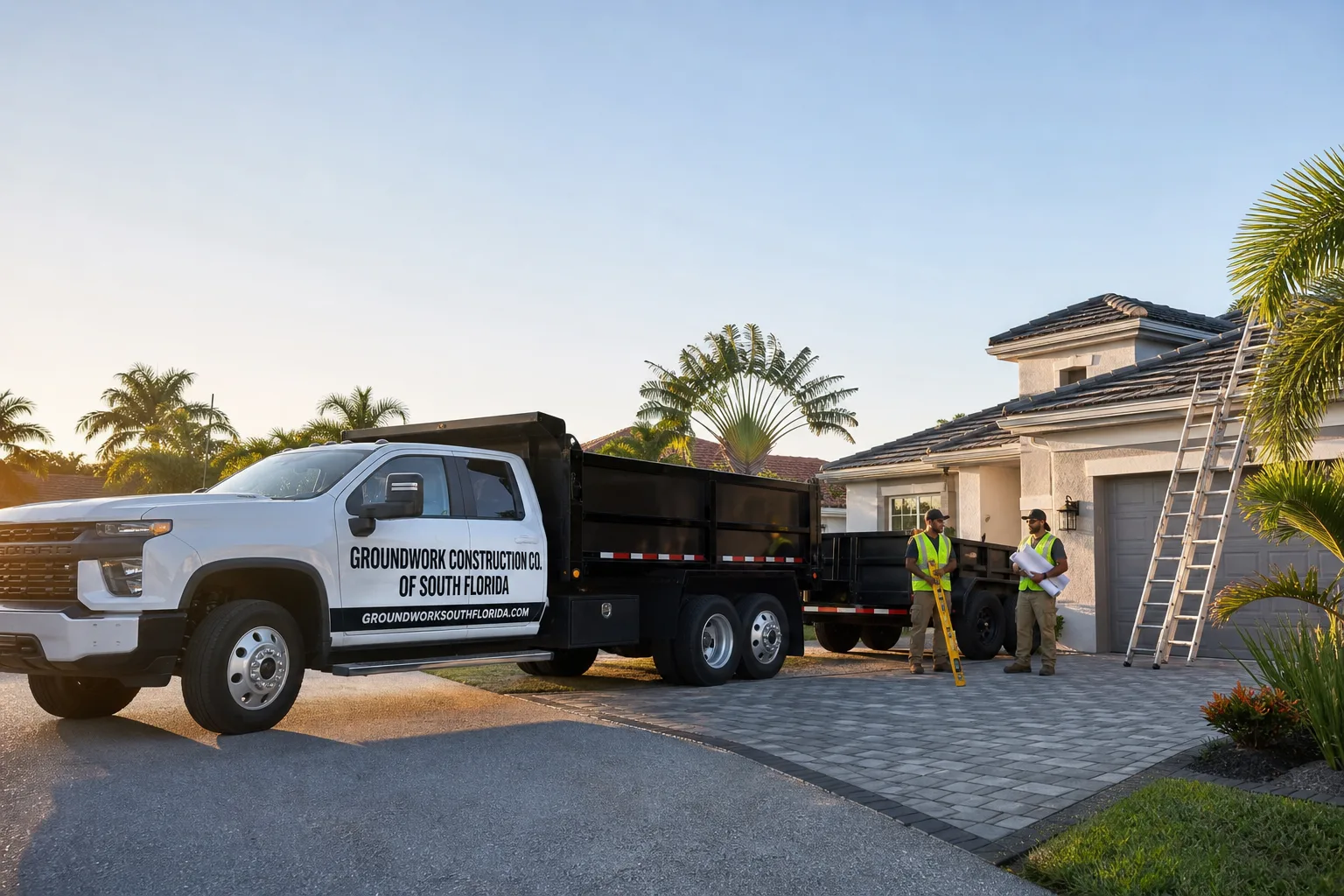
Concrete Driveways & Concrete Work in Plantation, FL - What It Costs and How Long It Takes
Concrete driveways & concrete work in Plantation, FL typically run $4,500-$12,000 for a full installation, with most residential projects completed in 3-5 business days once permits clear. We’re Groundwork Construction Co., and you can reach us at (844) 665-0162 for a free on-site estimate that breaks down your specific grade, finish, and drainage requirements. If you’re replacing an aging driveway on one of Plantation’s 1960s-era CBS homes, the job often ties into broader wind-mitigation and code-compliance work triggered by the same permitting cycle.
How We Pour and Finish Concrete Driveways & Concrete Work
Every concrete driveway we install in Plantation follows a five-stage sequence. Homeowners know exactly where we are each day and what decision points are coming.
Stage 1: Site evaluation and permit pull (1-3 days)
We measure your existing drive, check pitch and drainage toward the street or swale, and photograph any cracks or settlement in the adjacent walkway or garage slab. In Plantation, we also verify whether your project sits within a community with active HOA architectural review, since several neighborhoods along Broward Boulevard still enforce original covenant restrictions on visible hardscape materials. You’ll decide at this stage whether to match an existing sidewalk, widen the apron, or add a turnaround pad. We pull the Broward County permit and schedule the mandatory pre-pour inspection.
Stage 2: Demolition and base prep (1 day)
We break out the old concrete or asphalt, haul it off, and expose the subgrade. Plantation’s high seasonal water table, especially during the wet season when the Everglades-adjacent western edge sees groundwater rise within a foot or two of grade, means we sometimes hit saturated soil. If we do, we bring in crushed concrete base and compact it in lifts so your new slab won’t settle. You’ll decide here whether to add reinforcement wire mesh, rebar on 18-inch centers, or fiber mesh mixed through the pour itself.
Stage 3: Forming and pre-pour inspection (1 day)
We set wood or composite forms to your finished dimensions, establish slope for drainage, and install any expansion joints at 10-foot intervals. The Broward County inspector checks form height, reinforcement placement, and proximity to property lines or utilities. We don’t pour until we pass. You’ll confirm your finish choice at this point: broom, exposed aggregate, or a smoother steel-trowel surface.
Stage 4: Pour and finish (1 day)
We schedule the ready-mix delivery for first light, place the concrete with a pump or wheelbarrow depending on backyard access, screed it level, and apply your chosen finish while the cream is workable. In Plantation’s summer heat, that window shrinks, so our crew sizes the pour to match what we can hand-finish before the surface skins. You’ll be on-site or reachable by phone in case we hit an unexpected utility or need to adjust the expansion joint layout.
Stage 5: Curing and final walkthrough (2-7 days)
Concrete reaches workable strength in 24-48 hours, but we keep vehicles off for seven days minimum. We strip forms, seal any control joints, and walk the surface with you for final acceptance. If this concrete driveway & concrete work project is part of a full exterior renovation, we’ll coordinate next steps with Driveway & Pavers in Plantation scope, whether that’s paver walkways, a patio extension, or fencing.
The Concrete Choices You’ll Actually Make
- Standard 3,000 PSI mix vs. 4,000+ PSI: Most residential driveways in Plantation use 3,000 PSI with air entrainment for our wet-dry cycles. If you’re parking a heavy truck or RV, or if the driveway doubles as a work pad, 4,000 PSI adds roughly $1-$2 per square foot but resists surface spalling from tire abrasion and salt exposure.
- Wire mesh vs. rebar vs. fiber: Wire mesh is the baseline, enough for passenger vehicles on stable soil. Rebar on 18-inch centers is our recommendation for Plantation’s older homes where the original fill may have settled unevenly over 50-plus years. Fiber mesh mixed into the wet concrete controls plastic shrinkage cracking but doesn’t add structural strength, so we rarely use it alone.
- Broom finish vs. exposed aggregate vs. steel trowel: Broom finish gives you grip when Plantation’s afternoon thunderstorms leave surfaces slick. Exposed aggregate, where we wash away the top paste to reveal stone, costs more and requires sealing every 2-3 years but stays cooler underfoot and hides stains. Steel trowel is smooth and modern-looking but slippery when wet, so we only recommend it for covered or lightly used areas.
- Integral color vs. surface stain: Integral color, mixed through the entire batch, won’t wear away but limits you to earth tones. Acid stain or water-based stain applied after curing gives richer variation but needs resealing and can fade where tires scrub. For HOA-governed neighborhoods in Plantation, we verify approved color palettes before ordering.
What Concrete Driveways & Concrete Work Costs in Plantation, FL
| Scope | Typical Range |
|---|---|
| Standard concrete driveway (single car, replace in kind) | $4,500-$7,500 |
| Two-car driveway with turnaround or apron extension | $7,500-$12,000 |
| Reinforcement upgrade (rebar vs. mesh) | +$800-$1,800 |
| Exposed aggregate or integral color finish | +$1,200-$2,500 |
| Drainage correction or swale regrading | +$500-$1,500 |
Five variables push your number up or down. First, size and thickness: a standard 4-inch residential slab versus a 6-inch heavy-duty pad. Second, what’s coming out: asphalt is easier to break than old concrete, and if there’s a buried stump or construction debris from the 1960s build, excavation runs longer. Third, access for the concrete truck and pump, which can be tight on Plantation’s older lots with mature oak canopies and narrow side yards. Fourth, finish complexity: a broom-finished gray slab is straightforward; exposed aggregate with a hand-seeded border is not. Fifth, whether this concrete driveway & concrete work project is bundled with other permitted work, since Broward County sometimes combines inspections and reduces per-project fees when roofing, windows, and hardscape are all on the same master permit for a full renovation.
Our written estimates include demolition, haul-off, base material, concrete, reinforcement, forming, finishing, and the first inspection. They do not include permit fees, tree removal, or utility relocation. If your driveway crosses a sewer cleanout or buried electrical run, we’ll flag that during evaluation and bring in the appropriate trade.
What Plantation Homes Specifically Do to This Job
Plantation’s housing stock shapes nearly every concrete driveway & concrete work project we take on. The city was master-planned from the 1950s onward with its heaviest residential build-out in the 1960s and 1970s, leaving thousands of single-story CBS homes now 50-60 years old. Many of these original driveways were poured as thin, unreinforced slabs over poorly compacted fill. We regularly see longitudinal cracking parallel to the garage, where the slab has settled away from the foundation footer, and spalling at the apron where decades of salt and sun exposure have degraded the surface paste.
The older subdivisions along Broward Boulevard and east of University Drive, developed in Plantation’s earliest phases, concentrate these problems. Their flat-roof and low-slope CBS homes are simultaneously hitting insurance-mandated roof replacement age, which means homeowners are already in the permitting system for wind-mitigation work. It often makes sense to sequence the driveway replacement with that broader renovation, since the same inspector may cover multiple trades and the disruption is consolidated. We’ve also learned to check for active HOA architectural committees in these original sections, where covenants written in the 1960s sometimes restrict visible concrete color or require specific setback dimensions that differ from current city code.
Climate matters too. Plantation’s western boundary sits against the Everglades Water Conservation Areas, and the shallow limestone aquifer beneath the city can bring groundwater within a foot or two of grade during the June-October wet season. Any excavation for thickened edges, drainage channels, or tie-in to a new garage slab has to account for that hydrostatic pressure. We coordinate with Broward County surface water management rules when the job affects swale flow or street drainage. And the hurricane exposure that drives Florida’s stringent wind-load requirements means that any concrete work tied to a structural element, like a garage slab that serves as a tie-down point for roof straps, gets engineered to the current Florida Building Code, not the original 1960s standard.
Our Driveway & Pavers crew covers Plantation and the surrounding cities, and we regularly coordinate with homeowners who are also exploring Garage Conversion ADU in Plantation or a New Detached ADU in Plantation to expand their footprint. If you’re already in the permitting cycle for one project, bundling concrete work can streamline inspections and reduce mobilization costs.
Serving Plantation, FL - Our Local Coverage Area
We’re based in the Plantation area and know this community well. Use the map below to see our service coverage - if you’re nearby, we can almost certainly help.
Frequently Asked - Concrete Driveways & Concrete Work in Plantation
Most concrete driveways & concrete work projects in Plantation take 3-5 business days of active construction once permits are issued, plus 7 days of curing before you can park on the surface. Permitting through Broward County typically adds 5-10 business days depending on inspection backlog. Call (844) 665-0162 and we’ll check current turnaround times when we quote your job.
Yes, Broward County requires a permit for any new concrete driveway or replacement that changes dimensions, drainage, or structural connection to the home. If your project is part of a larger renovation, it may be covered under a master building permit instead. We handle the application, the pre-pour inspection, and the final sign-off as part of our standard process.
In most cases, yes, if the existing driveway was built over undisturbed soil and no utilities cross the pour area. We locate buried lines with a private utility locator before breaking ground. On some 1960s-era Plantation homes, we’ve found original sewer cleanouts or irrigation mains that were paved over decades ago; if we hit one, we’ll show you the repair options before proceeding.
Concrete costs less upfront, installs faster, and gives you a continuous surface that’s easy to clean. Pavers cost more but allow spot repairs if a section settles, and certain HOA-governed neighborhoods in Plantation prefer their aesthetic. If you’re considering pavers for walkways or patios while keeping concrete for the drive, we can design a complementary system using materials from our hardscape portfolio including Belgard, Unilock, Tremron, and Techo-Bloc.
We warranty our workmanship, including proper base preparation, reinforcement placement, and finish application, for a period we specify in your written contract. The concrete itself carries the ready-mix supplier’s batch warranty. We do not warranty against cracking from ground settlement beyond our control or from vehicle loads exceeding the design specification, which is why we discuss PSI and reinforcement choices with you before the pour. Ask us for the specific terms when we meet on-site.
Get Your Free Estimate for Concrete Driveways & Concrete Work in Plantation
Call (844) 665-0162 to schedule a free on-site estimate. Raymond Estevez or a member of our project team will walk your driveway, check drainage and access, and deliver a written quote with line-item pricing for concrete grade, finish, reinforcement, and any drainage corrections. We serve Plantation and nearby Fort Lauderdale, Broadview Park, Lauderhill, and Lauderdale Lakes.
Written by Raymond Estevez, Owner at Groundwork Construction Co., serving Plantation since our South Florida launch.