
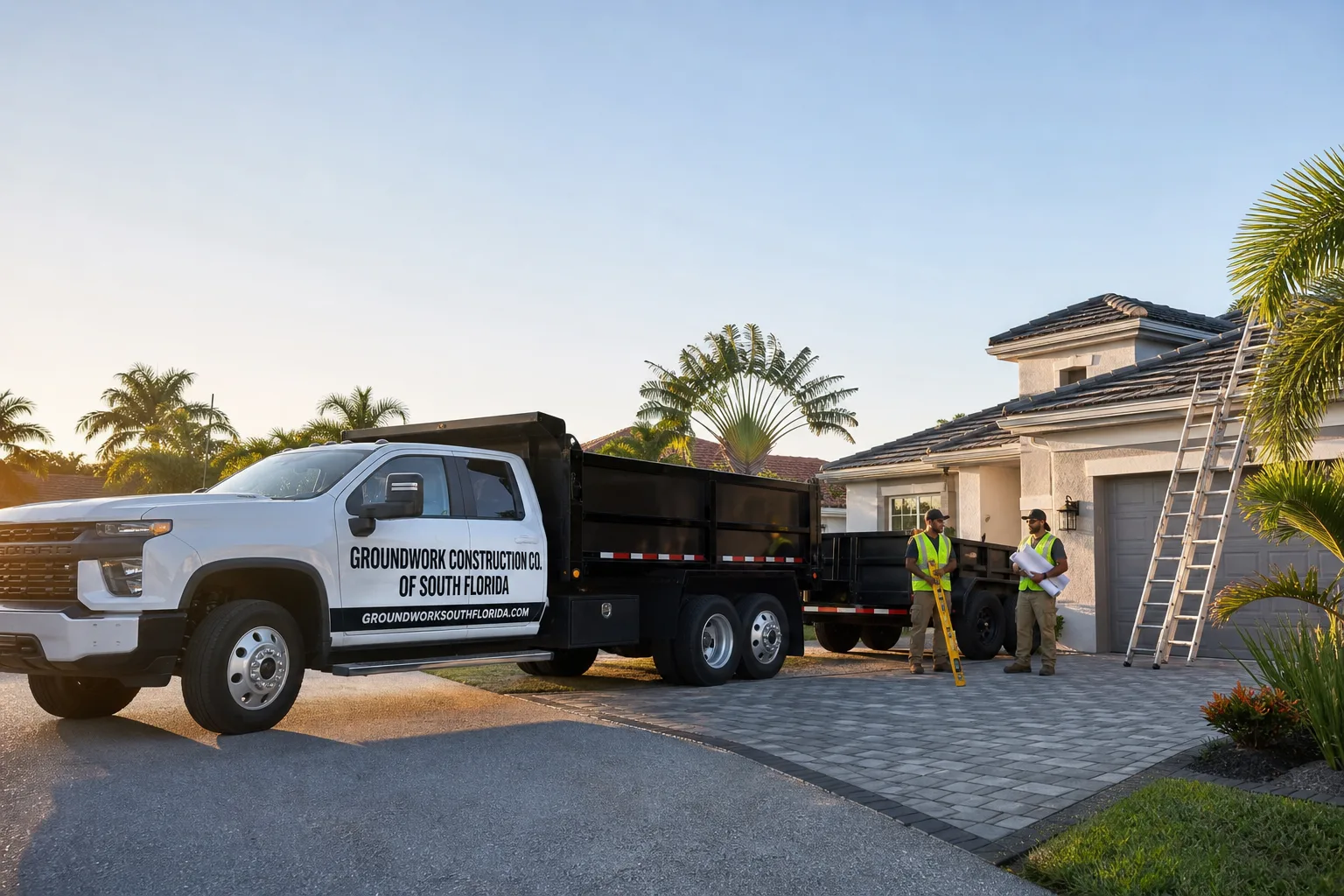
How Much Does Emergency & Storm Damage Repair Cost in Lake Worth Corridor?
Emergency & Storm Damage repair in Lake Worth Corridor typically runs $400-$2,500 for roof and envelope fixes, with full structural recovery after a major event reaching $8,000-$20,000 when replacement is needed. Most emergency tarping and stabilization happens same day; permanent repairs usually take 3-10 business days once Palm Beach County permits clear. Call (844) 665-0162 for immediate response - we’ll assess damage on-site and give you a written estimate before any work starts.
What happens from the first call to the final inspection
Storm damage isn’t one job. It’s a sequence of decisions under pressure, and the order matters. Here’s how we handle Emergency & Storm Damage in Lake Worth Corridor from the moment you call.
Stage 1: Emergency stabilization (same day, 2-4 hours on site)
We arrive with tarps, plywood, and temporary sealant to stop active leaks and prevent secondary damage. You’re deciding whether to file an insurance claim right then - we document everything with photos and measurements so your adjuster has independent evidence. We don’t start permanent work until you tell us your claim strategy.
Stage 2: Damage assessment and scope definition (1-2 days)
Once the structure is secure, we strip back damaged sections to assess the full extent. In Lake Worth Corridor’s 1950s-1970s CBS homes, this is where we often find the real problem: moisture has traveled through cracked stucco into block cavities, or the original built-up tar roof has failed at the seams. We mark structural versus cosmetic damage and flag anything that triggers Palm Beach County’s mandatory upgrade requirements.
Stage 3: Permit pull and compliance check (3-10 business days)
Because Lake Worth Corridor is unincorporated Palm Beach County, every substantial repair runs through the county building department - no city hall shortcut. If we uncover unpermitted prior work (carport conversions are the classic), that has to be documented and brought to current Florida Building Code before new work proceeds. This stage is where out-of-area crews get caught off guard. We’ve worked with Palm Beach County inspectors long enough to front-load the paperwork and avoid red-tag surprises.
Stage 4: Structural repair and envelope restoration (2-7 days)
Depending on scope, this means reframing damaged roof sections, replacing decking, installing new underlayment, and resealing stucco transitions. For roof replacement tied to storm damage, we specify wind-rated materials from GAF, CertainTeed, or Owens Corning - all meet Florida’s wind-borne debris region requirements. You’re choosing between repair and full replacement at this stage, and we give you load calculations and warranty terms for each path.
Stage 5: Final inspection and warranty activation (1 day)
Palm Beach County inspects for code compliance and wind-load anchoring. We pass the certificate to you and activate manufacturer warranties. The whole cycle, from emergency call to final sign-off, typically spans 1-3 weeks depending on permit queue depth and whether hidden damage extends the scope.
The repair decisions you’ll actually face after storm damage
Every Emergency & Storm Damage job in Lake Worth Corridor forces choices. These aren’t abstract - they show up on your estimate line by line.
- Spot repair versus full roof section replacement. Spot work runs $400-$1,800 and works when damage is isolated to a few shingles or a single membrane seam. Full section replacement starts around $5,000 but carries a 25-50 year manufacturer warranty and eliminates the patchwork look. If your roof is already 20+ years old, we typically recommend replacement - throwing good money at failing substrate doesn’t make sense.
- Standard underlayment versus self-adhered ice and water shield. Standard felt is code-minimum and cheaper upfront. Self-adhered membrane adds $800-$1,500 to a typical Lake Worth Corridor roof but seals around fasteners and resists the wind-driven rain that gets under shingles during our summer storms. For low-slope sections, self-adhered isn’t optional - it’s the only thing that works.
- Stucco repair with matching versus full resurfacing. Matching 40-year-old stucco texture is an art; full resurfacing guarantees uniformity but adds $2,000-$4,500. We keep samples of common local textures and can usually blend repairs well enough that you’d never know - unless the original stucco is failing systemically from humidity intrusion.
- Original jalousie window replacement versus impact-rated upgrade. Many Lake Worth Corridor homes still have the metal jalousies from the 1960s. Repairing the frame after storm damage costs $300-$800 per opening. Upgrading to impact-rated windows from PGT or CGI runs $800-$2,200 per opening but satisfies Florida Building Code for the wind-borne debris region and often lowers insurance premiums. If you’re already opening the wall for structural repair, the incremental cost drops significantly.
- Interior restoration scope. Ceiling drywall, insulation, and flooring damaged by roof leaks - do you restore exactly what was there, or upgrade? We quote both paths. Most homeowners doing Emergency & Storm Damage repair in Lake Worth Corridor use the moment to swap out 1970s popcorn ceilings and R-19 insulation for smooth finish and R-30 while the drywall’s down anyway.
What Emergency & Storm Damage costs in Lake Worth Corridor, FL
| Scope | Typical Range |
|---|---|
| Emergency tarping and stabilization | $250-$600 |
| Roof repair (shingle/built-up) | $400-$1,800 |
| Tile roof repair | $600-$2,500 |
| Roof section replacement | $5,000-$12,000 |
| Full roof replacement | $8,000-$20,000 |
| Stucco/envelope repair | $1,500-$6,000 |
| Structural reframing (if needed) | $3,000-$8,000 |
Five factors push your job to the high or low end of these ranges. Roof pitch and access matter - single-story homes with walkable roofs cost less than two-story structures requiring scaffolding. Extent of hidden moisture damage is the big unknown; we find it by probing, not guessing, but you should budget 15-20% contingency if your home has the original built-up tar roof common in 1960s Lake Worth Corridor construction. Permit complexity escalates fast if prior unpermitted work surfaces - documenting a 1980s carport conversion can add $1,000-$3,500 in engineering and compliance costs. Material grade affects both first cost and insurance discounts; impact-rated windows and Class 4 shingles cost more upfront but typically pay back through premium reductions. Interior restoration scope is entirely your call - we separate structural repair from cosmetic restoration on every estimate so you control the total.
A written estimate from us includes labor, materials, permits, and debris removal. It does not include your deductible or any insurance shortfall, temporary relocation costs, or landscaping repair from equipment access - those are real costs, and we don’t pretend otherwise.
Why Lake Worth Corridor homes make this job different
We’ve done Emergency & Storm Damage repair across Palm Beach County, and Lake Worth Corridor presents a specific profile we don’t see in newer western suburbs or the City of Lake Worth Beach proper.
The corridor’s housing stock is remarkably consistent: small CBS homes, 900-1,400 square feet, built 1955-1975, many with flat or low-slope built-up tar roofs that were never designed for the wind loads the Florida Building Code now requires. When a storm peels back that tar, we often find the original wood fiberboard decking - saturated, delaminated, and hiding moisture in the block cavity. The intense humidity here doesn’t let things dry out; it accelerates decay. Waterproofing isn’t an add-on in Lake Worth Corridor - it’s the difference between a repair that lasts and one that fails again in the next storm.
Then there’s the permitting reality. Because Lake Worth Corridor is unincorporated, every permit routes through Palm Beach County’s building department on Southern Boulevard. No city inspector shortcut. And because so many of these homes have unpermitted additions - especially the carport conversions from the 1970s and 1980s - pulling a permit for storm damage repair often triggers a full-structure compliance review. We’ve had county inspectors red-tag jobs because the back bedroom was built without hurricane straps on undersized footings. Out-of-area crews who don’t know this pattern get blindsided. We build the compliance check into our initial assessment so you’re not learning about it mid-project.
The wind-borne debris region designation also means any roof or window work must meet higher design pressures. We specify accordingly - not because we want to upsell, but because Palm Beach County won’t sign off otherwise. If you’re doing Emergency & Storm Damage repair as part of a full exterior upgrade, our Roofing in Lake Worth Corridor crew can coordinate the entire envelope: roof, windows, and stucco, with materials from our full brand roster including James Hardie siding where replacement makes sense.
Homeowners in Lake Worth Corridor often pair storm recovery with other projects once they see the efficiency of single-source work. We’ve seen clients add Custom Windows & Doors in Lake Worth Corridor while walls are open, or rebuild a wind-damaged Wood Fence in Lake Worth Corridor to match a refreshed exterior. Our Roofing division handles the structural side; you stay with one contractor, one timeline, one accountability point.
We cover Lake Worth Corridor and nearby Palm Springs, Greenacres, and Greenacres City with the same crew dispatch. Response time depends on storm severity and queue depth, but we prioritize active leaks and structural compromise.
Serving Lake Worth Corridor, FL - Our Local Coverage Area
We’re based in the Lake Worth Corridor area and know this community well. Use the map below to see our service coverage - if you’re nearby, we can almost certainly help.
Frequently asked - Emergency & Storm Damage in Lake Worth Corridor
Most jobs finish in 1-3 weeks from emergency call to final inspection. Emergency stabilization happens same day. Permanent repairs start once Palm Beach County permits clear, typically 3-10 business days for standard roof work. Call (844) 665-0162 and we’ll give you a realistic timeline based on current permit queue depth.
Yes, if the repair exceeds one square (100 square feet) or involves structural elements. Lake Worth Corridor is unincorporated Palm Beach County, so permits run through the county building department, not a city office. We pull permits as part of our standard process and handle all documentation.
Often yes, if the damage is isolated and your roof has sufficient remaining service life. We repair when the substrate is sound and the roof is under 15 years old. We recommend replacement when damage is widespread or the roof is already near end of life - spending $1,500 on a 25-year-old built-up tar roof doesn’t make financial sense.
Most homeowners policies cover sudden storm damage, less your deductible. We document everything for your adjuster and can meet them on-site. We don’t work for insurance companies - we work for you - but we speak their language and make sure nothing valid gets excluded. Call (844) 665-0162 before you file and we’ll walk you through documentation.
Workmanship warranty covers our labor; manufacturer warranties cover materials. GAF, CertainTeed, and Owens Corning shingles carry 25-50 year limited warranties when installed to their specifications. We register warranties in your name and pass certificates through at final inspection. Our workmanship warranty term is specified in your written estimate.
Get an on-site assessment for Emergency & Storm Damage in Lake Worth Corridor
Storm damage doesn’t wait, and neither should you. Call (844) 665-0162 for same-day emergency response in Lake Worth Corridor. We’ll stabilize what’s leaking, photograph everything for your insurance file, and deliver a written estimate with real numbers - no pressure, no placeholder pricing. If you decide to move forward, we handle permits, compliance, and build-back under one contract. One contractor, every phase.
Written by Raymond Estevez, Owner at Groundwork Construction Co., serving Lake Worth Corridor and South Florida.