
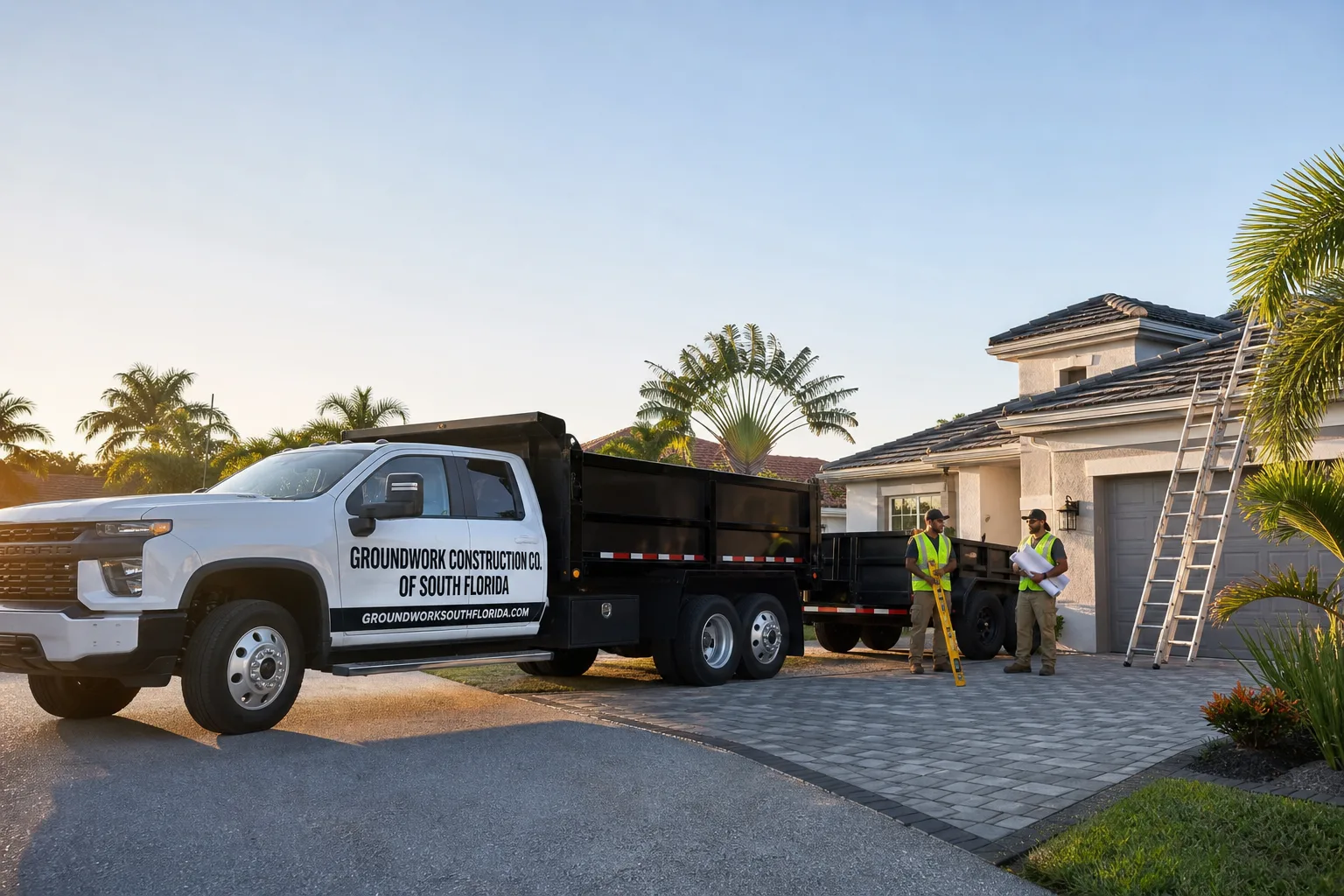
What Does Emergency & Storm Damage Repair Involve in Lauderhill?
Emergency & Storm Damage repair in Lauderhill typically addresses roof breaches, water intrusion, and structural compromise after severe weather events, with most stabilization work beginning within 24-48 hours and full restoration taking 2-6 weeks depending on permit complexity. For Lauderhill’s aging CBS homes built in the 1960s and 1970s, these jobs almost always uncover additional code-compliance requirements that newer suburbs avoid. Call (844) 665-0162 for emergency assessment and a free written estimate.
How We Handle Emergency & Storm Damage - Start to Finish
Storm damage doesn’t wait, but rushing the wrong sequence creates bigger problems. Here’s how we move through a typical Lauderhill emergency & storm damage job:
Stage 1: Emergency stabilization (Day 1)
We arrive to tarp the roof, seal active leaks, and document everything for your insurance adjuster. On Lauderhill’s flat and low-slope roofs, water travels horizontally before it drips, so we trace the full migration path - the visible stain is rarely the only damage. This stage takes 4-8 hours. You decide: whether to file an insurance claim now or wait for our full damage report.
Stage 2: Structural and moisture assessment (Days 2-3)
We remove wet drywall, insulation, and compromised roofing layers to inspect the roof deck, trusses, and interior framing. In Lauderhill’s CBS homes, water often pools at wall-to-roof junctions where original construction lacked modern flashing detail. This inspection reveals whether you’re looking at localized repair or a full roof replacement tied to roofing in Lauderhill standards. Duration: 1-2 days. You decide: repair scope based on our photo documentation and moisture-meter readings.
Stage 3: Permit and compliance planning (Days 4-10)
Here’s where Lauderhill diverges from neighboring cities. Broward County requires hurricane-hardening compliance on any structural roof work - roof-to-wall straps, impact-rated openings if windows were damaged, and wind-load calculations that 1960s-era homes never had. We submit engineered drawings and handle inspections. This phase runs 5-7 business days, longer if HOA approval is needed. You decide: material grade and whether to upgrade undamaged windows to impact-rated while the permit is open.
Stage 4: Restoration construction (Days 11-25)
We rebuild the roof system, replace damaged interior finishes, and address any secondary issues like mold remediation or electrical repair. For a typical 1,200-square-foot Lauderhill single-story home, roof restoration takes 5-7 working days; interior rebuild adds another 5-10 days depending on finish selections. You decide: whether to match original materials or upgrade - many homeowners shift to James Hardie siding or impact windows during this window.
Stage 5: Final inspection and closeout (Days 26-30)
Broward County inspects structural, roofing, and any trade work. We correct punch-list items, deliver warranty documentation, and provide maintenance guidance for your specific materials. You decide: whether to schedule annual inspections going forward, which we strongly recommend for Lauderhill’s older housing stock.
The Material and Spec Choices You’ll Face
Storm damage forces decisions fast. These are the real trade-offs we walk Lauderhill homeowners through:
- Roofing underlayment: Standard felt ($1.50-$2.50/sq ft installed) versus synthetic underlayment ($2.50-$4.00/sq ft). Felt is code-minimum and fine for budget-focused repairs. Synthetic handles Lauderhill’s driving rain and ponding better on low-slope sections, and most manufacturers require it for enhanced warranties.
- Shingle grade: 3-tab asphalt (lowest cost, 25-year rated) versus architectural/laminate (thicker, 30-50 year rated, better wind resistance). For Lauderhill’s hurricane exposure, we rarely recommend 3-tab on full replacements - the wind-speed differential matters.
- Sheathing replacement: OSB ($25-$35/sheet) versus plywood ($40-$55/sheet). OSB is code-compliant and cost-effective. Plywood handles repeated wet-dry cycles better, which matters in Lauderhill’s rainy season if future leaks occur before detection.
- Interior finish level: Match existing ($8-$12/sq ft for drywall, texture, paint) versus upgrade to moisture-resistant materials ($12-$18/sq ft). For homes with recurring leak history or slab-on-grade moisture issues, we often recommend cement board or mold-resistant drywall at the bottom 4 feet.
- Window replacement scope: Replace only damaged units, or upgrade all openings to impact-rated while the wall is open. The marginal cost of the latter drops significantly when interior finishes are already removed - typically 30-40% less than a standalone window project later.
Our roofing crew coordinates directly with interior trades on these jobs, so you’re not managing multiple contractors through the rebuild.
What Emergency & Storm Damage Costs in Lauderhill, FL
Emergency & storm damage repair in Lauderhill typically runs $2,800-$14,000 for partial restoration, and $8,000-$20,000 when the roof requires full replacement under the same permit. Here’s what moves you within or above that range:
| Cost Factor | Low-End Impact | High-End Impact |
|---|---|---|
| Roof area and pitch | Small, walkable roof | Large or steep section requiring staging |
| Structural damage extent | Localized sheathing rot | Truss repair, wall reframing |
| Code compliance triggers | Minimal - repair under existing structure | Full hurricane retrofit, impact windows |
| Interior finish scope | Single room, standard drywall | Multiple rooms, custom cabinetry, flooring |
| Material grade selected | 3-tab shingles, basic underlayment | Architectural shingles, synthetic underlayment, upgraded siding |
What’s included in our written estimate: emergency tarping, demolition of damaged materials, disposal, permit fees, all labor and materials for agreed scope, and final inspection coordination. What’s typically separate: mold testing and remediation (we coordinate but bill through certified specialists), temporary relocation costs, and any work outside the storm-damaged area unless specifically added.
Insurance usually covers the direct damage and code-required upgrades, but deductibles and depreciation calculations vary. We document everything to support your claim, and we never ask you to sign an assignment of benefits - that’s your money to control.
What Lauderhill Homes Specifically Do to This Job
Lauderhill’s housing stock shapes every emergency & storm damage repair we handle here. The city was largely built out by General Development Corporation between the 1950s and 1970s as one of South Florida’s first planned communities, leaving a dense concentration of CBS tract homes that predate modern wind-resistance standards. When storm damage opens a roof on one of these structures, we’re almost always looking at more than patchwork.
The flat and low-slope roofs common in Lauderhill’s garden apartment zones and single-story tracts pond water during our June-October rainy season. A storm breach that might drain quickly on a pitched roof instead saturates the assembly, spreading damage across a wider area than the initial leak suggests. We see this regularly in neighborhoods east of State Road 7, where original built-up roofing has been layered over multiple times without proper slope correction.
Then there’s the compliance reality. Broward County enforces Florida Building Code hurricane provisions strictly on any structural repair, and Lauderhill’s pre-Andrew homes rarely have the roof-to-wall straps, continuous load paths, or impact-rated openings that current code requires. A straightforward shingle replacement becomes a full structural upgrade once the inspector sees 1960s-era toe-nailed truss connections. We’ve handled jobs where the emergency tarp came down on a Tuesday and the permit review took ten days because engineered drawings were required for strap retrofits on a home that had never been through post-Andrew scrutiny.
The Caribbean-American homeowner community here - heavily Jamaican and Haitian - often uses storm damage as the trigger for long-planned expansions, converting damaged Florida rooms or carports into conditioned space. That shifts the job from repair to addition, triggering full FBC compliance on structures originally permitted under 1960s codes. We build those compliance costs into our initial assessment so there are no mid-project surprises.
Water table matters too. Lauderhill sits on flat, low-elevation interior Broward County land with seasonally high groundwater. Storm damage that compromises the roof often reveals existing slab moisture issues, especially where original construction lacked proper vapor barriers. We check for this during Stage 2 assessment - it’s not storm damage per se, but ignoring it guarantees callbacks.
Homeowners in Lauderhill often pair exterior restoration with Custom Windows & Doors in Lauderhill upgrades while the permit is open, or add Wood Fence in Lauderhill replacement if storm debris damaged perimeter structures. One permit cycle, multiple improvements - it saves money and disruption.
Serving Lauderhill, FL - Our Local Coverage Area
We’re based in the Lauderhill area and know this community well. Use the map below to see our service coverage - if you’re nearby, we can almost certainly help.
Frequently Asked - Emergency & Storm Damage in Lauderhill
Most jobs run 2-6 weeks from emergency tarp to final inspection, with permit compliance for older homes adding 5-10 days compared to newer construction. The roof work itself is usually 5-7 working days; interior restoration and Broward County inspections fill out the timeline. Call (844) 665-0162 and we’ll assess your specific damage and give you a realistic schedule.
Yes - any structural roof work in Broward County requires permitting, and Lauderhill’s pre-1992 homes almost always trigger additional hurricane-hardening requirements. We handle permit submission, engineered drawings if needed, and all inspections. The permit process adds cost upfront but protects your resale value and insurance coverage.
Sometimes - if the damage is localized to one slope and your roof is under 15 years old with adequate remaining life. We match existing materials and blend the repair. For Lauderhill’s older flat roofs with multiple layers or widespread saturation, partial repair often fails within 2-3 years and we recommend full replacement. We’ll show you photos and give you both options with honest projections.
Florida law requires insurers to cover code-compliant repairs when policyholders have law and ordinance coverage, which most standard policies include. We document all code-triggered work - roof straps, impact windows, sheathing upgrades - with photos and itemized estimates to support your claim. Without law and ordinance coverage, you’ll pay code-upgrade costs out of pocket.
Our workmanship warranty covers installation quality for 5 years, and material warranties range from 25 years (standard architectural shingles) to lifetime (premium systems) depending on what you select. Manufacturer warranties require proper installation and ventilation, which we verify during our quality check. Keep in mind: no warranty covers future storm damage - that’s what your homeowner’s policy is for.
Get Your Lauderhill Home Assessed
Storm damage doesn’t fix itself, and waiting risks mold, structural rot, and costlier repairs. We provide free on-site estimates for emergency & storm damage in Lauderhill - call (844) 665-0162, tell us what happened and when, and we’ll schedule assessment within 24 hours. Raymond Estevez or a senior project manager will walk your property, document everything for insurance, and deliver a written scope and price with no pressure to decide on the spot.
Written by Raymond Estevez, Owner at Groundwork Construction Co., serving Lauderhill since our South Florida founding.