
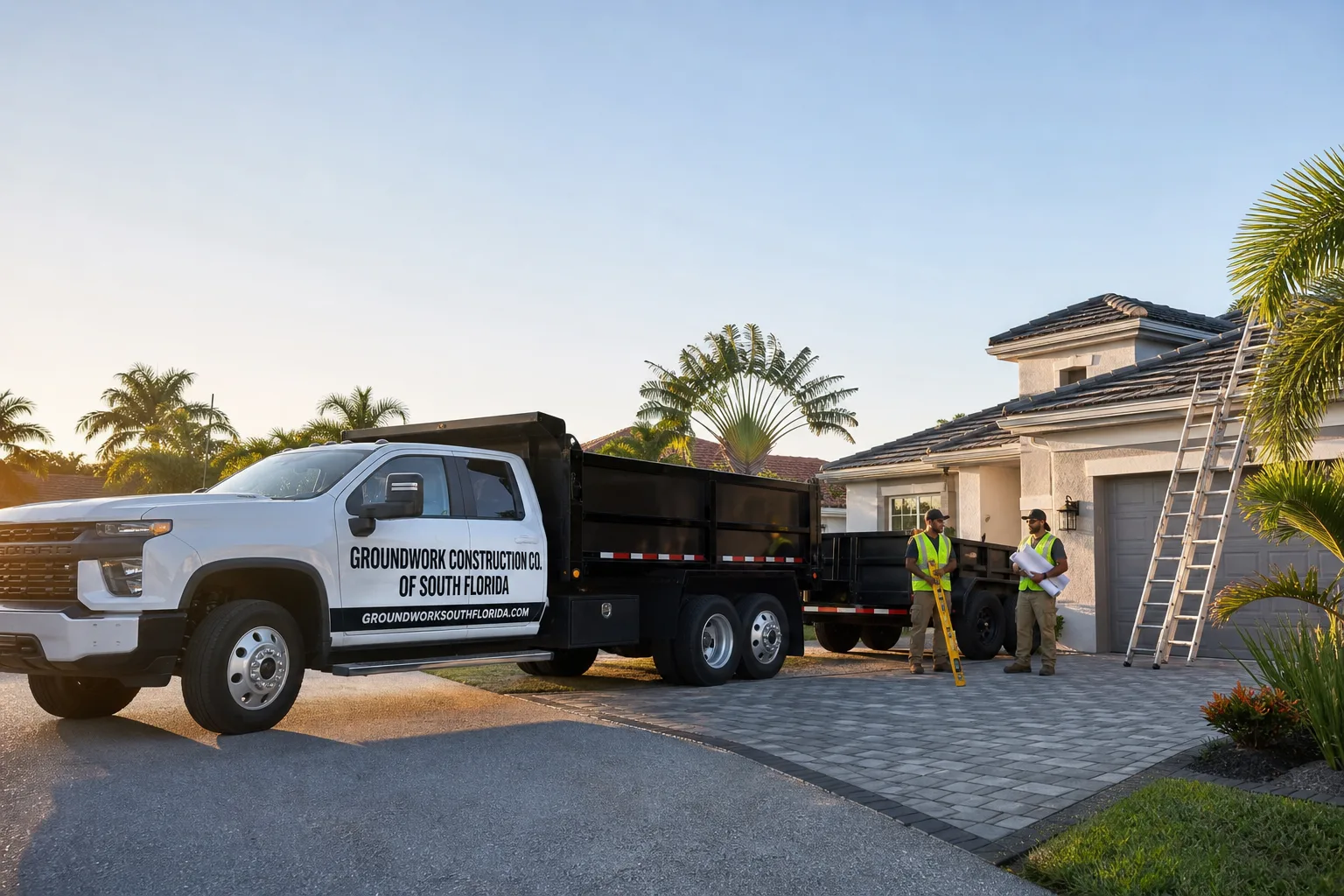
What Does Emergency & Storm Damage Recovery Cost and How Fast Can It Start in Miami Lakes?
Emergency & Storm Damage response in Miami Lakes typically runs $400-$1,800 for immediate stabilization and temporary weatherproofing, with full structural restoration ranging from $8,000-$20,000 depending on the scope. Most emergency calls in the 33014 area receive same-day tarping and board-up service, and we can usually begin permanent repairs within 48-72 hours once Miami-Dade NOA-compliant materials are sourced. Call (844) 665-0162 now for immediate dispatch - estimates are free, and we bill directly to most homeowners insurance policies.
How We Handle Emergency & Storm Damage from First Call to Final Inspection
Storm damage doesn’t wait for convenient timing, and neither do we. Here’s exactly what happens when you call us for Emergency & Storm Damage in Miami Lakes.
Stage 1: Emergency Response and Site Securing (Day 1, 2-4 hours)
We arrive with tarps, plywood, and temporary sealants to stop active water intrusion and prevent secondary damage. For Miami Lakes homes with original 1970s flat or low-slope roofs, we pay special attention to ponding areas where the membrane has torn - these collect water fast and collapse without warning. You’ll need to decide whether to file an insurance claim immediately or pay out-of-pocket for emergency measures; we document everything with photos either way.
Stage 2: Structural Assessment and Moisture Mapping (Day 1-2, 4-6 hours)
Once the building is dry enough to enter safely, we inspect roof decking, tie-beams, and interior finishes for hidden saturation. Miami Lakes’s CBS construction means water travels slowly through block walls, so surface dryness can deceive. We use thermal imaging to find trapped moisture in the concrete shell. At this stage, you decide whether to scope the project as repair-only or include full Roofing in Miami Lakes replacement if the roof is near end of life.
Stage 3: Mold Prevention and Controlled Demolition (Day 2-4, 1-3 days)
Saturated drywall, insulation, and compromised roof decking come out before mold establishes. Miami-Dade’s humidity means 48 hours is the practical limit. We contain the work zone with negative air pressure if needed. Your decision here: standard fiberglass replacement or upgrade to closed-cell spray foam, which performs better in our climate but adds cost.
Stage 4: Reconstruction with HVHZ-Compliant Materials (Day 5-14, varies by scope)
This is where Miami-Dade’s High-Velocity Hurricane Zone code matters. Every roofing product, window, and structural fastener must carry a Miami-Dade Notice of Acceptance. We don’t substitute - inspectors will fail the job. For tie-beam repairs common in aging Miami Lakes homes, we engineer supplemental connections to current wind-load standards. You choose material grades here: standard NOA-compliant asphalt shingles, or upgrade to impact-rated tile or metal.
Stage 5: Final Inspection and Documentation (Day of completion, 2-3 hours)
We coordinate Miami-Dade inspections, provide lien releases, and compile insurance documentation. If your damage was part of a broader event, we can also coordinate with our Roofing crew for full envelope restoration.
The Material and System Choices You’ll Face During Storm Recovery
Every Emergency & Storm Damage job in Miami Lakes involves decisions that affect cost, resilience, and future insurance premiums. These are the real trade-offs:
- Emergency tarping vs. temporary membrane: Basic blue tarps cost less but last 30-90 days in South Florida UV before degrading. Reinforced polyethylene membranes with batten strips run higher but survive six months and multiple storm events. Choose the membrane if material lead times stretch past 45 days.
- Standard roof decking vs. radiant-barrier upgrade: Replacing damaged decking with standard OSB meets code. Upgrading to radiant-barrier decking adds roughly 15% to decking labor and material but reduces attic temperatures 20-30 degrees - significant in Miami Lakes’s unvented flat-roof assemblies where summer attic heat cooks HVAC systems.
- Original tie-beam repair vs. engineered reinforcement: Many 1970s Miami Lakes homes have tie-beams with inadequate uplift connections by current standards. Repairing what’s there passes if undamaged. Adding hurricane straps and supplementary clips meets modern code and often qualifies for wind mitigation insurance discounts. The upgrade adds $800-$2,400 depending on roof perimeter linear footage.
- Interior restoration: like-for-like vs. moisture-resistant upgrade: Replacing standard drywall with moisture-resistant purple board or cement board in affected areas adds 30-50% to interior finish costs but prevents repeat loss in future water events. We recommend it for first-floor rooms in homes near the chain of lakes where water tables complicate drainage.
- Impact-rated window/door replacement vs. standard NOA product: If your storm damage included broken openings, this is your moment to upgrade to impact glazing. Standard NOA windows meet code. Impact-rated products from our lineup - Andersen, Pella, PGT - add 40-60% to opening costs but eliminate shutter installation in future storms and typically reduce insurance premiums.
What Emergency & Storm Damage Costs in Miami Lakes, FL
Here’s the honest range for Emergency & Storm Damage work we perform in the 33014 area:
| Scope | Price Range |
|---|---|
| Emergency tarping and temporary weatherproofing | $400-$1,800 |
| Roof decking repair (partial, under 200 sq ft) | $1,200-$3,500 |
| Tie-beam reinforcement and hardware upgrade | $800-$2,400 |
| Interior water damage restoration (drywall, insulation, paint, one room) | $2,500-$7,000 |
| Full roof replacement with HVHZ-compliant materials | $8,000-$20,000 |
| Complete envelope restoration (roof, windows, siding, structural) | $15,000-$45,000 |
Five factors push your job to the high or low end of these ranges:
- Roof pitch and access: Miami Lakes’s single-story homes with flat roofs are easier and cheaper to work on than two-story or steep-pitch structures. Low-slope membrane work requires specialized hot-air welding equipment that adds labor cost versus standard shingle installation.
- Extent of hidden moisture in CBS walls: Concrete block construction hides water migration. If thermal imaging reveals saturation through multiple courses of block, we must open, dry, and reseal - adding $1,500-$4,000 versus surface-only damage.
- Tie-beam condition and code path: Undamaged original tie-beams allow repair-only scope. Compromised or inadequately connected tie-beams trigger engineered reinforcement, adding cost but also insurance discounts.
- Material grade and NOA availability: Standard NOA asphalt shingles are stocked locally. Premium impact-rated tile or standing seam metal can require 2-4 week lead times and 50-100% material premiums.
- Permit scope and inspection scheduling: Miami-Dade’s HVHZ permitting is thorough and non-negotiable. Roof-only permits move faster. Projects involving structural, electrical, or window changes trigger additional inspections and longer timelines.
Your written estimate includes all labor, materials, permits, and debris removal. It does not include temporary relocation costs, tree removal (unless the tree damaged the structure), or upgraded finishes beyond like-for-like restoration.
Why Miami Lakes Homes Create Specific Challenges for Storm Recovery
Miami Lakes isn’t a generic South Florida suburb, and storm damage here doesn’t behave like it does in Hialeah or Country Club. The Graham Companies master-planned this community in the late 1960s through early 1980s, which means the housing stock is remarkably uniform - and uniformly aging.
We work on CBS homes in neighborhoods like Royal Oaks and Lake Suzanne that share the same construction DNA: flat or low-slope roofs, original tie-beam construction, and post-tensioned slabs in some commercial and multi-family buildings from that era. When Hurricane Irma tracked across South Florida in 2017, we saw the predictable failure pattern: original roof membranes past service life peeled at seams, water entered through compromised flashing at parapet walls, and the unvented attic spaces turned into steam chambers that destroyed drywall from the inside out.
The water table sits 1-2 feet below grade across much of Miami Lakes because of those interconnected man-made lakes. After a storm, water has nowhere to drain. Slab-on-grade homes can’t simply dry from below. This extends drying time, increases dehumidification equipment rental, and sometimes requires us to cut interior slab trenches for drainage correction - work that would be unnecessary in drier inland Miami-Dade sites.
Then there’s the code reality. Miami-Dade’s High-Velocity Hurricane Zone requires NOA-approved products that some contractors from Broward County don’t routinely stock. We’ve been called to fix jobs where out-of-area crews used standard materials that failed inspection, forcing homeowners to pay twice. Our Roofing division maintains relationships with GAF, CertainTeed, Owens Corning, IKO, Atlas, Tamko, and Boral specifically to source NOA-compliant products without delay.
Homeowners in Miami Lakes often pair storm recovery with broader upgrades. If you’re replacing damaged openings anyway, many clients add Custom Windows & Doors in Miami Lakes to improve energy performance. Others use the disruption to install Wood Fence in Miami Lakes with proper wind-load footings that survived the last storm better than their old installation.
Serving Miami Lakes, FL - Our Local Coverage Area
We’re based in the Miami Lakes area and know this community well. Use the map below to see our service coverage - if you’re nearby, we can almost certainly help.
Frequently Asked - Emergency & Storm Damage in Miami Lakes
Most Emergency & Storm Damage projects in Miami Lakes take 5-14 days from emergency response to final inspection, assuming standard roof and interior scope without structural complications. Jobs requiring engineered tie-beam reinforcement or specialty material orders can extend to 3-4 weeks. Call (844) 665-0162 and we’ll give you a timeline specific to your damage - estimates are free.
Yes, virtually all Emergency & Storm Damage restoration in Miami Lakes requires Miami-Dade building permits because the work triggers HVHZ compliance review. Roof repairs over one square (100 sq ft), any structural repair, and all window replacements need permitting. We handle the application, plans, and inspection scheduling as part of our service.
Most Emergency & Storm Damage work in Miami Lakes allows you to stay home, except during active roof replacement when noise and debris make it unpleasant, or if extensive interior demolition is needed for drying. We contain work zones with plastic barriers and negative air machines to minimize disruption. You’ll need to relocate only if multiple rooms require gutting simultaneously.
For Miami Lakes homes with roofs under 15 years old, spot repair is usually more economical. But given the concentrated 1970s-1980s building stock here, many roofs we encounter are at or past design life - in those cases, insurance often covers full replacement after storm damage, and the per-year cost of replacement beats repeated repairs. We document everything for your adjuster and give you both numbers.
Our workmanship warranty covers installation labor, while material warranties come directly from manufacturers - GAF, CertainTeed, Owens Corning, and others offer 10-year to lifetime limited warranties depending on the product tier you select. We register all warranties in your name and provide documentation at completion. Manufacturer warranties require proper installation; using an unlicensed contractor voids them, which is why we emphasize permitting and inspection on every job.
Get Your Miami Lakes Home Back to Pre-Storm Condition
Storm damage in Miami Lakes doesn’t fix itself, and waiting risks mold, structural decay, and denied insurance claims. Call Groundwork Construction Co. at (844) 665-0162 for a free on-site estimate. We’ll assess the damage, explain your options in plain language, and start emergency stabilization the same day if needed. Raymond Estevez and our team serve Miami Lakes with full-scope restoration capability - one contractor, every phase, from emergency tarp to final inspection.
Written by Raymond Estevez, Owner at Groundwork Construction Co., serving Miami Lakes since our South Florida founding.