
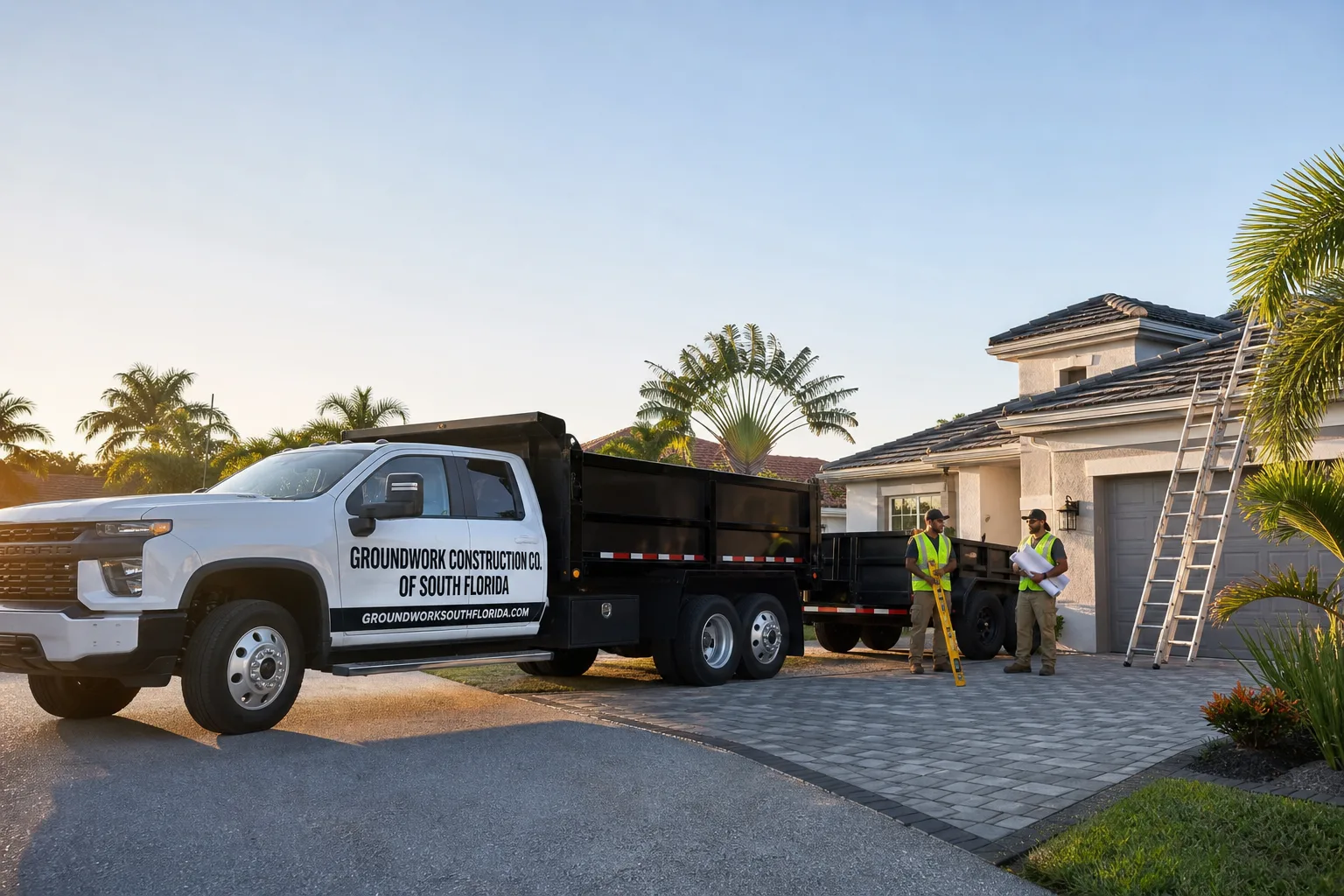
What Does Emergency & Storm Damage Repair Cost and Involve in Miami?
Emergency & storm damage repair in Miami typically runs from $400 for targeted fixes to $18,000 for full structural recovery after major hurricane impact, with most residential projects falling between $2,500 and $8,000. Most emergency calls receive same-day tarping and stabilization, with permanent repairs starting within 48 to 72 hours once Miami-Dade’s emergency permitting pathway clears. Call (844) 665-0162 for immediate response - estimates are free, and we coordinate directly with your insurance adjuster.
How We Handle Emergency & Storm Damage - Start to Finish
Storm damage in Miami isn’t a single event - it’s a sequence of decisions made under pressure, often while you’re still without power or dealing with water intrusion. Here’s how we structure the work so nothing gets missed.
Stage 1: Emergency stabilization (same day, 2-4 hours on site). Our crew arrives with temporary tarping, board-up materials, and moisture detection tools. We seal active leaks, document everything with photos for your insurance claim, and mark structural elements that need engineering review. You decide at this stage whether to proceed through insurance or self-pay - we work both ways, but the documentation we collect here serves either path.
Stage 2: Structural and moisture assessment (24-48 hours). Once the storm has passed and it’s safe to enter, we bring in moisture meters, thermal imaging, and if needed, a structural engineer to evaluate CBS wall integrity, rebar corrosion exposure, and roof deck saturation. In Miami’s 1940s-1970s housing stock - especially through Overtown and Flagami - we regularly find that wind-driven rain has penetrated far beyond the visible damage, traveling through block cavities and corroding rebar that appeared sound from the exterior. This stage determines whether you’re looking at surface repair or full assembly replacement.
Stage 3: Scope finalization and permitting (2-5 business days). We produce a line-item scope with material specs, submit for Miami-Dade emergency permitting if structural elements are involved, and coordinate with your insurance adjuster for agreed-price authorization. For roofing damage, every shingle, underlayment, and fastener must carry Miami-Dade NOA approval - we maintain a pre-approved material library so we don’t lose days to product sourcing. You approve the final scope and material selections here; we don’t start demolition until you sign off.
Stage 4: Demolition, drying, and reconstruction (duration varies: 3 days to 3 weeks). We remove damaged materials to dry substrate, run commercial dehumidification if moisture readings exceed 16% in wood or 4% in concrete block, then rebuild to code. For a typical single-story CBS home in Coral Gables with partial roof damage and interior ceiling collapse, this runs 5-8 working days. For homes in Miami‘s flood-prone zones where hydrostatic pressure has compromised the slab perimeter, we may need to extend waterproofing below grade - a condition that adds time but prevents the mold recurrence we see in homes that skipped this step.
Stage 5: Final inspection and closeout (1-2 days). Miami-Dade inspectors verify NOA compliance on all replaced materials, we conduct our own punch walk with you, and we deliver warranty documentation plus maintenance guidance for the specific products installed. If insurance is involved, we provide final invoicing in the format your carrier requires for depreciation release.
The Material and System Choices You’ll Face After Storm Damage
Every emergency & storm damage repair in Miami forces decisions under time pressure. These are the real trade-offs we walk homeowners through:
- Roofing underlayment: synthetic vs. felt. Synthetic underlayment (typically $0.75-$1.50 more per square foot installed) buys you a secondary water barrier that holds up if the primary covering fails in the next storm. Felt meets code but degrades faster in Miami’s UV and humidity. For homes with mature tree canopy or previous wind uplift, we push synthetic - the upgrade pays for itself if you get hit again before full roof replacement.
- Window replacement: impact-rated vs. standard with shutters. Impact-rated windows with Miami-Dade NOA approval (required in the High-Velocity Hurricane Zone) run 40-60% more than standard vinyl, but eliminate the shutter installation/removal cycle and qualify for insurance discounts. If your existing frames are structurally sound, we can sometimes retrofit impact glass into the original aluminum extrusions - a middle path that preserves interior trim and saves $200-$400 per opening.
- Interior finishes: restore-in-kind vs. upgrade opportunity. Insurance typically covers “like kind and quality” replacement, but many homeowners in Miami use storm damage as the moment to upgrade - better insulation, improved electrical, or layout changes. We price both paths so you can make an informed choice. Upgrades beyond insurance scope are self-pay, but our single-source structure means you’re not hiring a separate contractor for the enhancement work.
- Structural fasteners: standard vs. enhanced uplift resistance. Miami-Dade’s NOA system includes fastener ratings most homeowners never see. For homes in the 33129 corridor or other exposed locations, we may recommend upgrading to ring-shank nails or adhesive anchors with higher pull-out values - a marginal material cost ($150-$400 on a typical roof) that significantly improves performance in the next storm cycle.
What Emergency & Storm Damage Costs in Miami, FL
For emergency & storm damage repair in Miami, expect to invest between $2,500 and $8,000 for most residential projects, with smaller targeted repairs starting around $400 and full-structure recovery after major hurricane impact reaching $18,000 or more.
| Project Scope | Typical Range |
|---|---|
| Emergency tarping and temporary stabilization | $400-$1,200 |
| Targeted roof repair (partial shingle/underlayment) | $800-$3,500 |
| Window/door board-up and replacement (per opening) | $1,200-$4,500 |
| Interior ceiling/wall repair with moisture remediation | $2,000-$7,500 |
| Structural repair with engineered solutions | $5,000-$18,000 |
Five variables push your number up or down:
1. Extent of hidden moisture damage. Miami’s salt-air humidity means water travels farther through CBS cavities than in frame construction. A roof leak that looks localized often reveals saturated block and corroded rebar three rooms away. We find this on roughly one in three jobs in the 33126-33128 ZIPs.
2. Miami-Dade NOA compliance requirements. Products approved elsewhere in Florida may be unusable here. If your insurance estimate specifies materials that lack Miami-Dade approval, we source equivalents and document the substitution - but this can add 10-20% to material costs for specialty items.
3. Access and logistics. In Brickell and downtown Miami, crane and concrete-pump scheduling conflicts with high-rise construction can delay work and add equipment costs. Even in residential neighborhoods, alley access for debris removal in dense areas like Little Havana requires smaller trucks and more trips.
4. Structural involvement. If the storm compromised roof-to-wall connections, beam supports, or the slab perimeter, we bring in structural engineering - necessary and code-required, but it adds $1,500-$4,000 to the project.
5. Insurance coordination complexity. We handle this as part of our service, but jobs requiring multiple adjuster visits, supplemental claims, or depreciation disputes extend our administrative time and can delay start dates by one to two weeks.
A written estimate from Groundwork includes all labor, materials with specified brands and NOA numbers, permitting, debris haul-off, and our workmanship warranty. It does not include temporary relocation costs, tree removal (unless specified), or upgrades beyond insurance-approved scope.
Why Miami’s Building Environment Changes Everything
Emergency & storm damage repair in Miami operates under conditions that don’t exist forty minutes north in Fort Lauderdale or Palm Beach. The most consequential: Miami-Dade County’s Notice of Acceptance (NOA) system, a product approval regime entirely separate from Florida’s statewide building code. Every window, door, roofing assembly, and structural fastener must survive Miami-Dade’s own hurricane-simulation testing before legal installation. We’ve seen contractors from Broward County - just across the county line - install perfectly good materials that fail inspection here because they carry state approval but not Miami-Dade NOA. The permit gets red-tagged, the job stops, and the homeowner pays for re-demo and re-installation.
The housing stock amplifies this. Central Miami’s CBS homes from the 1940s-1970s, dense through Overtown, Flagami, and Allapattah, present a specific failure pattern: wind-driven rain penetrates aging flat roofs, saturates the hollow block cores, and activates rebar corrosion that’s been latent for decades. By the time you see ceiling stains, the structural damage is often advanced. We always run electrical continuity tests on exposed rebar during storm damage assessment - it’s not required by code for every permit, but in Miami’s salt-air environment, it’s the difference between a repair that lasts and one that fails in the next storm cycle.
Then there’s the water table. Miami sits on porous limestone with groundwater as shallow as two feet in many blocks. During king tides and heavy rain events, hydrostatic pressure pushes up through the slab rather than arriving as surface flooding. Conventional below-grade waterproofing - the kind used successfully in Orlando or Tampa - often fails here because it’s designed to repel water from above, not resist pressure from below. When storm damage includes foundation or slab perimeter compromise, we specify hydrostatic-pressure-rated systems and frequently coordinate with dewatering contractors, an added layer most emergency repair operations skip.
Finally, the density factor. In the 33129 ZIP covering Brickell and downtown, our crews share road space and crane airspace with concurrent high-rise projects. Concrete pump scheduling, debris box placement, and even parking for our work vehicles require coordination through the city’s congested infrastructure. A job that takes three days in Coconut Grove can take five in the core - not because the work is harder, but because the logistics are.
Homeowners often pair storm damage recovery with Custom Windows & Doors in Miami to upgrade to impact-rated systems, or with Wood Fence in Miami to replace wind-damaged perimeter structures as part of a coordinated exterior restoration. For projects where the damage reveals broader roofing system failure, we coordinate with our Roofing crew to assess whether repair or full Roofing in Miami replacement is the more cost-effective path.
Serving Miami, FL - Our Local Coverage Area
We’re based in the Miami area and know this community well. Use the map below to see our service coverage - if you’re nearby, we can almost certainly help.
Frequently Asked - Emergency & Storm Damage in Miami
We typically arrive for emergency stabilization within 4 hours for calls in the 33126-33129 ZIPs, and we maintain pre-staged materials in Fort Lauderdale for rapid deployment into Miami-Dade. Permanent repairs begin within 48-72 hours once emergency permitting clears. Call (844) 665-0162 - we answer 24 hours during active storm periods.
Yes, virtually all structural repairs, roofing work, and window replacements require Miami-Dade permitting, and we handle submission and inspection scheduling as part of our service. Emergency permitting exists for post-storm situations - we use it to start stabilization immediately while the full permit processes. Never let an unpermitted repair proceed; it voids insurance coverage and creates sale complications later.
Often yes, if the damage is localized and the remaining roof system has adequate service life. We assess membrane condition, fastener integrity, and substrate moisture before recommending repair vs. replacement. In Miami’s flat-roof housing stock, we find that partial recovery works roughly 60% of the time for storm damage under 25% of total roof area. We’ll show you the numbers for both paths.
Most Miami homeowners with wind/hurricane coverage receive payment for direct physical damage minus deductible, but coverage for code-upgrade costs (like Miami-Dade NOA-compliant materials) varies by policy. We document everything for your adjuster, provide line-item scopes in insurance-required format, and advocate for supplemental payments when hidden damage expands the scope. Call (844) 665-0162 and we’ll review your policy language with you.
Our workmanship warranty covers installation labor for the specified term, and all materials carry their manufacturer warranties - GAF, CertainTeed, Owens Corning, and others each have their own coverage periods and conditions. We register warranties in your name and deliver documentation at closeout. The key distinction: manufacturer warranties cover product failure, our workmanship warranty covers installation defects. Both are necessary, and neither replaces the other.
Get a Free Estimate for Emergency & Storm Damage in Miami
Call (844) 665-0162 to schedule a free on-site assessment. We’ll document the damage, explain what Miami-Dade permitting and NOA compliance means for your specific situation, and deliver a written estimate with material specs and timeline. Raymond Estevez and our team at Groundwork Construction Co. serve Miami homeowners with the single-source accountability that storm recovery demands.
Written by Raymond Estevez, Owner at Groundwork Construction Co., serving Miami since our founding in South Florida.