
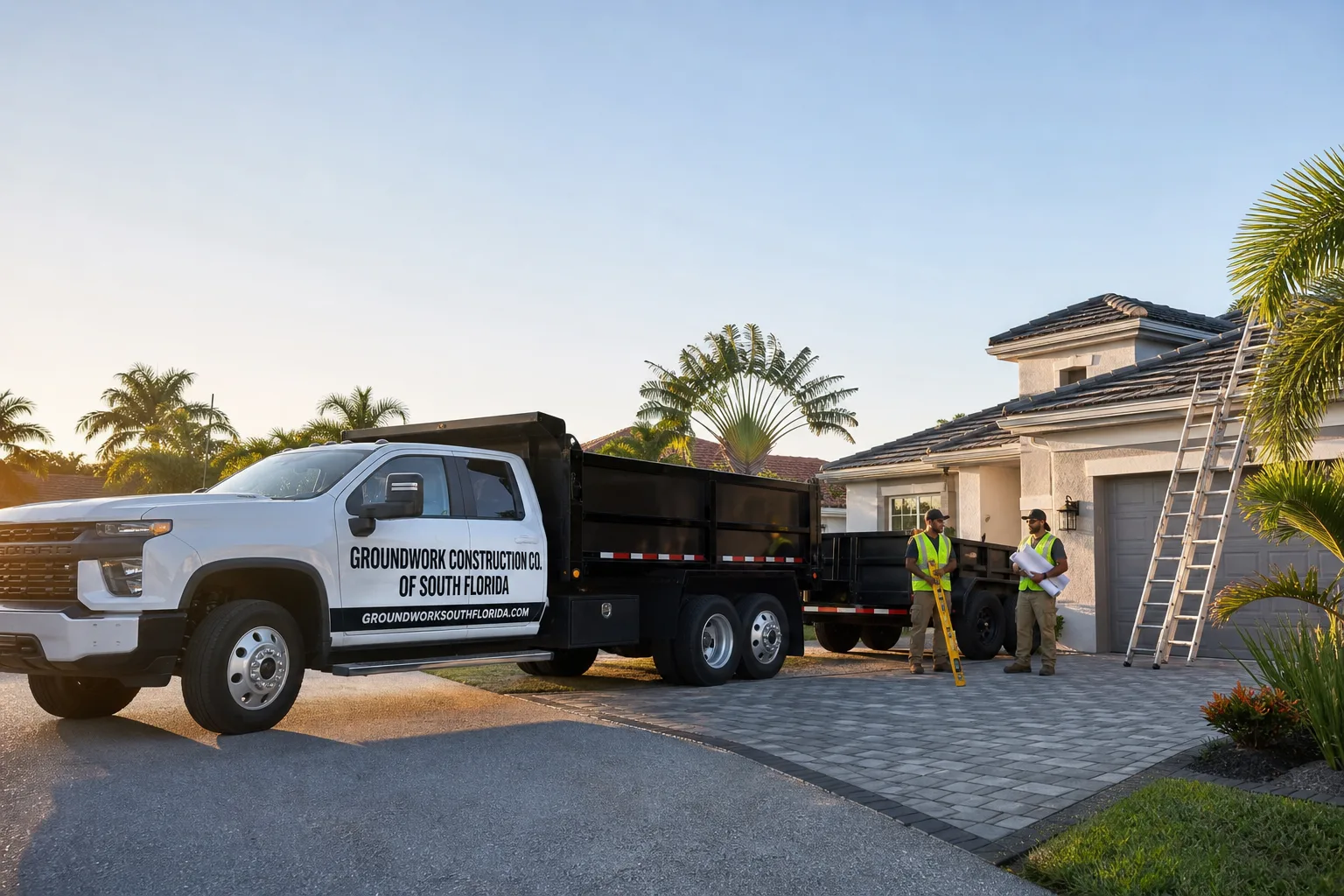
How much does Emergency & Storm Damage repair cost in Tamiami, FL?
Emergency & Storm Damage response in Tamiami typically runs from $400 for targeted tarping and minor structural stabilization up to $18,000 for full roof deck recovery and envelope restoration after a major event. Most homeowners we’re working with in the 33184 ZIP see initial emergency mitigation completed same-day, with full restoration phased over 2-6 weeks depending on Miami-Dade permitting and HVHZ material availability. Call (844) 665-0162 and we’ll have a crew on-site within hours to assess what’s urgent versus what can wait.
What happens after the storm - our Emergency & Storm Damage process
We’ve learned that the first 48 hours after a storm event in Tamiami determine everything about cost, timeline, and whether secondary damage takes hold. Here’s how we sequence it.
Stage 1: Emergency call-out and site secure (0-4 hours)
You call, we dispatch. Our first truck carries temporary roof tarps, structural bracing lumber, and debris-clearing equipment. We’re not doing permanent repairs yet - we’re stopping water intrusion, stabilizing anything that could collapse, and documenting conditions for your insurance adjuster. The homeowner decision at this stage: authorize emergency work and designate a point of contact for insurance coordination.
Stage 2: Damage assessment and moisture mapping (Day 1-2)
Once the structure is safe, we bring in moisture meters, thermal imaging, and structural inspection tools. In Tamiami’s 1970s-1990s CBS stock, we’re especially vigilant about water that has traveled inside block walls through compromised stucco - the damage often extends well beyond what’s visible from the exterior. We mark wet insulation, check for rebar corrosion initiation, and identify any compromised impact-rated openings that have lost their HVHZ certification. Homeowner decision: approve scope of invasive inspection if needed, and choose whether to file an insurance claim or proceed privately.
Stage 3: Temporary weatherproofing and drying (Day 2-7)
We install commercial-grade drying equipment, remove saturated drywall and insulation to prevent mold amplification, and apply secondary tarps or temporary membrane where the permanent roof system can’t be restored immediately. In Tamiami’s near-sea-level conditions with the shallow water table, slab-adjacent moisture can wick upward for days - we monitor and adjust. Homeowner decision: approve material selections for permanent restoration, understanding that HVHZ-compliant products often carry longer lead times than standard-grade alternatives.
Stage 4: Structural repair and envelope restoration (Week 2-4)
This is where permanent work begins: roof deck repair or replacement, window/door restoration or replacement with current HVHZ-rated products, stucco remediation with proper moisture barriers, and any interior reconstruction. For homes predating the 1994 code overhaul, we frequently must upgrade tie-down systems and opening protection to meet current Miami-Dade standards - not optional if the damage triggered structural exposure. Homeowner decision: confirm finish selections, approve any code-triggered upgrades, and schedule inspections.
Stage 5: Final inspection, documentation, and warranty transfer (Week 4-6)
We coordinate Miami-Dade building inspections, provide as-built documentation for insurance and resale, and transfer manufacturer warranties on all installed materials. For roofing components, this means registering warranties with GAF, CertainTeed, Owens Corning, or whichever manufacturer we specified. Homeowner decision: final walk-through sign-off and warranty registration confirmation.
Your Emergency & Storm Damage options - and the real trade-offs
- Temporary stabilization vs. permanent restoration first. Some homeowners want everything done at once; others need the structure secured while they negotiate with insurance or wait for funds. Temporary work costs less upfront but extends total project duration. We price both paths so you can decide with real numbers.
- Code-minimum repair vs. full HVHZ upgrade. If your 1980s Tamiami home suffered envelope damage, Miami-Dade often requires bringing exposed assemblies to current code. The upgrade adds 15-30% to affected areas but delivers impact-rated protection and reduced insurance premiums long-term. We map exactly where code triggers apply so you’re not guessing.
- Matching existing stucco texture vs. full exterior reskin. After water intrusion, damaged stucco must come off. Matching 40-year-old texture on one wall rarely blends; a full reskin looks cohesive but adds scope. We show you both approaches and the visual result you can expect from each.
- Standard shingle recovery vs. upgraded roofing system. If the roof took the hit, this is your moment to change systems. Standard architectural shingles restore function fastest. Metal, tile, or impact-rated composite systems cost more and may extend timeline by 1-2 weeks for specialty material delivery, but they survive the next Tamiami storm season better.
- Interior restoration scope. Water-damaged drywall and insulation must go - but do you restore exactly what was there, or use this as the entry point for a broader interior renovation? We coordinate with our kitchen and bathroom teams if you want to expand scope, or we contain work to storm-damaged areas only.
What Emergency & Storm Damage costs in Tamiami, FL
| Scope Level | Typical Range | What Drives It |
|---|---|---|
| Emergency tarping and stabilization | $400 - $1,800 | Roof area, accessibility, number of penetration points |
| Targeted structural repair (roof deck, wall section) | $2,500 - $8,000 | Extent of framing damage, need for engineered lumber |
| Envelope restoration with HVHZ upgrades | $8,000 - $18,000 | Full roof section, window/door count, stucco reskin area |
Five factors push your number within these ranges. First, the age of your home’s original construction - pre-1994 CBS homes in Tamiami almost always need code-triggered upgrades when the envelope is opened. Second, how long water ran before it was stopped - 6 hours of tropical downpour through a compromised roof deck versus 6 days of slow seepage produce radically different interior damage. Third, material grade selection - standard architectural shingles versus impact-rated or metal systems can double the roofing portion. Fourth, whether we hit that oolitic Miami limestone during any foundation or grade work - if storm damage extended to attached structures or requires regrading for drainage, the 12-18 inch dig to bedrock adds equipment and dewatering costs that inland contractors rarely anticipate. Fifth, permit scope and inspection scheduling - Miami-Dade’s HVHZ inspections are thorough and sometimes multi-visit, which we build into timeline but which can extend labor costs if rework is required.
A written estimate from Groundwork includes all emergency stabilization, demolition of damaged materials, structural repair, envelope restoration with specified products, interior reconstruction to match pre-loss condition, permit fees, and inspection coordination. What it typically does not include: your deductible or insurance shortfall, temporary relocation costs, landscaping restoration, or optional upgrades beyond code-minimum repair scope.
Why Tamiami homes need a specific approach to storm damage
Tamiami’s position at the western edge of developed Miami-Dade - literally where the grid meets the Everglades along US-41 - creates conditions we don’t see even 10 miles east in Tamiami‘s neighboring cities. The housing stock here is overwhelmingly CBS construction from the 1970s through 1990s westward expansion, built before the 1994 post-Hurricane Andrew code overhaul that rewrote Miami-Dade’s building standards. When we open walls or roofs on these homes for storm damage, we’re almost always looking at original tie-down hardware, pre-HVHZ windows and doors, and stucco systems without modern drainage planes.
The flat, near-sea-level terrain means stormwater has nowhere to drain after the intense June-October rain events that follow tropical systems. We’ve responded to calls on SW 137th Avenue and SW 152nd Street where water stood against slab perimeters for days, wicking through compromised stucco and accelerating the rebar corrosion that weakens block walls from within. That same salt-laden air from Biscayne Bay proximity, combined with standing water and intense UV, degrades exterior finishes faster than inland markets - so a storm damage repair that looks straightforward often reveals deeper envelope failure when we start peeling back layers.
Then there’s the ground itself. When storm damage extends to attached structures, carports, or requires any grade modification for drainage correction, our crews punch through thin topsoil into oolitic Miami limestone within 12-18 inches - hard enough to stall standard excavation, yet porous enough that groundwater flows freely through it. Dewatering pumps run continuously on these jobs, a reality that contractors from outside South Florida consistently underestimate when they bid Tamiami work remotely. We build it into our numbers from the start.
Permitting runs through Miami-Dade County’s HVHZ protocols, among the most stringent in the continental US. Any structural repair that exposes framing triggers inspection for current wind-load compliance, and window or door replacement requires product approval numbers from the Miami-Dade Notice of Acceptance database. We handle this documentation as part of our standard process - but homeowners should know that “matching what was there” isn’t always legally possible for pre-1994 homes.
For homeowners whose storm damage is part of a full exterior envelope project, we coordinate with our Roofing in Tamiami team and broader Roofing division to sequence work efficiently. Many clients also use this moment to address Custom Windows & Doors in Tamiami upgrades, or to add Wood Fence in Tamiami replacement where wind-driven debris damaged perimeter structures.
Serving Tamiami, FL - Our Local Coverage Area
We’re based in the Tamiami area and know this community well. Use the map below to see our service coverage - if you’re nearby, we can almost certainly help.
Frequently asked - Emergency & Storm Damage in Tamiami
Most projects run 2-6 weeks from initial call to final inspection, with emergency stabilization completed same-day. The timeline extends when Miami-Dade HVHZ inspections require rework, or when specialty impact-rated materials are backordered - common after regional storm events when demand spikes across South Florida. Call (844) 665-0162 and we’ll give you a realistic timeline based on current material availability and permit queue status.
Yes, virtually all structural and envelope repair in Miami-Dade requires permitting, and HVHZ-compliant homes trigger additional inspection layers. We pull permits as part of our standard scope and coordinate all inspections - you won’t need to visit the building department yourself. The permit process typically adds 3-5 business days to project start but protects you from unpermitted work that voids insurance coverage and complicates resale.
Often yes, if the damage is localized and the existing roof system has remaining service life. We target repair when the roof is under 15 years old and damage is confined to one or two sections. Full replacement becomes necessary when the roof is near end-of-life, when damage patterns indicate systemic failure, or when Miami-Dade code requires complete assembly upgrade for HVHZ compliance - common on pre-1994 Tamiami homes.
Emergency tarping and debris removal are tasks some homeowners handle safely. Structural repair, roof deck work, and any electrical or plumbing impact require licensed professionals - and your insurance policy likely mandates licensed contractor documentation for claim payment. We provide that documentation and warranty our work, which DIY repair cannot offer. For an exact comparison on your specific damage, call (844) 665-0162 - estimates are free.
Our workmanship warranty covers installation quality for the period specified in your written contract, while manufacturer warranties on roofing, windows, and doors transfer directly to you - GAF, CertainTeed, Owens Corning, and others each carry their own terms, typically 10 years to lifetime depending on product tier. We register all manufacturer warranties on your behalf and provide documentation for your records and resale disclosure.
Start your Emergency & Storm Damage recovery in Tamiami
Call (844) 665-0162 to schedule a free on-site assessment. We’ll arrive with emergency stabilization equipment, document conditions for your insurance claim, and walk you through scope and pricing before any work begins. For storm damage in Tamiami, speed matters - but so does getting the permanent solution right the first time.
Written by Raymond Estevez, Owner at Groundwork Construction Co., serving Tamiami and South Florida homeowners since our founding.