
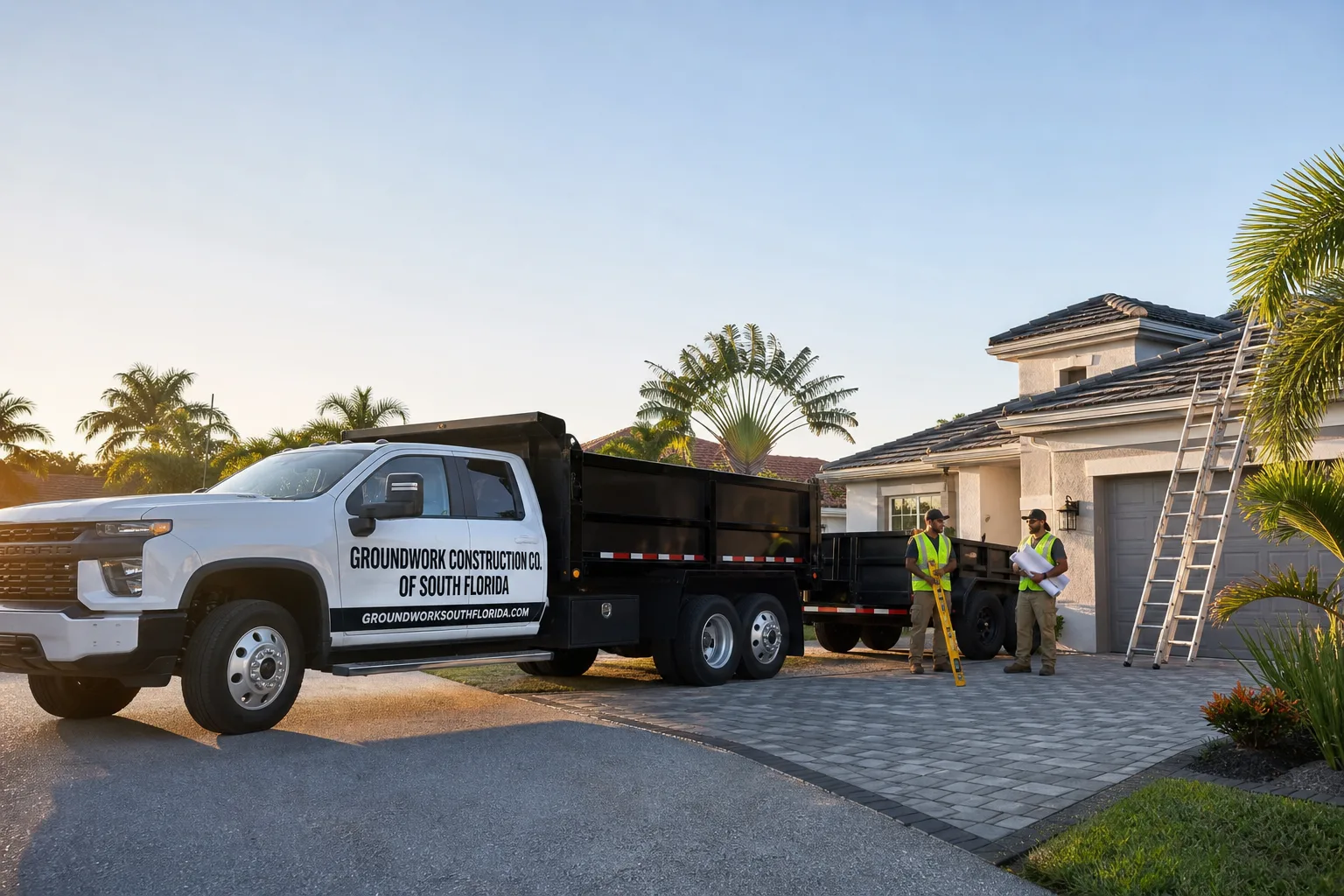
What Does Emergency & Storm Damage Repair Cost and Involve in West Little River?
Emergency & Storm Damage repair in West Little River typically runs $400-$1,800 for localized roof and exterior fixes, with full envelope restoration on aging CBS homes reaching $8,000-$20,000 depending on how far the water or wind got. Most emergency tarping and stabilization happens same day; permanent repairs usually take 3-7 business days once Miami-Dade County permits clear. Call (844) 665-0162 and we’ll dispatch a crew to assess what’s structural, what’s cosmetic, and what needs immediate weatherproofing.
How We Handle Emergency & Storm Damage From First Call to Final Inspection
Storm damage in West Little River doesn’t wait for convenient timing, and neither do we. Here’s how the work actually unfolds, stage by stage, so you know what to expect and when you’ll need to make decisions.
Stage 1: Emergency Response and Site Stabilization (Day 1, 2-4 hours)
Our crew arrives with temporary tarping, plywood, and moisture detection tools. We seal any active leaks, remove debris that could cause secondary damage, and document everything with photos for your insurance carrier. At this stage, you decide whether to file a claim or pay out of pocket; we’ll provide a preliminary scope either way before we leave the property.
Stage 2: Interior and Structural Assessment (Days 1-2, 3-5 hours)
We inspect ceiling cavities, wall insulation, and the roof deck from inside the attic space. Many 33147 homes have original terrazzo floors that can wick moisture from slab edges, so we check for hidden pooling. You decide here whether to open up drywall for drying or remove and replace it entirely; partial drying often saves money but risks mold if humidity lingers.
Stage 3: Scope Finalization and Permitting (Days 2-5, homeowner downtime)
We finalize material selections and submit to Miami-Dade County’s EPERMITS system. Because West Little River is unincorporated, there’s no city building department to shortcut through; every repair beyond cosmetic touch-up needs county approval. We handle the NOA documentation for all products, but you may need to provide HOA approval letters if your neighborhood requires them.
Stage 4: Demolition and Repair (Days 5-10, varies with weather)
Standing water from summer thunderstorms can delay exterior work, so we sequence interior drying first if the slab perimeter is saturated. Roof deck replacement, fascia repair, and window/door sealing happen once conditions allow. You make one key decision here: whether to match original materials exactly or upgrade to HVHZ-compliant alternatives that add resilience but extend the timeline by 2-3 days.
Stage 5: Final Inspection and Closeout (Days 10-12, 2-3 hours)
Miami-Dade County inspects for code compliance, wind-load attachment, and proper flashing integration. We address any punch items immediately and provide you with permit closure documentation and material warranty registrations. This is when you confirm satisfaction; we don’t consider the job finished until the county signs off.
The Repair Choices You’ll Actually Face After Storm Damage
Every Emergency & Storm Damage job in West Little River presents forks in the road. These aren’t upsells; they’re real options with different cost, durability, and timeline implications.
- Temporary tarping vs. immediate permanent repair: Tarping buys time and costs less upfront, but Florida’s UV and humidity degrade tarps in 30-60 days. If county permitting delays stretch past three weeks, you’ll pay twice for access labor. We recommend tarping only when material lead times or insurance adjuster schedules make it unavoidable.
- Roof deck patching vs. full deck replacement: Localized plywood repair runs $400-$800; full deck replacement on a 1,200 sq ft home hits $2,500-$4,500. The deciding factor is moisture saturation percentage. We test with moisture meters; anything above 19% in the deck substrate means replacement, or you’ll face rot and mold within two seasons.
- Standard shingles vs. HVHZ-rated alternatives: Standard architectural shingles meet code but offer minimal uplift resistance. Upgrading to GAF Timberline HDZ or CertainTeed Landmark PRO with proper fastening patterns adds $1,200-$2,800 to a typical West Little River roof but satisfies Miami-Dade’s HVHZ requirements and often reduces insurance premiums. For homes near the Miami Canal corridor with persistent moisture, the better seal warranty matters.
- Drywall repair vs. full replacement with moisture-resistant board: Repair and texture matching costs less initially, but standard drywall in humid cavities fails again. We often recommend upgrading to moisture-resistant board as part of a full roofing and envelope restoration, especially in homes with original Federal Pacific panels where electrical access requires wall opening anyway.
- Original window restoration vs. impact-rated replacement: Jalousie and single-pane windows are common in 33147’s 1950s-1970s stock. Restoration preserves character but leaves you vulnerable. Impact-rated vinyl or aluminum options from PGT or CGI add $450-$850 per opening but satisfy HVHZ and often qualify for wind mitigation credits. Many homeowners pair this with Custom Windows & Doors in West Little River to consolidate contractor visits.
What Emergency & Storm Damage Costs in West Little River, FL
| Scope | Typical Range |
|---|---|
| Emergency tarping and stabilization | $250-$600 |
| Localized roof repair (deck + shingles) | $400-$1,800 |
| Full roof replacement (HVHZ-compliant) | $8,000-$20,000 |
| Interior drywall and insulation restoration | $1,200-$4,500 |
| Window/door impact upgrade (per opening) | $450-$850 |
| Full exterior envelope restoration | $12,000-$28,000 |
Five factors push your number up or down. Roof pitch and access matter: flat or low-slope roofs common in West Little River are easier to work on but trap water, often requiring more extensive decking replacement. Electrical panel age is a hidden variable; if we open walls and find Federal Pacific or fuse-box era equipment, code requires updating before we can close up, adding $800-$2,400. Material grade moves the needle significantly, as HVHZ-rated products carry a 15-25% premium over standard equivalents. Permit scope affects timeline cost; simple repairs clear in 2-3 days, but anything involving structural assessment or electrical tie-in triggers full plan review. Moisture intrusion extent is the biggest unknown; surface damage is straightforward, but slab-edge wicking in near-sea-level 33147 can require French drain or grade work that isn’t visible until demolition begins.
Our written estimates include labor, materials, permit fees, and waste hauling. They don’t include tree removal (we’ll refer a certified arborist), temporary relocation expenses, or optional upgrades you select after work begins. Call (844) 665-0162 for an exact quote; estimates are free and include moisture mapping so surprises stay minimal.
Why West Little River Homes Make This Job Different
West Little River’s unincorporated status isn’t just an administrative detail; it reshapes every Emergency & Storm Damage repair we do here. With no city building department to appeal to, every permit routes through Miami-Dade County’s EPERMITS system, and every product must carry a current Notice of Acceptance (NOA) proving it meets High-Velocity Hurricane Zone standards. Contractors accustomed to working in incorporated municipalities like Fort Lauderdale or Hialeah often stumble on this. We’ve seen jobs delayed two weeks because a roofer specified standard fasteners that lacked Miami-Dade NOA documentation; the county inspector rejected them outright.
The housing stock amplifies the challenge. Most 33147 homes are small, single-story CBS ranch structures from the 1950s-1970s, built before Hurricane Andrew forced the 1992 code overhaul. Original flat or built-up roofs weren’t designed for today’s wind loads, and the concrete block construction, while durable, offers no forgiveness when flashing fails; water travels fast through block cavities. We regularly find that storm damage visible on the ceiling started at the fascia three courses up, then ran inside the wall.
Then there’s the site condition. Near-sea-level elevation and the Miami Canal corridor mean summer thunderstorms leave standing water that delays exterior work and compromises ground-level framing if we don’t sequence properly. Salt-laden humidity and intense UV degrade stucco and fascia faster than inland markets, so repairs that might last fifteen years elsewhere need attention in eight to ten here. When we restore a Wood Fence in West Little River as part of broader storm recovery, we specify pressure-treated southern yellow pine or cedar with marine-grade fasteners, not standard hardware-store stock.
The payoff for navigating this correctly is significant. Homes that get proper HVHZ retrofitting, including roof-to-wall hurricane straps and impact-rated glazing, often qualify for substantial wind mitigation insurance credits that offset the upgrade cost within three to five years.
Serving West Little River, FL - Our Local Coverage Area
We’re based in the West Little River area and know this community well. Use the map below to see our service coverage - if you’re nearby, we can almost certainly help.
Frequently Asked - Emergency & Storm Damage in West Little River
Most jobs finish in 3-7 business days after permitting, though full envelope restoration on aging CBS homes can stretch to two weeks if moisture intrusion is extensive. Emergency tarping happens same day. Call (844) 665-0162 and we’ll give you a timeline based on your specific damage.
Yes, for anything beyond cosmetic touch-up. Because West Little River is unincorporated Miami-Dade, all permits run through the county’s EPERMITS system, and inspectors verify HVHZ compliance and product NOA documentation. We handle submission and scheduling; you don’t need to visit the county office.
Sometimes, but often no. If damage requires opening walls near original Federal Pacific or fuse-box era panels, Miami-Dade code requires updating to modern equipment before we can close up and pass inspection. We identify this during assessment so you’re not surprised mid-project.
Repair is cheaper now, but deferred damage in West Little River’s climate usually costs more later. Moisture trapped in CBS wall cavities or under compromised decking breeds mold and structural decay; we’ve seen $1,200 repairs become $8,000 restorations after two humid seasons. If your roof is past fifteen years, bundling repair into replacement often makes financial sense.
Our workmanship warranty covers installation quality, while material warranties come directly from manufacturers like GAF, CertainTeed, or Owens Corning and range from 25 years to lifetime depending on the product tier you select. We register all warranties in your name and provide documentation at closeout. Call (844) 665-0162 to discuss which material grade fits your situation.
Get Your West Little River Property Assessed This Week
Storm damage doesn’t improve with waiting, and in West Little River’s humidity, secondary issues develop fast. Call (844) 665-0162 to schedule a free on-site estimate. We’ll assess what’s urgent, what’s structural, and what can wait, then provide a written scope with real numbers and a permit-ready timeline. Our roofing crew coordinates directly with our interior and exterior teams, so one contractor handles every phase from tarp to final inspection.
Written by Raymond Estevez, Owner at Groundwork Construction Co., serving West Little River and South Florida.