
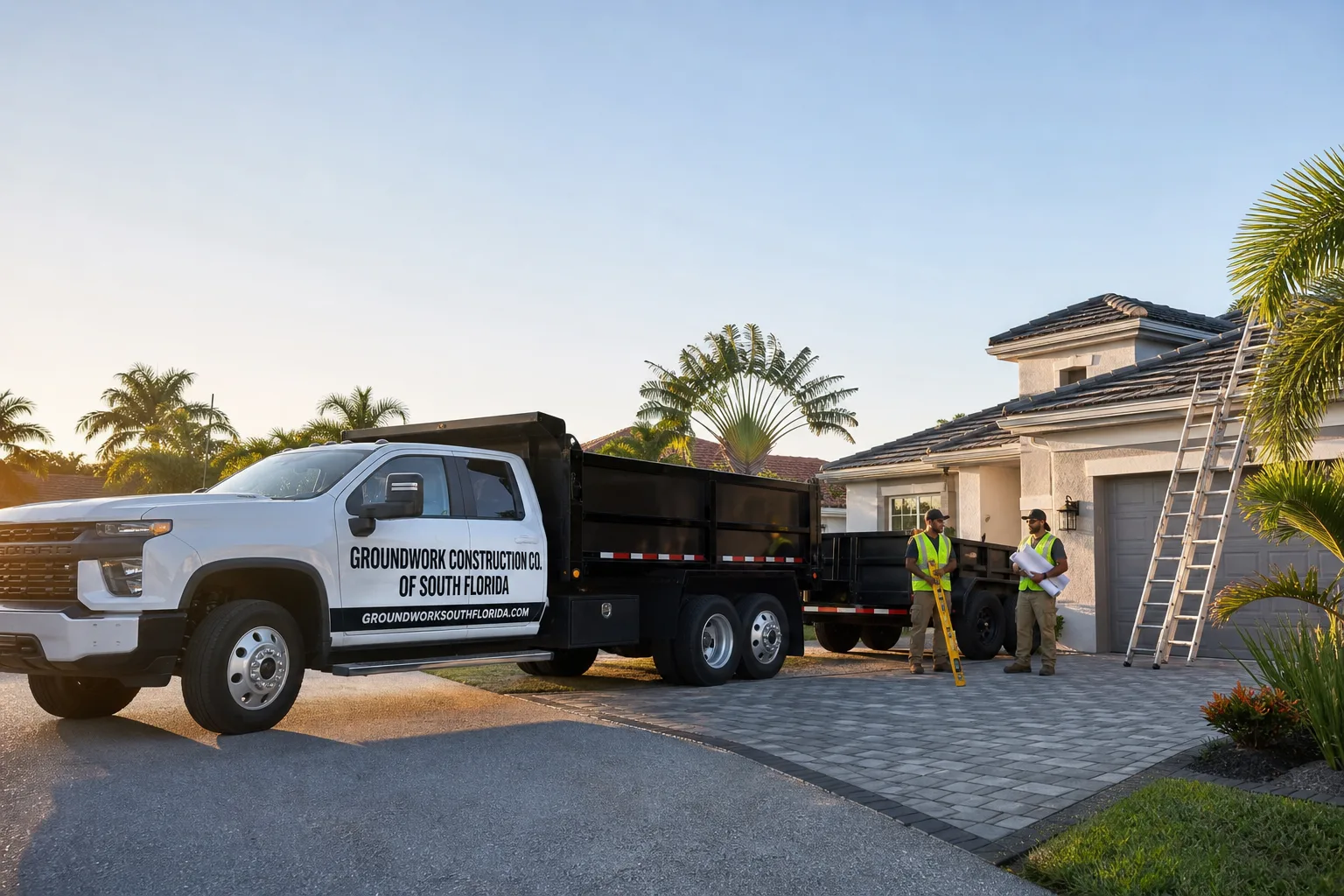
Metal Roofing in Miami Springs: Cost, Timeline, and What to Expect
Metal roofing in Miami Springs typically runs $15,000-$40,000 for a full installation, with most residential jobs wrapping in 5-10 business days once materials arrive. You’ll choose between standing seam, screw-down panel, and stone-coated steel systems, each with different wind ratings, noise profiles, and lifespans suited to South Florida’s conditions. Call (844) 665-0162 for a free on-site estimate and written breakdown.
How We Handle a Metal Roof Installation Start to Finish
We break every metal roofing job into five clear stages so you know what’s happening and when you need to make decisions.
Stage 1: Site assessment and substrate evaluation (1-2 hours, day 1)
We walk the roof with you and check what’s underneath. In Miami Springs, that often means 1920s-1950s concrete block homes with original clay barrel-tile roofs sitting on skip sheathing or 1x planking rather than modern plywood decking. We note soft spots, the condition of fascia and rake boards, and whether your existing structure can handle the transition to metal’s different load and fastening pattern. You decide here whether we’re removing the old roof entirely or installing over one layer per Florida Building Code allowances. Full tear-off adds $2,000-$5,000 but lets us inspect and replace compromised decking.
Stage 2: Material selection and order (your decision point, 1-2 weeks lead time)
This is where you pick your system, gauge, finish, and color. We order only after you sign off. Standing seam in 24-gauge with a Kynar 500 finish costs more upfront but carries a 40-year paint warranty and handles Miami-Dade’s 175-mph wind-speed requirements without exposed fasteners. Screw-down panels in 26-gauge save roughly 30% but need fastener maintenance every 7-10 years in salt air. Stone-coated steel splits the difference, mimicking tile or shake visually while weighing less than the original clay. You’ll see physical samples, not catalog photos, because color shifts under Florida’s UV.
Stage 3: Tear-off and deck prep (1-2 days)
Crews strip old roofing, haul to a roll-off, and expose the deck. We replace water-damaged or termite-weakened sheathing, add solid blocking where open sheathing existed, and install synthetic underlayment rated for high-temperature applications. In Miami Springs, we also verify hurricane straps and truss connections at this stage. Older homes often have minimal strapping by current standards; we note upgrades but don’t upsell them unless structural review reveals gaps.
Stage 4: Metal panel installation and flashing (2-4 days)
Panels run from eave to ridge, seamed or screwed per your system choice. We custom-fabricate valley, ridge, and sidewall flashing on-site for your roof’s exact planes and penetrations. Every chimney, vent, and HVAC curb gets a welded or double-locked boot. Miami Springs’ flat terrain and proximity to Biscayne Bay mean salt spray hits these details hard; we use stainless or coated fasteners even on inland-facing slopes.
Stage 5: Final inspection and walkthrough (half day)
Miami-Dade County inspects for code compliance, wind uplift attachment, and proper flashing at penetrations. We meet the inspector with you or represent you if you prefer. After pass, we walk the finished roof together, review maintenance intervals, and hand over manufacturer warranty docs and our workmanship guarantee.
The Metal Roofing Options You’ll Actually Choose Between
- Standing seam (concealed fastener): The premium choice for Miami Springs. Panels lock together with hidden clips, so no screw holes penetrate the metal surface. Costs 40-60% more than screw-down but needs zero fastener maintenance and carries the longest paint warranties. Best for homeowners planning to stay 15+ years or who want the cleanest modern look on a Mediterranean Revival update.
- Screw-down panel (exposed fastener): Common on agricultural and commercial buildings, adapted for residential budget jobs. The screws have rubber washers that degrade in 7-10 years of South Florida UV and thermal cycling. Budget-friendly upfront, but factor in re-screwing costs. We mention this honestly because some homeowners in Miami Springs use it for detached garages or carports where longevity matters less.
- Stone-coated steel: Pressed steel panels with ceramic-coated stone granules. Weighs roughly 1.5 pounds per square foot versus 8-10 pounds for traditional clay tile, making it viable on older Miami Springs homes with structure originally built for lighter materials. Mimics barrel tile or wood shake visually. Mid-range price, 50-year material warranties common.
- Substrate and underlayment grade: High-temp synthetic underlayment ($1.50-$2.50/sq ft) versus standard felt. In Miami Springs’ attic temperatures, the upgrade pays for itself in leak prevention. Self-adhered ice-and-water shield at valleys and eaves is code-required and non-negotiable.
- Finish class: Kynar 500/Hylar 5000 PVDF resists chalking and fading; silicone-modified polyester (SMP) costs 15-20% less but shows color shift in 10-15 years. For a home visible from Curtiss Parkway or the Circle, finish quality affects curb appeal directly.
What Metal Roofing Costs in Miami Springs, FL
| Cost Component | Typical Range |
|---|---|
| Metal roof installation (full) | $15,000-$40,000 |
| Standing seam system | $22,000-$40,000 |
| Screw-down panel system | $15,000-$25,000 |
| Stone-coated steel | $18,000-$32,000 |
| Full tear-off and disposal | $2,000-$5,000 |
| Deck repair/replacement | $1,500-$4,000 |
| Hurricane strap upgrade (if needed) | $800-$2,500 |
Five variables push your number within these ranges. First, roof size and complexity: a simple gable on a 1,200-square-foot 1940s cottage near the Miami Springs Golf & Country Club runs lower than a multi-plane Mediterranean with turrets and valleys. Second, existing condition: homes with original skip sheathing need full plywood overlay, adding material and labor. Third, material gauge and finish: 24-gauge Kynar standing seam versus 26-gauge SMP screw-down is a $7,000-$12,000 spread on typical homes. Fourth, access and height: single-story ranch homes on standard lots are straightforward; two-story Spanish Colonials with pool enclosures and mature oak canopies slow material staging. Fifth, permit scope: most metal re-roofs need standard Miami-Dade roofing permits, but if you’re part of a full Roofing in Miami Springs project with structural modifications or vertical additions, FAA airspace coordination may apply.
A written estimate from us includes material, labor, tear-off, disposal, underlayment, standard flashing, and permit fees. It does not include tree trimming for access, gutter replacement, or structural engineering if inspection reveals truss damage. We flag these possibilities during assessment so you’re not surprised.
Why Miami Springs Homes Make Metal Roofing a Different Conversation
Metal roofing in Miami Springs isn’t just about picking a panel and color. The city’s physical and regulatory environment shapes every decision.
Start with the noise. Homes beneath MIA’s flight paths, particularly north of Curtiss Parkway where 747s and cargo jets run low on final approach, already deal with significant acoustic load. Metal roofing doesn’t have to amplify it. We specify insulated underlayment systems and solid sheathing rather than direct-to-purlin installation that turns the roof plane into a drum. Homeowners on DeLeon Drive and Esplanade Street notice the difference immediately.
The housing stock matters too. Those 1920s-1950s Mediterranean Revival and Spanish Colonial homes with original clay barrel-tile roofs? Their roof structures were engineered for 8-10 pounds per square foot of tile. Standing seam metal runs 1-2 pounds; stone-coated steel hits 1.5. That weight reduction is an advantage, but the original skip sheathing or 1x planking wasn’t designed for metal’s concentrated fastener loads. We often install plywood overlay, not just for modern code but so the fastening pattern holds through Category 4 wind events.
Salt corrosion is real here. Miami Springs sits at roughly 9 feet elevation with Biscayne Bay’s salt-laden air moving freely across flat terrain. We’ve replaced prematurely failed metal roofs where previous contractors used standard galvanized fasteners or aluminum flashing in valley applications. We specify stainless or coated fasteners and break-formed valley pans, not cut-and-fold shortcuts.
Then there’s the regulatory layer most South Florida contractors never touch. Because Miami Springs sits inside Miami International Airport’s Part 77 airspace surface, any project that adds significant vertical height, including some raised roof profiles or cupola additions, requires FAA Form 7460-1 filing. Our Roofing crew coordinates this when needed; most re-roofs at existing height don’t trigger it, but we verify before permitting rather than discover it mid-process.
Finally, the aesthetic context. Miami Springs has active historic preservation sensibilities rooted in Glenn Curtiss’s original 1920s plan. Stone-coated steel in a barrel-tile profile lets homeowners on Hunting Lodge Circle or Quail Avenue keep the Mediterranean visual character while gaining modern wind and fire ratings. Standing seam reads more contemporary, which suits the mid-century ranch infill on the outer streets. We help you match the material to the home’s era and the neighborhood’s expectations.
Homeowners in Miami Springs often pair exterior envelope work with Window Replacement in Miami Springs or Impact Windows & Doors in Miami Springs to complete their hurricane hardening in one coordinated project.
Serving Miami Springs, FL - Our Local Coverage Area
We’re based in the Miami Springs area and know this community well. Use the map below to see our service coverage - if you’re nearby, we can almost certainly help.
Frequently Asked - Metal Roofing in Miami Springs
Most residential metal roofing jobs in Miami Springs take 5-10 business days from tear-off to final inspection, plus 1-2 weeks material lead time. Complex rooflines, custom fabrication, or FAA coordination for height changes can extend this. Call (844) 665-0162 and we’ll give you a timeline specific to your home’s footprint.
Yes, Miami-Dade County requires a roofing permit for all metal roof installations, with inspections for deck condition, underlayment, fastening pattern, and flashing. If your project adds height that penetrates MIA’s Part 77 airspace surface, FAA Form 7460-1 is also required. We handle both filings as part of our standard process.
Florida Building Code allows one roof covering over existing, but we rarely recommend it for Miami Springs’ older clay tile. The weight stack stresses structure, and we can’t inspect or repair compromised sheathing underneath. Full tear-off adds $2,000-$5,000 but protects your investment and satisfies most manufacturer warranty requirements.
Properly installed metal roofing with solid sheathing and quality underlayment is not noticeably louder than tile. In Miami Springs’ airport flight paths, we specify additional insulation layers that actually reduce interior noise compared to uninsulated older tile. The key is installation method, not the material itself.
Material warranties range from 20 years (basic screw-down finishes) to 40+ years (Kynar 500 standing seam). Stone-coated steel often carries 50-year limited warranties. Our workmanship guarantee covers installation labor and flashing integrity. Manufacturer and labor warranties are separate; we explain both before you sign. Call (844) 665-0162 for warranty details on the specific system you’re considering.
Get Your Miami Springs Metal Roofing Estimate
We’ll walk your roof, assess your structure, and deliver a written estimate with material options from our roofing portfolio, including GAF, CertainTeed, Owens Corning, and specialized metal manufacturers. No pressure, no generic quote. Call (844) 665-0162 or request your free on-site estimate for metal roofing in Miami Springs.
Written by Raymond Estevez, Owner at Groundwork Construction Co., serving Miami Springs since our South Florida launch.