
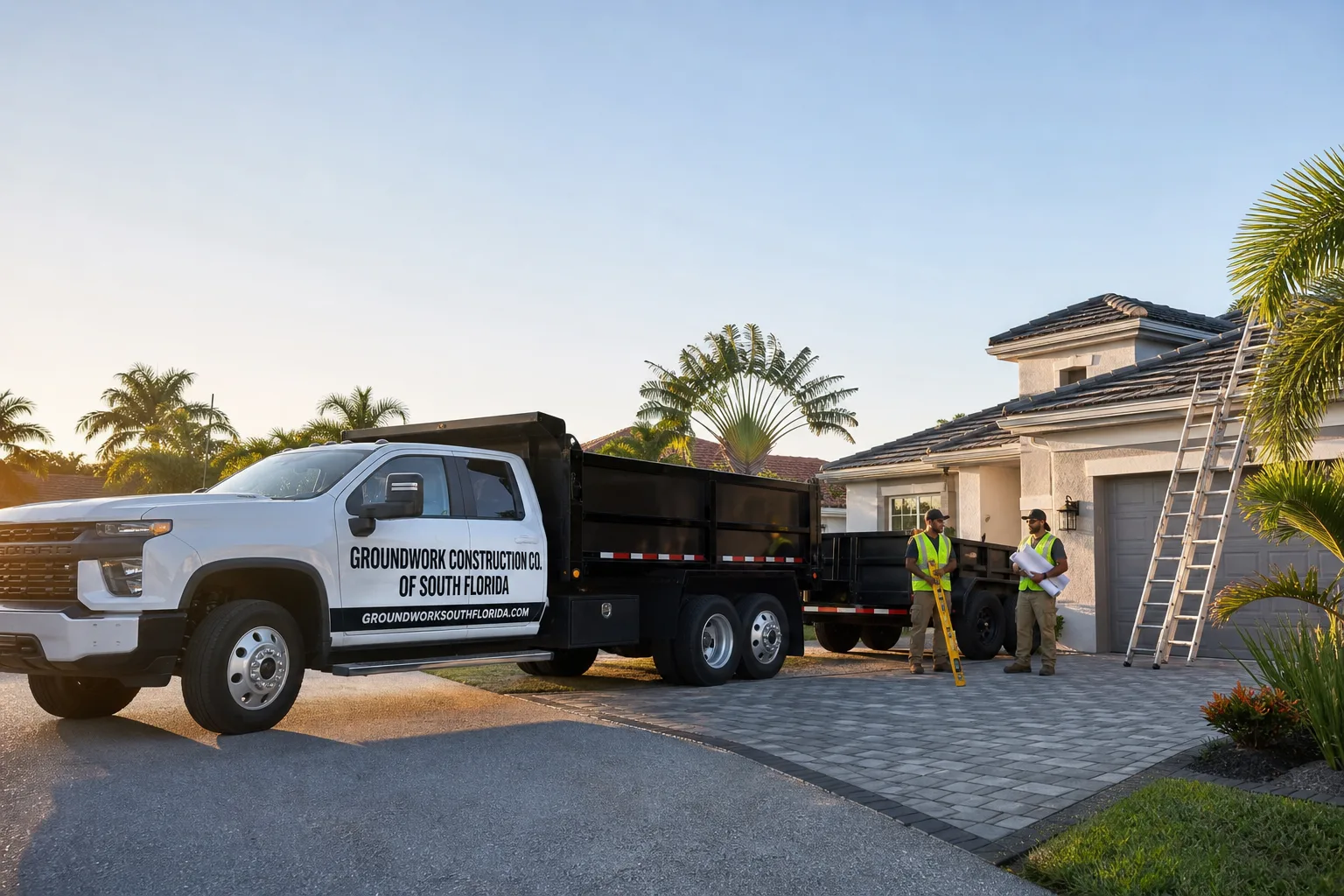
What’s Involved in Building a New Detached ADU in Lake Worth Corridor
A new detached ADU in Lake Worth Corridor is a standalone living unit built on your existing property, separate from the main house, typically ranging from 400 to 1,200 square feet with full kitchen, bath, and independent utilities - learn more about our Home Additions & ADU in Lake Worth Corridor. Most projects we handle here take 4 to 8 months from permit approval to final inspection, though Palm Beach County’s review timeline and any legacy code issues on your property can shift that. Budget for $90,000-$220,000 depending on size, finish level, and whether we need to upgrade existing structures to current Florida Building Code. Call (844) 665-0162 and we’ll walk your lot and give you a written estimate with real numbers.
How We Build a New Detached ADU - Start to Finish
We’ve learned that homeowners sleep better when they know exactly what’s coming. Here’s how a typical new detached ADU unfolds in Lake Worth Corridor, stage by stage.
Stage 1: Feasibility and site assessment (1-2 weeks)
We walk your property with a survey in hand, checking setbacks, utility locations, and access for construction equipment. In Lake Worth Corridor, this is where we often spot trouble: a carport that was enclosed without permits in 1982, or an addition that lacks hurricane straps. You’ll decide at this stage whether you want a stick-built structure, a prefab unit from Abodu or Dvele, or something hybrid. We measure, photograph, and flag any Palm Beach County compliance issues before design begins.
Stage 2: Design and permitting (6-14 weeks)
Because Lake Worth Corridor is unincorporated Palm Beach County, every permit runs through the county building department in West Palm Beach - no city hall shortcut. We submit architectural plans, structural calcs for wind load, and MEP drawings. If your main house has unpermitted work, we handle the code-compliance documentation now, before the inspector ever sets foot on site. You’ll choose exterior finishes, window specs (impact-rated is standard here), and whether the ADU connects to your existing septic or needs its own. This stage stretches longest when legacy issues surface.
Stage 3: Site prep and foundation (2-4 weeks)
We clear the build area, run temporary power, and pour footings designed for Florida’s sandy soils and hurricane wind loads. Most Lake Worth Corridor lots are tight; we coordinate equipment staging to avoid blocking alley access or neighbor driveways. If we’re running new water, sewer, or electrical service from the street, trenching happens now. You’ll see stakes, strings, and rebar grids before the slab or stem walls go in.
Stage 4: Structure and envelope (4-8 weeks)
Walls rise, roof trusses go up, and we close in against weather. For CBS construction - the standard here - we lay concrete block and apply stucco with integrated waterproofing because the corridor’s humidity will find any gap. Windows and doors go in, rough MEP gets inspected, and we pass the “dry-in” milestone. At this point you’ll do a walk to confirm room layouts and electrical locations before insulation and drywall.
Stage 5: Finishes and final inspection (3-5 weeks)
Flooring, cabinets, countertops, fixtures, and paint. We install appliances, test every system, and clean for county final inspection. Palm Beach County inspectors verify wind-load compliance, egress, and utility separation. Once we pass, you get keys and as-built drawings. The whole process, from our first site visit to move-in, typically spans 6 to 10 months in Lake Worth Corridor.
The Build Options You’ll Actually Decide Between
Every new detached ADU in Lake Worth Corridor forces real choices. Here’s where your money goes and what you trade:
- Stick-built vs. prefab: Traditional framing on site gives unlimited customization and matches existing CBS architecture seamlessly - expect 20-30% longer build time. Prefab units from Abodu or Mighty Buildings cut on-site construction to 4-8 weeks but require crane access and precise foundation prep. Prefab works best on flat lots with alley or side-yard crane staging; stick-built wins on tight properties or where HOA design guidelines demand aesthetic matching.
- Foundation type: Monolithic slab is cheapest and standard for Florida’s high water table, but if your lot drains poorly, a stem-wall foundation with raised floor adds $8,000-$15,000 and protects against seasonal flooding. We’ve seen both in Lake Worth Corridor; the 1950s-1970s lots near drainage canals almost always need the upgrade.
- Exterior envelope: Stucco over CBS block matches corridor housing stock and meets Florida Building Code wind requirements with minimal drama. James Hardie fiber-cement siding offers richer color options and resists humidity-driven paint failure, but costs 15-25% more installed. Your HOA may dictate this choice before you even start.
- Kitchen and bath package: KraftMaid or Wellborn cabinetry with solid-surface counters runs $4,500-$8,000 for a compact ADU kitchen. Upgrade to Cambria quartz and you’re adding $2,000-$4,000 but getting stain resistance that matters in a rental unit. We spec appliance packages from Whirlpool or GE that fit 24-inch openings without feeling cheap.
- Utility independence: Tapping existing sewer and water saves $6,000-$12,000 versus new lateral lines, but Palm Beach County requires separate meters for rental ADUs. Electrical can subpanel from the main house or run standalone; standalone adds $3,000-$5,000 but simplifies future sale or conversion to primary residence.
What New Detached ADU Costs in Lake Worth Corridor, FL
New detached ADU construction in Lake Worth Corridor runs $90,000-$220,000. Here’s what pushes you toward either end:
| Cost Driver | Low-End Impact | High-End Impact |
|---|---|---|
| Size (400-1,200 sq ft) | 400 sq ft studio, minimal kitchen | 1,200 sq ft 2-bed with full kitchen and laundry |
| Legacy code compliance | Clean title, permitted main house | Unpermitted additions requiring documentation and retrofit |
| Utility work | Tap existing sewer/water, subpanel electric | New laterals, standalone meter, septic upgrade |
| Finish level | Vinyl flooring, basic cabinets, fiberglass shower | Tile throughout, quartz counters, frameless glass, custom trim |
| Foundation and site | Flat lot, monolithic slab, no tree removal | Poor drainage, stem-wall foundation, extensive grading |
Our written estimates include architectural plans, permit fees, all materials and labor, and final cleanup. What typically sits outside: tree removal beyond the build footprint, separate landscape restoration, and furniture or window treatments. If we hit unpermitted work during demo, we’ll pause, document, and price the compliance fix before proceeding - no surprise invoices. Call (844) 665-0162 for an exact quote; estimates are free.
Why Lake Worth Corridor Homes Change This Job
Lake Worth Corridor isn’t like building in Boca Raton or Wellington, and the difference shows up in your timeline and budget.
The corridor sits entirely in unincorporated Palm Beach County, which means every permit for a new detached ADU routes through the county building department - not a city planner who knows your street. That single point of control can streamline things when you know the process, but it also means no local variance board to appeal setbacks or parking requirements. We’ve worked with county inspectors long enough to know what documentation prevents delays: complete structural calcs, proof of existing septic capacity or new system design, and explicit MEP separation from the primary residence.
The housing stock here is almost uniformly 1950s-1970s concrete block stucco homes, many under 1,400 square feet with flat roofs and original jalousie windows. It’s common for us to open a wall on what looks like a straightforward ADU utility tie-in and find a 1980s carport conversion with no permit, no hurricane straps, and footings that don’t meet current Florida Building Code. Palm Beach County inspectors will red-tag the whole project until that legacy work is documented and brought to compliance. Out-of-area crews get caught off guard by this; we’ve handled enough Lake Worth Corridor jobs to build that contingency into our initial assessment.
The climate adds its own layer. Palm Beach County’s wind-borne debris region mandates impact-rated glazing and enhanced roof-to-wall connections. Year-round humidity accelerates stucco cracking and moisture intrusion into aging CBS walls, so waterproofing details that might be optional elsewhere are mandatory here. We don’t treat envelope work as an upsell; it’s survival engineering for this environment.
Homeowners often pair a new detached ADU with interior updates to the main house, which is why our Kitchen Design & Layout in Lake Worth Corridor crew stays busy on these same projects. And since flooring runs through both structures, Backsplash, Tile & Flooring in Lake Worth Corridor is a natural coordination point with our ADU team.
Serving Lake Worth Corridor, FL - Our Local Coverage Area
We’re based in the Lake Worth Corridor area and know this community well. Use the map below to see our service coverage - if you’re nearby, we can almost certainly help.
Frequently Asked - New Detached ADU in Lake Worth Corridor
From permit approval to final inspection, typically 4 to 8 months; add 1 to 3 months for Palm Beach County plan review and any legacy code compliance on your property. Call (844) 665-0162 and we’ll assess your specific timeline during a free site visit.
Yes, absolutely - Lake Worth Corridor is unincorporated Palm Beach County, and the county building department requires full permits for any detached dwelling unit including structural, electrical, plumbing, and mechanical approvals. Attempting this without permits risks red-tagging, fines, and mandatory demolition of unapproved work.
Sometimes, but Palm Beach County requires adequate capacity documentation for sewer, water, and electrical service to support both structures; if your main house has original 100-amp service or an aging septic system, you’ll likely need upgrades before the ADU permit issues. We evaluate this during our initial feasibility walk.
Garage conversions typically run $30,000-$80,000 versus $90,000-$220,000 for new detached ADU construction, but the detached unit adds more resale value, avoids losing covered parking, and faces fewer code hurdles if your garage has unpermitted modifications. We cover garage conversions separately; this page focuses on Home Additions & ADU like new detached units.
Our workmanship warranty covers structural and systems installation, while manufacturer warranties apply to specific products like roofing, windows, and appliances - we register all warranties in your name and provide documentation at project closeout. Ask us for specifics on any component during your estimate.
Ready to Expand Your Lake Worth Corridor Property?
Call (844) 665-0162 to schedule a free on-site estimate for your new detached ADU in Lake Worth Corridor. We’ll walk your lot, flag any compliance issues, and deliver a written quote with real numbers and a realistic timeline. No deposit required to get started.
Written by Raymond Estevez, Owner at Groundwork Construction Co., serving Lake Worth Corridor and South Florida.