
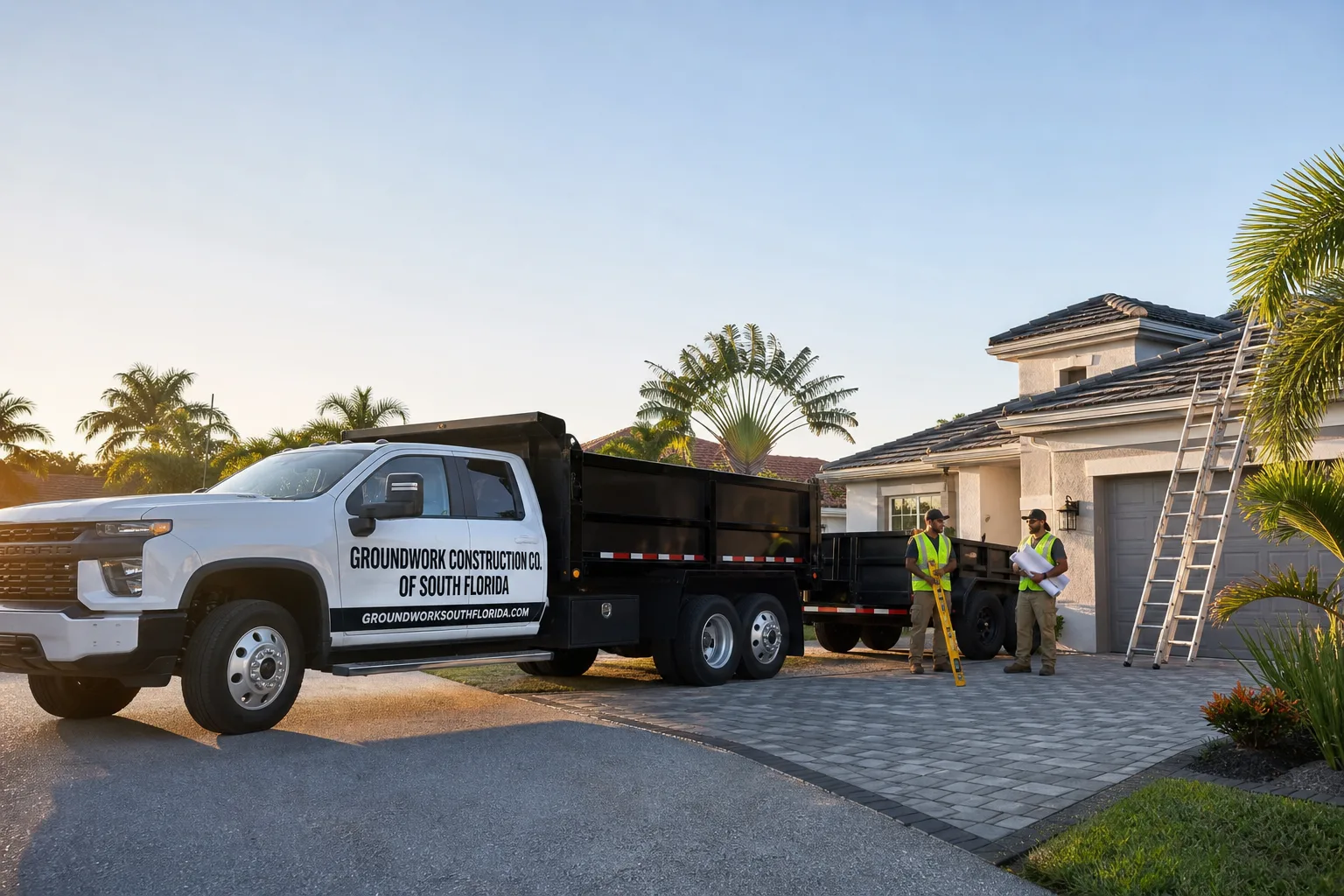
How Much Does a New Detached ADU Cost in Naranja, FL?
A new detached ADU in Naranja typically runs $90,000-$220,000 and takes 6-10 months from permit application to final inspection, with the HVHZ hurricane code adding both time and material cost compared to standard Florida builds. Most homeowners in the 33039 zip code zone call us at (844) 665-0162 once they’ve confirmed their lot has the required setback space and utility access for a standalone structure.
We’re Groundwork Construction Co., and we’ve learned that building detached here means planning around rock, water, and some of the strictest wind-load requirements in the country. The payoff is a rentable, habitable structure that adds real square footage without touching your main house’s footprint or floor plan.
How We Build a New Detached ADU in Naranja - Start to Finish
We’ve refined our process across Miami-Dade’s southern corridor, and Naranja’s combination of limestone, high water table, and HVHZ enforcement means we front-load more preparation than crews might need in Fort Lauderdale or Palm Beach.
Stage 1: Site evaluation and feasibility (1-2 weeks). We verify setbacks against your plat, locate existing septic or sewer ties, and run a probe test for the Miami oolitic limestone that sits 12-18 inches beneath most lots here. If we’re hitting rock, you’ll know before we price the job, not after. You’ll decide at this stage whether to pursue a traditional stick build or one of our prefab routes through Mighty Buildings or Boxabl, which can reduce on-site foundation work.
Stage 2: Design and HVHZ engineering (3-5 weeks). Every new detached ADU in Naranja needs HVHZ-compliant structural plans, impact-rated openings, and roof-to-wall connections that meet post-Andrew standards. We submit to Miami-Dade Building Department with a structural engineer’s wet stamp. Your decisions here: square footage (400 sq ft studio vs. 800+ sq ft two-bedroom), roof style (hip roofs perform better under uplift loads), and whether to spec standing-seam metal or HVHZ-rated asphalt shingles.
Stage 3: Permitting and pre-construction (4-8 weeks). Miami-Dade’s HVHZ plan review is thorough and not fast. We use this window to order long-lead items: impact windows, pre-hung exterior doors, and any prefab modules if you’ve chosen that path. You’ll finalize interior finishes during this period - flooring, cabinetry, countertop material. We often coordinate with homeowners who are also planning interior work on the main house; if you’re considering a kitchen update or flooring refresh, our Kitchen Design & Layout in Naranja and Backsplash, Tile & Flooring in Naranja crews can sequence both projects to minimize disruption.
Stage 4: Foundation and structure (6-10 weeks). This is where Naranja’s geology shows up in the schedule. We routinely need hydraulic rock-cutters or jackhammer rigs to trench for utilities and pour footings. Dewatering is standard, even in winter months - the water table here doesn’t drop far. Once the slab cures, we frame, sheath, and install the HVHZ-rated window and door package. If you’re building stick-frame, we use pressure-treated lumber and stainless or galvanized fasteners throughout; salt air starts attacking standard hardware before the paint dries.
Stage 5: Systems, finishes, and final inspection (4-6 weeks). Electrical, plumbing, mini-split HVAC, insulation, drywall, flooring, cabinets, fixtures. Miami-Dade requires a mid-point inspection and a final before certificate of occupancy. We schedule our own pre-inspection walkthrough to catch anything an HVHZ inspector might flag. You’ll do a punch list with our project lead, and we don’t close out until you’re satisfied.
The Build Choices You’ll Actually Make for Your New Detached ADU
Every decision below moves your number and your timeline. We don’t default you to one path - you choose, we spec it, we build it.
- Foundation type: Monolithic slab on grade is standard and cost-effective, but if your lot has severe rock or drainage issues, a raised pier foundation adds $8,000-$15,000 and 2-3 weeks. Piers let us work above the water table and simplify utility routing.
- Construction method: Traditional stick-built gives maximum flexibility on layout and finish but takes longer on-site. Prefab options from Plant Prefab or Mighty Buildings arrive 60-80% complete, cutting framing time to days rather than weeks. Trade-off: prefab modules need crane access and precise foundation tolerances, which doesn’t work on every Naranja lot.
- Exterior envelope: Stucco over concrete block (CBS) matches most post-Andrew Naranja housing and meets HVHZ with minimal engineering drama. Fiber-cement siding (James Hardie) is lighter and faster to install but requires additional impact-rated sheathing behind it to satisfy Miami-Dade.
- Roofing: Standing-seam metal (24-gauge minimum) handles wind uplift and salt corrosion better than any asphalt product, but costs 40-60% more. If budget’s tight, GAF or CertainTeed HVHZ-rated architectural shingles with proper fastening patterns still pass inspection.
- Windows and doors: Impact-rated vinyl from PGT or CGI is the practical choice for most detached ADUs; aluminum-clad wood from Andersen or Pella upgrades the look and longevity but adds 25-35% to the glazing package.
- Interior systems: Mini-split HVAC is nearly universal in ADUs this size. Tankless water heaters save space but need gas service or heavy electrical; standard electric tanks are cheaper upfront but consume floor space you’ll miss in a 400 sq ft unit.
What New Detached ADU Costs in Naranja, FL
| Component Range | Low End | High End |
|---|---|---|
| Total project (typical 400-800 sq ft) | $90,000 | $220,000 |
| Foundation and site prep (including rock work) | $12,000 | $35,000 |
| HVHZ structural and impact-rated envelope | $25,000 | $55,000 |
| Interior finish (mid-grade to premium) | $18,000 | $45,000 |
| Utilities, HVAC, electrical, plumbing | $15,000 | $35,000 |
| Permits, engineering, dewatering, contingency | $8,000 | $20,000 |
Five factors push you toward the high or low end of that $90,000-$220,000 range for a new detached ADU in Naranja:
- Size and complexity: A 400 sq ft studio with a kitchenette and bath sits near the bottom. An 800 sq ft two-bedroom with full kitchen, laundry, and covered entry pushes toward the top.
- Rock and water conditions: If probing shows shallow limestone or we need continuous dewatering, foundation costs can double. We’ve seen $8,000 foundation bids turn into $22,000 on day one of excavation.
- Utility distance and capacity: Tapping into existing sewer 80 feet away is straightforward. Running new electrical service from a maxed-out main panel, or installing septic for a detached unit where city sewer doesn’t reach, adds $10,000-$25,000.
- Material grade: Builder-grade finishes throughout keeps costs contained. Cambria countertops, KraftMaid cabinetry, and Andersen A-Series windows upgrade the space but move the finish line significantly.
- Permit scope and HOA requirements: Some Naranja communities have design review boards with additional aesthetic rules beyond code. That means a second round of plan revisions and sometimes materials you wouldn’t otherwise choose.
Our written estimates itemize labor, materials, permits, and a line-item contingency. What they don’t include: your own appliance selections above a standard allowance, landscape restoration after construction, or separate fees for utility connection that Miami-Dade or FPL bills directly.
What Naranja’s Conditions Specifically Do to This Job
Naranja isn’t a generic Miami-Dade job site, and contractors who treat it like one eat costs they didn’t price in.
The HVHZ code born from Hurricane Andrew’s 1992 destruction of this community still governs every new detached ADU we build here. That means impact-rated openings with missile-level certification, continuous load paths from roof to foundation, and wind speeds designed for 175 mph. Inspectors know what they’re looking at - many worked the post-Andrew rebuild themselves - and they don’t rubber-stamp plans that cut corners.
The housing stock reinforces this rigor. Most homes in the 33039 area are CBS construction from the 1993-1997 rebuild wave, with reinforced connections and impact windows already in place. When we tie a new detached ADU into these properties, we’re matching or exceeding that standard. The scattered pre-Andrew wood-frame survivors are a different story - if your main house needs hurricane-mitigation upgrades to comply with current code, that work has to happen before or alongside your ADU permit.
Then there’s the ground itself. The Miami Rock Ridge limestone beneath Naranja stops standard excavators cold. We budget jackhammer or hydraulic cutter time on every job that needs footings, sewer laterals, or electrical trenches. Out-of-area contractors who’ve never worked south of Kendall routinely underestimate this by $5,000-$10,000.
Finally, the water table and rainy season compress our outdoor work into morning windows from November through April. June through October, afternoon storms turn low-lying lots into ponds. We plan pours and framing accordingly, and we dewater when we must - another line item that doesn’t appear on inland bids.
If you’re exploring how a detached unit fits into a broader expansion plan, our Home Additions & ADU in Naranja page covers the full vertical, and our Home Additions & ADU service hub explains how we approach these projects across South Florida. We’re based in Fort Lauderdale and serve Naranja regularly - our crews know the route, the inspectors, and the rock.
Serving Naranja, FL - Our Local Coverage Area
We’re based in the Naranja area and know this community well. Use the map below to see our service coverage - if you’re nearby, we can almost certainly help.
Frequently Asked - New Detached ADU in Naranja
Most projects run 6-10 months from permit submission to certificate of occupancy, with 4-8 weeks of that eaten by Miami-Dade’s HVHZ plan review alone. Rock excavation and dewatering can add 2-3 weeks to the foundation phase during rainy season. Call (844) 665-0162 and we’ll give you a realistic timeline based on your lot conditions.
Yes - every new detached ADU in Naranja requires a Miami-Dade building permit with HVHZ structural engineering, electrical, plumbing, and mechanical sub-permits. No exceptions. We handle the application, engineer coordination, and inspection scheduling as part of our standard process.
Sometimes, but rarely without some modification. Most Naranja lots built in the 1993-1997 wave have electrical panels and sewer connections sized for the main house only. We evaluate your service capacity in stage one; if your panel is maxed or septic is undersized, you’ll need an upgrade - typically $3,500-$12,000 depending on scope.
Prefab from Mighty Buildings, Boxabl, or Plant Prefab can reduce on-site labor and framing time by 30-50%, but the savings shrink once you factor in crane rental, precise foundation tolerances, and Miami-Dade’s requirement that all structural connections meet HVHZ standards. On tight lots with rock issues, stick-built often wins on total installed cost.
We warranty our workmanship for one year from final inspection, and every material we install carries its own manufacturer warranty - GAF or CertainTeed roofing, Andersen or PGT windows, James Hardie siding. We pass those warranties directly to you with registration paperwork. For questions about coverage on a specific product, call us at (844) 665-0162.
Ready to Add a New Detached ADU to Your Naranja Property?
We’ll come to your lot, probe for rock, check your setbacks, and give you a written estimate with real numbers - no pressure, no generic ranges. Call (844) 665-0162 to schedule your free on-site consultation for a new detached ADU in Naranja. Raymond Estevez or a member of our project team will walk the site with you, explain the HVHZ requirements that apply to your specific property, and outline a build path that matches your budget and timeline.
Written by Raymond Estevez, Owner at Groundwork Construction Co., serving Naranja and South Florida homeowners since our founding.