
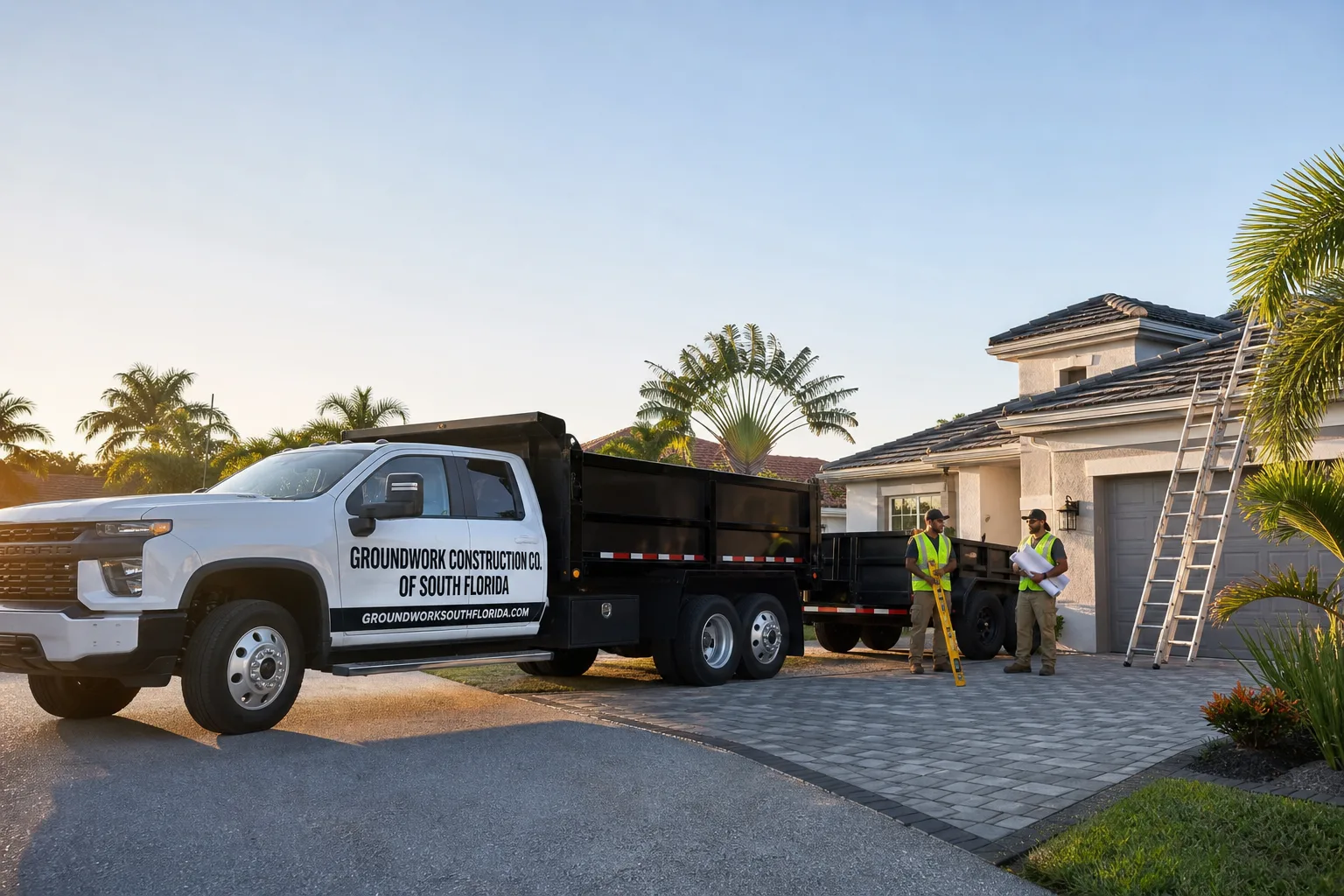
Patios, Walkways & Pool Decks in Oakland Park, FL: What to Expect
Patios, walkways & pool decks in Oakland Park typically run $3,500-$11,000 for paver patio installation, with walkways and pool decks scaling by square footage and base condition. Most projects finish in 5-10 business days once permits clear, though older homes with drainage or code-compliance issues can add a week. Call (844) 665-0162 for a free on-site estimate and a written quote with your material options spelled out.
How We Build Patios, Walkways & Pool Decks in Oakland Park
We’ve worked enough 1950s-1970s CBS homes in Oakland Park to know this job isn’t just laying pavers on dirt. The flat lots, original slab conditions, and South Florida rainfall patterns mean the prep either holds up for 20 years or fails in three. Here’s how we sequence it.
Stage 1: Site assessment and utility locate (Day 1)
We mark sprinkler lines, pool plumbing, and any buried electrical before a shovel breaks ground. In Oakland Park’s older neighborhoods, we’ve found abandoned galvanized water lines and original aluminum wiring still live in the yard from previous additions. Homeowner decision point: whether to relocate any irrigation heads now or work around them. Relocating adds $200-$500 but prevents future repair bills when a root or settling paver cracks a PVC line.
Stage 2: Demolition and base excavation (Days 1-2)
Existing concrete, old pavers, or degraded shell gets removed to depth. For pool decks, we’re typically excavating 6-8 inches to accommodate a compacted limestone base plus bedding sand. The clay and sandy mix in Broward County drains poorly when disturbed, so we grade for runoff toward existing drains or swales. Homeowner decision point: whether to add a French drain or channel drain if the yard holds water after storms. This adds $800-$2,000 but solves the soggy-yard problem we see constantly in Oakland Park’s low-lying 33334 lots.
Stage 3: Base installation and compaction (Days 2-3)
We lay and compact #57 limestone in 4-inch lifts, testing density with a plate compactor. For walkways bearing foot traffic only, 4 inches of base suffices. Pool decks and patios with furniture or entertainment loads get 6-8 inches. Homeowner decision point: edge restraint type. Plastic edging with spikes works for most patios; concrete haunching or aluminum edging holds better on pool decks where chlorine and splash erosion attack lesser materials.
Stage 4: Paver laying, cutting, and pattern setting (Days 3-6)
We lay pavers to your chosen pattern, cut border pieces with a wet saw, and set pool coping if applicable. This is where material choice matters most. Belgard’s Catalina or Tremron’s Olde Towne handle salt and chlorine well for pool decks; Unilock’s Beacon Hill Flagstone gives a cleaner look for modern patio renovations. Homeowner decision point: pattern complexity. Running bond installs fastest; herringbone or circular designs add 15-25% in labor but resist shifting better on sandy Broward soils.
Stage 5: Compaction, polymeric sand, and seal (Days 6-8)
Final compaction locks pavers, polymeric sand fills joints to lock out weeds and ants, and sealer goes on if selected. We typically wait 48 hours after rain to seal; Oakland Park’s afternoon thunderstorms in summer can push this stage. Homeowner decision point: sealer type. Matte finish penetrates and breathes; wet-look enhances color but requires reapplication every 2-3 years in UV-heavy South Florida.
The Material and Design Choices You’ll Make
Every patio, walkway, or pool deck we build in Oakland Park involves trade-offs between upfront cost, slip resistance, heat retention, and how the material ages next to a pool or under oak canopy. Here’s what we walk homeowners through:
- Concrete pavers (standard grade, 2 3/8″ thickness): The baseline for most Oakland Park patios. Runs cooler than poured concrete, repairs by lifting single units, and comes in dozens of face textures. The trade-off: color fades slightly over 5-7 years in South Florida UV, and cheap pavers imported from unknown mills can spall or lose corners. We spec Tremron or Belgard for their density ratings and local availability.
- Permeable pavers: Required by some Broward County developments for stormwater management. Gaps between units let rain percolate through, reducing runoff on Oakland Park’s flat lots where puddling is chronic. Costs 20-30% more, needs a deeper, open-graded stone base, and requires vacuuming debris from joints twice yearly. Worth it if you’re in a flood-prone pocket of 33334 or your HOA mandates it.
- Natural stone (travertine, coral stone, shell stone): Premium look, stays cooler underfoot than concrete, and handles salt pool environments well. The trade-off: porosity means staining from oak tannins, pool chemicals, or grill grease if not sealed religiously. Also pricier and harder to match for future repairs. We recommend this for covered patios or pool decks with automatic covers.
- Poured concrete with stamping or scoring: Lower material cost, seamless surface, and no weed growth in joints. The trade-off: cracks are inevitable in South Florida’s expansive clay; repairs are visible and often worse than the original crack. We steer homeowners away from this for pool decks where water infiltration accelerates spalling.
- Pool coping material: Often overlooked until late in the project. Bullnose concrete pavers match the deck and cost less; natural stone coping elevates the look but needs freeze-thaw testing (irrelevant here, but porosity to salt matters). We typically set coping in a mortar bed with bond beam tie-in for structural integrity on older Oakland Park pools where the shell may have shifted slightly over decades.
What Patios, Walkways & Pool Decks Costs in Oakland Park, FL
For paver patio installation in the Oakland Park market, expect $3,500-$11,000. Walkways typically fall in the $2,500-$6,000 range depending on length and width. Pool decks run $5,000-$14,000+ given the coping integration, drainage requirements, and salt-resistance specifications.
Five variables push your number up or down:
- Existing surface condition: Removing cracked concrete with rebar costs more than lifting loose pavers. Unexpected buried debris from old carport conversions, common in 1950s-1970s Oakland Park homes, adds dump fees and labor.
- Base drainage needs: Flat lots with poor percolation need deeper excavation, geotextile fabric, and sometimes channel drains. We’ve seen $1,500-$3,000 added to projects near the Middle River basin where water tables sit high.
- Material grade and source: Standard concrete pavers from a reputable domestic mill run $4-$7 per square foot installed. Premium travertine or imported porcelain pavers hit $12-$18. The difference across a 400-square-foot pool deck is substantial.
- Pattern complexity and border detail: Simple running bond with a soldier course border installs efficiently. Circular inlays, multiple color bands, or custom cuts around existing oak roots (protected by Oakland Park tree ordinances) slow production and raise labor.
- Permit and inspection scope: Broward County requires permits for pool deck modifications affecting the bond beam or drainage. If your project triggers a full compliance review, plan for $400-$800 in permit fees and potential re-inspection delays.
A written estimate from Groundwork includes demolition, base material and compaction, pavers and bedding sand, edge restraint, polymeric sand, and basic site cleanup. It does not include tree protection fencing (if required), sprinkler repair, permit fees, or long-term sealing maintenance. We itemize these so you’re not surprised.
What Oakland Park Homes Specifically Do to This Job
Oakland Park’s housing stock shapes nearly every patio, walkway, and pool deck we build here. The dominant 1950s-1970s CBS construction means we’re often working around original slabs poured with minimal reinforcement, sometimes cracked from decades of root intrusion or settlement on Broward’s sandy-loam over limestone. In the neighborhoods north of Oakland Park Boulevard, we’ve pulled up pool decks where the original concrete was 2.5 inches thick with no vapor barrier, moisture wicking through to stain interior floors.
The flat terrain and high water table in 33334 mean drainage isn’t optional. After a typical July afternoon storm, water sits on these lots for hours. We design every patio with a minimum 1% slope away from the house, and we regularly specify channel drains or slot drains for pool decks where the yard has nowhere else to shed water. Homeowners in the older blocks near Dixie Highway sometimes discover their original pool decks were built without expansion joints against the house foundation, a detail that violates current Florida Building Code and triggers a compliance upgrade when we touch it.
HOA rules vary by pocket, but the Oakland Park zoning framework generally allows hardscaping within setback limits without variance if you stay under impervious surface ratios. We check your specific parcel before design. Hurricane season compresses our exterior schedule, too, June through November, we watch the forecast closely and won’t pour or seal within 48 hours of predicted rain, which can push completion dates in a wet year.
Many homeowners tackling patios, walkways & pool decks are also addressing other exterior or expansion needs. If you’re considering a broader property update, our Driveway & Pavers in Oakland Park page covers the full hardscape scope. Some clients pair this work with ADU Site Prep & Utilities in Oakland Park when they’re expanding the backyard footprint, or with Full Kitchen Remodeling in Oakland Park for a cohesive indoor-outdoor entertainment flow. Our Driveway & Pavers service hub explains how we handle material selection across all exterior surfaces. Wherever you are in Oakland Park, we build to the specific conditions of your lot and era of construction.
Serving Oakland Park, FL - Our Local Coverage Area
We’re based in the Oakland Park area and know this community well. Use the map below to see our service coverage - if you’re nearby, we can almost certainly help.
Frequently Asked - Patios, Walkways & Pool Decks in Oakland Park
Most patios, walkways & pool decks finish in 5-10 business days after permit approval. Older homes with drainage issues or buried debris from prior additions can add 3-5 days. Call (844) 665-0162 and we’ll assess your specific site conditions during the free estimate.
Yes, if the project modifies pool bond beams, drainage patterns, or exceeds impervious surface limits under Broward County code. Simple walkway replacements sometimes qualify as repair, but we verify permit requirements before breaking ground to avoid stop-work orders. We handle the application and inspection scheduling as part of our project management.
Often yes, but it depends on layout. We design around fixed utilities when possible to save $500-$2,000 in relocation costs. If your pool equipment pad or main drain line sits where you want the deck expansion, we’ll flag it during the Day 1 utility locate and present options. You decide before excavation starts.
Standard pavers shed water to the surface and need graded drainage; permeable pavers let water pass through to a stone reservoir below, reducing runoff. In Oakland Park’s flat, flood-prone lots, permeable systems solve standing-water problems but cost 20-30% more and need periodic joint maintenance. We recommend them for properties with drainage complaints or HOA stormwater requirements.
We warranty installation workmanship, including base compaction and settlement, for the period specified in your written contract. Material defects fall to the manufacturer, Tremron and Belgard both carry product warranties we register on your behalf. Sealer performance varies by product and maintenance; we specify expectations in writing so you know what’s covered and what requires your ongoing attention. For exact terms on your project, call (844) 665-0162.
Get Your Free Estimate for Patios, Walkways & Pool Decks in Oakland Park
Call (844) 665-0162 to schedule a free on-site estimate. We’ll measure your space, assess drainage and existing conditions, and return a written quote with material options from our curated brand roster. Raymond Estevez and our team at Groundwork Construction Co. handle every phase, one contractor, one accountability line, from base prep to final compaction.
Written by Raymond Estevez, Owner at Groundwork Construction Co., serving Oakland Park since our founding in South Florida.