
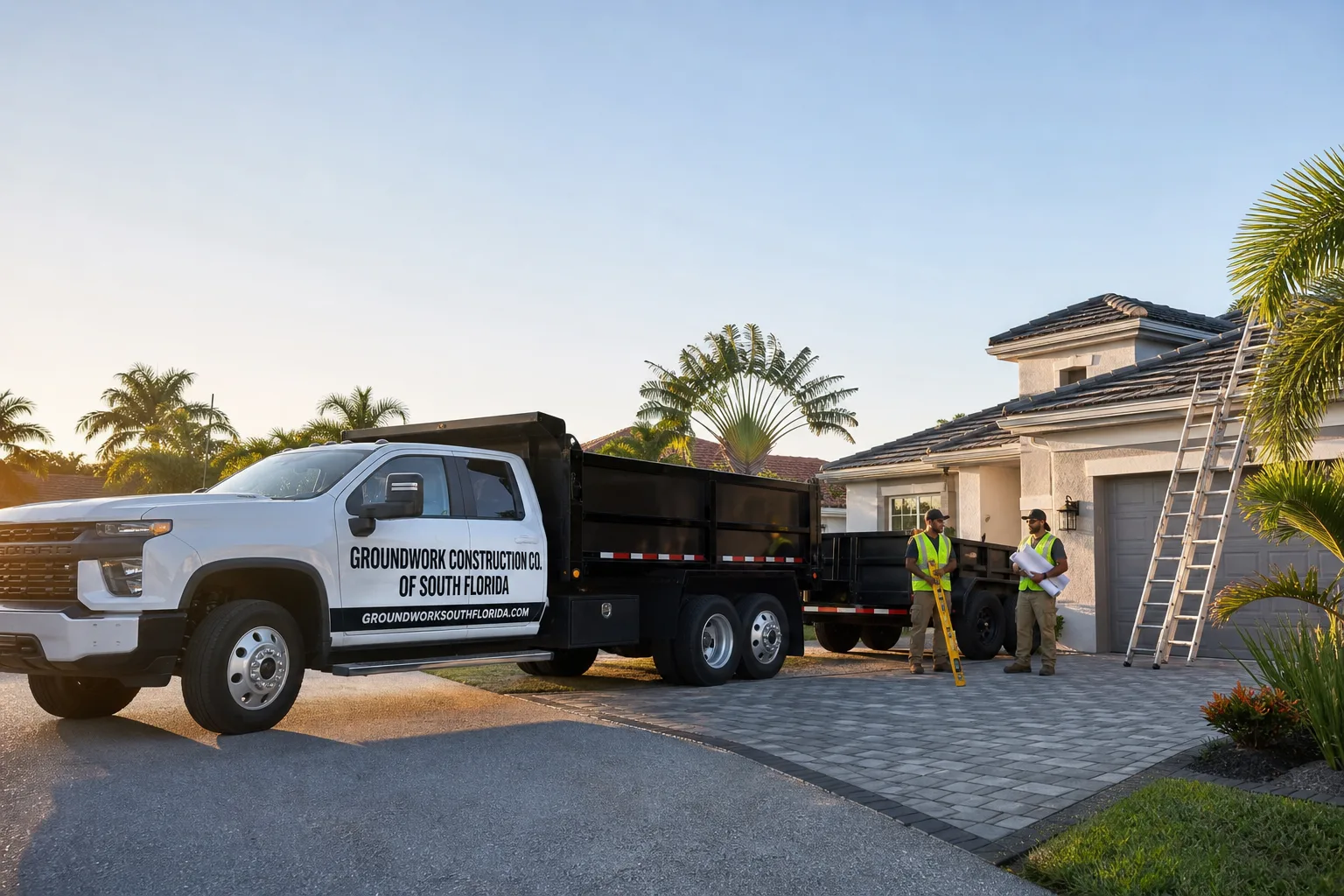
Paver Driveways in Florida City, FL: Timeline, Cost, and What to Expect
A paver driveway installation in Florida City typically runs $7,000-$18,000 and takes 4-7 business days from excavation to final compaction. Most homeowners call us after their existing concrete or asphalt surface has cracked beyond repair, or when they’re ready to replace a gravel driveway that turns to mud every summer. Call (844) 665-0162 and we’ll walk you through what’s realistic for your property.
How We Install Paver Driveways from Start to Finish
We’ve learned that homeowners in Florida City want to know exactly when their driveway will be unusable and what decisions they need to make before we show up. Here’s how the job actually unfolds.
Stage 1: Site evaluation and utility clearance (Day 1, 2-3 hours)
We walk the existing surface, check for sprinkler lines, shallow electrical, or drainage cleanouts that sit in our path. In Florida City, we regularly find mid-1990s irrigation systems buried only 4-6 inches deep, installed when these post-Andrew homes were rebuilt. You’ll decide at this stage whether to relocate any lines or work around them, which affects the layout and sometimes the price.
Stage 2: Demolition and excavation (Days 1-2)
We remove the old driveway material, whether it’s fractured concrete, failed asphalt, or compacted shell. Excavation depth is typically 8-10 inches for residential paver driveways, but Florida City’s shallow water table on Miami Limestone means we sometimes hit saturated oolite within the first foot. When that happens, we adjust the base strategy rather than fight the water, adding geotextile fabric and increasing drainage aggregate thickness. You’ll see the exposed subgrade and confirm the final grade direction.
Stage 3: Base installation and compaction (Days 2-3)
This is where most cheap jobs fail. We lay and compact crushed concrete or limestone aggregate in 4-inch lifts, each one tested with a plate compactor until we hit 95% Proctor density. The base depth ranges from 6 inches for light-duty residential use to 10 inches where heavy vehicles or poor drainage demand it. We slope the base away from the house at minimum 1% grade, critical in a city that sees 60 inches of annual rainfall compressed into intense tropical downpours. You don’t make decisions here, but you should understand that skipping this stage is why some paver driveways in Florida City settle and heave within three years.
Stage 4: Edge restraint, bedding sand, and paver laying (Days 3-5)
We set concrete or aluminum edge restraints on a concrete haunch, then screed 1 inch of coarse bedding sand. Paver laying proceeds from the lowest point upward. For most Florida City driveways, we’re working with 4×8 or 6×9 pavers in running bond or herringbone patterns, herringbone being our default for any surface that takes vehicle traffic because it locks laterally under load. You’ll have already chosen color, texture, and pattern by this point. We keep samples on-site for final confirmation before we open the pallets.
Stage 5: Compaction, joint sand, and cleanup (Day 5-6, sometimes 7)
We run a plate compactor over the laid field, vibrate polymeric or fine joint sand into the gaps, then compact again. In Florida City’s humidity, we sometimes wait an extra half-day for surfaces to dry sufficiently before the final sand sweep. We then roll the driveway edge with your vehicle to confirm no rocking or settling. The surface is drivable immediately, though we ask you to avoid sharp turns or heavy braking for 48 hours while the joint sand fully locks.
Throughout the process, our Driveway & Pavers crew coordinates directly with any related exterior work you have underway. Many homeowners in Florida City time paver driveway installation with roofing or window projects to minimize repeated site mobilization.
The Material and Design Choices You’ll Actually Make
- Concrete pavers vs. clay brick: Concrete dominates Florida City installations for good reason. Modern concrete pavers from manufacturers like Belgard, Unilock, and Tremron carry compressive strengths above 8,000 PSI and come in surface textures that mimic natural stone without the staining and weed-growth issues. Clay brick looks warmer and more traditional but costs 25-40% more, fades unevenly in intense UV, and is harder to match if you later expand the driveway. We recommend concrete for most homeowners here, clay only when architectural consistency with an existing brick home demands it.
- Standard vs. permeable pavers: Standard interlocking pavers shed water to the edges and rely on surface grade for drainage. Permeable pavers with enlarged joints and open-graded base allow rainfall to percolate through, reducing runoff and helping with Miami-Dade’s stormwater management requirements on larger properties. The trade-off: permeable systems cost 15-25% more upfront and require vacuum-sweeping maintenance to prevent joint clogging from leaf litter and limestone sediment. For typical Florida City lots on compacted oolite with limited yard drainage, standard pavers with proper base drainage usually perform better long-term.
- Textured vs. smooth surface finish: Textured or tumbled pavers hide scuffs, tire marks, and the inevitable organic staining from South Florida’s dense tree canopy. Smooth-faced pavers look crisp when new but show every oil drip and leaf-tannin mark within the first year. We steer Florida City homeowners toward medium-texture finishes unless the driveway is short, shaded, and primarily aesthetic.
- Pattern geometry: Herringbone at 45 or 90 degrees handles vehicle loads best. Running bond works for straight, lightly used driveways. Basketweave and circular inlays are available but add cutting labor and material waste. We quote pattern complexity separately so you see where the money goes.
- Border treatment: A contrasting soldier course border frames the driveway and contains the field pattern. It adds roughly 8-12% to material cost but dramatically improves the finished appearance, especially on driveways visible from the street. We typically use a darker, smaller paver for the border to create visual weight.
What Paver Driveways Cost in Florida City, FL
| Project Scope | Typical Range |
|---|---|
| Single-car driveway (10×20 ft), standard concrete pavers | $7,000-$10,500 |
| Two-car driveway (20×20 ft), standard concrete pavers | $11,000-$15,000 |
| Two-car driveway with permeable system | $13,000-$18,000 |
| Existing concrete removal and disposal | $1,200-$2,800 |
| Gravel or shell base driveway, no removal needed | $5,500-$8,500 |
Five factors push any Florida City paver driveway toward the high or low end of these ranges:
Existing surface condition: Removing and hauling cracked concrete costs more than scraping compacted shell. If your current driveway is thick, reinforced, or extends beyond the planned paver footprint, demolition labor increases.
Subgrade drainage challenges: Florida City’s high water table and shallow Miami Limestone sometimes require additional excavation, dewatering during work, or imported fill to achieve stable base depth. We’ve had jobs where we hit standing water at 14 inches and had to redesign the drainage layer.
Material grade and brand: Entry-level 60mm pavers from regional manufacturers run $3-$4 per square foot material-only. Premium 80mm products from Belgard or Techo-Bloc with enhanced colorfastness warranties run $5-$7. The difference over 400 square feet is real money, but so is the 25-year fade resistance.
Access and site constraints: Fenced yards with narrow gates, overhead power lines limiting equipment height, or driveways that slope steeply toward the garage all add labor hours. Florida City’s mid-1990s lot layouts were often compact, with garages positioned for vehicle access rather than construction logistics.
Permit and inspection scope: Miami-Dade County requires a building permit for any new driveway installation that modifies drainage or connects to public right-of-way. Permit fees, plans, and inspection scheduling add $400-$900 and 1-2 weeks to project timeline. We handle this in our standard process, but it’s a cost you should see itemized, not buried.
Our written estimates include demolition, base materials, pavers, edge restraints, bedding and joint sand, compaction, and rough grade restoration. They do not include sprinkler repair, landscape replacement, or decorative lighting you might add later. Call (844) 665-0162 for an exact quote on your property, estimates are free.
What Florida City’s Conditions Specifically Mean for Your Driveway
Florida City is not a generic South Florida job site, and contractors who treat it like one run into predictable trouble.
The housing stock here is almost entirely post-Hurricane Andrew reconstruction, rebuilt in concentrated waves during 1992-1996 after the storm leveled the city. Those mid-1990s CBS homes are now thirty years old, and their original driveways, whether poured concrete or asphalt, are reaching end of service life simultaneously. We see the same failure patterns repeatedly: slab cracking from limestone substrate movement, surface spalling from decades of salt air and UV exposure, and drainage that was adequate in 1994 but has been compromised by root intrusion and soil settlement.
The deeper issue is Florida City’s position within Miami-Dade County’s High Velocity Hurricane Zone. While paver driveways themselves don’t carry the same product-approval burden as roofing or impact windows, any work that touches the home’s drainage, that modifies curb cuts, or that connects to municipal stormwater systems gets scrutinized through the same stringent permitting lens. Out-of-county contractors accustomed to Florida’s statewide building code often underestimate the documentation and inspection rigor here. We’ve been called to fix jobs where non-local crews poured paver bedding over untreated organic soil, skipped geotextile separation, or failed to call for base inspection before laying pavers, all of which triggered stop-work orders and costly rework.
Climate compounds everything. Florida City’s 60 inches of annual rainfall, delivered in concentrated tropical bursts, tests surface drainage immediately. A driveway that ponds for two hours after a summer thunderstorm will breed mosquitoes, stain pavers with organic debris, and eventually undermine the base. We design every Florida City installation with that rainfall intensity in mind, not with drainage standards that suffice thirty miles north in Fort Lauderdale.
Homeowners here also face a practical consideration that doesn’t apply inland: many Florida City properties sit on compacted fill over shallow oolite where the water table sits just below finished grade. Any excavation deeper than 10 inches risks becoming a sump. Our crews know to dewater actively, work in shorter lifts, and compact quickly before the hole fills. Contractors from outside this immediate area rarely anticipate the problem until they’re standing in six inches of clear water at 9 AM on day two.
We’ve also found that homeowners planning significant exterior renovation in Florida City often pair paver driveway work with Garage Conversion ADU in Florida City projects or ADU Design & Permitting in Florida City, since both require coordinating site access, drainage, and exterior finish transitions. Handling these through a single contractor eliminates the finger-pointing that happens when separate crews overlap.
Our Florida City coverage extends throughout the 33035 ZIP code and surrounding areas including Homestead, Leisure City, Naranja, and Princeton. For homeowners considering paver driveways as part of a full exterior transformation, we also coordinate with our Driveway & Pavers in Florida City team to ensure material consistency across patios, walkways, and the driveway itself.
Serving Florida City, FL - Our Local Coverage Area
We’re based in the Florida City area and know this community well. Use the map below to see our service coverage - if you’re nearby, we can almost certainly help.
Frequently Asked - Paver Driveways in Florida City
Most residential paver driveways in Florida City take 4-7 business days from start to finish, assuming standard access and no utility conflicts. Permitting through Miami-Dade County adds 1-2 weeks before work can begin. Call (844) 665-0162 and we can check current permit turnaround times for your specific address.
Yes, Miami-Dade County requires a building permit for new paver driveway installations that modify existing drainage or connect to public right-of-way. The permit covers base inspection, final grade verification, and stormwater compliance. We prepare and submit plans as part of our standard process.
We don’t recommend it for Florida City properties. Thin-set paver overlays on cracked or settled concrete transfer every underlying failure upward within 2-3 years, and they add 2-3 inches of height that often creates trip hazards at garage thresholds and sidewalk transitions. Proper removal and base reconstruction costs more upfront but eliminates the callback.
Standard pavers need joint sand replenishment every 2-3 years and occasional pressure washing to remove organic stains. Permeable pavers require vacuum-sweeping twice yearly to prevent joint clogging from leaf litter and limestone sediment, plus more frequent joint aggregate replacement. The maintenance burden is real, so we recommend permeable systems only where stormwater management regulations or specific site conditions justify the added care.
We warranty our installation workmanship, including base preparation, edge restraint integrity, and surface grading, for a period we specify in your written contract. Paver manufacturers like Belgard and Tremron carry their own material warranties against excessive fade or structural failure, typically 25 years or lifetime depending on product line. The two warranties are separate, manufacturer defects are handled directly with the supplier, installation issues come back to us.
Get Your Free Estimate for Paver Driveways in Florida City
Call (844) 665-0162 to schedule a free on-site estimate. We’ll measure your existing driveway, check subgrade conditions, discuss material options from our curated brand roster, and deliver a written quote with line-item pricing. Most Florida City homeowners have their estimate within 48 hours of our visit, permitting timeline included.
Written by Raymond Estevez, Owner at Groundwork Construction Co., serving Florida City and South Florida homeowners from our Fort Lauderdale headquarters.