
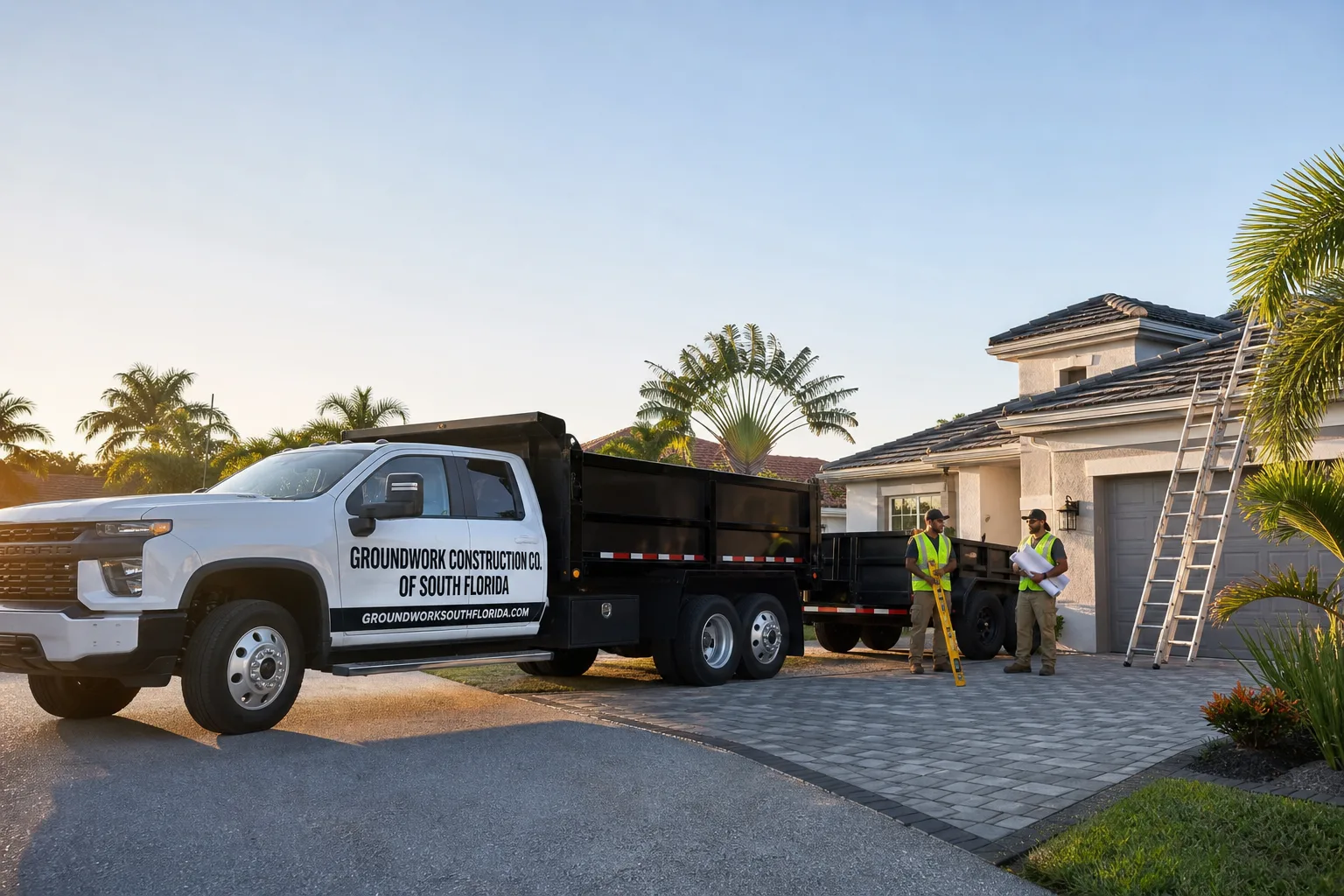
Paver Driveways in Palm Springs, FL: What to Expect
Our Driveway & Pavers services in Palm Springs typically run $7,000-$18,000 for a standard two-car approach, with most projects wrapping in 4-7 business days from demolition to final compaction. You’ll need a Palm Beach County permit for any new driveway or replacement that alters drainage or the existing footprint, and because so many Palm Springs homes sit on 1950s-1970s concrete slab foundations with original utility routing, we often uncover irrigation or electrical lines that need rerouting before pavers go down. Call us at (844) 665-0162 and we’ll walk your property, flag those issues upfront, and give you a written estimate with line-item pricing.
How We Build a Paver Driveway, Start to Finish
We’ve installed paver driveways across Palm Beach County long enough to know where the surprises hide, especially in Palm Springs’ older subdivisions where the original concrete has been baking since the Eisenhower administration. Here’s how the job actually unfolds.
Day 1: Demolition and utility locate. We cut and remove the existing driveway surface, whether that’s cracked concrete, old asphalt, or a previous paver job that failed. Before the first load of debris leaves, we verify underground utilities. In Palm Springs, this step matters more than in newer construction: many homes on streets like Purdy Lane and Forest Hill Boulevard still have original sprinkler lines and low-voltage landscape wiring running shallow beneath the driveway apron. We mark everything, photograph the layout, and only then proceed.
Day 1-2: Excavation and subgrade prep. We dig to 8-10 inches below finished grade, accounting for base, bedding sand, and paver thickness. The limestone substrate here drains poorly when compacted improperly, so we test moisture content as we go. If we hit the water table (common in Palm Springs’ low-lying pockets near the C-51 Canal basin), we adjust the base depth and add geotextile fabric to prevent pumping. You decide at this stage whether to extend the driveway width or add a parking pad, since changing the footprint after this point means revisiting the permit.
Day 2-3: Base installation and compaction. We lay 6-8 inches of crushed concrete aggregate (road base), compact in 2-inch lifts with a plate compactor, then verify with a nuclear density gauge. Palm Beach County inspectors check this step on permitted jobs. We schedule the inspection once, not twice, by getting the grade right the first time. Homeowner decision point: whether to integrate a drainage channel or French drain if your driveway slopes toward the garage or foundation.
Day 3-4: Edge restraint, bedding sand, and paver layout. We set concrete or aluminum edge restraints, screed 1 inch of coarse bedding sand, and begin laying pavers in your chosen pattern. Herringbone handles vehicle loads best; running bond works for lighter-duty approaches. This is when material choice becomes visible: Belgard’s Bergerac line in a tumbled finish versus Techo-Bloc’s sleek Blu 80 in a smooth surface. We lay a small sample section if you want to see it in your actual light before committing to the full field.
Day 4-5 (or 7 for larger jobs): Cutting, compaction, and joint sand. We cut border pieces with a wet saw, compact the field again to seat pavers, sweep polymeric sand into joints, and activate with water. The polymeric hardens to lock everything in place and resist weed growth. Final inspection, cleanup, and we review maintenance: re-sand every 2-3 years, seal if you want color enrichment (optional, not required for structural performance).
The Options You’ll Choose Between
Paver driveways aren’t one-size-fits-all. The choices you make in Palm Springs should account for intense UV exposure, occasional storm debris, and the reality that your home’s resale value depends on curb appeal in a village where mid-century architecture still dominates.
- Concrete pavers (standard grade): The workhorse option. Typically 2 3/8-inch thickness, available in earth tones that complement Palm Springs’ terrazzo-and-pastel exteriors. Cost-effective, widely stocked, and easy to match for future repairs. Trade-off: color can fade slightly over a decade of South Florida sun; sealing helps but adds maintenance.
- Concrete pavers (premium/tumbled): Thicker bodies (3-3 1/2 inches), more pigment depth, and antiqued edges that hide wear. Brands like Belgard’s Dublin Cobble or Tremron’s Olde Towne suit the vintage character of Palm Springs’ ranch homes. Trade-off: 25-40% higher material cost, longer lead times for specialty colors.
- Permeable pavers: Open-graded base and wider joints allow rainfall to percolate through, reducing runoff. Required by some Palm Beach County drainage ordinances for expanded footprints that increase impervious surface. Trade-off: Higher base construction cost, more frequent joint maintenance to prevent clogging with our sandy, organic debris.
- Paver size and pattern: 4×8-inch rectangles in herringbone for maximum load distribution; larger 6×9 or plank-style formats in running bond for contemporary aesthetics. Pattern choice affects cutting waste and labor time. Trade-off: complex patterns (basketweave, circular inlays) add 10-15% to labor.
- Edge treatment: Standard concrete curb, soldier course in contrasting color, or integrated lighting channel. Trade-off: lighting adds $800-$2,500 but eliminates the need for separate pathway fixtures in tight Palm Springs setbacks.
Our driveway and pavers crew can also show you how a paver driveway fits into a full Driveway & Pavers in Palm Springs project if you’re considering adjacent walkways or a patio refresh.
What Paver Driveways Cost in Palm Springs, FL
In the Palm Springs market, paver driveway installation ranges from $7,000 to $18,000, with most single-family projects landing between $9,500 and $14,000.
| Cost Driver | Low-End Scenario | High-End Scenario |
|---|---|---|
| Driveway size | 400 sq ft, single-car | 800+ sq ft, double with parking pad |
| Existing surface | Gravel or thin asphalt, minimal demo | Thick reinforced concrete, extensive removal |
| Subgrade condition | Stable, well-draining limestone | Soft spots, high water table, requiring geotextile and deeper base |
| Material grade | Standard 2 3/8-inch concrete pavers | Premium tumbled or permeable system |
| Utility/plumbing work | No relocation needed | Rerouting irrigation, electrical, or storm drainage |
| Permit scope | Like-for-like replacement | Expanded footprint triggering drainage review |
Our written estimates include demolition, disposal, base materials, pavers, edge restraints, bedding and joint sand, compaction, and standard cleanup. What typically isn’t included: tree or stump removal, significant grading beyond the driveway footprint, decorative lighting electrical, and permit fees paid directly to Palm Beach County. We flag these line items during our on-site walkthrough so you’re not surprised.
Homeowners in Palm Springs often pair driveway work with exterior upgrades. If you’re considering expanding your home’s footprint, Garage Conversion ADU in Palm Springs is a path we’ve helped clients explore once the hardscape is sorted.
What Palm Springs Homes Specifically Do to This Job
Palm Springs isn’t like Greenacres or Lake Worth Corridor. The village’s core housing stock - CBS ranch homes built from the 1950s through the 1970s, many with original tile roofing - creates a specific set of conditions that reshape what “paver driveway installation” means here.
First, the permitting reality. Palm Beach County’s post-Hurricane Andrew code adoption means pulling nearly any significant construction permit triggers mandatory wind-mitigation and drainage compliance. We’ve seen driveway replacement permits escalate when inspectors flag non-compliant jalousie windows or unreinforced roof-to-wall connections on the same structure, which is why we also offer our Specialty Roofing service in Palm Springs to address these issues proactively. The driveway itself might be straightforward, but the project context rarely is. We build this into our initial assessment so you’re not mid-project when the county adds scope.
Second, the physical site conditions. Those mid-century slabs were poured with minimal reinforcement and no consideration for modern vehicle weights. We regularly find original driveways on streets like Kirk Road and Sparrow Drive that have settled differentially from the garage slab, creating a trip hazard and drainage problem that demands more than cosmetic paving. The shallow water table in this limestone terrain means any below-grade work risks groundwater intrusion; our base prep accounts for it.
Third, the humidity factor. Persistent South Florida moisture accelerates corrosion in any steel edging or fasteners, and promotes organic growth in paver joints. We spec aluminum or heavy-gauge PVC edge restraints and polymeric sand specifically to combat this, not because it’s standard elsewhere but because Palm Springs’ climate demands it.
Serving Palm Springs, FL - Our Local Coverage Area
We’re based in the Palm Springs area and know this community well. Use the map below to see our service coverage - if you’re nearby, we can almost certainly help.
Frequently Asked - Paver Driveways in Palm Springs
Most residential paver driveways in Palm Springs take 4-7 business days from demolition to final compaction, assuming no permit delays or utility conflicts. Larger driveways, permeable systems, or jobs requiring significant subgrade repair can extend to 10 days. Call (844) 665-0162 and we’ll give you a timeline based on your actual site conditions.
Yes, Palm Beach County requires a permit for any new driveway or replacement that alters the existing footprint, drainage pattern, or impervious surface area. Like-for-like replacements on the same footprint sometimes qualify for an expedited review, but we verify this during our estimate. We handle permit drawings and submission as part of our project management.
Sometimes, if utilities run deep and outside the excavation zone. More often in Palm Springs, we find original irrigation and low-voltage wiring installed shallow beneath the driveway apron in the 1960s or 1970s, before modern depth standards existed. We locate everything before digging and give you options: reroute, protect in-place with conduit, or redesign the layout to avoid conflict.
Repairing isolated cracks with overlay or patchwork costs less upfront but typically fails within 2-4 years in our climate, especially when the underlying base has settled. Paver replacement at $7,000-$18,000 eliminates the failing substrate and gives you 25-30 years of service with proper maintenance. For a definitive comparison on your specific driveway, we’ll inspect the subgrade condition and give you both numbers.
We warranty our installation workmanship, including base preparation, grading, and compaction, for a period we specify in your written contract. Paver materials carry manufacturer warranties against defects; Belgard, Tremron, and Techo-Bloc each have their own terms. The warranty does not cover damage from heavy equipment, oil spills, or failure to maintain joint sand levels. We’ll review all coverage details before you sign.
Many clients exploring property expansion find that ADU Design & Permitting in Palm Springs dovetails naturally with hardscape improvements, since both require navigating the same county code environment.
Ready to Talk Through Your Paver Driveway?
We’ll walk your Palm Springs property, assess the existing surface and subgrade, flag any utility or code issues, and deliver a written estimate with line-item pricing. No pressure, no generic quotes. Call (844) 665-0162 to schedule your free on-site estimate.
Written by Raymond Estevez, Owner at Groundwork Construction Co., serving Palm Springs and South Florida.