
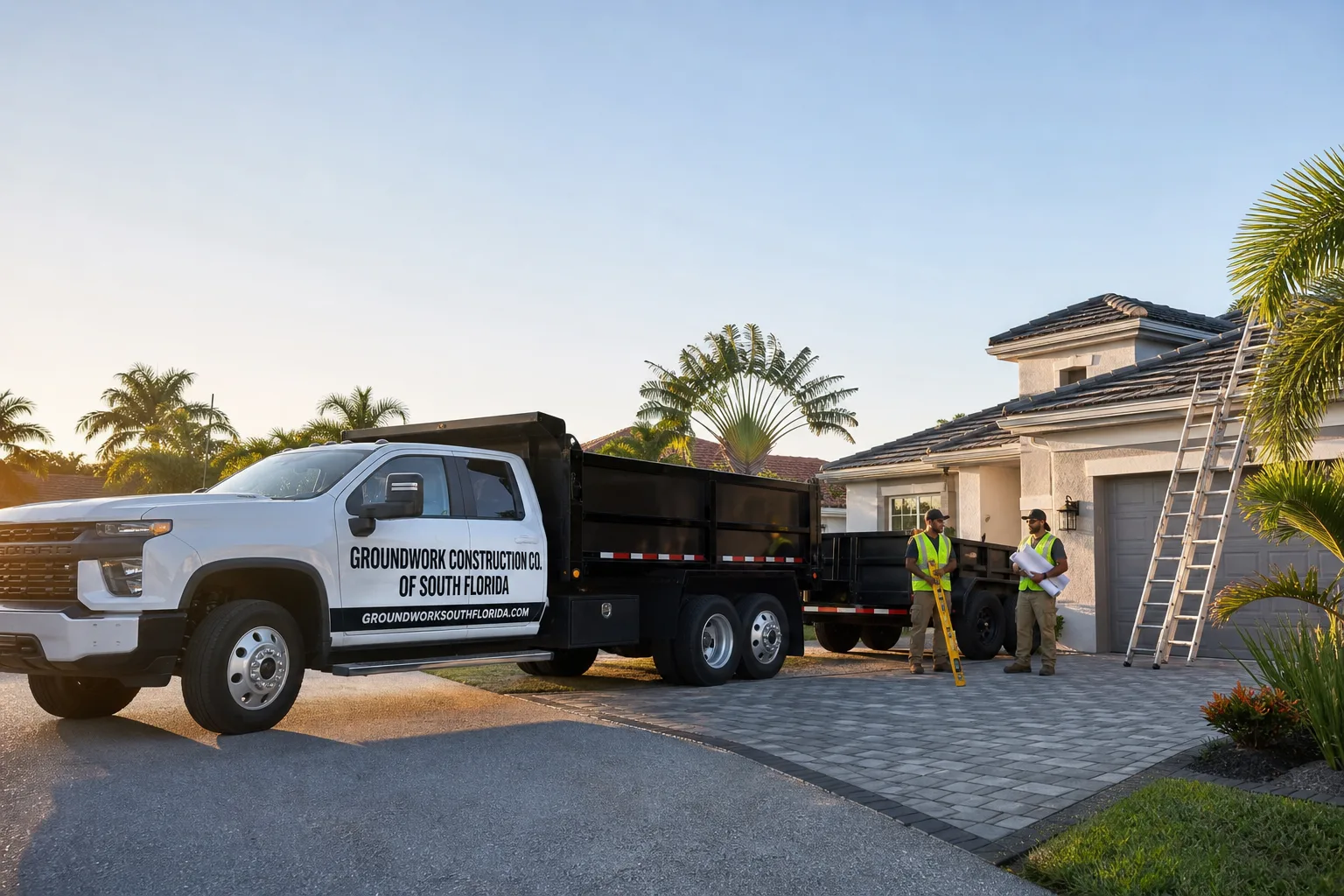
What Does Specialty Roofing in Hobe Sound Actually Involve?
Specialty roofing in Hobe Sound covers non-standard installations like flat/low-slope systems, built-up roofing, modified bitumen, and custom architectural configurations that fall outside conventional shingle or tile work. Most projects run 3-7 days depending on substrate condition and whether we’re tying into an existing structure or building from sheathing up. In Hobe Sound, specialty roofing typically ranges from $12,000 to $35,000, with coastal flood-zone homes often requiring additional structural prep. Call (844) 665-0162 for a free on-site estimate and we’ll scope your specific assembly.
We handle these jobs as part of a full exterior envelope approach or as standalone projects. When a homeowner in Hobe Sound needs a low-slope roof over a new addition, a custom parapet detail, or a built-up system that integrates with Roofing in Hobe Sound on the main structure, the sequencing and material choices get specific fast. This isn’t a commodity shingle swap. It’s spec-driven work where the wrong membrane or inadequate slope calculation shows up as ponding, premature failure, or a failed inspection three years later.
How We Handle Specialty Roofing From First Measurement to Final Walk
Every specialty roofing job in Hobe Sound follows a five-stage sequence. We’ve refined this through projects on everything from 1970s ranch reconfigurations to new custom builds along the barrier island corridor.
Stage 1: Site assessment and substrate diagnosis (Day 1)
We arrive with a moisture meter, core cutter if needed, and a level to check actual slope versus design slope. On older Hobe Sound homes, we regularly find sagging sheathing from decades of minor leaks, or original construction that assumed a 2:12 pitch that has settled closer to flat. The homeowner decision here: do we restore the original slope with tapered insulation, or reframe? That choice locks in material options. Tapered iso adds $3-$8 per square foot but solves drainage permanently. Reframing costs more upfront but opens up any membrane system. We photograph everything and send you the findings same day.
Stage 2: Specification and material selection (Days 2-3)
Based on slope, exposure, and whether the roof ties into an occupied space below, we present two or three assembly options. For Hobe Sound’s salt-air environment within a mile of the Atlantic or Intracoastal, we generally steer away from uncoated metal flashings and toward stainless or copper. The homeowner chooses the membrane type (TPO, PVC, modified bitumen, or built-up with gravel), insulation R-value, and whether to add a walkable surface or rooftop equipment pad. We also confirm color and finish for any visible edge metal. This is where our Roofing crew coordinates with the main roofline if we’re tying into existing work.
Stage 3: Permitting and pre-construction (Days 4-10, overlapping)
We pull permits through Martin County’s Building Department, which for specialty roofing means submitting the membrane manufacturer’s installation details, insulation attachment method, and wind uplift calculations. In Hobe Sound’s AE and VE flood zones, we also document whether the work affects the building’s base flood elevation. If the home is in a gated community or has HOA architectural review, we handle that submission simultaneously. Homeowner involvement: sign the permit application and confirm any HOA deadline. We track the review and flag any requests for information before they become delays.
Stage 4: Demolition, prep, and installation (Days 11-16, weather dependent)
We strip to sound substrate or install new sheathing, then build the assembly in lifts: vapor barrier if required, insulation boards mechanically attached or adhered per spec, membrane rolled and heat-welded or torched, then flashings at every penetration and edge. On low-slope work, we install internal drains or scuppers to our pre-agreed locations. Each day’s work gets photographed for the close-out binder. The homeowner needs to be available for two mid-installation checks: one after insulation to confirm thickness and attachment pattern, one after membrane to approve seam placement and drain locations.
Stage 5: Inspection, punch, and documentation (Days 17-20)
Martin County inspects for membrane integrity, fastening patterns, and flood-vent compliance if the roof encloses a crawl or utility space. We schedule the inspection only when we’ve already done our own flood test or electronic leak detection. After sign-off, we deliver the warranty registration, manufacturer maintenance guidelines, and photos of all penetration details. The homeowner keeps this for resale or insurance documentation.
The Assembly Choices You’ll Actually Decide Between
- TPO (thermoplastic polyolefin): White reflective surface, heat-welded seams, mid-range cost. Best for Hobe Sound homes where cooling load matters and the roof is visible from above. Seams are strong but require skilled welders; we’ve seen failed TPO jobs where corners were rushed. Lifespan 15-20 years with proper maintenance.
- PVC (polyvinyl chloride): Chemical-resistant, more flexible in cold, higher cost than TPO. Worth it if the roof will have grease or chemical exposure, or if you want the longest possible seam integrity in salt-air conditions. We’ve installed PVC on homes near the Hobe Sound National Wildlife Refuge where chemical cleaners aren’t permitted and durability matters more than initial cost.
- Modified bitumen (torch-down or self-adhered): Traditional multi-ply feel, excellent puncture resistance, lower material cost but more labor. Good for roofs with foot traffic, equipment, or where homeowners prefer a repairable system over a replaceable one. The granulated cap sheet comes in several colors; we typically specify white or tan for reflectivity.
- Built-up roofing (BUR) with gravel surfacing: The heaviest assembly, best fire rating, longest track record. We use this when the structure can handle the load and the homeowner wants a roof that can be patched indefinitely. Gravel surfacing protects the membrane from UV and foot traffic but complicates future leak detection.
- Insulation and slope package: Tapered polyiso adds $3-$8 per square foot depending on thickness and complexity. We design the taper to drain to internal drains, scuppers, or roof edges. On Hobe Sound’s flat-roofed mid-century ranches, this is often the difference between a roof that lasts 20 years and one that ponds water in year three.
What Specialty Roofing Costs in Hobe Sound, FL
Specialty roofing in Hobe Sound typically runs $12,000 to $35,000 for residential projects, with most falling in the $18,000-$28,000 range for assemblies between 1,500 and 3,000 square feet.
| Cost Driver | Low-End Impact | High-End Impact |
|---|---|---|
| Existing substrate condition | Solid sheathing, minor repair | Full reframing, sag correction, sistering joists |
| Slope correction needed | Minimal taper, simple drain layout | Complex tapered iso, multiple drains, scuppers |
| Membrane grade and thickness | 45-mil TPO, standard warranty | 80-mil PVC, premium warranty, walkable surface |
| Penetrations and detailing | Few pipes, standard curbs | Skylights, HVAC platforms, custom parapets |
| Flood-zone structural requirements | Standard attachment | Enhanced fastening, flood-vent integration, elevation documentation |
What’s included in our written estimate: membrane and insulation materials, labor, permit fees, dumpster and disposal, our project management, and manufacturer warranty registration. What’s typically separate: structural engineering if reframing is needed, electrical or plumbing relocation for drains and vents, and any HOA application fees. We flag these during assessment so there’s no surprise.
Call (844) 665-0162 and we’ll walk through where your project likely falls in that range. Estimates are free and include the full assembly specification.
Why Hobe Sound Changes How We Build These Roofs
Hobe Sound sits entirely within Martin County, which has among the most restrictive growth management and coastal construction regulations in Florida. Contractors working here must navigate Martin County’s Coastal Construction Control Line setbacks, environmental buffers tied to the Hobe Sound National Wildlife Refuge, and Loxahatchee River-adjacent flood zone requirements that simply do not apply just across the county line in Jupiter or Palm Beach Gardens.
For specialty roofing, this shows up in specific ways. The mainland side of 33455 mixes mid-century Florida ranch homes from the 1960s-80s with newer infill custom builds. Those older structures commonly lack modern hurricane strapping and require full tie-down upgrades when permitted for remodel. We’ve opened up flat roofs on 1970s ranches near Bridge Road to find original construction with no edge metal fastening to speak of, just gravel holding down a 50-year-old BUR assembly. Bringing that to current Martin County wind standards means more than new membrane; it means re-engineering the attachment.
The barrier island corridor near Jupiter Island drives different demands entirely: high-end luxury construction with strict wind-load and impact-rated envelope requirements. Specialty roofing there often integrates with impact-rated skylights, custom parapets designed for architectural review boards, and concealed drainage that doesn’t interrupt sight lines.
Salt-air corrosion accelerates fastener, flashing, and metal connector failures on homes within a mile of the water. We specify stainless or copper for all exposed metal on coastal specialty roofing, and we avoid dissimilar metal contact that sets up galvanic corrosion. In Hobe Sound’s direct Atlantic exposure, that detail alone can add five years to a roof’s service life.
Martin County’s Development Review Committee enforces environmental buffer rules tied to gopher tortoise habitat and wildlife refuge adjacency. While this more commonly affects ground-disturbing work, we’ve seen it delay projects where specialty roofing required crane placement on undeveloped portions of a lot, or where demolition debris handling crossed refuge buffer zones. We map this out before we price the job, not after permits are pulled.
Many homeowners in Hobe Sound pair exterior envelope work with other upgrades. We’ve seen specialty roofing projects naturally expand to include Sliding & Patio Doors in Hobe Sound for indoor-outdoor flow, or Glass Railing Systems in Hobe Sound for rooftop terraces and balconies that connect to the new roof assembly. Our crew coordinates these as one project, not sequential contractor handoffs.
Serving Hobe Sound, FL - Our Local Coverage Area
We’re based in the Hobe Sound area and know this community well. Use the map below to see our service coverage - if you’re nearby, we can almost certainly help.
Frequently Asked - Specialty Roofing in Hobe Sound
Most specialty roofing projects in Hobe Sound take 3-7 days of active construction, with 2-3 additional weeks for permitting and material lead times. Martin County’s permit review typically runs 7-10 business days for assemblies requiring manufacturer detail sheets. Call (844) 665-0162 and we’ll confirm current lead times for your specific membrane choice.
Yes, all roofing work in Martin County requires a building permit, and specialty roofing additionally needs manufacturer installation details and wind uplift documentation submitted with the application. Homes in AE or VE flood zones may need elevation certificates reviewed. We handle the entire permit package; you sign and we file.
Often yes, if the existing drains, vents, and conduit are in serviceable locations and the new assembly can tie in cleanly. We redesign drain positions only when slope correction or code compliance requires it. During assessment, we map every penetration and tell you upfront what stays and what moves.
PVC typically runs 15-25% higher material cost than TPO for the same thickness, or roughly $2,000-$5,000 more on a 2,500-square-foot assembly. In Hobe Sound’s salt-air environment, that premium buys better long-term seam integrity and chemical resistance. We quote both when the application supports either, so you see the exact difference for your roof.
Manufacturer material warranties range from 10 years for standard modified bitumen to 20-30 years for premium TPO or PVC with approved installation. Our workmanship warranty covers installation labor and detailing. We register both warranties in your name and deliver documentation at closeout. For warranty claim support down the road, call us first; we handle manufacturer contact so you’re not navigating that alone.
Get Your Specialty Roofing Estimate in Hobe Sound
Call (844) 665-0162 to schedule a free on-site assessment for specialty roofing in Hobe Sound. We’ll measure your roof, photograph the substrate condition, and deliver a written estimate with assembly options and real numbers within 48 hours. No deposit required to start the conversation.
Written by Raymond Estevez, Owner at Groundwork Construction Co., serving Hobe Sound since our South Florida expansion.