
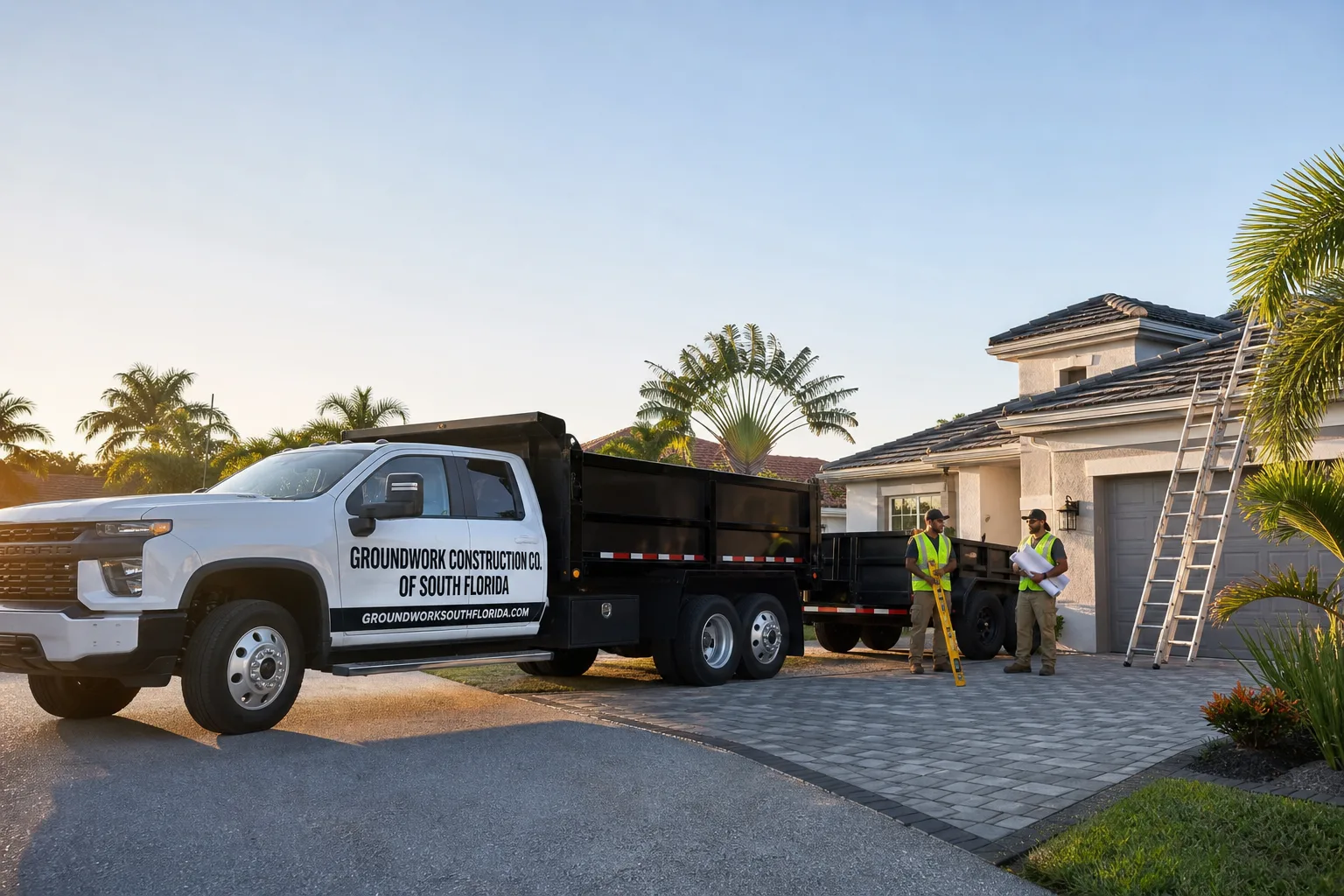
What Does Specialty Roofing in Lake Lucerne Actually Involve?
Specialty roofing in Lake Lucerne covers the non-standard roof systems that fall outside typical shingle replacement: flat and low-slope membranes, built-up roofing, modified bitumen, and hurricane-hardened retrofit installations on older CBS homes. Most projects we handle here run 3-7 working days depending on membrane type and whether we’re stripping multiple old layers, with costs typically ranging from $8,000 for a straightforward flat-roof recover to $20,000+ for a full tear-off with new insulation and NOA-approved drainage. Call (844) 665-0162 and we’ll walk your roof the same week.
How We Handle a Specialty Roofing Job from Start to Finish
Every specialty roofing project in Lake Lucerne follows a five-stage sequence. We’ve refined this over dozens of Miami-Dade flat-roof and membrane jobs, where the HVHZ rules don’t leave room for improvisation.
Stage 1: Roof walk and moisture mapping (Day 1)
We start by core-cutting or using infrared scanning to find trapped moisture in the existing assembly. On 1960s-era Lake Lucerne homes with original built-up roofing, we’ve found up to 40% of the field area saturated while the surface still looked intact. You’ll decide here whether we proceed with a recover (new membrane over sound existing) or full tear-off. Recover saves roughly 30-40% on labor, but only if moisture readings stay below 12% across the deck.
Stage 2: Deck inspection and structural note (Day 1-2)
Once exposed, we assess the concrete deck or wood fiberboard for spalling, chloride contamination, or deflection. Many 33056 homes have original 3/4-inch fiberboard that won’t meet current Miami-Dade uplift standards. If we find compromised substrate, you’ll choose between replacing sections with new high-density cover board or, in severe cases, adding structural framing. This decision point typically adds 1-2 days and $1,500-$4,000.
Stage 3: Drainage and edge detail planning (Day 2)
Flat roofs in Lake Lucerne live or die by drainage. We evaluate existing scuppers, internal drains, and perimeter edge conditions. The afternoon thunderstorms that hit this zip code from May through October will pond on any surface with less than 1/4-inch-per-foot slope. You’ll decide whether to add tapered insulation crickets (recommended for roofs under 1/8-inch slope), replace scupper heads with NOA-approved overflow assemblies, or both. Tapered iso adds material cost but eliminates the callbacks we see on flat roofs with poor drainage.
Stage 4: Membrane installation and flashing (Days 3-5)
We install your selected membrane system with full adhesion, mechanical attachment, or ballast depending on wind-uplift calculations and your preference. All base sheets, cap sheets, and adhesives carry current Miami-Dade NOA numbers; we keep copies on-site because county inspectors routinely request them. This stage includes welding seams, installing pre-manufactured edge metal, and sealing all penetrations. We schedule the mandatory third-party inspection before final surfacing.
Stage 5: Final inspection and warranty registration (Day 6-7)
Miami-Dade requires a roofing completion inspection for all specialty and flat-roof work. We coordinate this; you don’t need to be present. Once passed, we register your manufacturer warranty and provide the NOA documentation package for your records. The entire sequence from signed contract to final sign-off typically spans 10-14 calendar days, though wet-season weather can push this to 3 weeks.
The Specialty Roofing Options You’ll Actually Choose Between
Lake Lucerne homeowners with flat or low-slope roofs face three primary membrane paths, each with genuine trade-offs:
- Modified bitumen (torch-applied or self-adhered): The most common retrofit on 1960s-1970s CBS homes here. Two-ply systems run $8,000-$14,000 for typical 1,500-square-foot residential flat roofs. Torch-applied offers superior seam integrity but requires fire-watch protocol; self-adhered installs cleaner but costs 15-20% more. Lifespan: 15-20 years with proper maintenance. Best for homeowners who want proven performance without premium pricing.
- TPO (thermoplastic polyolefin) single-ply: White reflective membrane that cuts cooling loads significantly in South Florida’s climate. Material costs run 10-15% above modified bitumen, with total projects at $10,000-$17,000. The welded seams resist ponding better than taped systems, but TPO formulations vary; we specify only NOA-listed thicknesses from established manufacturers. Best for homes with chronic heat-gain issues or where the roof serves as occasional terrace space.
- Fluid-applied restoration: A coating system over sound existing substrate, not a true membrane replacement. Runs $3,500-$7,000 but carries shorter warranty terms (5-10 years versus 15-20). We recommend this only when core samples confirm dry substrate and the existing membrane is still structurally intact. Best for budget-focused homeowners planning to sell within 5 years, or as an interim measure before full replacement.
Drainage upgrades and tapered insulation represent separate decisions that cross all three membrane types. We typically recommend them together; a premium membrane with poor drainage still fails prematurely in Lake Lucerne’s rainfall pattern.
What Specialty Roofing Costs in Lake Lucerne, FL
| Project Scope | Price Range |
|---|---|
| Modified bitumen recover (sound substrate) | $8,000-$12,000 |
| Modified bitumen tear-off with insulation replacement | $12,000-$18,000 |
| TPO single-ply with full tapered insulation | $14,000-$20,000 |
| Fluid-applied restoration (coating only) | $3,500-$7,000 |
| Drainage/scupper upgrade (standalone) | $1,500-$4,000 |
Five factors push any specialty roofing job toward the high or low end of these ranges. Existing layer count matters most: each additional roofing layer adds tear-off labor and disposal cost. Deck condition determines whether we recover or strip to structure. Drainage complexity - adding crickets, relocating scuppers, or installing overflow drains - can equal 20% of total project cost. Access difficulty on tightly built 1960s lots with mature banyan trees affects crane and debris-removal logistics. And insulation depth: bringing a flat roof to current Miami-Dade energy code often requires adding R-30 polyiso, which adds material but qualifies for utility rebates.
A written estimate from us includes membrane, insulation, drainage components, edge metal, NOA-compliant fasteners and adhesives, permit fees, third-party inspection scheduling, and warranty registration. It does not include structural repairs beyond the roof deck, interior drywall repair if moisture damage exists, or tree trimming for access; we flag these separately during the roof walk.
Why Lake Lucerne Homes Make Specialty Roofing Different
The 33056 ZIP sits squarely in Miami-Dade County’s High Velocity Hurricane Zone, and that regulatory reality shapes every specialty roofing decision here. After Hurricane Andrew exposed catastrophic roof failures in 1992, the county built the NOA system - a product-by-product approval registry that no other Florida county matches. A roofing underlayment or adhesive that works in Fort Lauderdale or Boca Raton means nothing in Lake Lucerne unless it carries a current Miami-Dade Notice of Acceptance. We’ve seen Broward-based crews hit with stop-work orders on 33056 jobs because they substituted a non-NOA drip edge or modified bitumen base sheet mid-project. That doesn’t happen when your contractor knows the local inspection rhythm.
The housing stock reinforces this. Most Lake Lucerne homes are CBS construction from the 1960s-1970s suburban wave, with flat or low-slope roofs that were never designed for modern hurricane loads. Original fiberboard insulation, absent hurricane strapping, and scupper drains sized for lighter rainfall all show up regularly on our roof walks. The shallow Miami Limestone bedrock that surfaces inches below grade in this area doesn’t directly affect roofing, but it does complicate any associated work - like adding structural columns for a roof-mounted solar array or running new electrical for rooftop equipment.
Then there’s the wet season. From May through October, near-daily afternoon thunderstorms compress exterior construction windows. We schedule membrane installations during drier morning hours and maintain temporary waterproofing protocols. A flat roof left open overnight in July is a liability we don’t accept. This scheduling reality is part of why specialty roofing in Lake Lucerne demands a contractor who works this market consistently, not one passing through from a neighboring county.
Serving Lake Lucerne, FL - Our Local Coverage Area
We’re based in our Lake Lucerne service area and know this community well. Use the map below to see our service coverage - if you’re nearby, we can almost certainly help.
Frequently Asked - Specialty Roofing in Lake Lucerne
Most specialty roofing projects here take 3-7 working days of actual installation, with 10-14 calendar days from contract to final inspection. Wet-season weather and Miami-Dade’s third-party inspection scheduling can extend this to 3 weeks. We build weather contingencies into every timeline we provide; call (844) 665-0162 for a specific schedule based on your roof size and membrane choice.
Yes. Miami-Dade County requires permits for all roofing work, and specialty or flat-roof jobs trigger additional third-party inspection requirements under the HVHZ code. We handle permit application, NOA documentation, and inspector coordination as part of our standard process. The permit fee is included in your written estimate.
Usually, yes. Most residential flat roofs in 33056 have rooftop HVAC curbs and electrical conduit that we work around rather than relocate. If your equipment sits directly in a drainage path or on saturated substrate we need to replace, we’ll flag that during the roof walk and discuss options. Equipment relocation is the exception, not the rule.
Coating costs roughly 40-60% less upfront - typically $3,500-$7,000 versus $8,000-$20,000 for full replacement - but carries a shorter warranty and doesn’t address underlying moisture damage. We recommend coating only when core samples confirm dry substrate and your planning horizon is under 10 years. For most Lake Lucerne homeowners with original 1960s-1970s roofing, full replacement is the sounder long-term investment.
Manufacturer material warranties range from 10 years (standard modified bitumen) to 20 years (premium TPO with proper maintenance). Our workmanship warranty covers installation-specific issues for a period we specify in writing. The critical factor is proper warranty registration with NOA documentation; we handle this at project closeout so your coverage is valid if you ever need it.
Ready to Talk Through Your Roof?
Roofing services like ours in Lake Lucerne aren’t a commodity purchase - it’s a regulated, climate-specific decision that benefits from a contractor who knows the NOA system and the 33056 housing stock. We’ll walk your roof, show you what we find, and build an estimate that accounts for your actual conditions, not a generic square-foot price. Call (844) 665-0162 to schedule a free on-site evaluation. Raymond Estevez or a senior member of our roofing crew will meet you, answer your questions, and email a written estimate within 48 hours.
Written by Raymond Estevez, Owner at Groundwork Construction Co., serving Lake Lucerne and Miami-Dade County homeowners since our founding.