
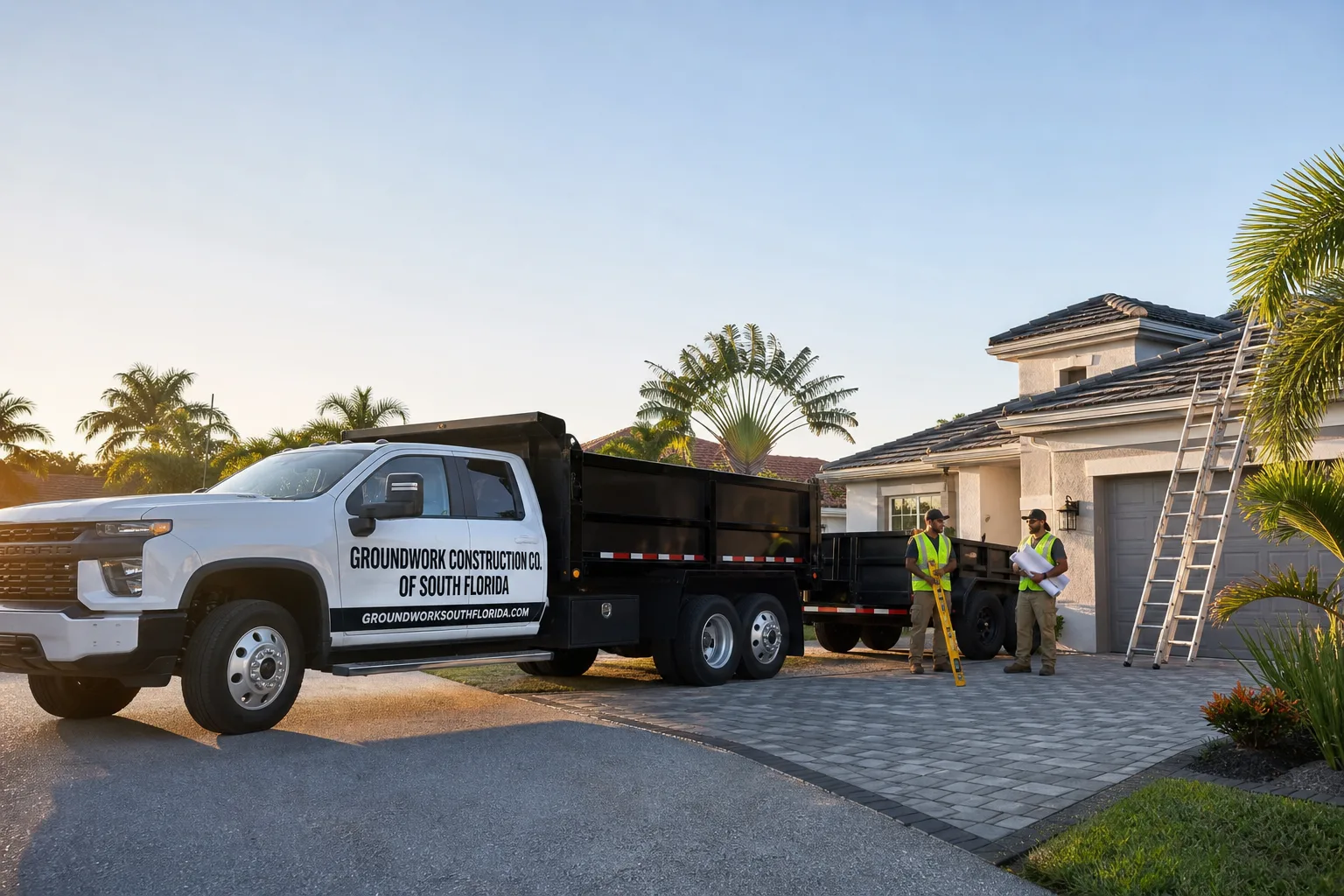
What Specialty Roofing in Lauderdale-by-the-Sea Actually Involves
Specialty roofing in Lauderdale-by-the-Sea covers the non-standard systems that standard asphalt shingle crews won’t touch: flat and low-slope membranes on condo buildings, built-up roofing on 1960s-1980s mid-rises, tapered insulation assemblies for ponding-prone decks, and full recoveries over existing modified bitumen. Most jobs we handle here run 3-7 days for residential-scale work and $8,000-$20,000 depending on substrate condition and membrane choice. Call (844) 665-0162 and we’ll walk your specific roof with you, no charge.
How We Run a Specialty Roofing Job from First Call to Final Walk
We break every specialty roofing project into five distinct stages. You’ll know where we are, what we’re doing, and what decision sits on your desk before we move forward.
Stage 1: Diagnostic site visit (1-2 hours, day 1)
Raymond Estevez or one of our senior estimators climbs the roof, probes the substrate with a moisture meter, and photographs every penetration, seam, and suspect area. On Lauderdale-by-the-Sea condos, we’re specifically looking for salt-air corrosion of metal flashings, concrete spalling around roof-level mechanical curbs, and whether the existing assembly is wet underneath. You get a written scope, membrane options, and a fixed-price estimate within 48 hours.
Stage 2: Material selection and permit filing (3-10 business days)
This is where you decide. We present membrane samples, R-value targets for any insulation replacement, and drainage improvement options if your flat roof ponds. For buildings under SB 4-D milestone inspection, we coordinate our structural drawings with your engineer’s report. We file permits with Broward County; most specialty roofing permits clear in 5-7 days, though condo association approval can add another week.
Stage 3: Tear-off and substrate prep (1-2 days)
We strip to sound deck, replace saturated insulation, and repair or replace rusted edge metal. In Lauderdale-by-the-Sea, we frequently find galvanized fasteners reduced to nubs and aluminum drip edge pitted through. We don’t cover that up. If your concrete parapet walls need spall repair before membrane termination, we bring in our concrete crew or coordinate with your structural contractor.
Stage 4: Membrane installation and flashing (2-4 days)
The crew lays the primary membrane, typically TPO or modified bitumen for commercial-style flat roofs, or a multi-ply built-up system on older buildings where matching existing height matters. Every seam gets hot-air welded or torched, every penetration gets a prefabricated boot or custom-fabricated counterflashing. We don’t leave until the roof holds a flood test or electronic leak detection scan, your choice.
Stage 5: Inspection, warranty registration, and closeout (1 day)
Broward County inspects for code compliance. We register your manufacturer warranty, typically 15-20 years on membrane and 5-10 on labor, and leave you with photos, as-builts, and maintenance recommendations. Raymond reviews every closeout package personally.
The Specialty Roofing Options You’ll Actually Choose Between
Specialty roofing isn’t one product. It’s a set of assemblies, and the right one depends on your building’s structure, your association’s rules, and how long you plan to hold the property.
- TPO single-ply (white, heat-welded seams): The dominant choice for recoveries and new flat roofs in South Florida. Reflective surface cuts cooling load, seams are stronger than the sheet itself when done right. Best for: buildings with intact insulation that need a 15-20 year solution. Honest trade-off: cheaper upfront than multi-ply systems, but punctures from maintenance traffic require careful repair.
- Modified bitumen (torch-applied or self-adhering): Two-ply redundancy with a bituminous core that seals small punctures naturally. We specify this when the existing roof has multiple layers already and total tear-off would trigger structural load concerns, or when the building’s mechanical equipment requires frequent foot traffic. Best for: older condo roofs with substrate uncertainty. Trade-off: darker surface absorbs more heat; energy costs run higher unless you add reflective coating.
- Built-up roofing (BUR) with gravel or cap sheet: The original 1960s-1970s assembly still found on many Lauderdale-by-the-Sea mid-rises. We install this only when matching existing height is mandatory for door thresholds, drainage scuppers, or association aesthetic rules. Best for: historical compliance and impact resistance. Trade-off: heavy, slower to install, and requires more structural load capacity than single-ply alternatives.
- Tapered insulation recovery: Not a membrane type but a configuration: we install sloped polyiso insulation boards beneath the new membrane to eliminate standing water without restructuring the deck. Best for: roofs that pond in multiple locations but have sound structural framing. Trade-off: adds $2-$4 per square foot, but solves the problem that destroys most flat roofs in this climate.
What Specialty Roofing Costs in Lauderdale-by-the-Sea, FL
| Scope Level | Typical Range |
|---|---|
| Partial recovery (good substrate, single membrane layer) | $8,000 - $12,000 |
| Full tear-off with standard insulation replacement | $12,000 - $16,000 |
| Complex job: tapered insulation, concrete repair, multiple penetrations | $16,000 - $20,000 |
Five variables push you toward the high or low end. Existing substrate condition is the biggest: dry, intact decking means recovery; wet, compromised assemblies require full tear-off and replacement. Square footage matters less than you might think on flat roofs because labor efficiency is high; complexity of penetrations matters more. Insulation depth and type - replacing 1-inch fiberboard versus installing 4-inch tapered polyiso - can swing the number $3,000 either way. Concrete parapet or curb repair, common in salt-exposed Lauderdale-by-the-Sea buildings, is scoped separately but often runs concurrently. Permit and inspection scope varies: Broward County charges by valuation, and SB 4-D-triggered structural coordination adds engineering review fees that standard re-roofs don’t carry.
Our written estimates itemize membrane, insulation, fasteners, edge metal, permit fees, and labor. They do not include interior damage repair, structural engineering (we’ll refer), or tree trimming for access - those are separate trades we can coordinate but don’t self-perform.
What Lauderdale-by-the-Sea Specifically Does to Specialty Roofing Jobs
No other market in Broward County looks like this one. Lauderdale-by-the-Sea’s entire 1.3-square-mile footprint sits flush against the Atlantic, and the building stock - overwhelmingly 1960s-1980s low- and mid-rise condominiums - carries damage patterns you won’t see three miles inland.
The salt air here doesn’t just corrode; it accelerates concrete spalling at roof parapets and mechanical curbs, which then channels water behind membranes that would otherwise be intact. We regularly open roofs on El Mar Drive and Bougainvilla Drive buildings to find galvanized steel edge nails reduced to rust dust, and aluminum coping stones pitted through to substrate. The near-sea-level water table, sometimes 2-3 feet below grade, means any roof leak that reaches interior walls encounters saturated block that won’t dry without aggressive remediation.
Then there’s SB 4-D. Because every qualifying condo in Lauderdale-by-the-Sea sits within three miles of the coastline, the 25-year milestone inspection trigger applies universally. The structural reports generated from these inspections are creating a continuous pipeline of specialty roofing work: not full replacements necessarily, but targeted membrane recoveries tied to concrete spall repair, rebar encapsulation, and balcony soffit restoration. We’re often brought in by property managers who need a roofing contractor who can interface directly with their structural engineer’s repair schedule, not just shingle a pitched roof and leave.
HOA architectural committees here are active and specific. Color, reflectivity, and edge profile often get dictated by decades-old declarations. We submit membrane samples and detail drawings before permit filing to avoid mid-project holds.
If your project scope extends beyond the roofline, we handle that too. Our Roofing in Lauderdale-by-the-Sea page covers the full vertical, and many condo associations pair roof work with Sliding & Patio Doors in Lauderdale-by-the-Sea or Glass Railing Systems in Lauderdale-by-the-Sea to address multiple envelope failures from the same salt-air exposure. As a Roofing contractor with full exterior capability, we coordinate the full scope under one contract.
Serving Lauderdale-by-the-Sea, FL - Our Local Coverage Area
We’re based in the Lauderdale-by-the-Sea area and know this community well. Use the map below to see our service coverage - if you’re nearby, we can almost certainly help.
Frequently Asked - Specialty Roofing in Lauderdale-by-the-Sea
Most residential and small-scale commercial specialty roofing projects in Lauderdale-by-the-Sea run 3-7 days of actual construction, plus 5-10 days for permit approval and material procurement. Condo association approval can add another week. Call (844) 665-0162 and we’ll give you a specific timeline for your building.
Yes. Broward County requires permits for all roof replacements, recoveries, and structural modifications; Lauderdale-by-the-Sea’s building department enforces this strictly, especially for condo buildings under SB 4-D milestone inspection. We handle permit filing, engineering coordination, and inspection scheduling as part of our standard scope.
Usually yes. Flat and low-slope specialty roofing sits above - not through - your building’s MEP systems. We work around existing penetrations for vents, condensate lines, and conduit. Relocation becomes necessary only when rooftop equipment needs reconfiguration or when structural repairs below the membrane require access; we’ll flag that in our initial scope if so.
Roof repair addresses isolated leaks or storm damage on any roof type. Specialty roofing refers to the full assembly - membrane, insulation, drainage, and flashings - on flat or low-slope structures that standard shingle crews don’t handle. In Lauderdale-by-the-Sea’s condo market, we more often perform specialty roofing than conventional repair because the building stock demands it.
Manufacturer warranties on TPO and modified bitumen membranes typically run 15-20 years; our workmanship warranty covers installation defects for 5-10 years depending on system complexity. Warranties require documented maintenance - annual inspections and prompt repair of mechanical damage - which we offer as a separate service. Ask us for the specific terms on your chosen membrane.
Ready to Scope Your Specialty Roofing Project?
Call (844) 665-0162 to schedule a free, no-obligation site visit. Raymond Estevez or a senior estimator will walk your roof, probe the substrate, and deliver a written estimate within 48 hours. We serve all of Lauderdale-by-the-Sea, including the full 33303 ZIP, and we coordinate directly with your property manager, structural engineer, and HOA as needed. One contractor, every phase - from diagnosis to warranty registration.
Written by Raymond Estevez, Owner at Groundwork Construction Co., serving Lauderdale-by-the-Sea and South Florida.