
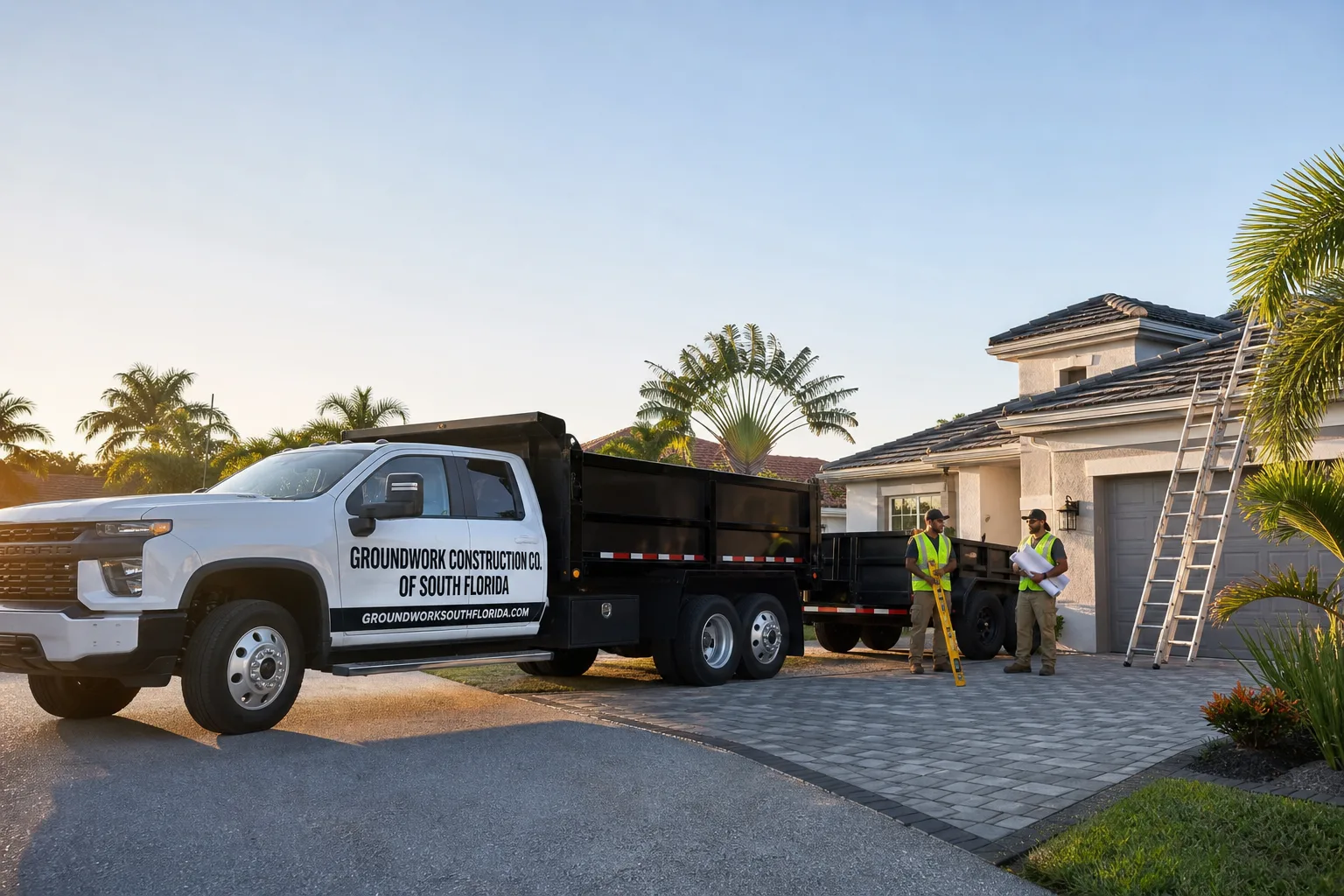
What Specialty Roofing in South Miami Actually Involves
Roofing in South Miami covers non-standard installations on flat roofs, low-slope structures, and architecturally unique homes that fall outside conventional shingle or tile replacement. Most projects we handle here run 3 to 7 days once permits clear, with costs typically landing between $8,000 and $20,000 depending on system complexity and structural condition. Call (844) 665-0162 and we’ll walk your roofline with you, identify what’s needed, and deliver a written estimate within 48 hours.
How We Handle a Specialty Roofing Project Start to Finish
Every specialty roofing job in South Miami follows a five-stage sequence. We’ve refined this over years of working with the city’s unique mix of post-war CBS ranches and tighter urban lots where access and tree protection add real constraints.
Stage 1: Site Assessment and Tree Survey Coordination (Day 1)
We walk the roof, document slope, drainage paths, and existing membrane or built-up conditions. Because South Miami requires a tree survey for virtually every construction permit, we flag protected canopy zones immediately and coordinate with a city-approved arborist if root zones overlap our work area. Homeowner decision point: whether to proceed with standard permitting or pursue a variance if tree mitigation is triggered.
Stage 2: Structural and Electrical Evaluation (Days 2-3)
Many homes we work on in South Miami were built between the late 1940s and early 1970s with original tie-beam construction and electrical panels that won’t pass current Miami-Dade HVHZ code. We assess whether your panel needs upgrading before the roofing permit can be approved. Homeowner decision point: whether to bundle the electrical upgrade with the roofing project or sequence it separately.
Stage 3: Material Selection and System Design (Days 3-5)
This is where specialty roofing diverges from standard replacement. We specify the membrane type, insulation R-value, fastening method, and edge detail based on your roof’s slope, the building’s wind-load requirements, and your long-term maintenance preferences. Homeowner decision point: membrane type, warranty length, and whether to add cool-roof or solar-ready features.
Stage 4: Permitting and Pre-Construction Prep (1-3 weeks)
We submit to South Miami’s building department, not Miami-Dade County’s. The city runs its own plan review and inspection schedule, which moves on a different timeline than unincorporated areas like Kendall. We handle the arborist report, wind-load calculations, and impact-opening documentation. Homeowner decision point: scheduling start date around permit release and any variance hearing outcomes.
Stage 5: Installation and Final Inspection (3-7 days on-site)
Crews arrive, strip existing roofing to substrate, repair any deteriorated decking, install the specified system, and flash all penetrations. South Miami’s wet-season flooding patterns mean we pay particular attention to drainage scuppers and interior gutter integration. Final city inspection follows, then warranty registration with the manufacturer.
The Material and System Choices You’ll Face
Specialty roofing isn’t one product. It’s a category of systems designed for roofs that standard shingles or tiles can’t serve. Here’s what South Miami homeowners actually choose between:
- TPO (Thermoplastic Polyolefin) single-ply: White reflective surface, heat-welded seams, strong puncture resistance. Best for flat roofs where cooling costs matter. Holds up 15-20 years in South Miami’s UV exposure. Honest trade-off: lower material cost than PVC, but less chemical resistance if your roof sees grease or solvent exposure from nearby mechanical equipment.
- PVC single-ply: Similar installation to TPO but with superior chemical resistance and slightly better seam strength. Costs 15-25% more upfront. Best for roofs with kitchen vents, grease exhaust, or heavy AC condensate exposure. Trade-off: the price premium only pays back if you actually need that chemical resistance.
- Modified bitumen (torch-applied or self-adhering): Multi-ply system with asphalt-based membranes reinforced with polyester or fiberglass. Excellent for low-slope transitions and detail-heavy roofs. Trade-off: heavier material weight means we verify your structure can handle it, and torch application requires additional fire-safety protocols on site.
- Built-up roofing (BUR) with gravel surfacing: The traditional 3-4 ply asphalt system with aggregate ballast. Still specified for some commercial-adjacent residential structures in South Miami. Trade-off: longest track record, but hardest to pinpoint leaks and heaviest structural load. We only recommend this when matching an existing system or when the structure was originally engineered for it.
- Fluid-applied restoration systems: Not a full replacement, but a viable specialty option for roofs with sound substrate but aged membrane. Silicone or acrylic coatings extend service life 10-15 years at roughly half the cost of tear-off. Trade-off: only works if we confirm the deck is dry and intact; it’s a deferral, not a solution, for failing structures.
Our roofing crew specs from GAF, CertainTeed, Owens Corning, and other manufacturer partners in our broader brand portfolio, but specialty flat and low-slope systems draw from dedicated commercial-grade product lines with their own warranty structures.
What Specialty Roofing Costs in South Miami, FL
| Project Scope | Typical Range |
|---|---|
| Specialty roofing (flat/low-slope, standard membrane) | $8,000 - $20,000 |
| Metal roof installation (standing seam or architectural) | $15,000 - $40,000 |
| Tile roof repair (limited scope) | $600 - $2,500 |
| Roof repair (general, non-specialty) | $400 - $1,800 |
Five factors push your South Miami specialty roofing project to the high or low end of that range:
1. Roof size and complexity. A simple 1,200 square foot flat rectangle costs less than the same footage broken into multiple levels, parapets, and mechanical penetrations. Each corner, vent stack, and transition adds labor and material.
2. Existing substrate condition. If we strip to find saturated decking or compromised tie-beams common in 1950s-60s South Miami construction, structural repair adds $2,000-$8,000 before the new membrane goes down.
3. Electrical panel upgrade requirement. When the city won’t release the roofing permit until your panel meets current code, that electrical work runs $1,500-$4,500 and must be completed first.
4. Material grade and warranty length. A 15-year TPO system with standard fasteners costs less than a 30-year PVC with induction-welded seams and extended manufacturer coverage. The gap can be $3,000-$6,000 on a typical residential flat roof.
5. Tree mitigation and variance costs. South Miami’s canopy protection ordinance can trigger arborist reports ($400-$800), mitigation fund payments based on caliper inches removed, and variance hearing fees if protected root zones conflict with equipment staging or material delivery paths.
A written estimate from us includes full tear-off, substrate repair up to 10% of roof area, specified membrane system, flashing, permits, and final inspection. It does not include electrical upgrades, tree mitigation payments, or structural engineering if your tie-beam system needs reinforcement. We flag these potentials during assessment so you’re not surprised.
Why South Miami Homes Make This Job Different
We’ve learned that contractors who cruise down from Fort Lauderdale or over from unincorporated Kendall expecting standard Miami-Dade County permitting get caught flat-footed in South Miami. The city occupies barely 2.3 square miles, governs its own building department, and enforces code amendments that don’t match the county’s unincorporated process. That matters for specialty roofing because flat and low-slope systems trigger stricter wind-uplift calculations here than in neighboring Glenvar Heights or Coral Gables, and the city’s inspectors know exactly how to read membrane seam weld tests and edge-metal fastening patterns.
The housing stock tells the rest of the story. Those CBS ranch homes built from the late 1940s through the early 1970s, concentrated around areas like the eastern edge near Sunset Drive and the southern blocks toward Ludlam, came with flat roofs designed for built-up asphalt systems that have now aged past 50 years. We regularly find original tie-beam construction with inadequate hurricane strapping and electrical panels that predate modern arc-fault requirements. The roof can’t be permitted until the panel is addressed, and the panel can’t be addressed without knowing if the roofing scope triggers a full re-evaluation of the home’s electrical load.
Then there’s the water. South Miami’s inland elevation and limited stormwater infrastructure mean chronic lot-level flooding from June through October. A specialty roofing project here isn’t complete until we’ve verified that interior drains, scuppers, and overflow routes actually move water off the roof faster than it arrives in a 6-inch-per-hour summer deluge. We’ve seen properly installed membranes fail because drainage was treated as an afterthought.
And the trees. Mature live oaks on properties near South Miami‘s commercial corridor can place protected root zones directly where crane or material staging needs to happen. We’ve learned to plan equipment paths before finalizing the install schedule, because a variance hearing adds weeks that templated contractors don’t build into their timelines.
Homeowners in this market often pair exterior envelope work with Sliding & Patio Doors in South Miami or Glass Railing Systems in South Miami to complete the transition between indoor and outdoor living spaces, especially on homes where the flat roof extends over a patio or deck area.
Serving South Miami, FL - Our Local Coverage Area
We’re based in the South Miami area and know this community well. Use the map below to see our service coverage - if you’re nearby, we can almost certainly help.
Frequently Asked - Specialty Roofing in South Miami
Most specialty roofing projects in South Miami take 3 to 7 days of actual installation once permits are released, but the full timeline from signed contract to final inspection typically runs 4 to 8 weeks. That longer window accounts for South Miami’s separate building department review, tree survey coordination, and any electrical panel upgrade that must precede the roofing permit. Call (844) 665-0162 and we’ll outline a realistic schedule based on your property’s specific conditions.
Yes, absolutely. South Miami requires a building permit for any roof covering replacement or structural modification, and the city operates its own permitting office independent of Miami-Dade County. Your permit application must include wind-load calculations, manufacturer specifications, and often a tree survey. We handle the entire submission and inspection scheduling as part of our project management.
Usually yes, if we’re talking about the roofing scope itself. The membrane and flashing work doesn’t inherently require relocating plumbing vents or electrical service. However, many South Miami homes need electrical panel upgrades to meet current code before the roofing permit can be issued, which is a separate but sequenced task. We assess this during stage 1 and bundle the work under our single-source management if needed.
Specialty roofing for flat or low-slope applications in South Miami typically runs $8,000 to $20,000, while conventional pitched-roof replacement with shingles or tile on a similar footprint might land in a comparable or slightly lower range depending on material. The real cost driver isn’t the specialty category itself, it’s the structural condition, drainage complexity, and permitting burden specific to your property. We itemize these factors in every written estimate.
You receive two layers of coverage: a workmanship warranty from Groundwork Construction Co. covering installation quality, and a material warranty from the membrane manufacturer (TPO, PVC, or modified bitumen) that typically runs 15 to 30 years depending on the system grade. Manufacturer warranties require proper installation by a qualified contractor and registration of the completed project, both of which we handle. The warranty does not cover damage from deferred maintenance, third-party alterations, or acts of nature beyond the system’s rated wind speed.
Ready to Talk Through Your Roof?
Specialty roofing in South Miami demands a contractor who knows the city’s separate permitting track, its canopy protection requirements, and the structural realities of its post-war housing stock, plus experience with South Miami ADU Site Prep & Utilities when projects expand beyond the roof. We’ll walk your property, identify what’s actually needed, and deliver a written estimate with no obligation. Call (844) 665-0162 to schedule your free on-site assessment. Raymond Estevez and our team will handle every phase from tree survey coordination through final inspection.
Written by Raymond Estevez, Owner at Groundwork Construction Co., serving South Miami since our founding in South Florida.