
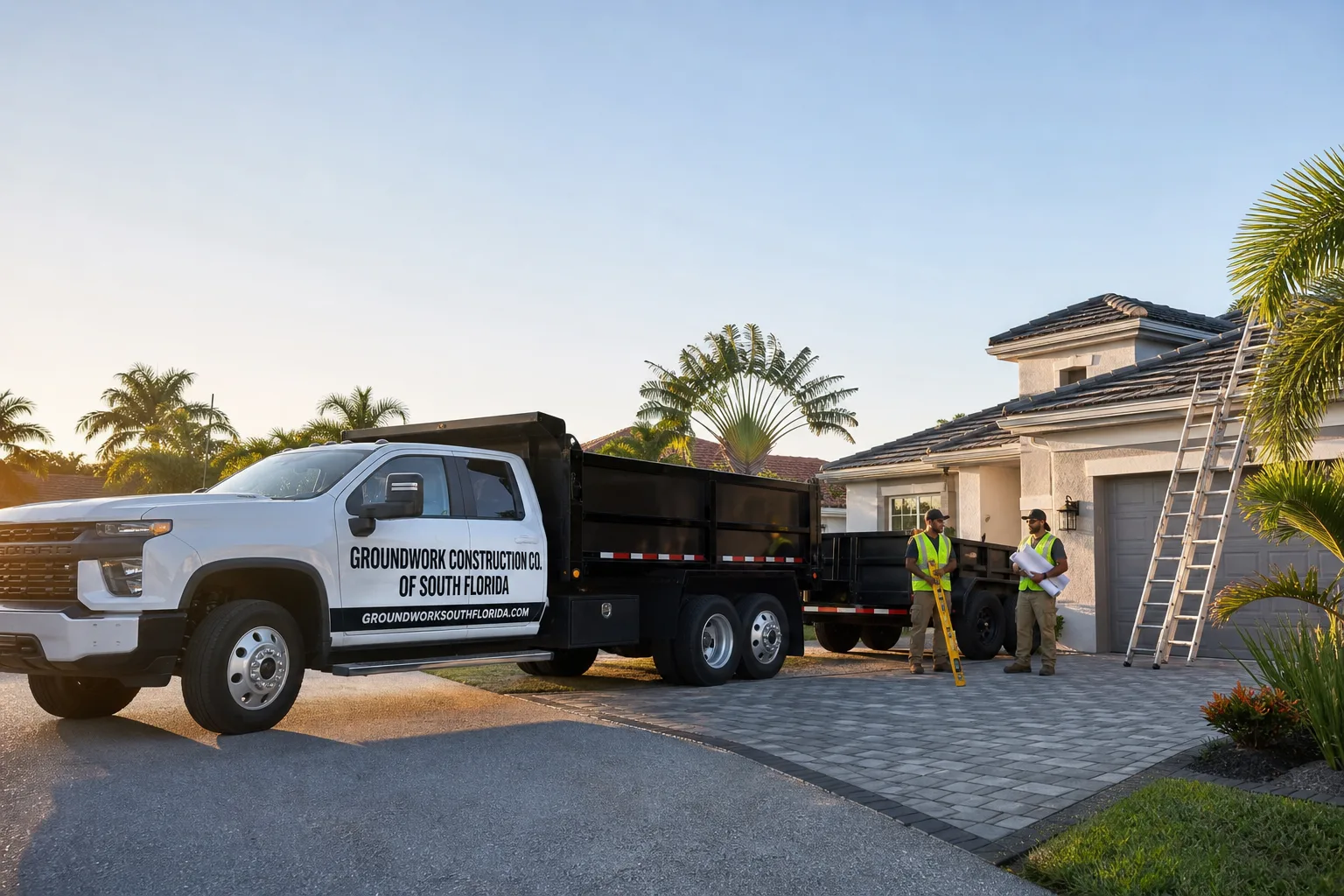
Tile Roofing in Glenvar Heights - Cost, Timeline, and What to Expect
Tile roofing in Glenvar Heights typically runs $8,000-$20,000 for a full replacement and $600-$2,500 for repairs, with most projects taking 5-10 business days from tear-off to final inspection. We’re Groundwork Construction Co., and we handle tile roofing as part of a full roofing project in Glenvar Heights or as a standalone job. Call (844) 665-0162 for a free on-site estimate and written quote.
How We Handle a Tile Roof Project Start to Finish
Every tile roof we install in Glenvar Heights follows a five-stage sequence. Homeowners know exactly where we are, what we’re doing, and what decision they need to make next.
Stage 1: Site assessment and permitting (2-5 days)
We walk the roof, photograph every plane, and measure for tile count, underlayment, and flashing. On Glenvar Heights homes built between 1950 and 1975, we’re checking for the original built-up roof substrate, the condition of the roof-to-wall connections, and whether Miami-Dade’s HVHZ requirements will trigger mandatory hurricane-strap upgrades. You’ll decide between clay and concrete tile at this stage, plus whether you want us to spec a secondary water barrier. We pull permits through Miami-Dade County and schedule the first inspection.
Stage 2: Tear-off and structural inspection (1-2 days)
We strip to the deck. Here’s where Glenvar Heights projects often reveal surprises: saturated plywood from decades of flat-roof ponding, termite damage in the fascia, or rafters spaced too wide for modern tile loads. If we find compromised decking, we stop and show you. You’ll approve the plywood replacement scope before we move on. This stage ends with a dry-in inspection by Miami-Dade.
Stage 3: Deck prep and underlayment (1-2 days)
We install ASTM D226 Type II felt or a self-adhering membrane, depending on your tile choice and the roof pitch. On low-slope sections common in 33143 ranch homes, we may recommend a modified bitumen transition to meet code. You’ll confirm your tile color and profile here; orders typically take 2-3 weeks, so we coordinate delivery to arrive just before Stage 4.
Stage 4: Tile installation and flashing (3-5 days)
We set starter courses, install field tile, and cut hips, ridges, and valleys. Clay barrel tile goes down differently than flat concrete; the former needs more labor, the former more structural load capacity. We install copper or painted steel flashing at all wall intersections and penetrations. You’ll do a mid-installation walk if you want one. This stage ends with a roofing inspection.
Stage 5: Final inspection and cleanup (1 day)
Miami-Dade inspects for code compliance, wind uplift attachment, and proper fastening patterns. We correct any punch items, haul debris, and magnet-sweep the property. You’ll receive your final invoice, manufacturer warranty paperwork, and our workmanship documentation.
The Tile Choices You’ll Actually Pick Between
Not all tile roofing performs the same in Glenvar Heights. Here’s what we see homeowners weigh:
- Clay barrel tile (Spanish/S-tile): The classic Mediterranean look, 80-100+ year lifespan, and excellent UV resistance. It’s also the heaviest option at 950-1,200 pounds per square, so your roof structure must handle it. Some 1950s ranch rafters need sistering or supplemental framing. Premium clay runs at the high end of our pricing range but rarely needs replacement.
- Flat concrete tile: More affordable, lighter at 700-900 pounds per square, and available in profiles that mimic slate or wood shake. It absorbs more moisture than clay and can show efflorescence over time. Concrete suits homeowners who want the tile aesthetic without structural reinforcement costs.
- Lightweight composite tile: Under 600 pounds per square, often installable over existing decking that wouldn’t pass for clay. The trade-off is a shorter proven lifespan in South Florida’s UV exposure. We specify this when structural capacity is fixed and the homeowner wants tile regardless.
- Underlayment grade: Standard felt vs. self-adhering ice-and-water shield. In Glenvar Heights, where wind-driven rain can push uphill during tropical systems, we recommend the self-adhering membrane on slopes below 6:12. It adds $800-$1,500 to a typical job but eliminates the most common leak path we see in tile callbacks.
- Fastening method: Foam adhesive vs. mechanical screws. Miami-Dade HVHZ code often mandates foam-adhered or screw-fastened systems with specific uplift ratings. We spec based on your tile manufacturer’s Miami-Dade NOA (Notice of Acceptance), not guesswork.
What Tile Roofing Costs in Glenvar Heights, FL
| Scope | Price Range |
|---|---|
| Tile roof repair (localized) | $600-$2,500 |
| Partial re-tile (one slope/section) | $3,500-$8,000 |
| Full tile roof replacement | $8,000-$20,000 |
Five factors move you toward the low or high end:
1. Existing roof condition. A single-layer tear-off with sound decking keeps you near $8,000-$11,000. Multiple layers, rotted plywood, or failed fascia pushes labor and material higher.
2. Structural reinforcement needs. Clay tile on a 1962 CBS ranch often requires rafter sistering or collar-tie upgrades. We’ve seen this add $2,000-$5,000.
3. Hurricane retrofit triggers. When Miami-Dade inspectors mandate roof-to-wall connection upgrades on pre-1994 homes, the scope expands beyond roofing. We price this possibility into our initial estimate so you’re not surprised.
4. Tile material and profile. Import clay costs more than domestic concrete. Custom color blends or high-profile barrel shapes increase per-square pricing.
5. Access and complexity. Steep pitches, multiple dormers, or tight lot lines in Glenvar Heights’ older neighborhoods slow production and raise labor.
A written estimate from Groundwork includes tear-off, disposal, decking repair up to a specified square footage, underlayment, tile, flashing, permits, and inspections. It does not include gutter replacement, soffit repair, or interior ceiling work from prior leaks.
Why Glenvar Heights Homes Change How We Bid This Job
Glenvar Heights sits in unincorporated Miami-Dade County within the High-Velocity Hurricane Zone, the strictest wind-load jurisdiction in the country. That reality shapes every tile roof we price here.
The 33143 ZIP is dominated by single-story CBS ranch homes built from roughly 1950 to 1975, many with flat or low-slope built-up roofs originally designed for hot-mop tar and gravel. When homeowners want tile, we’re often converting a near-flat roof to a pitched assembly or overlaying a low slope with profiled tile and enhanced waterproofing. Neither is straightforward.
The defining local challenge: Miami-Dade’s post-Andrew inspection protocol. Pull a permit on a pre-1994 home and inspectors routinely require full roof-to-wall connection upgrades to current Florida Building Code standards. Hurricane straps, enhanced nailing patterns, sometimes continuous load-path hardware. Out-of-area contractors miss this. We don’t. We build it into every Glenvar Heights bid because we’ve seen too many homeowners get halfway through a project and face a stop-work order.
The housing stock also matters for material selection. Those original slab-on-grade foundations over oolitic limestone don’t shift much, but the roof structures were never designed for modern tile loads. We engineer for it. And the near-zero elevation means any roof tear-off during rainy season needs aggressive tarping and drainage protection; water doesn’t run off, it sits.
Homeowners in Glenvar Heights often pair tile roofing with impact windows and doors in Glenvar Heights to satisfy the full envelope retrofit inspectors expect. Others add sliding and patio doors in Glenvar Heights while we’re already managing permits and trades on-site.
Serving Glenvar Heights, FL - Our Local Coverage Area
We’re based in the Glenvar Heights area and know this community well. Use the map below to see our service coverage - if you’re nearby, we can almost certainly help.
Frequently Asked - Tile Roofing in Glenvar Heights
Most full replacements take 5-10 business days, plus 2-5 days for permitting upfront. Weather, inspection scheduling, and any structural surprises can extend this. Call (844) 665-0162 and we’ll give you a realistic timeline for your specific roof.
Yes. All roofing work in unincorporated Miami-Dade requires a permit, and tile roofing in the HVHZ triggers additional wind-uplift inspections. Groundwork pulls permits and schedules all required inspections as part of our standard process.
Sometimes, but only if your existing rafters and decking can handle the load. Many 1950s-1970s Glenvar Heights homes need reinforcement for clay tile. We assess this during our initial inspection and tell you before you commit.
Yes. Tile roofing costs roughly 40-60% more than asphalt shingle upfront, but the lifespan is double or triple. For homeowners planning to stay 15+ years, the lifecycle cost often favors tile.
Manufacturer warranties on the tile itself typically run 50 years to lifetime. Our workmanship warranty covers installation defects for a period we document in writing. Material warranties vary by brand; we work with GAF, CertainTeed, Owens Corning, and others and match the right product warranty to your project.
Ready for a Written Estimate on Your Glenvar Heights Tile Roof?
Call (844) 665-0162 to schedule a free on-site assessment. We’ll measure your roof, check your structure, explain what Miami-Dade permitting will require, and deliver a written estimate with line-item pricing. No deposit to start the conversation. Glenvar Heights homeowners work with our roofing crew as a single-source contractor, or we coordinate tile roofing alongside larger exterior envelope projects. Raymond Estevez and our team handle every phase.
Written by Raymond Estevez, Owner at Groundwork Construction Co., serving Glenvar Heights since our founding.