
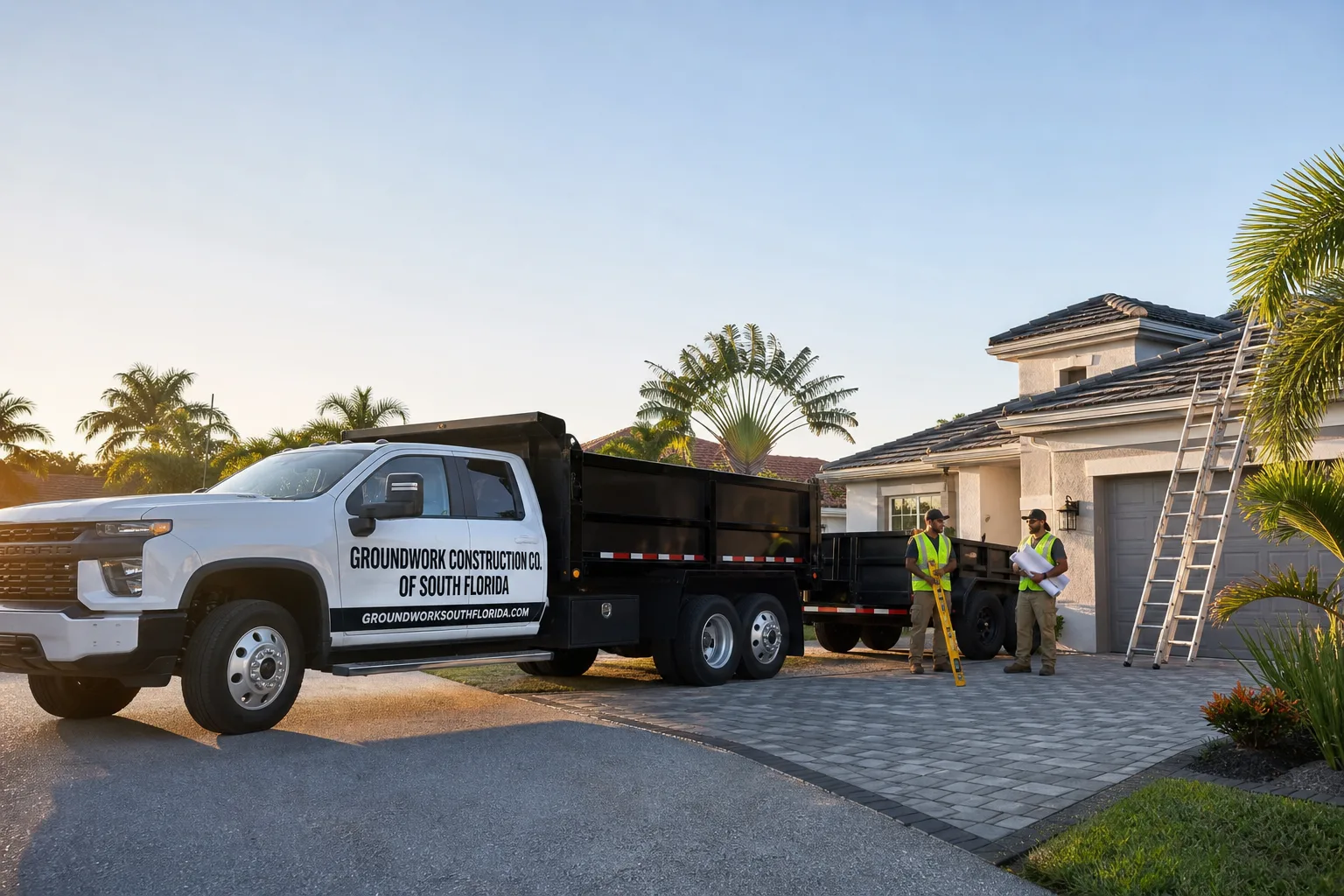
Tile Roofing in Sunset, FL: What It Costs and How Long It Takes
Tile roofing in Sunset typically runs $8,000-$20,000 for a full replacement and $600-$2,500 for targeted repairs, with most projects taking 5-10 business days from permit approval to final inspection. We work with clay and concrete tile systems from GAF, CertainTeed, and Owens Corning, all carrying Miami-Dade NOA documentation required for this zip code. Call (844) 665-0162 for a free on-site estimate and we’ll walk your roof the same week.
How We Handle a Tile Roof Project from Start to Finish
Every tile roofing job in Sunset follows a five-stage sequence. Homeowners who understand the timeline make better decisions about material upgrades and temporary living arrangements, so here’s exactly how we move.
Stage 1: Roof assessment and scope lock (Day 1)
We walk the roof with you, photograph every elevation, and probe the decking to check for soft spots. In Sunset’s 33173 corridor, we’re specifically looking for original wood decking from 1960s-1980s CBS ranches that predates post-Andrew sheathing requirements. You’ll decide at this stage whether we’re doing a tear-off to the rafters or a recover over existing sound decking. That single choice swings your timeline by 1-2 days and your cost by 15-25 percent.
Stage 2: Permit submission and material order (Days 2-5)
We file with Miami-Dade County, not a city office, since Sunset sits in unincorporated territory. Every tile, underlayment, and fastener must carry a current NOA number. We verify these against your permit set before ordering. Clay S-tiles from one manufacturer might have three different NOAs depending on wind-zone rating and fastener pattern. This step routinely delays out-of-county crews who assume standard Florida Building Code compliance is enough.
Stage 3: Tear-off and decking repair (Days 6-8)
Crews strip old tile and underlayment, then expose the decking for inspection. On pre-1993 homes in Sunset, we almost always find roof-to-wall connections that need hurricane strapping upgrades to meet current code. This isn’t optional if the inspector sees exposed framing. We’ll photograph the condition and call you before proceeding with structural work beyond the original scope.
Stage 4: Underlayment, flashing, and tile installation (Days 9-14)
We install synthetic or self-adhering underlayment per the tile manufacturer’s NOA, then set battens or direct-deck fasteners depending on the system. Tile goes down in sections so we can stage materials without overloading the structure. Clay tiles weigh 900-1,200 pounds per square; concrete runs 850-1,100. On older CBS ranches with original 2×4 or 2×6 rafters at 24-inch centers, we sometimes recommend engineered truss reinforcement before heavy-profile concrete tile.
Stage 5: Inspection and final walk (Day 15-17)
Miami-Dade sends a roofing inspector who checks NOA compliance, fastening patterns, and flashing details against the approved plans. We don’t collect final payment until you sign off on the walkthrough and have your inspection card in hand. Most Sunset tile roofing projects clear in one inspection; jobs with structural upgrades sometimes need a framing re-check.
The Tile Choices You’ll Actually Decide Between
Not all tile performs the same in South Florida’s climate. Here’s what we present to Sunset homeowners, with the honest trade-offs:
- Clay S-tile (traditional Spanish profile): The classic look for Mediterranean and barrel-style roofs. Fired clay doesn’t fade, but it’s brittle underfoot during installation and cracks if struck by wind-borne debris. Best for homeowners prioritizing longevity and curb appeal over impact resistance. Higher material cost, moderate labor cost due to careful handling.
- Concrete flat or low-profile tile: Heavier and more impact-resistant than clay, with color-through concrete that weathers gradually rather than showing surface wear. The weight matters on older Sunset homes; we often need engineering verification for 1960s-era rafters. Lower material cost than premium clay, but higher potential for structural prep.
- Lightweight composite tile: Engineered polymers or fiber-cement blends at roughly one-third the weight of concrete. Easier on older structures, but shorter material warranty and less thermal mass for attic temperature moderation. Good choice when you want the tile aesthetic without reinforcing the roof structure.
- Cool-roof rated tile (clay or concrete): Solar reflectance index (SRI) above 29 to meet Miami-Dade’s cool-roof provisions for certain rebuild scenarios. Costs 10-20 percent more but reduces attic heat gain measurably in Sunset’s unshaded, flat-terrain lots where summer sun is relentless.
- Underlayment grade: Standard synthetic underlayment versus self-adhering ice-and-water shield at valleys and penetrations. On Sunset homes with low-slope sections or original flat-to-tile transitions, we specify the upgraded membrane. It’s a few hundred dollars that prevents the leak call during the first September thunderstorm.
What Tile Roofing Costs in Sunset, FL
| Scope | Price Range |
|---|---|
| Tile roof repair (localized) | $600-$2,500 |
| Partial tile re-roof (one slope/section) | $4,000-$9,000 |
| Full tile roof replacement | $8,000-$20,000 |
Five variables push your number within these ranges:
1. Existing roof condition: A single-layer tear-off with sound decking lands near the bottom. Multiple layers, rotted wood, or pre-1993 structural connections that need hurricane strapping upgrades push toward the top. We’ve seen 1970s Sunset ranches where the roof-to-wall tie-down alone added $1,800.
2. Tile material and profile: Standard concrete flat tile runs lower than imported clay S-tile or custom color blends. Weight-driven structural reinforcement is a separate line item that only applies to some homes.
3. Roof complexity: Simple gable roofs with two slopes cost less per square than hipped roofs with valleys, dormers, or chimney penetrations. Each valley and penetration needs custom flashing and more labor hours.
4. Access and staging: Fenced yards with pool enclosures, mature oak canopies, or zero-lot-line setbacks in Sunset’s older subdivisions limit crane and material staging. We may need specialized equipment or hand-carrying, which affects labor.
5. Permit scope and inspections: Straight reroof permits are simpler. Jobs triggering structural upgrades or impact-rated opening requirements (common on pre-1993 homes) need additional plan review and inspection fees.
A written estimate from us includes tear-off, disposal, decking repair up to a specified square footage, underlayment, tile, flashing, permits, and final inspection. It does not include gutter replacement, soffit repair, or interior drywall remediation from prior leaks unless specifically noted.
Why Sunset Homes Make Tile Roofing a Different Job
Sunset sits in unincorporated Miami-Dade County within the corridor that bore the brunt of Hurricane Andrew’s 1992 destruction, leaving a neighborhood patchwork of pre-Andrew CBS homes with substandard roof-to-wall connections alongside post-1992 rebuilds that had to meet the newly overhauled Miami-Dade code. Any construction or renovation on pre-1993 structures here triggers mandatory upgrades to hurricane strapping, impact-resistant openings, and structural connections that contractors in neighboring Broward County simply don’t encounter at the same rate or under the same scrutiny.
The 33173 corridor is dominated by 1960s-1980s single-story CBS ranch homes built during Miami-Dade’s post-war suburban expansion westward toward the Everglades. Many retain original flat or low-slope roofs with aging wood decking that pre-dates Miami-Dade’s post-Andrew structural sheathing and fastening requirements, making reroof and addition permits particularly complex. When we quote roofing in Sunset, we’re accounting for this inspection reality from the first phone call.
Miami-Dade County’s product-approval system requires a Miami-Dade Notice of Acceptance (NOA) for virtually every structural and envelope component, meaning contractors working in Sunset can’t simply substitute a code-compliant product from another county. They must verify the specific NOA number on the plans before inspection. This workflow step routinely catches out-of-county crews unfamiliar with local permitting, and it’s why we see failed inspections on Sunset jobs started by Sunset contractors who don’t specialize in Miami-Dade’s unincorporated areas.
Homeowners in this zip code often pair exterior envelope work. If you’re upgrading to a tile roof, it’s worth considering whether impact windows and doors in Sunset should be part of the same permit package for streamlined inspection. Some clients also add sliding and patio doors in Sunset to open up the rear of these ranch-style homes while the exterior is already scaffolded.
Serving Sunset, FL - Our Local Coverage Area
We’re based in the Sunset area and know this community well. Use the map below to see our service coverage - if you’re nearby, we can almost certainly help.
Frequently Asked - Tile Roofing in Sunset
Most tile roofing projects in Sunset take 5-10 business days of active work after permit approval, with 2-3 additional weeks for Miami-Dade permit review. Pre-1993 homes needing structural upgrades add 2-4 days. Call (844) 665-0162 and we’ll give you a timeline based on your roof’s specific condition.
Yes, every tile roofing job in Sunset requires a Miami-Dade County permit, and the county verifies NOA numbers on all materials at inspection. Unpermitted work gets red-tagged and must come off. We handle the filing, plans, and inspection scheduling as part of our standard scope.
Often yes, but not always. Many 1960s-1980s Sunset ranches have rafters that can handle clay or concrete tile with minimal reinforcement. We verify this during assessment with load calculations. If your home needs structural upgrades, we’ll show you the engineering before you commit.
Tile roofing typically costs 40-60 percent more than asphalt shingle for the same footprint, but carries longer material warranties and better wind resistance. In Sunset’s high-velocity hurricane zone, that durability difference matters for insurance and resale. Our roofing crew can quote both so you compare directly.
Material warranties run 50 years for premium clay tile and 30-50 years for concrete, depending on manufacturer. Our workmanship warranty covers installation-specific issues like flashing and underlayment. We register your warranty with the manufacturer so coverage transfers if you sell the home.
Ready to Talk Through Your Roof?
We’ll walk your Sunset roof, photograph the condition, and deliver a written estimate within 48 hours. No deposit required to schedule, and we’ll flag any structural or permitting issues before you decide. Call (844) 665-0162 or request your free estimate online.
Written by Raymond Estevez, Owner at Groundwork Construction Co., serving Sunset and South Florida homeowners since 2014.