
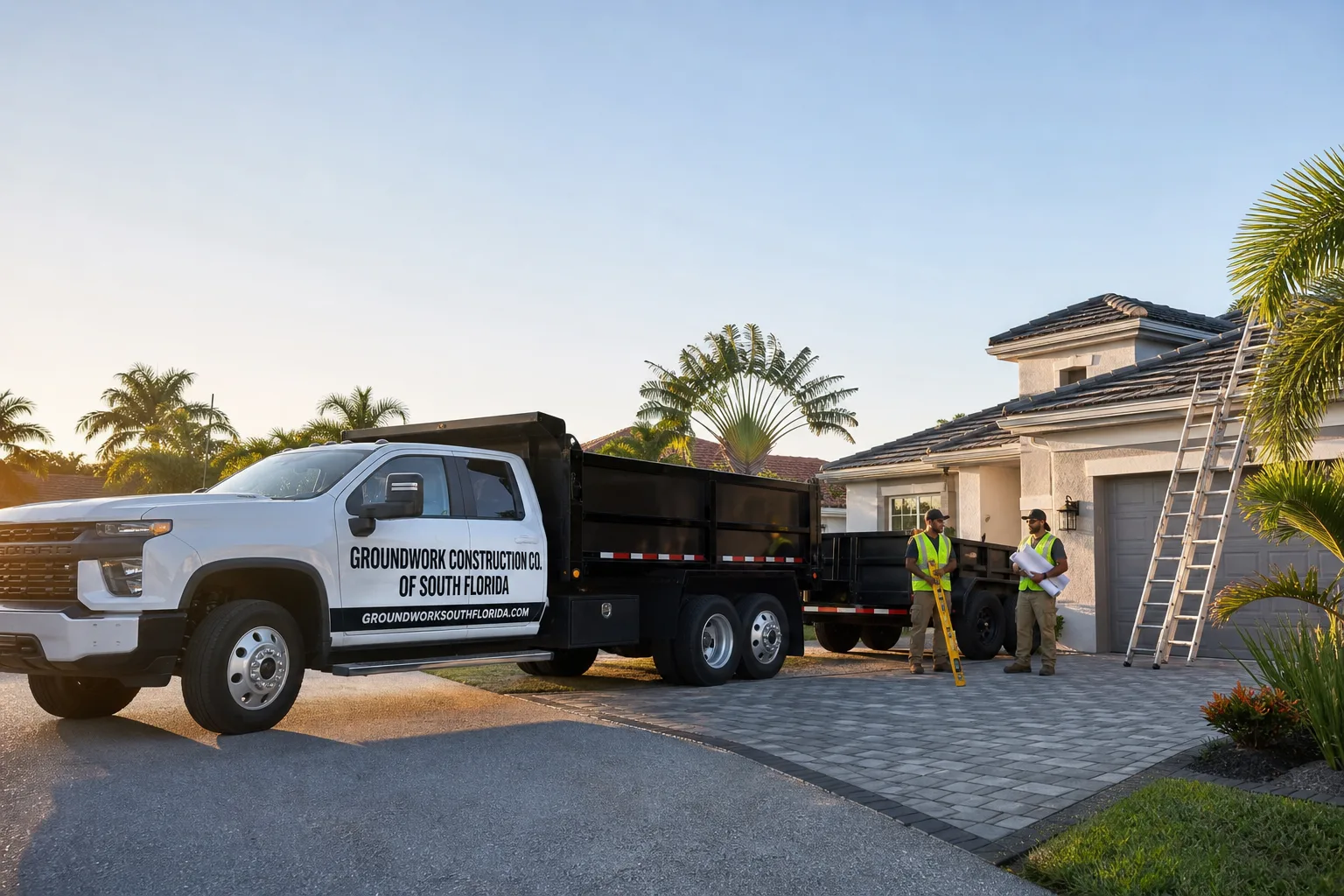
Tile Roofing in West Little River, FL: What It Costs and How Long It Takes
Tile roofing in West Little River typically runs $8,000-$20,000 for a full replacement on a standard single-story home, with most projects completed in 5-10 business days depending on Miami-Dade County inspection scheduling. We handle the HVHZ permitting, NOA documentation, and county inspections as part of every job. Call (844) 665-0162 to schedule a free on-site estimate and get a written quote with your specific material options.
How We Handle a Tile Roof from Tear-Off to Final Inspection
We’ve learned that homeowners in 33147 want to know what’s happening on their roof and when. Here’s the actual sequence we follow on a typical West Little River tile roofing project, with the decisions you’ll need to make at each point.
Day 1: Protect and strip. We arrive early, tarp the perimeter to protect your slab and any existing landscaping, then remove the old roof system down to the deck. On the 1950s-1970s CBS homes common here, we often find deteriorated felt, corroded fasteners, or soft spots where the flat or low-slope original roof trapped moisture. We photograph everything and walk you through what we found before lunch. If the decking needs replacement, that’s your first decision point: patch isolated areas or redeck entire sections. Patching saves money now; redecking gives you a uniform substrate and better warranty coverage.
Days 2-3: Deck repair and dry-in. We install new plywood where needed, then apply the underlayment system. In Miami-Dade’s HVHZ, this means a high-temperature, self-adhered membrane or double-layer synthetic underlayment that meets the county’s NOA requirements for your chosen tile profile. The underlayment is your real waterproofing layer; the tile is the armor. We also install new flashings at penetrations, valleys, and wall transitions. You’ll decide on drip-edge color and whether to replace fascia boards if they’re water-stained or termite-damaged, which we see frequently on homes near the Miami Canal corridor where humidity stays elevated.
Days 4-6: Tile installation. We set battens if your tile profile requires them, or direct-set if you’re going with a flat profile that permits it. Each tile is fastened to HVHZ standards: foam adhesive, screws, or combination systems depending on the manufacturer’s NOA. The pattern, exposure, and ridge detail are set during our pre-construction meeting. This is where material choice matters most. Standard concrete tile weighs 900-1,200 pounds per square; lightweight profiles run 600-800. On older CBS homes with original roof framing, the structural load matters. We’ve had projects where the 1958 rafter spacing required us to sister joists before the county would sign off. We catch this during our initial attic inspection, not mid-project.
Day 7: County inspection and detail work. Miami-Dade County schedules the HVHZ inspection, which we coordinate through the EPERMITS system. The inspector verifies fastener patterns, NOA labels on materials, and roof-to-wall tie-downs. While we wait for the inspection window, we finish ridge caps, install ventilation if specified, and seal all penetrations. If the inspector flags anything, we address it same-day. We’ve worked with county inspectors long enough to know the common catches: missing documentation on foam adhesive batch numbers, or tile overhang that exceeds the NOA exposure limit.
Days 8-10: Final walkthrough and documentation. We clean the site completely, run a magnetic sweep for fasteners, and deliver your packet: manufacturer material warranty, our workmanship warranty terms, and the passed inspection record from Miami-Dade County. You keep these for your insurance and future sale. The whole process, from signed contract to final sign-off, typically spans 2-3 weeks in West Little River when county inspection availability is normal. Hurricane season backups can push this to 4 weeks, which we build into our scheduling conversations upfront.
The Tile Options You’ll Actually Choose Between
Not all tile is the same, and the right choice depends on your roof pitch, structural capacity, and how long you plan to stay in the home. Here’s what we present to West Little River homeowners:
- Standard concrete tile: The most common replacement choice. Costs less upfront, comes in dozens of profiles (S-tile, flat, barrel), and carries 50-year material warranties from manufacturers like Eagle and Boral. The trade-off is weight. At 950+ pounds per square, your 1960s rafters may need reinforcement, which adds $1,500-$4,000 to the project. Best for homeowners planning to stay 15+ years and wanting maximum durability.
- Lightweight concrete tile: Same profiles and warranties, but engineered to 650-750 pounds per square. Fits older CBS homes without structural mods in most cases. Costs 15-25% more than standard. The honest limitation: slightly more brittle during installation, so crew experience matters. We recommend this for most 33147 homes built before 1980.
- Clay tile: The premium option, especially barrel or “Spanish” profiles. Natural color that doesn’t fade, 75-100 year lifespan, and the aesthetic that defines Mediterranean architecture throughout South Florida. Weight is comparable to standard concrete. The trade-off is cost, typically 30-40% above concrete, and more fragile underfoot during installation. We suggest clay when the home’s architecture demands it or when resale value in the Miami market justifies the investment.
- Flat profile vs. profiled (S/barrel): Flat tile sits lower, sheds water faster, and works on pitches as low as 2.5:12 in some NOA-approved systems. Profiled tile needs 4:12 or steeper but handles wind uplift better and channels water more aggressively during West Little River’s summer deluges. Your existing roof pitch often decides this for you.
- Cool roof color: Light-colored or “cool” tiles reflect more solar energy, which matters in Miami-Dade’s UV intensity. The difference can be 20-30 degrees on surface temperature. We see this spec increasingly on homes where the attic ductwork runs through the roof space. It costs marginally more and pays back in HVAC load over years.
What Tile Roofing Costs in West Little River, FL
Based on our recent projects in 33147 and surrounding Miami-Dade neighborhoods, tile roof replacement in West Little River ranges from $8,000 to $20,000. Tile roof repair runs $600-$2,500 for localized issues.
| Project Scope | Typical Range |
|---|---|
| Tile roof replacement, small home (1,000 sq ft) | $8,000-$12,500 |
| Tile roof replacement, mid-size home (1,500 sq ft) | $12,000-$17,000 |
| Tile roof replacement, larger or complex roof | $16,000-$20,000+ |
| Tile roof repair (limited area) | $600-$2,500 |
| Structural reinforcement (if needed) | $1,500-$4,000 |
Five factors push your number up or down:
1. Existing roof condition. A roof with one layer of old built-up roofing that strips cleanly stays at the lower end. Multiple layers, saturated decking, or termite-damaged fascia adds labor and material.
2. Structural modifications. Homes from the 1950s-1960s often need rafter reinforcement or spacing adjustments to meet current wind-load requirements. We identify this during our attic inspection and include it in the written estimate, not as a surprise.
3. Tile material and profile. Standard concrete S-tile at the base of the range; clay barrel or premium lightweight concrete at the top. Color and finish options within each category have modest impact.
4. Penetrations and complexity. Skylights, chimneys, multiple valleys, or second-story additions add flashing labor and material. A simple gable roof on a 1,100-square-foot CBS ranch is straightforward; a 1970s modified roof with multiple additions is not.
5. Permit and inspection scope. Miami-Dade County’s HVHZ requirements mean every tile roofing project needs full permitting, NOA documentation, and inspection. The permit fees are fixed by the county, but the documentation and compliance labor varies with project complexity. We handle all EPERMITS submission and inspector coordination; this is included in our estimate, not billed separately.
Our written estimates include tear-off, disposal, deck repair up to a specified square footage, underlayment, tile, fasteners, flashings, vents, permit fees, and inspection coordination. Items typically not included: full redecking beyond the specified allowance, structural engineering if required, gutter replacement, or interior ceiling repair from prior leaks.
What West Little River’s Housing Stock and Rules Mean for Your Roof
West Little River’s unincorporated status puts every tile roofing project through Miami-Dade County’s EPERMITS system and the High-Velocity Hurricane Zone code, one of the strictest in the nation. Contractors who work mostly in incorporated cities like Hialeah or Miami proper sometimes underestimate the documentation burden. We’ve seen projects stall because a roofer submitted generic product specs instead of the exact NOA documentation the county inspector required for the specific tile batch on the truck.
The homes we work on most in 33147 are small, single-story CBS ranches from the 1950s through the 1970s, typically 800-1,400 square feet on slab foundations. Many still carry their original flat or low-slope built-up roofs, sometimes with a second layer added in the 1990s post-Andrew rush. These roofs weren’t designed for modern tile profiles or HVHZ wind loads. When we open them up, we regularly find inadequate or missing roof-to-wall hurricane straps, corroded fasteners from decades of salt-laden humidity, and decking that’s compromised where standing water sat after summer thunderstorms.
The Miami Canal corridor’s drainage patterns matter too. Lots near the canal or its tributaries hold moisture longer after heavy rain, which accelerates fascia and soffit decay. We inspect these areas carefully because they’re often the first failure point, and because a tile roof is only as good as the edge details that keep water out of the wall cavity. In West Little River, we don’t just install tile; we rebuild the perimeter defense that the original construction never included.
Homeowners in this area often pair a new roof with other storm-hardening work. If you’re considering Impact Windows & Doors in West Little River or Sliding & Patio Doors in West Little River, we can sequence the projects so the roof tie-ins and window head flashings are coordinated, not cobbled together by separate crews. That’s the advantage of a single-source contractor handling your full exterior envelope.
Serving West Little River, FL - Our Local Coverage Area
We’re based in the West Little River area and know this community well. Use the map below to see our service coverage - if you’re nearby, we can almost certainly help.
Frequently Asked - Tile Roofing in West Little River
Most tile roof replacements take 5-10 business days of on-site work, with 2-3 weeks total from contract to final county sign-off. Miami-Dade County inspection availability is the usual variable; during peak hurricane season, expect the longer end. Call (844) 665-0162 and we’ll check current county scheduling when we quote your job.
Yes, every tile roofing project requires a Miami-Dade County permit through the EPERMITS system. West Little River is unincorporated, so there’s no city building department to shortcut through. We submit all documentation, including manufacturer NOA certificates, and coordinate inspections as part of our standard process.
Often yes, but not always. Many 1950s-1970s CBS homes in 33147 need rafter reinforcement or additional hurricane straps to meet current HVHZ requirements. We inspect your attic framing during our estimate and tell you definitively before you sign. When structural work is needed, we include it in the written quote with a fixed price.
Tile roofing costs more upfront than asphalt shingle but less than standing seam metal for most West Little River homes. The $8,000-$20,000 range for tile compares to $8,000-$20,000 for standard shingle replacement and $15,000-$40,000 for metal. Tile’s advantage is lifespan: 50+ years for concrete, 75-100 for clay, versus 20-25 for shingle. If you’re staying in the home long-term, the math favors tile.
Manufacturer material warranties run 50 years for concrete tile and 75 years for clay from major producers. Our workmanship warranty covers installation labor and flashing details. The full warranty package, including passed Miami-Dade inspection records, is delivered at project closeout. Keep these documents; buyers and insurers in South Florida routinely request them.
Get Your West Little River Tile Roofing Estimate
We’ll come to your home in West Little River, inspect your attic and roof structure, and deliver a written estimate with your material options and a fixed price. No pressure, no surprise add-ons. Call (844) 665-0162 or reach out through our site to schedule. Most estimates take 45 minutes, and we can typically start pre-construction within two weeks of approval.
Written by Raymond Estevez, Owner at Groundwork Construction Co., serving West Little River and Miami-Dade County.