
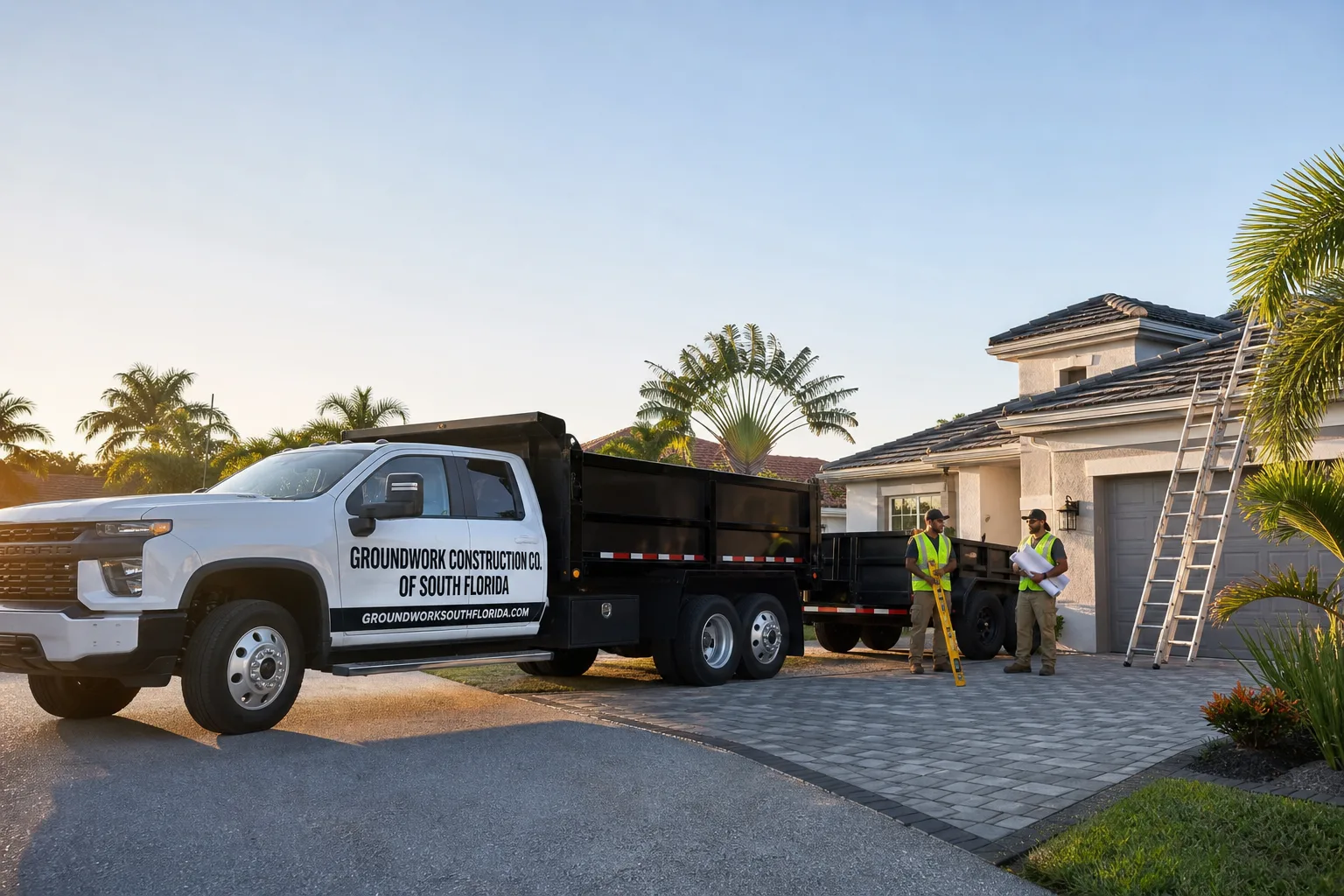
Paver Driveways in Fort Lauderdale: Cost, Timeline, and What to Expect
A new paver driveway in Fort Lauderdale typically runs $7,000-$18,000 and takes 3-5 days from demolition to final compaction, assuming standard access and no seawall or utility complications. Most homeowners in neighborhoods like Victoria Park and Plantation Park are replacing cracked concrete or original shell driveways laid in the 1960s and 70s. Call (844) 665-0162 for a free on-site estimate and written breakdown.
How We Build a Paver Driveway, Start to Finish
We break every paver driveway job into five stages so you know what’s happening and when you need to make a decision.
Stage 1: Demo and utility locate (Day 1)
We saw-cut the existing driveway edge, break out old concrete or asphalt, and haul it off-site. Before we touch a shovel, we call 811 for a utility locate and hand-dig test pits near the water meter and electrical feed. In Fort Lauderdale’s older CBS neighborhoods, we’ve found original copper water mains running directly beneath driveways poured in the 1950s. If we hit one, you’ll know the same day and we’ll adjust the grade plan. Duration: 4-6 hours for a standard two-car width.
Stage 2: Subgrade prep and drainage (Day 1-2)
We strip to stable soil, typically 8-10 inches below finished grade. Here’s where Fort Lauderdale’s groundwater table matters: if we hit standing water at 14 inches, we lay a geotextile fabric and switch to an open-graded stone base that lets water percolate laterally rather than pooling beneath the pavers. We establish slope at 1% minimum toward the street or a French drain. You’ll decide now whether to add a channel drain across the garage threshold, which adds $400-$800 but stops sheet flow into your garage during summer downpours.
Stage 3: Base installation and compaction (Day 2)
We bring in #57 stone in two lifts, compacting each with a plate compactor to 98% Proctor density. The base thickness depends on your vehicle load: standard passenger vehicles get 6 inches, while households with delivery trucks or RVs need 8-10 inches. We check grade with a laser every 4 feet. This stage looks finished but isn’t, and it’s your last chance to change the border detail or inlay pattern without material waste.
Stage 4: Bedding sand and paver laying (Day 3-4)
We screed 1 inch of coarse bedding sand and begin laying pavers from a fixed string line. Most Fort Lauderdale homeowners choose running bond or herringbone patterns in earth-tone concrete pavers that hide pollen and irrigation rust. We cut border pieces with a wet saw and set soldier courses where the driveway meets the lawn or walkway. If your project is part of a full exterior update, this is where we coordinate with our Driveway & Pavers in Fort Lauderdale crew to match patio or walkway materials.
Stage 5: Compaction, joint sand, and final inspection (Day 4-5)
We run the plate compactor over the finished field, sweep polymeric joint sand into the gaps, and compact again. The polymeric sand hardens when misted, locking the field together and resisting weed growth better than traditional mason’s sand. We photograph the completed grade for your records and walk the driveway with you. Total elapsed time from start to vehicle traffic: typically 5 days, or 7 if we hit unexpected utilities or weather delays.
The Material Choices That Change Your Driveway
Not all pavers suit Fort Lauderdale’s climate and salt air. Here’s what our Driveway & Pavers team specs most often, and who each option fits:
- Standard concrete pavers ($3-$5 per square foot material): The workhorse choice. Pressed concrete in 4×8 or 6×6 sizes, rated for 8,000 PSI. Colors fade gradually over 10-15 years in full sun, but the structural integrity holds. Best for homeowners who want a clean look at moderate cost and plan to reseal every 3-4 years.
- Tumbled concrete pavers ($4-$6 per square foot material): Factory-tumbled edges give a weathered, Old World texture that works well with 1950s-1970s ranch and Florida modern architecture common in Poinsettia Heights. The tumbling process slightly weakens edges, so we avoid these on driveways with tight turning radii where tires scrub.
- Porcelain pavers ($6-$9 per square foot material): Through-body color, near-zero water absorption, and salt resistance make these ideal for waterfront homes along South Seabreeze Boulevard or Las Olas Isles where salt spray and flood exposure are real factors. The catch: porcelain requires a mortar-set installation over concrete, not a flexible sand base, which adds $2,000-$4,000 to the project and extends timeline by 2 days.
- Permeable pavers ($5-$7 per square foot material): Open-graded joints allow stormwater infiltration, which helps with Fort Lauderdale’s strict stormwater management requirements for properties over 5,000 square feet. We often spec these when a driveway expansion triggers new impervious-surface calculations with the city. They require vacuum extraction rather than pressure washing for maintenance.
- Natural stone travertine ($8-$14 per square foot material): Cool underfoot and visually distinctive, but porous and vulnerable to acid etching from fertilizer or pool chemicals. We recommend this only for showpiece entries with minimal vehicle traffic, not daily-use family driveways.
Border choices matter too: a contrasting soldier course in charcoal or tan adds definition but also cost. Inlay medallions or compass roses run $800-$2,500 depending on complexity. We sketch these details in your estimate so you’re not guessing.
What Paver Driveways Cost in Fort Lauderdale, FL
Paver driveway installation in Fort Lauderdale ranges from $7,000 to $18,000 for typical residential projects. Here’s what pushes a job toward the low or high end:
| Cost Factor | Low-End Scenario | High-End Scenario |
|---|---|---|
| Driveway size | 400 sq ft, single-car | 900+ sq ft, double with turnaround |
| Existing condition | Gravel or thin concrete, easy demo | Thick reinforced concrete, buried utilities |
| Material grade | Standard concrete pavers, basic border | Porcelain or travertine, custom inlay |
| Drainage work | Natural slope to street | Channel drain, French drain, or pump tie-in |
| Permit and inspection scope | Driveway replacement only | Expansion triggering new impervious surface review |
A written estimate from Groundwork includes demolition, haul-away, base material and compaction, pavers and bedding sand, edge restraints, polymeric joint sand, and final cleanup. What it typically does not include: tree or stump removal, relocating sprinkler lines (common in older Plantation Park lots), connecting to municipal stormwater systems, or permit fees, which run $150-$400 in Fort Lauderdale depending on project scope. We itemize these separately so you’re not surprised.
Homeowners in Las Olas and surrounding areas often ask whether a paver driveway adds resale value. In Fort Lauderdale’s 1950s-1970s housing stock, replacing cracked original concrete with a well-drained paver surface consistently ranks among the highest-ROI exterior improvements, particularly when paired with updated landscaping.
What Fort Lauderdale’s Conditions Do to This Job
Fort Lauderdale’s identity as the “Venice of America” shapes paver driveway work in ways that inland Florida contractors rarely encounter. The city’s near-sea-level elevation and tidal influence push the groundwater table to within 12-18 inches of grade across much of the 33301, 33309, and 33312 ZIP codes. That means virtually any full-depth driveway replacement hits saturated soils, and we plan for active dewatering or open-graded base systems from the start. Out-of-market crews who bid this work dry often return with change orders after the first rain.
The housing stock tells the rest of the story. In Victoria Park, Poinsettia Heights, and Plantation Park, we’re working on 1950s-1970s CBS homes with original driveways poured when cars were smaller and drainage standards were looser. These slabs are often 3 inches thick with no steel, cracked by decades of root intrusion from live oaks and banyans that the city protects. Demo reveals unexpected conditions: old oil tanks, abandoned septic fields, or original storm lines that no longer connect to the municipal system.
Broward County’s High Velocity Hurricane Zone designation doesn’t directly affect paver driveways, but it signals the broader regulatory environment we navigate. Any driveway expansion that increases impervious surface area triggers stormwater review, and properties near the navigable waterways threading through The Landings or Victoria Park may face additional scrutiny if the work is waterward of the seawall line. We handle permitting through the City of Fort Lauderdale’s Building Services Division and flag potential complications before demolition begins.
HOA rules add another layer in gated communities along East Oakland Park Boulevard and near Las Olas Boulevard. Some associations restrict paver colors to earth tones or require pre-approval of patterns. We pull HOA guidelines during estimating so your selections don’t get rejected at the architectural review stage.
Serving Fort Lauderdale, FL - Our Local Coverage Area
We’re based in the Fort Lauderdale area and know this community well. Use the map below to see our service coverage - if you’re nearby, we can almost certainly help.
Frequently Asked - Paver Driveways in Fort Lauderdale
Most paver driveway installations in Fort Lauderdale take 3-5 days from demolition to final compaction, assuming standard access and no buried utility conflicts. Porcelain or mortar-set installations add 1-2 days for curing. Weather delays are most common in summer afternoon storm season; we build buffer days into every schedule. Call (844) 665-0162 and we’ll confirm a realistic timeline for your specific site.
Yes, the City of Fort Lauderdale requires a building permit for driveway replacement if you’re changing the footprint, drainage pattern, or surface material. Simple in-kind replacement of existing concrete with pavers at the same grade may qualify for a faster administrative approval. We pull permits as part of our standard process and include the fee in your written estimate. Properties in historic districts or near canal setbacks may face additional review.
Sometimes, but not always. In Fort Lauderdale’s older neighborhoods, original sprinkler lines often run shallow and cross beneath the driveway apron. We expose and evaluate them during the utility locate phase. If they’re PVC in good condition and positioned below our base depth, we can often bridge over them. If they’re galvanized steel or poorly sloped, we recommend relocation to avoid future leaks that undermine the paver base. We flag this during estimating, not after excavation.
Concrete repair typically costs less upfront but rarely lasts in Fort Lauderdale’s climate. Patchwork on a 1960s slab with underlying settlement or drainage issues usually fails within 2-3 years, while a properly based paver driveway lasts 25-30 years with periodic resealing. For a driveway that’s more than 30% cracked or has significant settlement, full replacement with pavers is the more economical 10-year decision. We’ll show you both numbers so you can choose.
Groundwork warrants paver driveway workmanship for a period we specify in your written contract, covering base failure, settlement, and joint sand washout under normal residential use. Material warranties come from the paver manufacturer directly and vary by product line. We register these on your behalf and provide documentation at project closeout. The warranty does not cover damage from heavy equipment, tree root intrusion, or failure to maintain joint sand levels.
Get Your Free On-Site Estimate in Fort Lauderdale
We’re a Fort Lauderdale-based crew, not an out-of-market sales team guessing at your soil conditions. Raymond Estevez or one of our project leads will walk your driveway, check drainage and utility exposure, and deliver a written estimate with material options from our paver portfolio. No pressure, no same-day hard sell. Call (844) 665-0162 to schedule, or mention if you’re also considering Garage Conversion ADU in Fort Lauderdale or ADU Design & Permitting in Fort Lauderdale - we often coordinate exterior hardscape with footprint-expansion projects.
Written by Raymond Estevez, Owner at Groundwork Construction Co., serving Fort Lauderdale and surrounding Broward County communities.