
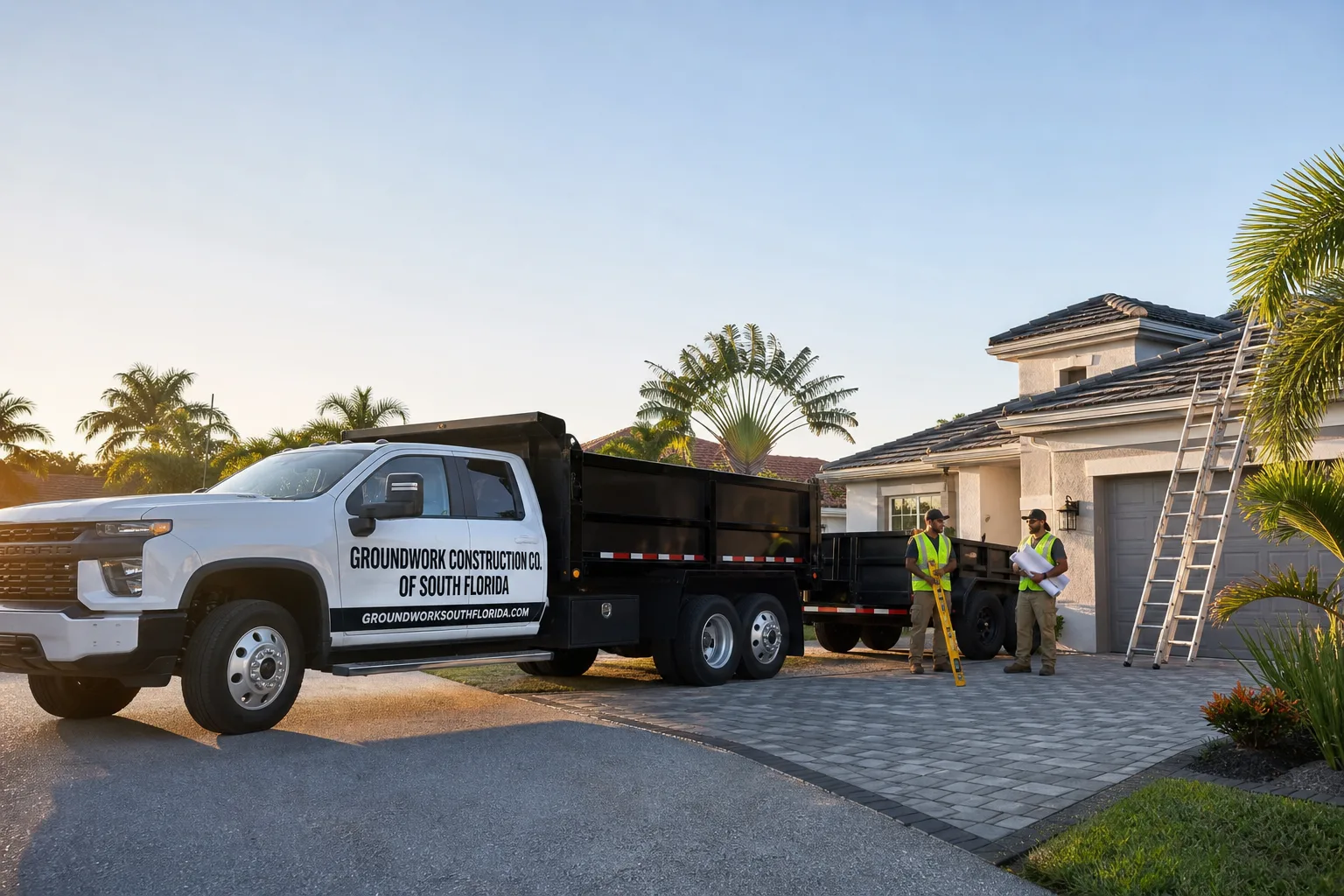
What Is Specialty Roofing in Fort Lauderdale and What Should You Expect to Pay?
Specialty roofing in Fort Lauderdale covers non-standard installations like flat membrane systems, built-up roofing (BUR), modified bitumen, and architectural metal configurations on low-slope or complex-geometry structures. Most projects run 3-10 business days depending on substrate condition and whether we’re working over occupied space. In Fort Lauderdale, you’re typically looking at $8,000-$20,000 for a full specialty roof replacement, with repairs starting around $400 and topping out near $1,800 for membrane patches or flashing rebuilds. Call (844) 665-0162 and we’ll walk your roofline with you, no charge.
How We Approach Specialty Roofing Step by Step
Every specialty roofing job in Fort Lauderdale follows a sequence we’ve refined across hundreds of flat and low-slope installs, from the mid-century homes off East Broward Boulevard to the canal-front properties in Victoria Park. Here’s what actually happens, and where you’ll need to make decisions.
Stage 1: Roof deck and substrate diagnosis (Day 1, 2-4 hours)
We core-cut or thermally scan to see what we’re working with. On 1950s-1970s CBS construction, we often find original tar-and-gravel built-up roofing that’s absorbed decades of tropical moisture, or a prior homeowner’s DIY membrane patch that’s trapping water against the deck. You’ll decide here whether we spot-repair isolated wet areas or strip to the structural deck. That single choice can swing your timeline by 1-3 days and your cost by $1,500-$4,000.
Stage 2: Material selection and Miami-Dade NOA verification (Day 1-2, homeowner decision required)
Because Fort Lauderdale sits in Florida’s High Velocity Hurricane Zone, every roofing component must carry a Miami-Dade Notice of Acceptance. We pull the NOA documentation for your chosen membrane system, whether that’s TPO, PVC, modified bitumen, or a fluid-applied restoration coating. Not all manufacturers maintain active NOAs for every product line, so this step prevents a mid-project substitution. You’ll see the exact product name, wind-uplift rating, and expiration date in your proposal.
Stage 3: Tear-off and deck prep (Days 2-4, weather-dependent)
On occupied homes, we section the work to maintain temporary waterproofing each night. For commercial or multi-family flat roofs, we may phase by quadrant to keep HVAC and drainage operational. If your existing insulation is saturated, we remove it. If the concrete or plywood deck is delaminated, we cut back to sound material and sister in replacement sheathing. This is where hidden conditions surface, and where our daily photo updates keep you ahead of any change orders.
Stage 4: Installation of membrane, flashing, and detail work (Days 4-7)
We mechanically fasten or fully adhere the membrane per the NOA, then weld seams, install termination bars at parapet walls, and fabricate custom flashings for penetrations like vent stacks, skylight curbs, and satellite mounts. On specialty roofing with integrated Roofing in Fort Lauderdale elements like solar-ready attachments or green-roof dead-load platforms, we coordinate those rough-ins now. You don’t want to puncture a finished membrane later.
Stage 5: Inspection, flood testing, and final walkthrough (Days 7-10)
Fort Lauderdale requires a roofing inspection for any full replacement. We schedule it, meet the inspector on-site, and address any punch items same-day. For flat systems, we recommend a 24-hour flood test on sections with interior drainage. You sign off only when you’ve seen the thermal imaging, the inspection approval, and the manufacturer warranty registration.
The Specialty Roofing Options You’ll Actually Choose Between
Specialty roofing isn’t one product. It’s a category of systems, and each suits a different structure, budget, and performance priority in Fort Lauderdale’s climate. Here’s how they compare:
- TPO (thermoplastic polyolefin) single-ply: White reflective surface, welded seams, strong chemical resistance. Best for energy-conscious homeowners and commercial flat roofs where cooling load matters. Typically runs mid-range on cost. Seams require skilled welders; a bad weld is a future leak.
- PVC single-ply: More flexible than TPO in cold conditions, superior resistance to grease and oils. Ideal if your roof has kitchen exhaust or you’re in a multi-unit building. Higher material cost, but longer track record in South Florida.
- Modified bitumen (torch-applied or self-adhered): Two-ply system with asphalt-based sheets. Tough, puncture-resistant, forgiving of foot traffic. Common on older Fort Lauderdale homes where we’re matching existing construction. Heavier than single-ply; may need structural verification on aging decks.
- Fluid-applied restoration: Not a full replacement, but a coating system over sound substrate. Extends service life 5-10 years at roughly one-third the cost of tear-off. Only viable if your existing roof is fundamentally dry and well-adhered. We candidly disqualify half the roofs we inspect for this option.
- Architectural standing seam (specialty profile): For low-slope applications where aesthetics matter, like visible roof sections on Las Olas corridor townhomes. Requires precise slope calculations and hidden fastener clips. Premium cost, 40+ year potential lifespan.
Our Roofing crew sources these through GAF, CertainTeed, Owens Corning, and other manufacturer partners, so you’re selecting from proven product lines rather than whatever’s in the warehouse this week.
What Specialty Roofing Costs in Fort Lauderdale, FL
For specialty roofing in Fort Lauderdale, expect these ranges:
- Roof Repair (specialty membrane/flashing): $400-$1,800
- Roof Replacement (specialty/low-slope systems): $8,000-$20,000
- Metal Roof Installation (specialty architectural profiles): $15,000-$40,000
Five factors push you toward the high or low end of these ranges:
1. Existing substrate condition. Dry, intact decking means we install over it. Saturated concrete or delaminated plywood adds $2,000-$6,000 for removal, replacement, and proper drying time.
2. Roof size and complexity. A simple 1,200-square-foot flat rectangle is straightforward. Multiple levels, interior drains, skylight curbs, or mechanical equipment cradles add detail hours and material waste.
3. Access constraints. Homes on narrow canal lots in The Landings or dense neighborhoods off Northwest 6th Avenue may require crane or boom-lift rental where a standard ladder setup won’t work. That equipment shows up in your estimate.
4. Material grade and warranty length. A 15-year TPO system costs less than a 30-year system with enhanced fleece backing and no-dollar-limit labor coverage. We quote both when both are available.
5. Permit and inspection scope. Fort Lauderdale’s building department requires roofing permits for full replacement; some repair scopes qualify for express permitting. If your property is in a designated flood zone or has a seawall setback, additional documentation may apply.
Your written estimate includes tear-off, deck prep, membrane and insulation, flashings, permits, and inspection scheduling. It does not include interior drywall repair from pre-existing leaks, structural engineering if we find compromised framing, or crane rental if access surprises emerge mid-project. We flag likely add-ons during our initial walkthrough so you’re not ambushed.
What Fort Lauderdale Homes Specifically Do to This Job
Specialty roofing in Fort Lauderdale isn’t interchangeable with specialty roofing anywhere else in Florida. The city’s housing stock and regulatory environment create conditions we plan for from the first phone call.
The dominant construction era here is 1950s-1970s concrete block, particularly in Victoria Park, Poinsettia Heights, and Plantation Park. Those original flat roofs were built with minimal insulation and tar-and-gravel BUR that has long since exceeded its design life. We regularly find three or four prior “repairs” layered on top of each other, each trapping more moisture. In these neighborhoods, we often recommend full strip-to-deck replacement rather than another overlay, because another layer buys you two years and hides rot.
Meanwhile, Fort Lauderdale’s identity as the “Venice of America” means canal-front homes in communities like The Landings face a dual challenge: roof replacement over occupied space where any interior water intrusion threatens finished living areas below, and the broader property may already be navigating seawall or marine construction permitting. We coordinate our roofing timeline with those parallel permits so you’re not paying for a roof crew to stand idle while Army Corps documentation clears.
The High Velocity Hurricane Zone designation affects every material choice. We source only Miami-Dade NOA-approved membranes and attachment systems. Out-of-market contractors unfamiliar with this requirement have shown up with product that passes inspection elsewhere in Florida, then faced rejection at Fort Lauderdale’s building department. That’s a costly restart we prevent by verifying approvals before we order material.
Finally, the groundwater table sits 12-18 inches below grade across much of the city. While that’s more relevant to foundation and hardscape work, it matters for specialty roofing when we’re installing green-roof or solar-ballasted systems where dead-load calculations must account for saturated growing media or standing water. We engineer for Fort Lauderdale’s actual conditions, not a generic Florida load table.
Serving Fort Lauderdale, FL - Our Local Coverage Area
We’re based in the Fort Lauderdale area and know this community well. Use the map below to see our service coverage - if you’re nearby, we can almost certainly help.
Frequently Asked - Specialty Roofing in Fort Lauderdale
Most residential specialty roofing projects finish in 3-10 business days, with flat membrane replacements averaging 5-7 days and complex architectural metal installs stretching toward two weeks. Permitting adds 3-5 business days before we start, and canal-front properties with dual permitting can extend that timeline. Call (844) 665-0162 and we’ll check current Fort Lauderdale building department turnaround.
Yes, full roof replacement requires a City of Fort Lauderdale building permit with roofing inspection. Minor repairs under one roofing square (100 square feet) sometimes qualify for express permitting, but we pull permits on every job that touches the structural deck to protect your resale and insurance documentation. We handle the application, the scheduling, and the inspector meeting.
Usually, yes. We design membrane layouts and flashing details around existing penetrations. If your HVAC curb is failing or your vent stack is improperly flashed, we’ll flag it and quote the correction separately, but we don’t relocate mechanical systems unless you specifically request it as part of a broader renovation. Many homeowners pair this work with Sliding & Patio Doors in Fort Lauderdale upgrades to address the full exterior envelope at once.
Repair fixes isolated failures, replacement addresses systemic condition. If we core-cut and find dry substrate with one bad seam, repair makes sense. If we find multiple moisture pockets, degraded insulation, or previous patches exceeding 25% of the surface area, replacement is more economical than chasing leaks for the next three years. We show you the thermal images and let you decide.
Manufacturer material warranties range from 10 to 30 years depending on the membrane system and thickness you select. Our workmanship warranty covers installation defects for a period we specify in writing. Because Fort Lauderdale’s HVHZ requirements are strict, manufacturer warranties here are typically more comprehensive than in non-hurricane-zone markets, provided installation follows the NOA exactly. We register your warranty and provide the certificate.
Ready to Talk Through Your Roof?
Specialty roofing in Fort Lauderdale demands product knowledge, local permitting fluency, and honest assessment of whether your existing system is worth saving. We’ll walk your property, show you what we find, and build an estimate that reflects actual conditions, not a template. Call (844) 665-0162 to schedule your free on-site evaluation. Raymond Estevez and our Fort Lauderdale team typically book within 48 hours, and we’ll have your proposal within two business days of the visit. If you’re also considering exterior upgrades like Glass Railing Systems in Fort Lauderdale, we can scope both during the same appointment.
Written by Raymond Estevez, Owner at Groundwork Construction Co., serving Fort Lauderdale and South Florida.