
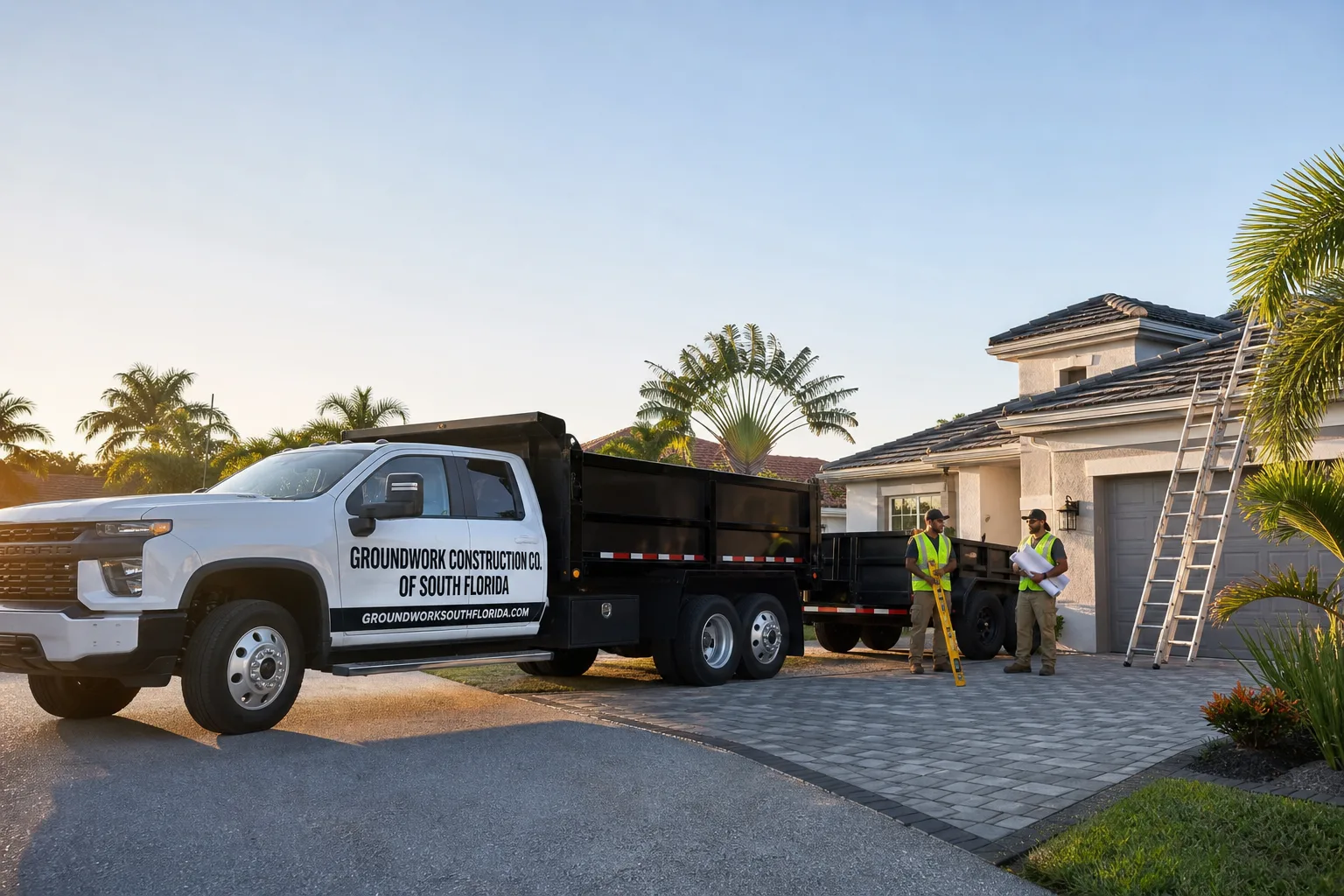
Asphalt Driveways & Resurfacing in Homestead, FL - What It Costs and How Long It Takes
Asphalt driveways and resurfacing in Homestead typically runs $3,500-$9,000 for new paving and $2,500-$6,500 for resurfacing an existing surface, with most residential jobs completed in 2-4 days once permits clear. Call (844) 665-0162 for a free on-site estimate and a written quote with line-item pricing. We’re Raymond Estevez’s crew at Groundwork Construction Co., and we handle the full scope - from soil prep and base compaction to the final roll - without handing you off to subcontractors.
How We Handle Asphalt Driveways & Resurfacing from Start to Finish
Every asphalt job in Homestead follows a five-stage sequence. Homeowners who understand the timeline make better decisions about when to schedule and what to expect at each checkpoint.
Stage 1: Site evaluation and utility locate (Day 1)
We walk the driveway with you, mark underground utilities through Sunshine 811, and assess what’s beneath the surface. In Homestead’s post-Andrew subdivisions, we often find builder-grade base material that settled unevenly over 20-30 years, or drainage channels that were never properly sloped away from the garage. You’ll decide at this stage whether to resurface over existing asphalt or do a full removal - a choice that typically adds $1,500-$3,500 but extends service life by 8-12 years.
Stage 2: Permitting and HOA notification (3-10 business days)
We pull the permit through Miami-Dade County’s online system and notify your HOA if required. Most Homestead HOAs in master-planned communities like Keys Gate or Silver Palm require pre-approval for material changes or footprint alterations. This stage runs parallel to material ordering so we don’t lose calendar time.
Stage 3: Demolition and base preparation (1-2 days)
For full replacements, we remove existing asphalt and any failed base, then grade and compact the subgrade to 95% standard Proctor density. In western Homestead near the Redland, where marl soils expand and contract with wet-season moisture, we may recommend 2-4 inches of limerock base instead of standard shell rock. This is your last decision point on base depth and material.
Stage 4: Asphalt placement and compaction (1 day)
We lay hot-mix asphalt at 275-300°F in 2-inch lifts for residential driveways, rolling each lift while it’s still workable. For Homestead’s tropical sun and heavy rain exposure, we typically specify a polymer-modified binder (PG 76-22) rather than standard PG 64-22 - it resists rutting in 95°F heat and holds up better during the wet season’s daily downpours.
Stage 5: Curing, striping, and final walkthrough (24-48 hours)
Asphalt needs 24-48 hours before vehicle traffic. We return to verify edge support, check drainage flow during the next rain if timing allows, and address any surface imperfections. You’ll get care instructions: no sharp turns for two weeks, sealcoat after 6-12 months, and expect 15-20 years of service with proper maintenance.
The Material and Spec Choices You’ll Make
Not all asphalt is the same. Here are the decisions that actually affect how your driveway performs in Homestead’s climate:
- Removal vs. overlay: Overlay saves $1,500-$3,500 upfront but requires existing asphalt in fair condition with no alligator cracking or base failure. Full removal lets us correct drainage and build a proper base - the better long-term value for most Homestead homes built in the 1990s-2000s with original driveways.
- Base material depth: Standard 4-inch base works for most residential loads. If you park a work truck, RV, or plan to add a new detached ADU in Homestead with shared access, we spec 6-8 inches of compacted base to prevent rutting.
- Asphalt thickness: 2 inches of compacted asphalt is standard for residential overlay; 3 inches for new construction or heavy-use driveways. That extra inch adds roughly $800-$1,200 to a typical 600-square-foot driveway but pays back in reduced maintenance.
- Binder grade: PG 64-22 is the Florida standard and fine for shaded or lightly used driveways. We recommend PG 76-22 polymer-modified binder for south-facing driveways in Homestead, where summer surface temperatures exceed 140°F and standard binders soften.
- Edge treatment: Tapered edges with soil backfill are standard. Concrete ribbon curbs or Belgian block edging add $12-$25 per linear foot but protect against edge cracking and give a finished look that helps in HOA communities with strict aesthetic codes.
What Asphalt Driveways & Resurfacing Costs in Homestead, FL
| Scope | Typical Range | Best For |
|---|---|---|
| Resurfacing (overlay) | $2,500-$6,500 | Existing asphalt in fair condition, no base failure |
| New asphalt driveway | $3,500-$9,000 | Full replacement or new construction |
| Driveway extension | $1,800-$4,500 | Adding parking or turnaround space |
| Base repair + resurfacing | $4,500-$8,500 | Failed base with surface still intact |
Five variables move your number within these ranges:
1. Square footage and shape complexity: A straight 12×50 driveway is efficient to pave. T-shaped turnarounds, radius curves, or multiple parking pads add labor and material waste.
2. Existing condition: Alligator cracking, potholes, or standing water mean base failure - overlay won’t fix it, and full reconstruction is necessary.
3. Drainage corrections: If your driveway funnels water toward the garage or foundation, regrading and adding a trench drain adds $800-$2,500. In Homestead’s flat terrain with a high water table, this is more common than most homeowners expect.
4. Base material requirements: Standard shell rock base is included in our pricing. Limerock stabilization for expansive soils, geogrid reinforcement, or deeper excavation in the Redland’s organic muck layers adds $500-$2,000.
5. Permit and HOA compliance scope: Simple Miami-Dade permits run $150-$400. HOA architectural review fees, drainage plan submittals, or variance requests for non-standard materials add time and cost.
Our written estimates include demolition, hauling, base preparation, asphalt placement, compaction, and permit fees. They do not include tree removal, irrigation relocation, or decorative finishes like stamped borders - we line-item those separately so you choose what matters.
What Homestead Specifically Means for This Job
Homestead’s identity was forged by Hurricane Andrew. When the storm leveled entire neighborhoods in August 1992, it triggered a rebuild under Miami-Dade’s newly created High-Velocity Hurricane Zone standards - the strictest wind-load codes in the continental United States. The homes we work on most, concentrated in subdivisions across ZIPs 33032 through 33035, are that post-Andrew vintage: CBS construction, hip roofs, hurricane-strapped trusses, and driveways poured or paved in the 1993-2010 window.
Those driveways are hitting their functional end-of-life right now. The original asphalt was often builder-grade - thin lifts over minimal base, installed to pass inspection, not to last. We see the pattern repeatedly in communities off Campbell Drive and SW 288th Street: surface cracking at 15-18 years, water infiltration through the wet season, then base failure that turns a $3,500 overlay into a $7,000 reconstruction if the homeowner waits too long.
The Miami-Dade product approval system also affects material sourcing. Every asphalt binder, aggregate blend, and geotextile we use on a Homestead job must carry a Miami-Dade NOA or Florida Building Code approval. Contractors who work primarily in Broward or Palm Beach counties sometimes show up with products that don’t clear Miami-Dade’s more stringent database - a permit rejection that costs weeks. We spec only pre-approved materials from the start.
Then there’s the water. Homestead’s flat terrain, high water table, and sheet-flow flooding during May-through-October wet season mean drainage isn’t optional. A driveway that pools after a 3-inch afternoon thunderstorm will fail prematurely no matter how good the asphalt. We grade for positive flow toward the street or a catch basin, and in flood-prone sections near the C-102 or C-103 canals, we coordinate with Miami-Dade’s stormwater division on discharge compliance.
Finally, the jurisdictional complexity: we’re the last incorporated city before the Florida Keys, and many driveway & pavers crews run jobs down US-1 into Monroe County the same week. That’s a completely different building department, separate permit fees, and Keys-specific elevation requirements in FEMA AE and VE zones. We keep the two workflows distinct - Homestead permits under Miami-Dade rules, Keys jobs under Monroe - so nothing crosses wires.
Serving Homestead, FL - Our Local Coverage Area
We’re based in the Homestead area and know this community well. Use the map below to see our service coverage - if you’re nearby, we can almost certainly help.
Frequently Asked - Asphalt Driveways & Resurfacing in Homestead
Most residential jobs are completed in 2-4 days of actual work, plus 3-10 business days for Miami-Dade permitting. Weather delays are most common in June through September, when afternoon thunderstorms can halt hot-mix placement. Call (844) 665-0162 to check our current schedule and lock in a dry-window start date.
Yes - Miami-Dade County requires a permit for any driveway replacement, extension, or material change that alters drainage patterns. Simple sealcoating or crack filling does not require permitting. We pull the permit as part of our standard process and handle all inspections.
Usually, yes. We pave around existing sprinkler heads and shallow utility lines, adjusting grade to maintain coverage patterns. If your system runs directly through the driveway footprint at insufficient depth, we flag it during evaluation and coordinate with your irrigation contractor - or our driveway & pavers in Homestead crew can handle the relocation as part of a wider hardscape project.
Resurfacing costs roughly 40-60% less than full replacement, but only if the base is sound. We verify this with core samples or test pits during evaluation. If you overlay a failed base, you’ll pay twice - the overlay cracks within 2-3 years, then you still need reconstruction. We give honest recommendations, not the upsell.
We warranty workmanship - proper base preparation, adequate compaction, and correct drainage slope - for two years. Material defects in the asphalt itself are covered by the supplier’s mill certification. Manufacturer warranties on polymer-modified binders extend to 5 years in some cases. We document everything in your written contract, not a handshake.
Get Your Free Estimate for Asphalt Driveways & Resurfacing in Homestead
Call (844) 665-0162 to schedule a free on-site evaluation. Raymond Estevez or a senior project manager will walk your driveway, assess base condition and drainage, and deliver a written estimate with line-item pricing within 48 hours. No deposit required to schedule, and we coordinate permitting and HOA submittals as part of every asphalt driveways and resurfacing project in Homestead. If you’re also considering expanding your home’s footprint, ask how this work pairs with a junior ADU & interior conversion in Homestead - many homeowners tackle both while heavy equipment is on site.
Written by Raymond Estevez, Owner at Groundwork Construction Co., serving Homestead and South Florida.