
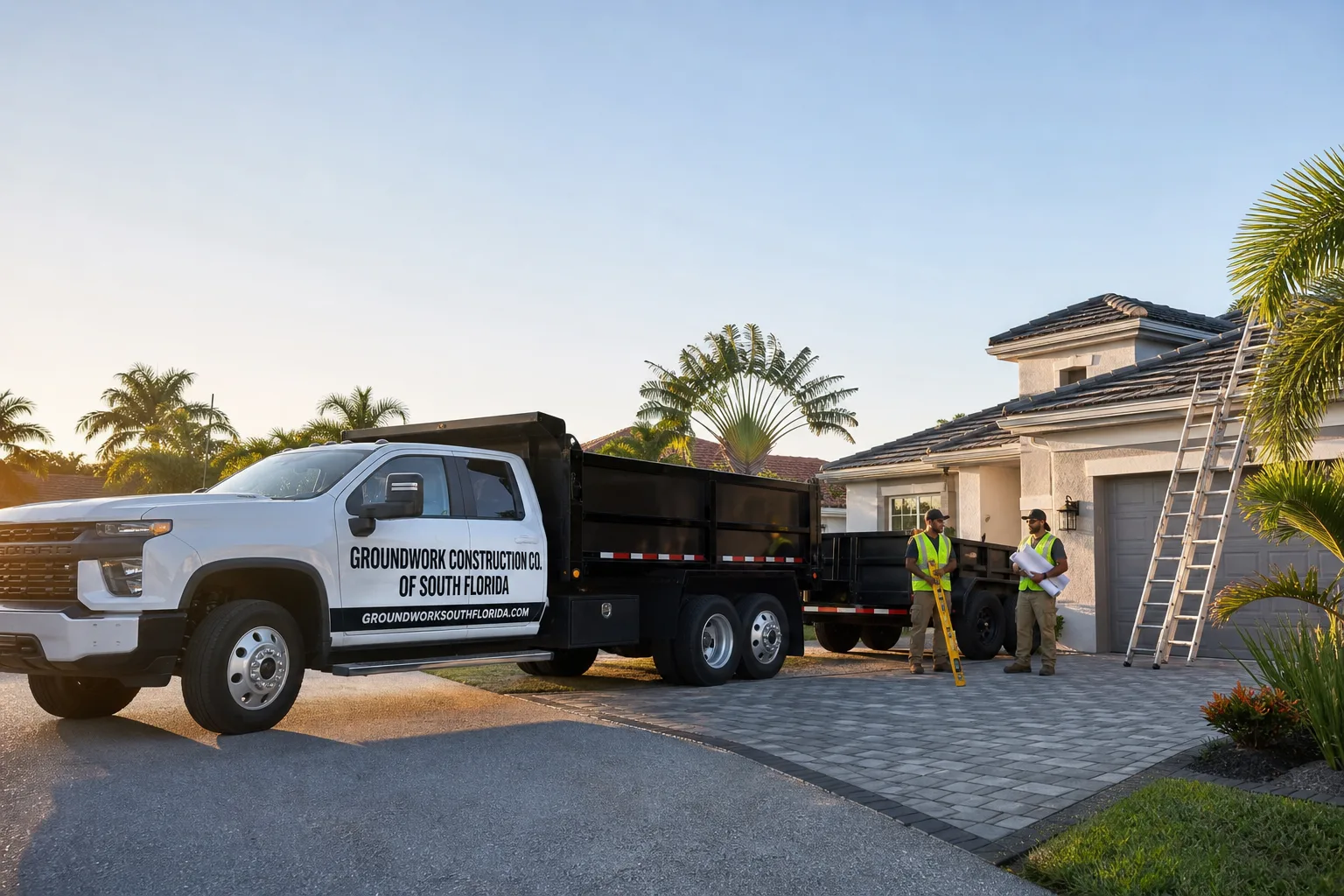
Paver Driveways in Miami Beach: What to Expect
A paver driveway installation in Miami Beach typically runs $7,000-$18,000 for a standard residential job, with most projects completed in 4-7 business days once permits are in hand. You’ll choose between concrete, clay brick, or natural stone pavers in a range of thicknesses and locking patterns, each with different performance profiles against salt air and the city’s high water table. Call (844) 665-0162 for a free on-site estimate and material samples brought to your property.
Unlike mainland Miami, where excavation stays dry and code requirements are less severe, Miami Beach sits on a barrier island barely above sea level with salt exposure from both the Atlantic and Biscayne Bay. That changes everything about how a paver driveway gets built here, from the base material depth to the drainage slope to whether your existing apron even matches the newly raised street grade outside your curb.
How We Build a Paver Driveway in Miami Beach
We’ve refined this into five clear stages. Here’s what happens, what you’ll need to decide, and how long each phase takes.
Stage 1: Site Assessment & Elevation Check (Day 1)
We measure your existing driveway, photograph the approach from street to garage, and shoot grades with a laser level. The critical question in Miami Beach is whether your driveway apron sits below the current street grade. The city’s “Miami Beach Rising Above” program has lifted road levels 1-2 feet in many South Beach and Mid-Beach neighborhoods, and we regularly find original as-built elevations that no longer comply. If your entry sits low, we’ll flag whether a retaining wall, regraded walk, or revised drainage plan is needed before pavers go down. This stage takes 2-3 hours on-site.
Stage 2: Permit & HOA Documentation (3-14 days, parallel to prep)
We pull the permit through Miami Beach Building Department and handle any Historic Preservation Board submission if you’re in a designated district. For homes in South Beach’s Art Deco zones, exterior alterations require board approval, and we coordinate that submission with our permit package. You’ll need to sign off on the paver pattern, color, and border treatment at this stage, since these details get submitted with the site plan. We handle the drawings; you handle the HOA architectural review if one exists.
Stage 3: Demolition & Base Excavation (1-2 days)
We remove the existing surface, whether it’s cracked concrete, old asphalt, or failed pavers. In Miami Beach, excavation stops when we hit water, which is often just 18-24 inches below grade. We don’t fight the water table; we build above it. That means a thicker, well-compacted aggregate base (typically 8-12 inches of crushed limestone, versus 6-8 inches on the mainland) and a geotextile fabric layer to prevent migration. We also inspect any adjacent concrete walls or foundations for the chloride-driven spalling common here, and we’ll show you what we find.
Stage 4: Base Compaction, Bedding Layer & Paver Installation (2-3 days)
We compact the base in lifts with a plate compactor, then lay 1 inch of coarse bedding sand screeded to pitch. Pavers go down in your chosen pattern, cut to fit with a wet saw for clean edges around drains and curves. In Miami Beach, we pitch everything toward the street or a designated drain, never toward the house, because king-tide flooding can push water backward through any low point. We install edge restraints on all free sides, anchored below the frost line (which isn’t a concern here, but wind uplift is).
Stage 5: Compaction, Joint Sand & Final Inspection (Day 4 or 5)
We run the plate compactor across the finished field to seat the pavers, sweep polymeric sand into the joints, and activate it with a light water mist. The city inspector checks drainage slope and edge restraint anchoring. We walk the job with you, verify that the apron meets the street cleanly, and hand over care instructions. Most joint sand needs a refresh at 18-24 months in this climate.
The Paver Choices You’ll Actually Decide Between
- Standard concrete pavers (2 3/8″ thick): Your baseline option. Runs $7,000-$11,000 for a typical two-car driveway in Miami Beach. Good compressive strength, consistent color, and widely available in tumbled or smooth finishes. The trade-off: surface color can fade slightly under intense UV, and the porous body absorbs some salt spray over time. Best for homeowners who want a clean, modern look without premium cost.
- Thick concrete pavers (3 1/8″ or 3 15/16″): Adds $2,000-$4,000 to the job. The extra mass handles vehicle loads better and resists the slight settling that can happen on Miami Beach’s sandy, high-water-table soils. We recommend these for driveways that see delivery trucks, boat trailers, or any commercial-grade use. The trade-off: fewer color options and a heavier, more formal visual weight.
- Clay brick pavers: Runs $10,000-$15,000 for the same footprint. The fired clay body doesn’t fade, and the classic red or salmon tones suit Mediterranean and Art Deco architecture common in South Beach and Mid-Beach. The trade-off: lower compressive strength than concrete, so we specify a thicker base and tighter joint pattern. Not ideal for heavy vehicles.
- Natural stone (travertine, granite, or coral stone): $13,000-$18,000+. Travertine stays cool underfoot, a real advantage in Miami Beach’s summer heat, and the material prestige is unmistakable. The trade-off: higher porosity in some stones means more frequent sealing, and color variation is natural, not uniform. We source from specific quarries with proven salt-resistance; not all stone can handle this environment.
- Permeable paver systems: Adds 15-25% to base cost. Open-graded base and wider joints allow water infiltration, which helps with Miami Beach’s flooding management goals and can reduce runoff charges on some properties. The trade-off: requires more frequent joint maintenance and isn’t suitable where the water table sits within 12 inches of grade.
What Paver Driveways Cost in Miami Beach, FL
| Project Scope | Price Range |
|---|---|
| Standard concrete paver driveway (single-car, existing grade OK) | $7,000-$10,000 |
| Standard concrete paver driveway (two-car, typical base conditions) | $9,000-$14,000 |
| Clay brick or premium concrete, complex layout | $12,000-$16,000 |
| Natural stone or permeable system, grade correction required | $14,000-$18,000 |
Five factors move you up or down this range:
1. Existing driveway condition. A crumbling concrete slab with rebar corrosion underneath costs more to remove than intact asphalt. We won’t know until we cut test pits.
2. Street-grade mismatch. If the city raised your road and your apron now sits low, we may need a short retaining wall, extended ramp, or revised drainage catch basin. That can add $1,500-$5,000.
3. Material grade and pattern complexity. Herringbone or circular patterns take 30-40% more labor than running bond. Natural stone cuts slower than concrete.
4. Utility conflicts. Older Miami Beach homes sometimes have water lines, septic cleanouts, or irrigation running under the driveway. Relocating these adds cost and may require separate permitting.
5. Permit scope. Straightforward replacements clear in a week. Historic Preservation Board review or drainage variances can stretch to 3-4 weeks.
Our written estimates include demolition, disposal, base material, pavers, edge restraints, joint sand, compaction, and permit fees. They do not include tree removal, utility relocation, or decorative lighting unless specified.
What Miami Beach Specifically Does to This Job
Miami Beach is not a market where you can transplant mainland Florida paver practices and expect them to hold up. The barrier island geography, averaging roughly 4 feet above sea level with salt water on both sides, creates conditions we account for on every job.
The salt air here is omnidirectional and relentless. Chloride-driven concrete spalling isn’t a future risk; it’s what we find on nearly every older property we excavate. In Mid-Beach’s MiMo-era buildings and North Beach’s 1950s-60s stock, we regularly encounter active rebar corrosion in adjacent foundations and aprons. We don’t pour new concrete against corroding old concrete without addressing the source, so our site prep often includes forensic investigation and patch-and-seal work that a mainland crew might skip.
The water table sits just below grade everywhere. In Miami Beach, routine excavation for a paver base hits standing water that mainland contractors never see. That rules out any below-slab drainage work and forces us to build upward with thicker, free-draining base layers rather than digging deeper.
Then there’s the street elevation problem. The city’s ongoing pump-station and road-raising program has left many original driveways, especially in South Beach south of 23rd Street and parts of the Flamingo Park neighborhood, with aprons that no longer meet the curb cleanly. We check this on every estimate because the fix, whether it’s a regraded approach or a small retaining wall, changes the scope and the price.
For homeowners considering a broader exterior overhaul, paver driveways are often part of a full Driveway & Pavers in Miami Beach project. Our Driveway & Pavers crew coordinates directly with our roofing, window, and fencing teams when the scope expands. Some clients pair driveway work with ADU Design & Permitting in Miami Beach or a Garage Conversion ADU in Miami Beach to maximize their property’s utility under the same contractor relationship.
Serving Miami Beach, FL - Our Local Coverage Area
We’re based in the Miami Beach area and know this community well. Use the map below to see our service coverage - if you’re nearby, we can almost certainly help.
Frequently Asked - Paver Driveways in Miami Beach
Most paver driveway installations take 4-7 business days of active construction once permits are approved. Permitting itself ranges from 1 week for straightforward replacements to 3-4 weeks if Historic Preservation Board review is required. Call (844) 665-0162 and we’ll check your property’s permit path.
Yes, Miami Beach requires a building permit for any driveway replacement that changes the surface material or drainage pattern. We pull the permit, submit the site plan, and schedule inspections. If your home is in a historic district, you’ll also need Historic Preservation Board approval before we file for the building permit.
Sometimes. We map utilities during site assessment and design the paver layout to avoid conflicts where possible. If your irrigation main or water service lateral runs directly through the driveway footprint, relocation is unavoidable and requires a separate plumbing permit. We’ll show you exactly what we find before you commit.
Repair is cheaper short-term but rarely lasts in Miami Beach’s climate. Concrete patching over corroded rebar or chloride-damaged substrate typically fails within 2-3 years. A paver driveway at $7,000-$18,000 is a full replacement with a 20-30 year service life, individual paver replaceability, and better drainage. For an exact comparison on your property, call (844) 665-0162 - estimates are free.
We warranty our installation workmanship, including base compaction, drainage slope, and edge restraint integrity. Paver manufacturers warranty their product against defects; specific terms vary by brand and line. We specify the warranty details in your written estimate before work begins, with no vague promises.
Get a Free On-Site Estimate for Your Miami Beach Paver Driveway
Call (844) 665-0162 to schedule a free on-site estimate. Raymond Estevez or a senior member of our team will walk your property, check your street grade against your existing apron, and bring material samples from our paver lines. You’ll get a written estimate within 48 hours with clear scope, pricing, and permit timeline. No deposit required to schedule.
Written by Raymond Estevez, Owner at Groundwork Construction Co., serving Miami Beach since our South Florida founding.