
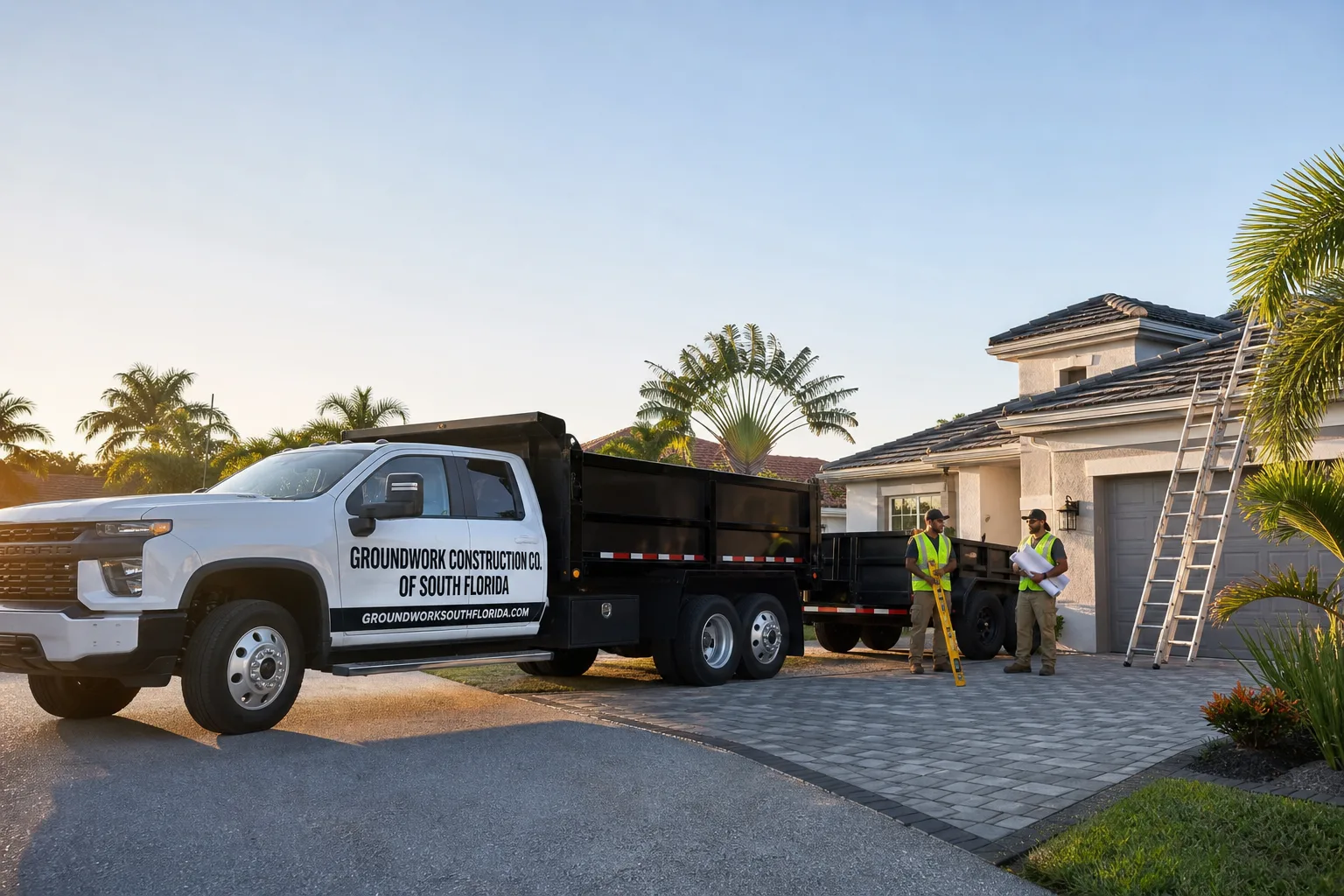
Specialty Roofing in Lantana, FL - What’s Involved, How Long It Takes, and What It Costs
Specialty roofing in Lantana covers the non-standard systems that standard asphalt shingle crews won’t touch: flat and low-slope built-up roofs, modified bitumen, TPO and PVC single-ply membranes, and the structural decking and drainage details underneath them. Most jobs we see in Lantana run 3 to 7 business days from tear-off to final inspection, with permits adding 5 to 10 working days on the front end. Expect to invest between $8,000 and $20,000 for a full specialty roof replacement on a typical Lantana home, with repairs starting around $400. Call (844) 665-0162 and we’ll walk your roof the same week.
How We Handle Specialty Roofing Start to Finish
Every specialty roof we install in Lantana follows a five-stage sequence. Homeowners know exactly where we are, what they’re paying for, and what decision sits in front of them.
Stage 1: Roof assessment and scope lock (Day 1)
We walk the roof, photograph every soft spot, measure drainage slope, and core-sample the existing membrane or built-up layers to see what’s actually underneath. On Lantana’s 1960s and 70s flat roofs, we often find three or four generations of material stacked on original wood decking that’s rotted at the scuppers. You’ll get a written scope, a line-item estimate, and a permit timeline before we leave. This visit takes 60 to 90 minutes.
Stage 2: Permit pull and material order (Days 2-10)
Palm Beach County requires a roofing permit for any work exceeding one square (100 square feet) or involving structural decking. For specialty systems, the permit package includes manufacturer spec sheets and wind-uplift calculations, which we handle. Your decision here is material selection: TPO’s white reflective surface cuts cooling costs but shows dirt faster; modified bitumen handles foot traffic better if you’re adding rooftop HVAC later. We order once you sign, and delivery typically hits in 5 to 7 days.
Stage 3: Tear-off and deck inspection (Days 11-13)
We strip to the substrate, replace any water-damaged decking (common at low points where Lantana’s flat roofs pond), and re-nail or replace fasteners with hot-dipped galvanized or stainless hardware - the salt air here destroys standard galvanized in four to five years. If your home sits in a FEMA AE flood zone and this project pushes you toward the 50% substantial improvement threshold, we flag it immediately. We’ve seen this change a roofing permit into a full elevation-compliance job.
Stage 4: Installation and detail work (Days 14-17)
Membrane or built-up system goes down per manufacturer spec, with welded seams on TPO/PVC or proper mopping on modified bitumen. Critical detail: we install secondary drainage and raise curbs for any HVAC or vent penetrations. On Lantana’s older CBS homes with original jalousie windows, we often coordinate this work with Sliding & Patio Doors in Lantana to seal the full exterior envelope at once. Your presence isn’t required, but we text photo updates twice daily.
Stage 5: Inspection and closeout (Days 18-20)
Palm Beach County inspects for proper fastening pattern, membrane adhesion, and drainage slope. We pass roughly 90% of our first inspections; when we don’t, it’s usually a fastener density correction we handle same-day. You get manufacturer warranty docs, our workmanship guarantee, and a final walkthrough. Payment is due on permit final.
The Material Choices You’ll Actually Decide Between
Specialty roofing isn’t one product. Here’s what Lantana homeowners weigh:
- TPO (Thermoplastic Polyolefin): White, heat-welded single-ply membrane. Best for energy savings - reflects Florida sun and drops attic temperatures 15 to 25 degrees. Costs mid-range. The trade-off: white surfaces show algae and dirt within two years near the Intracoastal, so budget for occasional cleaning.
- PVC (Polyvinyl Chloride): Similar to TPO but more chemical-resistant and flexible at seams. Better if your roof sees grease or solvent exposure (restaurant conversions, workshop exhaust). Runs 15 to 20% above TPO. Longer track record in coastal Florida.
- Modified Bitumen: Asphalt-based membrane with rubber or plastic modifiers, torch-applied or self-adhered. Handles foot traffic and equipment loads better than single-ply. Darker colors absorb heat. Good choice if you’re adding solar or satellite equipment later.
- Built-Up Roofing (BUR): The classic “tar and gravel” system still found on many 1960s Lantana apartment buildings. We install it where matching existing is required by HOA or historic review, or where extreme puncture resistance matters. Heaviest load on structure, slowest install.
- Fluid-Applied Restoration: Not a full replacement - a coating system over sound existing substrate. Lowest upfront cost, shortest lifespan (5 to 10 years vs. 15 to 20 for full systems). Honest use case: your roof’s structurally sound but leaking at seams, and you’re staging a larger renovation in three to five years.
We source these through our Roofing supplier relationships - GAF, CertainTeed, Owens Corning, and others - so you’re choosing from graded, warranted product lines, not whatever’s in the warehouse.
What Specialty Roofing Costs in Lantana, FL
Most specialty roof replacements in Lantana fall between $8,000 and $20,000. Repairs start at $400 and typically cap around $1,800 unless structural decking is involved.
| Scope | Price Range |
|---|---|
| Flat/low-slope repair (patch, seal, localized membrane) | $400 - $1,800 |
| Partial re-roof (one section, under 1,000 sq ft) | $4,500 - $9,000 |
| Full specialty roof replacement (typical 1,200-2,000 sq ft Lantana home) | $8,000 - $20,000 |
| Structural decking replacement (per 100 sq ft) | $800 - $1,500 additional |
| Drainage reconfiguration or scupper replacement | $1,200 - $3,500 additional |
Five variables push you to the high or low end:
1. Existing roof layers: Two or three built-up roofs stacked since the 1960s mean heavier tear-off, more disposal, and often hidden deck damage. Each additional layer adds $1,500 to $3,000.
2. Drainage condition: Lantana’s flat roofs pond water at low spots. If we need to re-slope with tapered insulation or install new internal drains, that’s $2,000 to $5,000.
3. Material grade and warranty length: A 15-year TPO vs. a 20-year system with enhanced seam warranty can swing cost 20%.
4. Flood-zone compliance trigger: If your home’s in a FEMA AE zone and this project crosses the 50% substantial improvement line, elevation requirements can add five figures fast. We pull the flood map and assessed value before we quote.
5. Access and protection: Tight lots near Ocean Avenue or the Intracoastal mean crane or hoist costs, and protecting landscaping or adjacent structures adds labor.
Our written estimates include tear-off, disposal, decking repair up to 10% of roof area, membrane or built-up system, flashing, permits, and inspection scheduling. What’s typically separate: structural engineering if required, elevation work if triggered, and any interior drywall repair from prior leaks.
What Lantana’s Conditions Do to This Work
Lantana’s geography writes the rules. The town sits barely above sea level on the Intracoastal Waterway, and that proximity shapes every specialty roof we touch.
The salt-laden air here corrodes exposed metal faster than inland Palm Beach County by a meaningful margin. We stopped using standard galvanized fasteners on Lantana jobs years ago - stainless or hot-dipped galvanized is non-negotiable, and we spec aluminum flashing over steel. A roof that holds up in Greenacres can fail prematurely here if the hardware’s wrong.
The housing stock matters too. Lantana’s built-out neighborhoods - the concrete block homes east of Broadway, the small multi-family pockets near Hypoluxo Island - mostly date to the 1950s through 1970s with original flat or low-slope built-up roofs, jalousie windows, and electrical panels that predate modern hurricane codes. These weren’t built for current wind loads. Palm Beach County’s post-Andrew requirements mean any substantial roofing work must verify roof-to-wall connections and impact-rated openings, adding compliance cost we price in from the first conversation.
And then there’s the flood code. Lantana’s low-lying position puts much of its older housing inside FEMA Special Flood Hazard Areas. A seasoned contractor here pulls the FEMA flood map and the county appraiser’s assessed value before quoting. We’ve seen a straightforward roof replacement on a 1962 CBS home near the water cross the 50% substantial improvement threshold, converting the permit into a full flood-elevation compliance event. That changes a roofing job into a slab-raising project. We catch it upfront so you’re not surprised after signing.
If your project scope is expanding, we often coordinate specialty roofing as part of a full Roofing in Lantana package, or pair exterior work with Glass Railing Systems in Lantana for waterfront homes updating their full envelope. Our crew serves all of Lantana and nearby Lake Worth, Greenacres, and the Lake Worth Corridor.
Serving Lantana, FL - Our Local Coverage Area
We’re based in the Lantana area and know this community well. Use the map below to see our service coverage - if you’re nearby, we can almost certainly help.
Frequently Asked - Specialty Roofing in Lantana
Most jobs run 3 to 7 business days of actual construction, plus 5 to 10 days for permit approval. If your home’s in a FEMA flood zone and the project triggers substantial improvement review, add 2 to 4 weeks for elevation compliance planning. Call (844) 665-0162 and we’ll confirm your timeline after a site visit - estimates are free.
Yes. Palm Beach County requires a roofing permit for any work over one square (100 square feet) or involving structural decking. Specialty systems need manufacturer spec sheets and wind-uplift documentation included in the permit package. We pull permits as part of our standard process. If you’re in an HOA near the Intracoastal, check your association’s architectural review timeline too - some require 30-day notice.
Usually, yes. Most Lantana flat roofs have rooftop HVAC on curbs that we work around or temporarily support. We only relocate equipment if the existing curb is structurally compromised or if you’re upgrading to a larger unit as part of the project. Plumbing vent stacks get new flashing and seals but stay in place. We’ll confirm your specific layout during the Day 1 assessment.
TPO typically runs 10 to 15% less than modified bitumen for the same square footage, but the gap narrows if you need enhanced fastening for wind uplift. Modified bitumen’s advantage is puncture resistance - better if you have maintenance traffic or plan to add equipment. For pure cooling savings in Lantana’s sun, TPO wins. We’ll quote both so you can see your exact numbers.
You get two layers: the manufacturer’s material warranty (10 to 20 years depending on product grade) and our workmanship guarantee covering installation quality. Manufacturer warranties require certified installer status, which we maintain with our supplier partners. The workmanship guarantee covers leaks attributable to our installation for the guarantee period. Maintenance exclusions apply - debris-clogged drains or storm damage aren’t covered. We’ll walk you through both documents before you sign.
Get Your Free Specialty Roofing Estimate in Lantana
Call (844) 665-0162 to schedule a no-charge roof assessment. Raymond Estevez or a senior member of our team will walk your roof, photograph the condition, and deliver a written estimate with permit timeline and material options within 48 hours. No pressure, no surprises - just the specifics you need to decide.
Written by Raymond Estevez, Owner at Groundwork Construction Co., serving Lantana since our South Florida founding.