
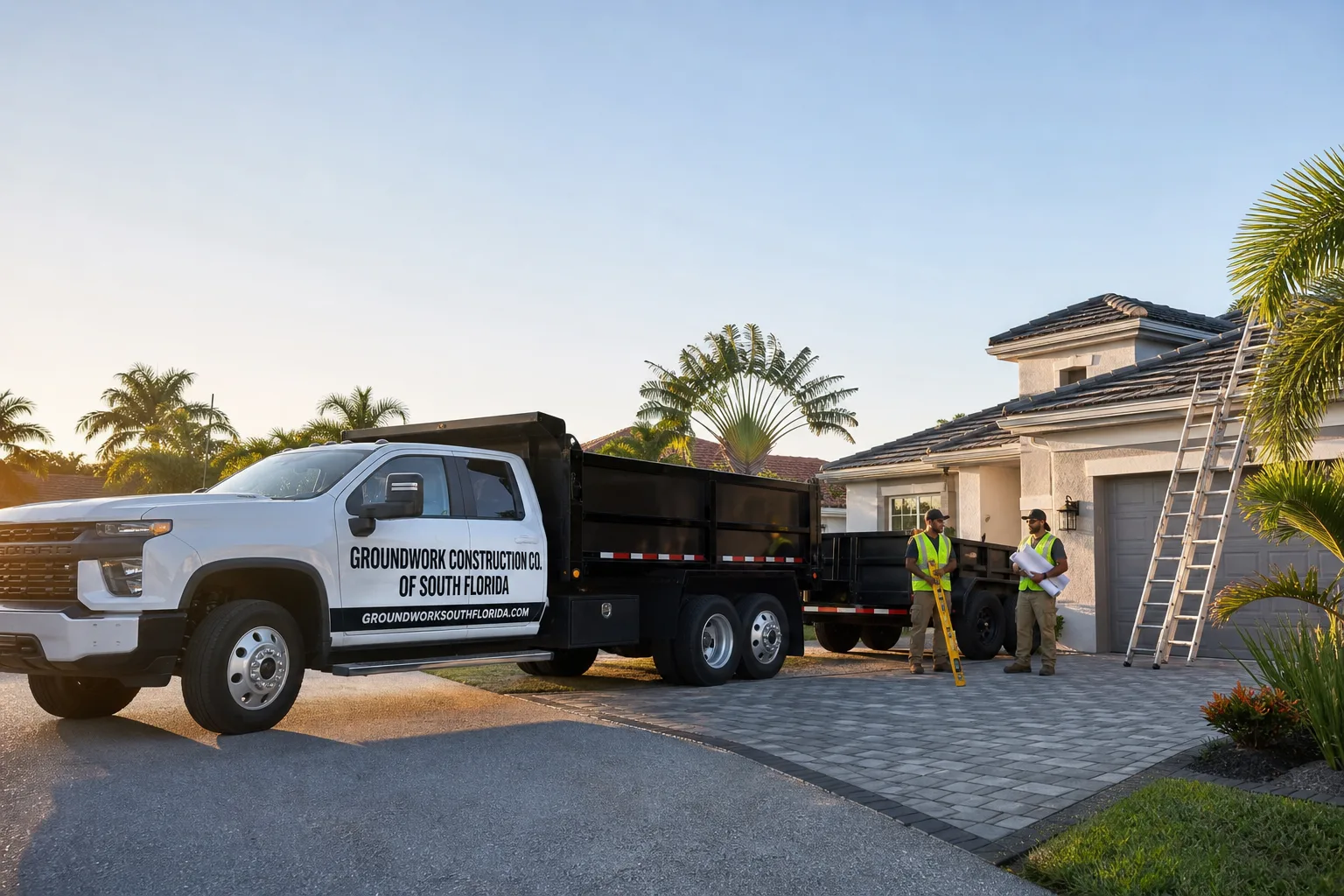
ADU Site Prep & Utilities in Lantana, FL - What It Costs and How Long It Takes
ADU site prep and utilities in Lantana runs $45,000-$130,000 as part of a full home addition, typically spanning 3-6 weeks before the main construction phase begins. The work covers lot clearing, soil compaction, utility trenching or rerouting, foundation prep, and rough connections for water, sewer, electric, and gas. Call (844) 665-0162 for a free on-site estimate with line-item pricing.
How We Handle ADU Site Prep & Utilities Step by Step
Every ADU site prep and utilities job in Lantana follows a fixed sequence. We’ve learned that skipping a stage or rushing the compaction phase creates problems that surface months later, especially in Lantana’s low-lying, salt-exposed environment.
Stage 1: Site survey and utility locate (2-3 days)
We pull the FEMA flood map and Palm Beach County property appraiser records before any shovel hits dirt. In Lantana, this isn’t paperwork for its own sake. A 1960s CBS home near the Intracoastal can sit in an AE flood zone where the substantial improvement threshold (50% of assessed value) triggers full flood-elevation compliance. We mark underground lines, identify the main sewer lateral depth, and confirm whether the existing electrical panel can handle the ADU load or needs a service upgrade. You’ll decide here whether to proceed with standard slab-on-grade or if flood-code requirements push us toward stem-wall or elevated foundation design.
Stage 2: Demolition and lot clearing (3-5 days)
Old sheds, concrete patios, and mature tree root systems come out. We haul off debris and test soil compaction at multiple depths. Lantana’s fill soils vary block by block, some areas near Dixie Highway holding organic muck that won’t support a slab without remediation. If we hit unsuitable material, we switch to engineered fill or crushed concrete base, which adds time but prevents settlement cracks later.
Stage 3: Rough utility trenching and temporary connections (4-7 days)
Water, sewer, and electric get trenched from the main house or street connection to the ADU footprint. In Lantana’s older neighborhoods, original sewer laterals are 4-inch cast iron or clay tile that can’t handle additional flow. We camera the line and give you the video. If the lateral needs replacement, that’s a separate permit but we coordinate the dig to avoid double trenching. Temporary power and water get established so the main house stays functional throughout.
Stage 4: Foundation prep and formwork (3-5 days)
Grading, vapor barrier, rebar or post-tension cable layout, and form setting. For Lantana’s flood-prone lots, we spec stainless steel or hot-dipped galvanized fasteners and hurricane strap hardware. Salt air corrodes standard galvanized hardware within a few seasons. You’ll choose between monolithic slab, stem-wall with fill, or elevated pile foundation depending on flood zone and your finished floor target.
Stage 5: Pre-slab inspection and pour (2-3 days)
Palm Beach County building inspectors verify depth, reinforcement, and flood-vent placement before the pour. We don’t schedule concrete until we have the green tag. Post-pour, we cure for minimum 7 days before framing load touches the slab. Total timeline from survey to cured slab: 3-6 weeks, weather permitting.
The Material and System Choices You’ll Face
ADU site prep and utilities in Lantana involves more decisions than most homeowners expect. These aren’t cosmetic choices. They affect permit path, long-term maintenance, and whether your project crosses into flood-elevation territory.
- Foundation type: Monolithic slab-on-grade is fastest and cheapest, but unusable in AE flood zones where finished floor must sit above Base Flood Elevation. Stem-wall with engineered fill adds $8,000-$18,000 but buys you the required height. Elevated pile foundation, sometimes necessary on waterfront lots, runs substantially higher but preserves the build entirely.
- Utility routing: Trenching new lines from the street offers clean separation and independent metering, but requires Palm Beach County right-of-way permits and longer lead times. Tapping off the main house utilities is faster and cheaper, though it ties your ADU usage to the primary residence’s capacity. For rental ADUs, independent metering is usually worth the extra trenching cost.
- Electrical service: Many Lantana homes from the 1960s and 1970s still run 100-amp panels with fuse boxes or early breaker panels. Adding an ADU kitchen, bath, and HVAC typically demands 200-amp service minimum. Panel upgrade with FPL coordination adds 2-3 weeks and $4,000-$8,000. We identify this in stage 1 so you’re not surprised mid-project.
- Water and sewer line material: PVC Schedule 40 is standard for new trenching. Where we’re tying into older cast iron or clay systems, we often recommend replacing the lateral segment to the property line to avoid root intrusion and flow restriction. The extra cost upfront prevents excavating the same trench twice.
- Soil stabilization: On lots with poor compaction or organic content, we offer lime stabilization or geogrid reinforcement. This adds $3,000-$7,000 but eliminates the risk of differential settlement that cracks slab and finishes alike.
What ADU Site Prep & Utilities Costs in Lantana, FL
ADU site prep and utilities in Lantana typically falls between $45,000 and $130,000 as a component of a full Home Additions & ADU in Lantana project. This range assumes standard soil conditions, slab-on-grade or stem-wall foundation, and utility routing from the existing house.
Five factors push any given job toward the low or high end:
- Foundation elevation requirement: Standard slab work sits at the lower third. Flood-zone elevation with stem-wall or pile foundation drives the upper half.
- Utility distance and complexity: Short trench runs to the main house keep costs down. Long runs to the street, sewer lateral replacement, or electrical service upgrades add $10,000-$25,000.
- Existing structure demolition: Clearing a small shed versus removing an old garage, pool, or large concrete pad changes labor and haul-off costs significantly.
- Soil condition: Native compactable sand is ideal. Organic fill, muck, or high water table requiring dewatering adds material and labor.
- Permit scope and inspection rounds: Simple additions with no flood trigger move faster. Projects crossing into substantial improvement territory face additional FEMA documentation, elevation certificates, and inspection holds that extend timeline and soft costs.
A written estimate from Groundwork Construction Co. includes all labor, materials, hauling, permit fees, and inspection scheduling for the scope described. It does not include FPL service upgrade fees, separate well or septic work (most Lantana properties are on municipal water/sewer), or landscape restoration beyond basic grading and sod.
What Lantana’s Older Housing Stock Means for This Job
Lantana’s built environment shapes every ADU site prep and utilities project we take on. The town is effectively fully developed, with housing stock dominated by 1950s-1970s concrete block stucco homes on small lots, many sitting on original flat or low-slope roofs with jalousie windows and electrical panels that predate modern hurricane codes. There’s no greenfield construction here. Every ADU is an infill project, working around mature landscaping, tight setbacks, and aging infrastructure.
The flood dynamic is what separates Lantana from inland Palm Beach County towns. That low-lying position on the Intracoastal Waterway puts large sections of the 33462 ZIP inside FEMA AE zones. We’ve seen straightforward projects on streets near Ocean Avenue turn into elevation-mandatory builds once the assessed value math comes in. A seasoned contractor pulls those numbers before the contract, not after. The salt air is equally relentless. Standard hardware corrodes fast here. We specify stainless or hot-dipped galvanized on every anchor bolt, strap, and fastener. Palm Beach County’s post-Andrew wind code adds another layer: impact-rated openings and verified roof-to-wall connections are required on all substantial work, and inspectors check them.
Homeowners in Lantana often pair their ADU groundwork with interior updates to the main house. If you’re already trenching utilities and upgrading electrical service, it makes sense to coordinate with Small & Partial Kitchen Remodels in Lantana or Full Bathroom Remodeling in Lantana to avoid redundant permits and disruption. Our Home Additions & ADU crew handles the sequencing so trades don’t trip over each other.
Serving Lantana, FL - Our Local Coverage Area
We’re based in the Lantana area and know this community well. Use the map below to see our service coverage - if you’re nearby, we can almost certainly help.
Frequently Asked - ADU Site Prep & Utilities in Lantana
Most jobs run 3-6 weeks from initial survey to cured slab, assuming standard soil and no flood-elevation complications. Flood-zone projects with stem-wall or pile foundations add 2-4 weeks for additional inspections and engineered drawings. Call (844) 665-0162 and we’ll timeline your specific lot after a site visit.
Yes. Palm Beach County requires building permits for any foundation work, utility trenching, and electrical or plumbing rough-in. If your project triggers the 50% substantial improvement threshold, you’ll also need FEMA elevation documentation and a finished floor certificate. We pull and manage all permits as part of our scope.
Sometimes, if the ADU footprint sits close to the main house and the existing panels and laterals have adequate capacity. More often in Lantana’s older homes, we find undersized electrical service and original clay or cast iron sewer lines that can’t handle the additional load. We camera and load-calculate in stage 1 so you know before we dig.
Tapping off the main house water, sewer, and electric with subpanels and shared metering minimizes upfront cost. The trade-off is no separate utility billing for a rental unit and potential capacity constraints during peak use. For homeowners planning long-term rental income, independent metering usually pays back within a few years despite higher initial trenching and permit costs.
Groundwork Construction Co. warranties structural and utility rough-in workmanship. Specific material warranties apply to branded components we install. Foundation work carries a standard structural warranty against defects in workmanship. Finished utilities (fixtures, appliances, HVAC) are covered by manufacturer warranties once final connections are complete. We document all warranty terms in your written contract.
Get a Free On-Site Estimate for ADU Site Prep & Utilities in Lantana
We’ll walk your lot, pull the flood map and utility records, and deliver a line-item estimate for ADU site prep and utilities in Lantana within 48 hours of our visit. No obligation. Call (844) 665-0162 to schedule. Raymond Estevez or a senior project manager will meet you on site, answer questions about your specific soil conditions and utility routing, and outline the permit timeline so you know exactly what to expect before any ground is broken.
Written by Raymond Estevez, Owner at Groundwork Construction Co., serving Lantana and South Florida.