
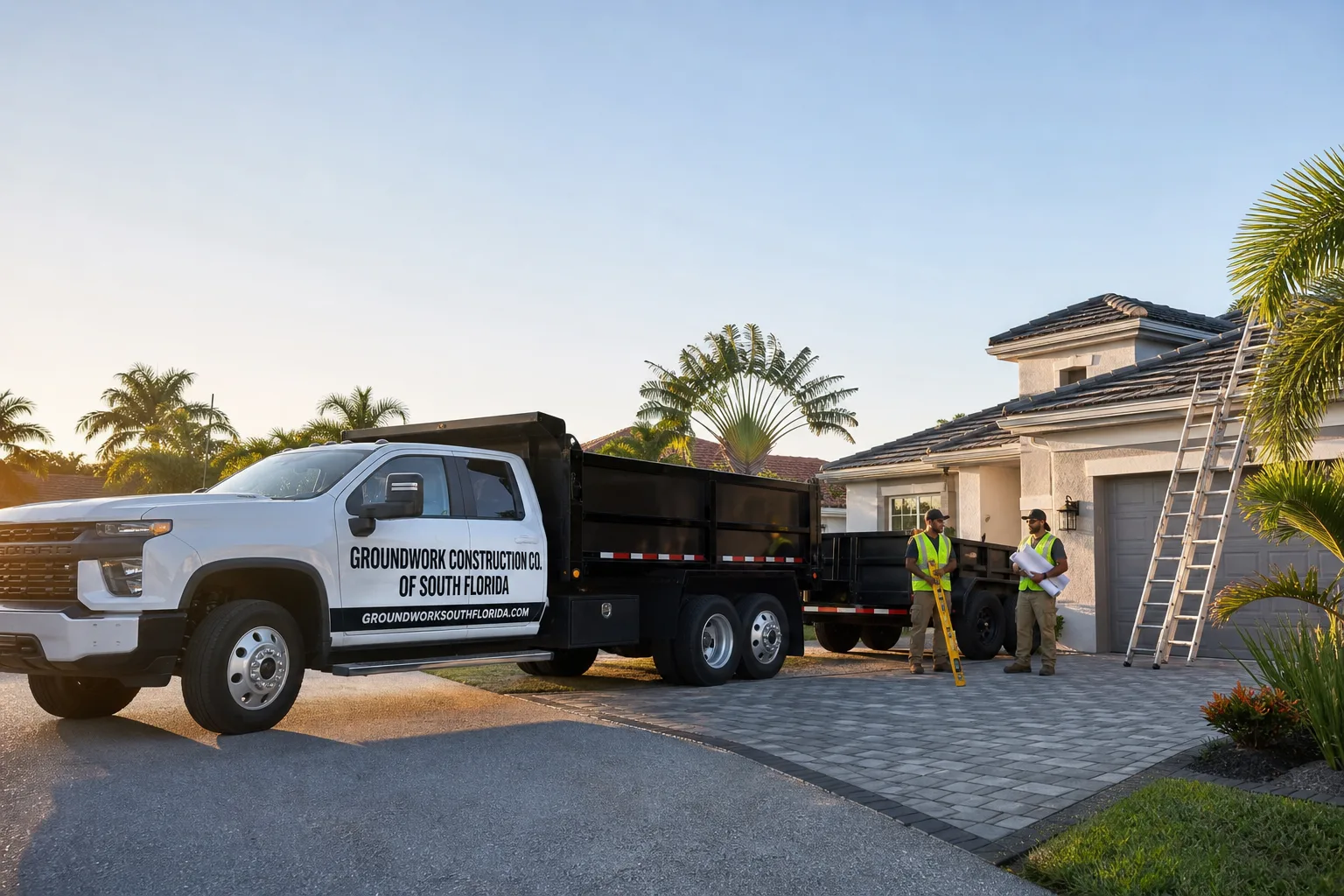
What Does ADU Site Prep & Utilities Cost and Involve in Lake Worth Corridor?
ADU Site Prep & Utilities in Lake Worth Corridor typically runs $45,000-$130,000 and spans 4-8 weeks before the main construction phase begins. The work includes lot clearing, utility trenching and rough-ins, foundation excavation or slab prep, drainage correction, and all county inspections required by Palm Beach County’s building department. Most homeowners in the 33461 ZIP call us at (844) 665-0162 once they’ve got preliminary drawings and want a grounded estimate for the ground-level work.
How We Handle ADU Site Prep & Utilities, Stage by Stage
Every ADU Site Prep & Utilities job in Lake Worth Corridor follows a sequence we’ve refined across Palm Beach County’s unincorporated areas. Here’s what actually happens, who decides what, and how long each phase takes.
Stage 1: Existing Conditions Survey and Demo (Days 1-4)
We walk the lot with the homeowner and verify what’s on paper matches what’s in the ground. In Lake Worth Corridor, this means checking for undocumented carport conversions, unpermitted slab extensions, or utility lines that don’t appear on county records. We’ll flag any of these before permits are pulled, not after. You’ll decide whether to demolish existing outbuildings or work around them. Demo of a 200-square-foot shed or carport typically takes one day; a full backyard clear with root removal runs three.
Stage 2: Permit Submission and Utility Coordination (Days 5-14, overlapping)
Because Lake Worth Corridor sits in unincorporated Palm Beach County, every permit routes through the county building department in West Palm Beach, not a city hall. We submit structural, plumbing, electrical, and mechanical plans simultaneously to avoid the staggered approval delays that catch contractors used to municipal permitting. While plans are in review, we coordinate with Florida Power & Light for service upgrades and with Palm Beach County Water Utilities for tap and meter sizing. Homeowner decision point: whether to upgrade to a 400-amp service now or plan for future EV charging and pool equipment later.
Stage 3: Rough Excavation and Grading (Days 15-21)
We cut to finished floor elevation plus slab depth, typically 18-24 inches below grade for a stem-wall foundation or 6-8 inches for a monolithic slab. Lake Worth Corridor’s flat terrain means minimal cut-and-fill, but poor natural drainage on lots south of 10th Avenue North often requires us to import fill and compact in lifts. You’ll choose between crushed concrete base (economical, $35-$50 per cubic yard delivered) or limerock base (superior compaction, $45-$65 per cubic yard). This choice affects both price and how the slab performs during our wet season.
Stage 4: Underground Utilities and Drainage (Days 22-35)
We trench for sewer lateral, water main, electrical conduit, and any gas line if you’re opting for tankless water heating or a kitchen range. In Lake Worth Corridor’s older CBS neighborhoods, we frequently find original clay sewer lines that have shifted with decades of root intrusion; replacement with PVC runs $85-$140 per linear foot depending on depth and street-to-lot distance. Drainage gets its own attention: we install French drains or channel drains where the existing grade traps water against the main house or ADU footprint. Homeowner decision: standard 4-inch perforated pipe with sock, or stepped up to HDPE dual-wall for longer runs through tree-root zones.
Stage 5: Foundation Prep and Pre-Slab Inspection (Days 36-42)
Forms go up, rebar or post-tension cables are placed, and we call Palm Beach County for the pre-pour inspection. This is the gate that stops more ADU Site Prep & Utilities jobs in Lake Worth Corridor than any other: if our survey uncovered unpermitted square footage on the main house, the inspector will require documentation or remediation before the new work proceeds. We’ve learned to front-load this conversation with the county, not hope it gets missed. Once we pass, the pour happens within 48 hours. You’ll have already chosen your slab finish: troweled for flooring overlay, or broom-finished if the ADU will use polished concrete or tile direct-set.
The Material and System Choices You’ll Make for ADU Site Prep & Utilities
These decisions come up on every job. The right choice depends on your ADU’s size, your main house’s existing systems, and how long you plan to hold the property.
- Foundation type: stem wall vs. monolithic slab. Stem walls with elevated floor joists cost 15-25% more but protect against the moisture wicking that accelerates mold in Lake Worth Corridor’s humidity. Monolithic slabs pour faster and suit smaller footprint ADUs where every dollar counts. If your lot sits low or you’ve seen standing water after summer storms, the stem wall pays for itself.
- Electrical service: 200-amp vs. 400-amp upgrade. A detached ADU with full kitchen, laundry, and HVAC typically needs its own 200-amp subpanel fed from a 400-amp main. If you’re building compact and skipping major appliances, a 200-amp main with calculated load sharing can work. The 400-amp route adds $3,500-$6,000 but eliminates future limitations.
- Sewer lateral material: PVC Schedule 40 vs. C900 ductile iron. PVC dominates residential work for its price and ease. C900 handles higher pressure and root intrusion better on long runs or where existing trees are protected, but it costs roughly double. On Lake Worth Corridor’s shorter setbacks, PVC is usually sufficient.
- Water line: 1-inch vs. 1.25-inch meter feed. A 1-inch line supports up to about 25 fixture units, adequate for a one-bedroom ADU. Go to 1.25 inches if you’re adding irrigation, a tankless water heater, or planning a two-bedroom unit. The upsize adds roughly $800-$1,200 in pipe and fittings.
- Drainage system: gravity daylighting vs. sump pump. Lake Worth Corridor’s flat lots often won’t drain by gravity alone. Daylighting to the street is cheapest where grade allows. A sealed sump with battery backup handles the lowest sites but requires maintenance and replacement every 7-10 years. We design for the 100-year rainfall event, not the average afternoon shower.
What ADU Site Prep & Utilities Costs in Lake Worth Corridor, FL
| Component | Typical Range |
|---|---|
| Full ADU Site Prep & Utilities package | $45,000 - $130,000 |
| Demo and lot clearing | $3,500 - $12,000 |
| Utility rough-ins (water, sewer, electric, gas) | $12,000 - $35,000 |
| Foundation excavation and prep | $8,000 - $22,000 |
| Drainage correction | $4,500 - $15,000 |
| Permits, surveys, and inspections | $3,500 - $8,500 |
Five factors move you toward the high or low end of that $45,000-$130,000 range. First, existing structure demo: removing a permitted shed costs little; demolishing an unpermitted addition with asbestos siding and undocumented electrical adds weeks and thousands. Second, utility distance from the street: a 75-foot sewer lateral to a rear-lot ADU runs more than a 25-foot run to a front-yard unit. Third, main house service capacity: if your 1960s panel can’t support a subpanel feed, the electrical scope expands dramatically. Fourth, soil and drainage conditions: lots near the C-51 Canal basin or with muck layers below grade need over-excavation and engineered fill. Fifth, permit complexity: Palm Beach County’s review timeline stretches when plans need revision for wind-load or flood-zone compliance, and every resubmission adds cost.
Our written estimates itemize labor, materials, permits, and disposal. What they don’t include: landscape restoration after utility trenching, final sod or irrigation repair, or any work inside the main house beyond the service connection points. We’ll flag these exclusions upfront so you’re not surprised when the backhoe leaves.
What Lake Worth Corridor Homes Specifically Do to This Job
Lake Worth Corridor’s built environment shapes ADU Site Prep & Utilities in ways that don’t apply to newer construction in Wellington or West Boca. The corridor’s concentration of small CBS homes from the 1950s through early 1970s means we’re often building behind structures that have already been modified, sometimes repeatedly and without permits. When we pull a Palm Beach County permit for your ADU, the inspector has authority to examine the main house for code compliance. We’ve opened backyard walls on Home Additions & ADU in Lake Worth Corridor projects and found the rear bedroom was a 1982 carport conversion with no hurricane straps, no footer below the slab edge, and romex run through the block wall without conduit. The county red-tags everything until it’s documented and remediated. Out-of-area contractors who don’t expect this level of scrutiny get caught flat-footed; their timelines blow up and the homeowner pays for the surprise.
The corridor’s flat, low-lying lots add another variable. Many sit at or near the 33461 area’s natural drainage divides, so water moves slowly across the surface. Combine that with original built-up tar roofs that funnel runoff to downspouts discharging at the foundation, and you’ve got chronic moisture at the slab perimeter. Our ADU Site Prep & Utilities work includes redirecting those downspouts and grading away from both structures, not just the new unit. It’s not optional if you want the foundation to last.
Wind-borne debris requirements under the Florida Building Code also affect every trench and penetration we make. Underground electrical conduit must be schedule 80 PVC where it emerges, and any new gas line needs tracer wire for post-hurricane damage assessment. These aren’t upsells; they’re code minimums that Palm Beach County enforces consistently.
Serving Lake Worth Corridor, FL - Our Local Coverage Area
We’re based in the Lake Worth Corridor area and know this community well. Use the map below to see our service coverage - if you’re nearby, we can almost certainly help.
Frequently Asked - ADU Site Prep & Utilities in Lake Worth Corridor
Most jobs run 4-8 weeks from demo to pre-slab inspection pass, with permit review consuming 10-14 business days of that. If Palm Beach County requires documentation of existing unpermitted work, add 2-4 weeks. Call (844) 665-0162 and we’ll review your lot’s specific timeline.
Yes. Because Lake Worth Corridor is unincorporated, every aspect of ADU Site Prep & Utilities requires Palm Beach County permits: demo, excavation, plumbing, electrical, and foundation. There is no “minor work” exemption for accessory structures. We handle all submissions as part of our scope.
Sometimes, if your main house has adequate service capacity and the sewer lateral runs in a straight path to the street. More often, we need to extend or upsize lines, especially on 1960s-era homes with ¾-inch water mains or original clay sewer. We map everything during the conditions survey so you know before permits are filed.
The lowest-cost path is a compact footprint (under 400 square feet), monolithic slab, no gas service, and a short utility run on a well-draining lot with no demo required. That combination can land near $45,000. Every added bedroom, upgraded service, or drainage fix pushes the number up. We’ll show you exactly where your decisions affect price.
Our workmanship warranty covers installation quality for one year, with manufacturer warranties on PVC pipe, electrical conduit, and drainage fittings running 10 years to lifetime depending on the product. Foundation work carries a structural warranty against settling exceeding ¼ inch in the first two years. Specific terms are detailed in your written estimate.
Ready to Get Your ADU Site Prep & Utilities Estimate in Lake Worth Corridor?
Call (844) 665-0162 to schedule a free on-site evaluation. We’ll walk your lot, check your existing services, and deliver an itemized estimate for ADU Site Prep & Utilities that accounts for Lake Worth Corridor’s specific permitting path and the real condition of homes in the 33461 area. Most estimates are ready within 48 hours of our visit.
Written by Raymond Estevez, Owner at Groundwork Construction Co., serving Lake Worth Corridor and South Florida homeowners since our founding.