
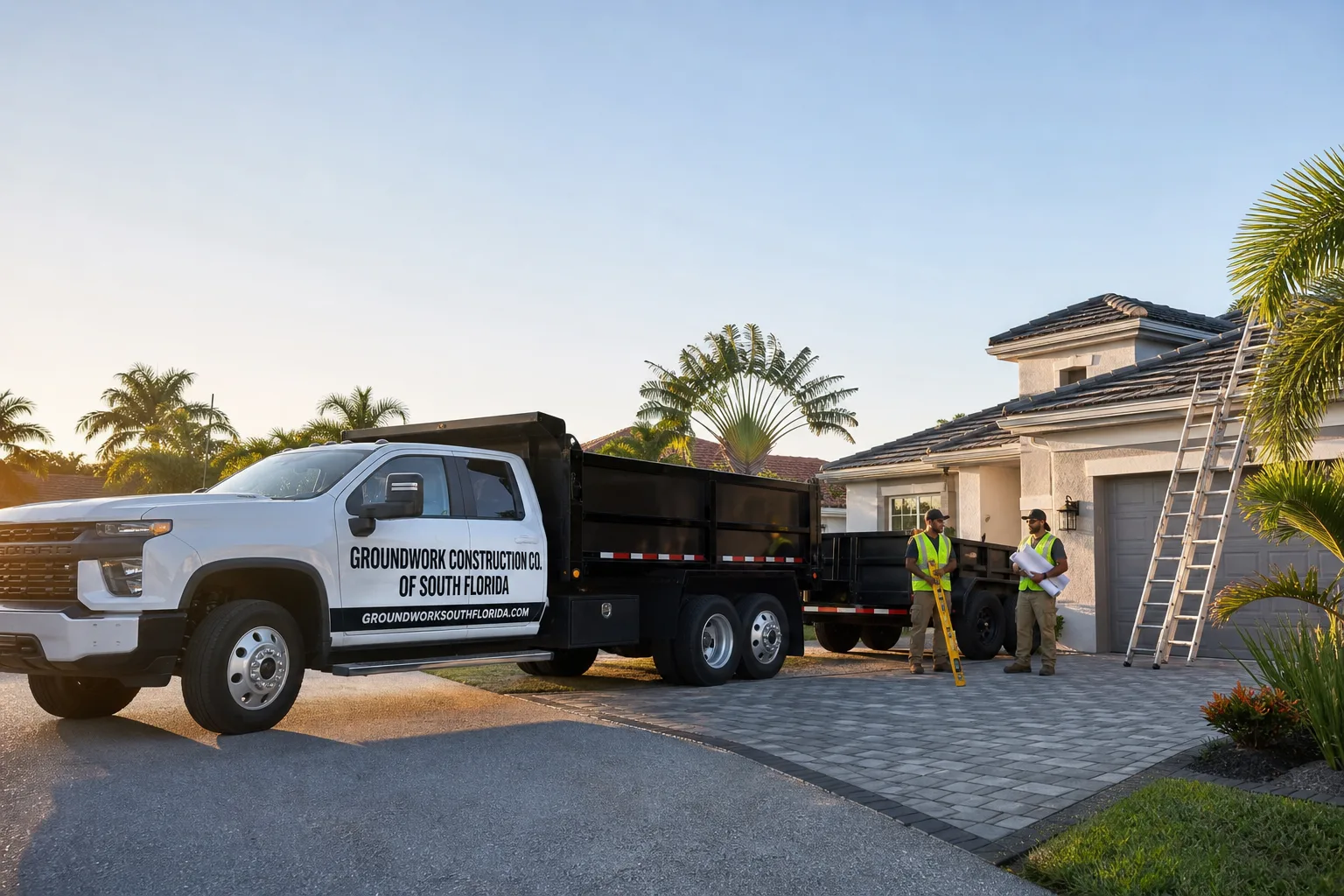
ADU Site Prep & Utilities in Carol City: What It Costs and How Long It Takes
ADU site prep and utilities in Carol City typically runs $45,000-$130,000 for a full package including demolition, grading, foundation work, and utility tie-ins, with most projects taking 4-8 weeks before the structure phase begins. Call (844) 665-0162 for a free on-site estimate and a written timeline based on your property’s actual conditions.
We’re talking about the unglamorous but critical work that happens before any walls go up: clearing the build area, demolishing old structures or concrete, bringing in fill and compacting it to spec, pouring footings and slab, and running water, sewer, gas, and electrical from the main house or street to the ADU footprint. In Carol City, this phase almost always takes longer than homeowners expect because of what sits beneath and around these 1960s-era lots.
How we handle ADU site prep and utilities from start to finish
Every Carol City job follows the same five-stage sequence, though the duration of each shifts based on what we find once we start digging.
Stage 1: Utility locate and site survey (3-5 days)
Before a shovel hits dirt, we pull permits for utility marking and send a surveyor to verify setbacks against Miami-Dade’s current flood zone and property records. Homeowners decide at this stage whether the ADU will tie into existing house utilities or run independent meters. That choice affects everything downstream. Independent meters mean separate sewer and water taps, which adds cost but eliminates capacity arguments later. Shared utilities are cheaper upfront but require a load analysis of the existing 1960s service panel, which in Carol City is often only 100 amps.
Stage 2: Demolition and clearing (2-7 days)
Old sheds, carports, concrete pads, and fencing come out. If there’s an existing septic tank or abandoned well on the lot, we coordinate abandonment to current Miami-Dade standards. The soil gets scraped to virgin ground where the footprint will sit. Homeowners sometimes keep mature trees for shade; we mark critical root zones and adjust the pad location if possible.
Stage 3: Rough grading and drainage (3-5 days)
Carol City’s flat terrain means water doesn’t leave on its own. We grade for positive drainage away from both structures and install French drains or catch basins where the lot sits lower than neighbors. During wet season, this stage can stretch because saturated soil won’t compact. We don’t pour on mud; it voids the warranty and fails inspection.
Stage 4: Underground utilities (5-10 days)
Trenching for water, sewer, gas, and electrical happens now, before the slab goes in. Depths are dictated by Miami-Dade code: water at 18 inches minimum, sewer with proper fall to the tie-in point, electrical conduit at 24 inches. In Carol City, we frequently hit shallow bedrock or high water table, which means switching from open trench to controlled fill methods or dewatering. The homeowner’s material choice for the main water line (PVC vs. copper) gets locked in here.
Stage 5: Footings, slab, and pre-structure inspection (7-14 days)
We form and pour footings to engineered specs, then the slab with vapor barrier and rebar grid. Miami-Dade inspectors review the underground rough before we pour, then again after. No exceptions. Once the slab passes, we’re ready to hand off to the structure crew or, if you’re working with a full Home Additions & ADU in Carol City package, our framing team steps in the next day.
The material and system choices that shape your ADU site prep
Homeowners often assume site prep is standardized. It isn’t. These are the real decisions you’ll make:
- Foundation type: monolithic slab vs. stem wall. A monolithic slab is faster and cheaper, poured in one pass. A stem wall with elevated floor gets you above flood-prone grade and allows plumbing access underneath, but adds $8,000-$15,000 and a week to the schedule. In Carol City’s low-lying areas near Scott Lake, we often recommend stem walls.
- Water service line: PVC Schedule 40 vs. copper. PVC is code-compliant, cheaper, and easier to repair. Copper lasts longer and handles pressure spikes better, but costs roughly 40% more. For a rental ADU with long-term durability in mind, copper often wins. For a family guest unit, PVC is fine.
- Electrical service: subpanel from house vs. new meter. A subpanel off the existing 200-amp service runs $2,500-$4,500. A new FPL meter and separate service adds $4,000-$7,500 but gives the ADU its own billing and capacity headroom. Many Carol City originals still run 100-amp mains, so a subpanel may require a full service upgrade first.
- Drainage: basic swale vs. engineered system. Simple grading with swales handles most Carol City lots. If you’re in a pocket with chronic standing water or zero fall to the street, we design a French drain or sump system. That’s an additional $3,000-$6,000 but prevents the callback nobody wants: water in the new unit six months after completion.
- Demolition scope: clear and haul vs. crush-and-leave. We haul all debris offsite. Some competitors offer to break old concrete and bury it as fill. We don’t. Miami-Dade inspectors can flag undocumented fill, and buried concrete shifts. It’s not worth the savings.
What ADU Site Prep & Utilities costs in Carol City, FL
| Component | Typical Range |
|---|---|
| Full ADU site prep and utilities package | $45,000-$130,000 |
| Demolition and clearing only | $3,500-$12,000 |
| Slab/foundation only | $12,000-$35,000 |
| Underground utilities only | $8,000-$28,000 |
| Drainage correction | $3,000-$12,000 |
Five factors push any Carol City job to the high or low end of that range:
Existing structures and hardscape. A bare backyard with grass is the easy scenario. Removing a 400-square-foot concrete patio with rebar, an old septic system, or a mature tree within the setback zone adds labor and disposal cost.
Utility distance and depth. Tying into a sewer lateral 80 feet from the house through a narrow side yard costs more than a 20-foot run across open lawn. Deep trenching through coral rock or dewatering for high water table adds equipment days.
Foundation complexity. Monolithic slab on stable fill is straightforward. Stem walls, elevated floors, or engineered fill over poor soils move the number up.
Code-triggered upgrades. Because Carol City falls under Miami-Dade’s High Velocity Hurricane Zone, inspectors may require wind-mitigation improvements to the existing house before they’ll sign off on the ADU connection. Roof-to-wall straps, upgraded garage door bracing, or impact-rated window replacement on the main house aren’t technically “ADU site prep,” but they become project prerequisites.
Permit and inspection timing. Miami-Dade’s Building Department runs on its own calendar. We don’t control inspection availability, and failed inspections for NOA documentation (more on that below) add weeks. Our estimates include standard permit fees; expedited reviews or resubmittals are extra.
A written estimate from Groundwork Construction Co. specifies exactly what’s included: demolition, hauling, rough grading, drainage design, utility trenching and materials to the ADU stub-outs, footings, slab, and all permit-related drawings and fees. What’s typically separate: tree removal by licensed arborist, FPL service upgrade, septic abandonment if required by Health Department, and any code-mandated upgrades to the existing structure.
What Carol City homes do to this job that other cities don’t
Carol City’s housing stock is almost entirely 1958-1968 concrete block tract homes built under FHA guidelines that predate every modern Florida building code. That matters for site prep in ways that don’t apply in Lake Lucerne or Miami Gardens, even though they’re nearby.
First, the flat topography and high water table. At roughly 8-10 feet above sea level with essentially zero natural drainage, any cut-and-fill operation has to account for seasonal saturation. We’ve had May starts where the trench fills with groundwater faster than we can pump it. We plan for dewatering in wet-season schedules; contractors who don’t build in that buffer end up with failed compaction tests and a slab that cracks in year two.
Second, Miami-Dade’s High Velocity Hurricane Zone requirements. This isn’t statewide code. It’s stricter, and it applies specifically to Carol City because it’s in Miami-Dade County, not Broward. Every structural material, every fastener, every window and door that will be installed in or connected to this ADU needs a valid Notice of Acceptance (NOA) number. We’ve seen out-of-county contractors spec standard Simpson straps that work fine in Fort Lauderdale but get red-tagged here because the NOA doesn’t match Miami-Dade’s HVHZ product approval database. That stops the job until the right material is sourced and resubmitted.
Third, the existing utility infrastructure. These 1960s originals often have galvanized water lines, clay sewer laterals, and 100-amp electrical services with no spare breaker spaces. We identify those constraints in our first site visit because they change the project scope. A homeowner who wants a full kitchen and laundry in the ADU may need a 400-amp service upgrade on the main house before FPL will approve the second meter. That’s not a surprise we deliver mid-project.
Fourth, the homogeneous lot layout. Narrow side yards, alley-loaded garages in some sections, and mature ficus hedges on property lines mean our excavation equipment has to fit through tight clearances. We use compact excavators and mini-skids where standard machines won’t pass. That affects mobilization cost and timeline, but it protects your neighbor’s driveway and your existing landscaping.
Serving Carol City, FL - Our Local Coverage Area
We’re based in the Carol City area and know this community well. Use the map below to see our service coverage - if you’re nearby, we can almost certainly help.
Frequently asked - ADU Site Prep & Utilities in Carol City
Most projects run 4-8 weeks from permit pull to slab completion, with underground utilities and foundation work taking the bulk of that time. Wet-season starts or complex utility tie-ins can push toward 10 weeks. Call (844) 665-0162 and we’ll walk your lot to give you a schedule based on actual conditions.
Yes, absolutely. Miami-Dade requires permits for demolition, excavation, utility work, and foundation pour, with separate inspections at rough underground and final slab stages. We handle all permit drawings and submissions as part of our scope. Working without permits in this jurisdiction risks stop-work orders and mandatory teardown of uninspected work.
Sometimes, if the ADU footprint sits close to the house and your existing service has spare capacity. More often in Carol City, we need to extend or upgrade lines because the original 1960s systems were never sized for an additional dwelling. We determine this during our utility locate and load calculation in stage one, before any digging starts.
A subpanel electrical tie-in, shared water and sewer lateral, and PVC service line will keep costs at the lower end of our range. The trade-off is reduced capacity and no separate billing. For a rental ADU, independent meters usually pay back over time. We’ll run the numbers both ways in your estimate.
We warranty our workmanship on foundation and utility installation, with specific coverage terms provided in writing with each estimate. Material warranties come from the manufacturers we specify. Our Home Additions & ADU crew coordinates directly with our site prep team, so there’s no gap in accountability between phases.
Ready to start your ADU site prep in Carol City?
Call (844) 665-0162 to schedule a free on-site estimate. Raymond Estevez or a member of our Carol City project team will walk your property, identify utility constraints and drainage conditions, and deliver a written scope with firm pricing and timeline. Whether your ADU is stick-built or you’re exploring prefab options through partners like Abodu or Dvele, the groundwork has to be right first. Many homeowners pair their ADU project with interior updates, and our Small & Partial Kitchen Remodels in Carol City or Full Bathroom Remodeling in Carol City crews can coordinate timing so you’re not living through two separate construction periods.
Written by Raymond Estevez, Owner at Groundwork Construction Co., serving Carol City and South Florida homeowners since 2014.