
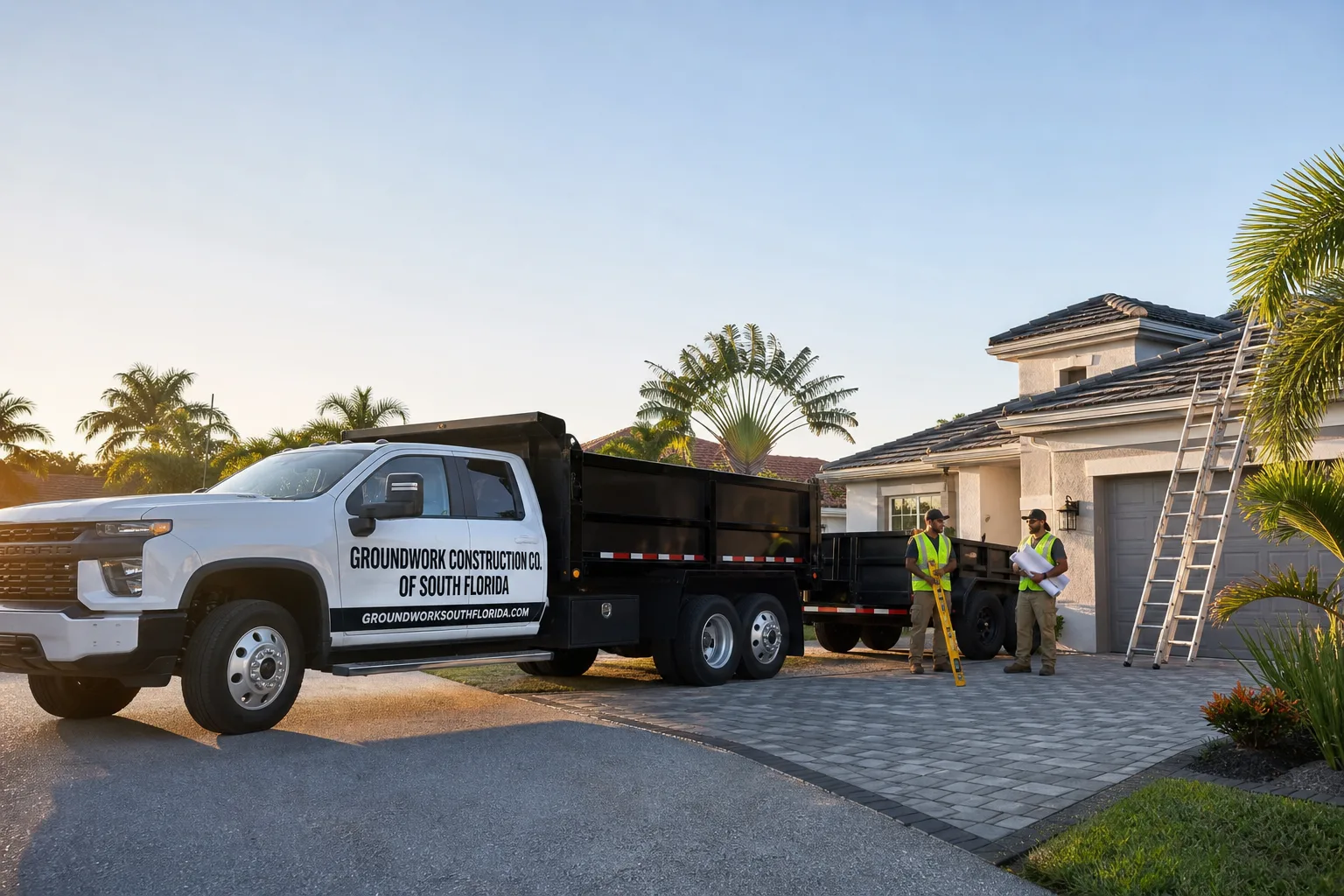
ADU Site Prep & Utilities in Miami Gardens: What It Costs and How Long It Takes
ADU site prep and utilities in Miami Gardens covers the full ground-up work before any walls go up: clearing and grading your lot, trenching for sewer and water lines, running electrical service from the main panel, and preparing a code-compliant foundation pad. Most jobs we handle in the 33056 area run 3 to 6 weeks from permit release to final utility hookup, with total project costs typically falling between $45,000 and $130,000 depending on how much of the existing site needs reworking. Call (844) 665-0162 and we’ll walk your property to give you a written estimate with no obligation.
How We Handle ADU Site Prep & Utilities, Start to Finish
Every ADU site prep and utilities job in Miami Gardens follows a five-stage sequence. We’ve refined this over enough Carol City-era ranch properties to know where the surprises hide, and we build that into the timeline upfront so you’re not left guessing.
Stage 1: Site survey and utility locate (2-3 days)
Before a shovel hits the ground, we pull the existing as-builts from Miami-Dade and have a private utility locator mark every line on your property. On these 1950s-1970s CBS ranch lots, we’ve found abandoned septic tanks, undocumented sprinkler mains, and old FPL service runs that don’t match county records. You decide at this stage whether you want us to proceed with the standard trenching plan or if you’ve got future hardscaping in mind that would change our routing.
Stage 2: Demolition and rough grading (3-5 days)
We clear the build footprint, remove any existing slabs or outbuildings, and cut to rough grade. Miami Gardens sits on a shallow water table, so we often hit standing water at 18 to 24 inches. That means dewatering with a well-point system or switching to a raised foundation with stem walls rather than a monolithic slab. You’ll choose here: slab-on-grade with engineered fill (faster, less expensive) or stem wall with vented crawl (better for flood resilience, adds roughly 15% to foundation cost).
Stage 3: Underground utilities and trenching (5-10 days)
This is where the real coordination happens. We trench from your main house to the ADU footprint for water, sewer, and electrical. Miami-Dade requires a licensed master plumber and electrician to pull separate permits for each trade, and all work gets inspected before backfill. If your existing main panel is at capacity, you’ll need to decide now whether to upgrade to a 400-amp service or run a separate meter for the ADU. The separate meter route is cleaner for future resale but adds roughly $3,500-$6,000 in FPL coordination fees.
Stage 4: Foundation pour and cure (7-14 days)
With utilities stubbed and inspected, we form and pour. In the HVHZ, that means rebar per Miami-Dade’s amended Florida Building Code, not just ACI 318 standard. We use a minimum 3,000 PSI concrete with fly ash for sulfate resistance given the shallow groundwater chemistry here. You choose your finish: broom for a standard utility slab, or steel-trowel if you’re planning finished flooring directly on concrete. The slab needs 7 days minimum cure before we load framing materials.
Stage 5: Final utility hookup and rough inspection (2-3 days)
We coordinate FPL for the permanent service connection, pressure-test water lines, and run the sewer lateral camera inspection Miami-Dade requires. Once rough utilities pass, we’re handing off a clean, inspected pad to the framing crew. If your Home Additions & ADU in Miami Gardens project includes a prefab unit from one of our partners, this is the handoff point where their install team takes over.
The Spec Choices That Shape Your Job
ADU site prep and utilities isn’t one-size-fits-all. The decisions you make here lock in performance and cost for decades. These are the actual trade-offs we walk Miami Gardens homeowners through:
- Foundation type: monolithic slab vs. stem wall with crawl. Slab is faster and runs roughly 20% less, but you’re locked at grade in a flood-prone area. Stem wall gets you above the water table, allows access for future plumbing repairs, and satisfies most mortgage lenders’ flood-risk requirements for detached ADUs. On lots near Lake Lucerne or Scott Lake where the water table sits especially high, we almost always recommend stem wall.
- Water service: direct tap vs. meter split. Tapping off your existing 3/4-inch line is cheapest upfront but means shared billing and potential pressure drop when both units run simultaneously. A split meter with separate 1-inch service to the ADU costs more but gives independent control and cleaner rental documentation. Miami-Dade Water and Sewer charges roughly $1,800-$2,400 for the new tap and meter.
- Electrical routing: overhead vs. underground. Overhead is rare in Miami Gardens post-Hurricane Andrew, but some Carol City blocks still have aerial service. Underground looks better, eliminates wind-damage risk, and is required for any new construction permit. The trade-off is trench depth: 24 inches minimum for direct-burial cable, 30 inches if we’re running rigid conduit for future-proofing.
- Sewer lateral material: PVC Schedule 40 vs. SDR-35. Schedule 40 is stronger for shallow-burial situations where we can’t get full cover. SDR-35 saves roughly 30% on material but needs deeper bedding. Given the shallow water table and occasional rocky marl we hit in Miami Gardens, we typically spec Schedule 40 unless soil conditions prove ideal.
- Grading and drainage: positive-slope yard vs. integrated French drain. Simple grade-away-from-structure works on lots with rear access and fall to the street. Flat lots or properties with pool-adjacent ADUs need a perimeter drain tied to the municipal storm system or a dry well. The dry well route adds $2,500-$4,500 but avoids Miami-Dade’s storm-connection permit queue, which can run 4 to 6 weeks.
What ADU Site Prep & Utilities Costs in Miami Gardens, FL
For a typical Miami Gardens lot with a standard 400-600 square foot ADU footprint, expect $45,000 to $130,000 for complete site prep and utilities. That’s a wide range because the variables below move the needle significantly:
| Cost Driver | Low-End Scenario | High-End Scenario |
|---|---|---|
| Lot condition | Clear grass, no obstructions | Existing slab demo, tree removal, debris hauling |
| Foundation type | Monolithic slab, engineered fill | Stem wall, imported fill, dewatering |
| Utility distance | ADU within 30 feet of main house | 100+ foot run, alley or street-side service |
| Electrical service | Tapped from existing panel | 400-amp upgrade or separate meter |
| Permit complexity | Standard Miami-Dade ADU permit | HVHZ engineering, flood zone elevation cert |
What’s included in our written estimate: all labor, materials, equipment rental, dewatering if needed, permit application and inspection scheduling, and utility coordination with FPL, Miami-Dade Water and Sewer, and any private providers. What’s typically separate: tree removal permits through the city of Miami Gardens, soil testing if geotechnical concerns arise, and any required asbestos or lead abatement on demolished structures. We flag these possibilities during our initial walk so you’re not surprised.
Jobs at the low end usually involve a rear-yard ADU on a cleared lot with the main house already running 200-amp service and a straight 40-foot utility run. High-end jobs hit when we’re working corner lots with street-frontage utility pulls, failing septics that need connection to municipal sewer, or properties where the original 1950s electrical service can’t handle any additional load without a full mast and weatherhead replacement.
Why Miami Gardens Homes Make This Job Different
The housing stock here defines everything about how we approach ADU site prep and utilities. Miami Gardens is built almost entirely on a dense grid of 1950s-1970s concrete block and stucco ranch homes from the Carol City suburban development era - homes that predate Miami-Dade’s post-Hurricane Andrew High Velocity Hurricane Zone code overhaul. That matters because every new foundation we pour has to meet 175 mph design wind speed, and every utility penetration through that foundation needs HVHZ-approved flashing and sealing.
We’ve learned to price in the roof-to-wall strap retrofit that Miami-Dade inspectors routinely require when any addition triggers a wind mitigation review. On original Carol City-era homes with tie-beam construction but no embedded hurricane straps, that means opening soffits, installing Simpson Strong-Tie or equivalent straps at 48 inches on center, and getting a re-inspection before we can close the ADU permit. Crews who primarily work Broward County miss this consistently; it’s not required there, and the budget blowout shows up mid-project.
The shallow water table is the other Miami Gardens reality. At roughly 18 to 24 inches across most of the 33056 ZIP, we can’t rely on standard drainage assumptions. French drains, dry wells, or positive-grade engineering aren’t optional upgrades here; they’re survival measures for any foundation that needs to pass a 30-year mortgage inspection. We’ve also found that the marl and limestone caprock in some Scott Lake-area lots demands pneumatic breaking equipment that sandy-soil crews don’t carry, another reason we bring full excavation capability to every site walk.
If you’re expanding your project scope, many homeowners pair their ADU groundwork with interior updates to the main house. Our Small & Partial Kitchen Remodels in Miami Gardens team often coordinates timing so you’re not living through two separate construction periods. Similarly, Full Bathroom Remodeling in Miami Gardens can be sequenced alongside the utility rough-in phase to share permit and inspection scheduling.
Serving Miami Gardens, FL - Our Local Coverage Area
We’re based in the Miami Gardens area and know this community well. Use the map below to see our service coverage - if you’re nearby, we can almost certainly help.
Frequently Asked - ADU Site Prep & Utilities in Miami Gardens
Most jobs run 3 to 6 weeks from permit release to final rough inspection, assuming standard soil conditions and no utility coordination delays. Dewatering requirements, FPL service upgrades, or Miami-Dade inspection backlogs can extend this to 8 weeks. Call (844) 665-0162 and we’ll check current permit turnaround times for your specific project.
Yes. Miami-Dade requires separate plumbing, electrical, and building permits for ADU site prep and utilities, even when the ADU itself is permitted as a single project. We pull and manage all three as part of our scope. The building permit triggers the mandatory wind mitigation inspection that catches many first-time ADU builders in Miami Gardens.
You can tap existing lines if your main house has adequate capacity, but most 1950s-1970s Carol City-era homes don’t. Electrical panels under 200 amps and 3/4-inch water service typically need upgrading to handle a second dwelling unit. During our site walk, we test your existing loads and give you the real numbers before you commit.
The lowest-cost path is a rear-yard ADU within 30 feet of the main house, tapped off an existing 200-amp panel and 1-inch water service, with a monolithic slab foundation and positive-grade drainage. That configuration typically lands near the $45,000 end of our range. Every deviation - distance, foundation type, service upgrade - adds cost. We’ll show you exactly where your property falls during the free estimate.
We warranty our workmanship on all ADU site prep and utilities for one year from final inspection, with manufacturer’s warranties on concrete, pipe, and electrical materials passing through to you. Foundation work carries a 10-year structural warranty. We’re a Miami Gardens-active contractor, so we’re available for warranty calls without the scheduling delays of out-of-area crews.
Get Your Miami Gardens Property Assessed
ADU site prep and utilities is the phase where hidden conditions turn into change orders, or where a thorough upfront assessment keeps your project on budget. We’ll walk your lot, test your existing services, and deliver a written estimate with line-item pricing for every stage. Call (844) 665-0162 to schedule your free on-site consultation. Our Home Additions & ADU crew serves all of Miami Gardens and surrounding areas including Carol City, Lake Lucerne, Scott Lake, and Opa Locka.
Written by Raymond Estevez, Owner at Groundwork Construction Co., serving Miami Gardens since our founding.