
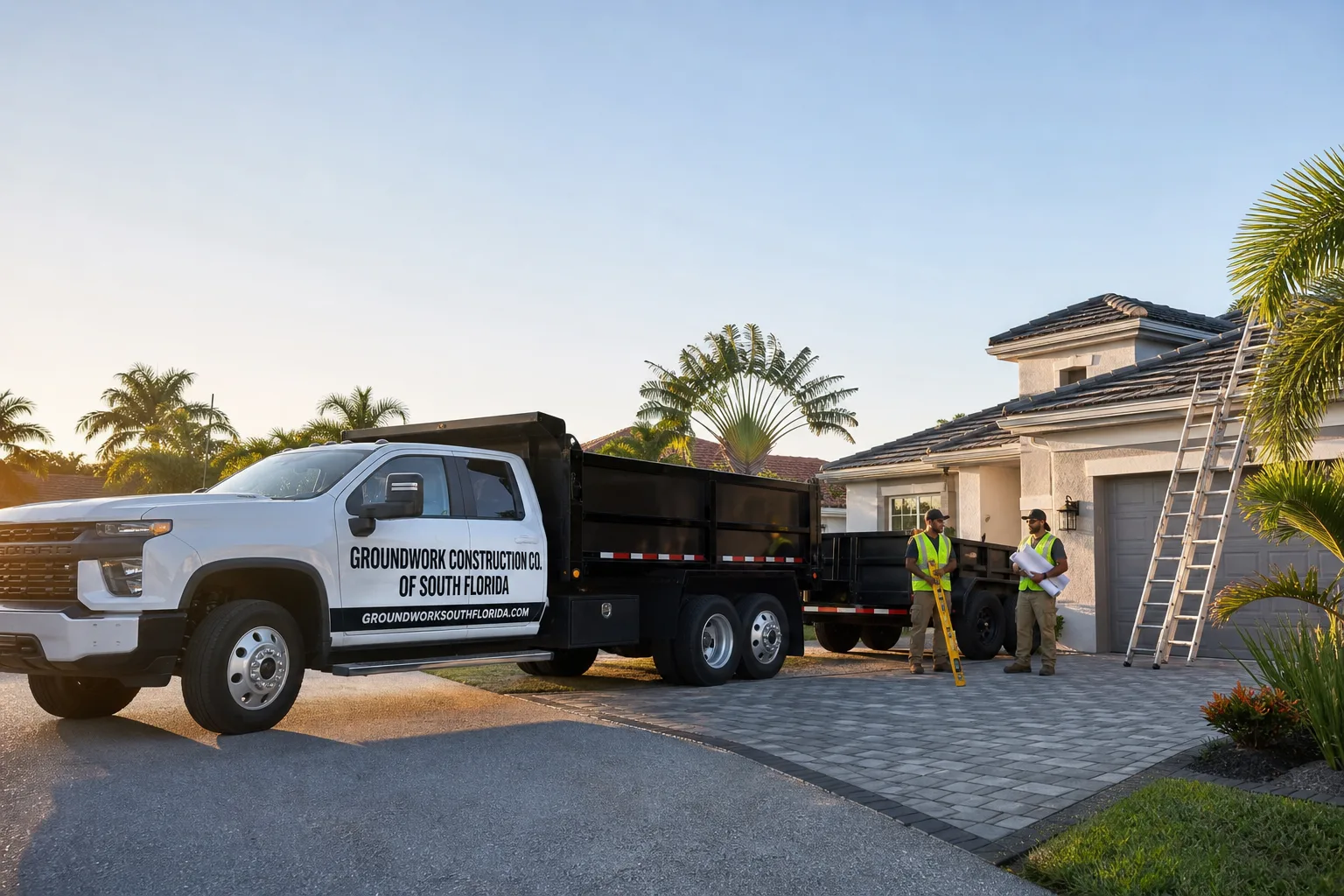
ADU Site Prep & Utilities in Miami Lakes, FL - What’s Actually Involved
ADU site prep and utilities in Miami Lakes means clearing and grading your lot, rerouting or extending water/sewer/electrical/gas lines to the accessory unit location, and bringing the pad up to Miami-Dade HVHZ code before any walls go up. Most Miami Lakes projects we handle run 3 to 6 weeks for this phase alone, with total ADU construction landing between $90,000 and $220,000 depending on size and finish level. Call (844) 665-0162 and we’ll walk your property to give you a written, line-item estimate for the prep scope specifically.
How We Handle ADU Site Prep & Utilities - Stage by Stage
Every ADU site prep and utilities job in Miami Lakes follows a sequence we’ve refined across dozens of South Florida projects. Here’s what actually happens, what you’ll need to decide, and how long each stage takes.
Stage 1: Site Survey & Utility Locate (2-4 days)
We mark existing underground lines, identify your home’s main sewer lateral and electrical service size, and verify whether your panel can handle the ADU load. You’ll decide now whether the ADU connects to your existing meter or gets its own. In Miami Lakes, many 1970s-era homes still run 150-amp service, so an electrical upgrade often gets bundled into this phase.
Stage 2: Demolition & Clearance (1-3 days)
We remove sheds, old patios, trees in the setback zone, or failing concrete pads. Anything with a root system near your sewer line gets flagged for hand-digging. If your lot backs onto one of Miami Lakes’s chain lakes, we establish erosion controls before touching soil.
Stage 3: Rough Excavation & Drainage Design (3-5 days)
With the water table sitting 1-2 feet below grade across much of Miami Lakes, we rarely dig deep without dewatering. Your footer trenches get pumped continuously, and we install perimeter drainage tied to your storm system or a French drain if gravity flow allows. You’ll choose between a monolithic slab or stem-wall foundation here; stem walls cost more but handle seasonal water pressure better in lake-adjacent lots.
Stage 4: Utility Rough-In & Inspection (5-10 days)
We trench water, sewer, and electrical from main to pad location. In Miami Lakes’s built-out neighborhoods, this often means boring under existing driveways or navigating mature oak root systems. Gas lines get pressure-tested, electrical conduit gets inspected before burial, and plumbing gets a rough-in sign-off from Miami-Dade. This is where post-tensioned slab risk shows up: if we’re cutting through any existing hardscape to reach your main, we bring in a structural engineer with GPR to scan for tensioned cables first.
Stage 5: Pad Prep & Final Grade (2-3 days)
We compact subgrade, lay vapor barrier, set rebar or post-tension cable per engineer spec, and pour to Miami-Dade HVHZ standards. The pad gets flood-vent openings if required, and we leave utility stub-ups precisely located for your ADU’s floor plan. Final grade directs water away from both structures.
The Spec Choices You’ll Make for ADU Site Prep & Utilities
These decisions come up on every Miami Lakes job. Each option has a real trade-off:
- Foundation type: Monolithic slab vs. stem wall. Monolithic pours faster and costs less upfront, but in Miami Lakes’s high water table, we’ve seen slab-edge moisture wick into finished floors during heavy rain seasons. Stem walls with raised floor joists add $4,000-$8,000 but keep mechanicals and finishes dry. We recommend stem walls for lake-adjacent lots.
- Utility connection: Tapped off main house vs. independent meters. Tapping existing lines saves trenching distance and permit complexity, but you’ll share capacity. Separate meters mean higher upfront cost and longer Miami-Dade Water & Sewer coordination, yet they simplify rental use later and avoid load conflicts during peak A/C draw.
- Electrical service upgrade: 200-amp panel vs. 320-amp dual service. If your existing panel is original to a 1970s Miami Lakes home, a 200-amp upgrade usually suffices for a modest ADU. For larger units with electric appliances and EV charging, we spec 320-amp dual service. The difference is roughly $2,500-$5,000 in electrical hardware alone.
- Drainage discharge: Storm tie-in vs. on-site retention. Miami-Dade requires stormwater management for any new impervious surface. Direct tie-in to municipal storm is cheapest where available, but some Miami Lakes sections near the lakes require on-site retention or exfiltration trenches. We’ll confirm with your specific lot’s drainage basin during survey.
- Pad insulation: Rigid foam under slab vs. edge-only. Full underslab insulation adds comfort and efficiency but complicates the pour sequence. Edge-only is standard for our market and meets code. We discuss this when the ADU will have finished flooring sensitive to thermal transfer, like Silestone or Caesarstone surfaces in an attached kitchenette.
What ADU Site Prep & Utilities Costs in Miami Lakes, FL
For the site prep and utilities portion specifically, Miami Lakes homeowners typically invest $18,000-$45,000 before the first wall rises. Total ADU construction runs $90,000-$220,000.
Five factors push you toward the high or low end of that prep range:
- Lot size and access. Narrow side yards between CBS homes mean mini-excavators instead of standard equipment, adding labor hours. Corner lots with alley access cut mobilization costs significantly.
- Existing utility locations. When your sewer lateral exits the opposite side of the house from the ADU pad, we trench 40-60 feet under driveway or through mature landscaping. Each linear foot adds material and restoration cost.
- Electrical service capacity. A straightforward 200-amp panel swap is routine. If FPL requires a new transformer drop or overhead-to-underground conversion, timelines extend and costs jump.
- Water table and dewatering. Lake-adjacent lots in Miami Lakes need continuous pumping during excavation. We price this as a daily rental plus fuel; wet weeks add up.
- Structural surprises in existing slabs. Post-tensioned cable systems, found in many 1970s-1980s Miami Lakes commercial and multi-family slabs, require GPR scanning and engineered cutting. Unplanned cable severing is a $10,000+ remediation we avoid through proper pre-work.
Our written estimates itemize each of these categories separately. You’ll see line items for dewatering, permits, inspections, and utility connection fees - nothing buried in “allowances.” What we don’t include: FPL or Miami-Dade Water & Sewer direct connection fees, which they bill you separately, and any HOA application fees if your Miami Lakes community requires architectural review.
What Miami Lakes Specifically Does to This Job
Miami Lakes was developed as a master-planned community by the Graham Companies beginning in the late 1960s, meaning the residential stock is almost entirely aging concrete block stucco construction from a single compressed era. When we cut into a 1970s slab on Royal Oak Lane or trench near a lakefront lot on Ludlam Road, we’re working on structures that were built before Miami-Dade’s current High-Velocity Hurricane Zone code existed. Every product we specify - from rebar ties to flood vents to the concrete mix itself - must carry a Miami-Dade Notice of Acceptance (NOA). Contractors working just across the county line in Broward don’t always stock these SKUs, and we’ve seen projects stall when out-of-county crews realize their standard materials won’t pass inspection.
The town’s extensive network of man-made lakes means the water table sits 1-2 feet below grade across much of the community. In Country Club of Miami Lakes or near Main Street’s commercial corridor, we’ve had footer excavations fill faster than we could pour. This isn’t a dealbreaker; it’s a planning reality. We schedule concrete deliveries for early morning, pump continuously, and keep a backup generator on site during hurricane season.
Many 1970s-1980s Miami Lakes buildings, including some duplex and multi-family stock near the original town center, sit on post-tensioned slab foundations. Any utility trench cutting through these slabs demands a structural engineer’s GPR scan first. We’ve seen contractors skip this step. The resulting cable severing requires slab demolition, re-tensioning, and engineering sign-off that adds weeks and five figures to a project. We don’t skip it.
Permitting runs through Miami-Dade County, not a local town office, but Miami Lakes’s HOA structures add a parallel review layer. Communities like Miami Lakes East or Royal Oaks have architectural committees that want renderings, material samples, and setback confirmations before we pull the county permit. We build this timeline into our schedule so county and HOA approvals run concurrently, not sequentially.
Serving Miami Lakes, FL - Our Local Coverage Area
We’re based in the Miami Lakes area and know this community well. Use the map below to see our service coverage - if you’re nearby, we can almost certainly help.
Frequently Asked - ADU Site Prep & Utilities in Miami Lakes
Three to six weeks is typical for the prep and utilities phase alone, with permitting and HOA review adding 2-4 weeks beforehand. Wet-season excavation near the lakes can push toward the longer end. Call (844) 665-0162 and we’ll give you a schedule tied to your specific lot conditions.
Yes - Miami-Dade County requires permits for any excavation, utility extension, and foundation work, plus separate electrical and plumbing permits. Miami Lakes HOA communities often require architectural pre-approval before county permitting begins. We handle both tracks as part of our project management.
Sometimes, if your ADU pad sits within 10-15 feet of your home’s existing utility exits and your panel has spare capacity. More often in Miami Lakes’s 1960s-1980s homes, we need to extend or upgrade one or more systems to meet current code and ADU load demands. Your site survey tells us which path applies.
The combination of HVHZ code compliance, high water table dewatering, and post-tensioned slab risk in this specific era of construction adds material and labor complexity. NOA-approved products cost more than standard equivalents, and wet excavation simply takes longer than dry. These aren’t markups; they’re real conditions we plan for.
Groundwork carries general liability and workers compensation coverage, and our contracts specify workmanship warranties on structural and utility installations. Manufacturer warranties cover the materials we specify, from concrete to PVC to electrical panels. We don’t warranty against unforeseen subsurface conditions we couldn’t reasonably detect, but we do warranty that we followed the engineered plan and code-required methods to address them.
Ready to Talk Through Your Miami Lakes ADU Site Prep?
We’ll walk your lot, identify your utility routing, flag any water table or slab concerns specific to your Miami Lakes property, and deliver a written estimate with line-item pricing for the full prep and utilities scope. No deposit required to schedule the site visit. Call (844) 665-0162 or request your free estimate through our Home Additions & ADU team.
Groundwork Construction Co. serves Miami Lakes and surrounding communities including Hialeah, Hialeah Gardens, Country Club, and Palm Springs North. Many homeowners pair their ADU project with interior updates; our crews also handle Small & Partial Kitchen Remodels in Miami Lakes and Full Bathroom Remodeling in Miami Lakes as part of a full property upgrade managed under one contract. For the complete ADU scope including design and permitting, see our Home Additions & ADU in Miami Lakes page.
Written by Raymond Estevez, Owner at Groundwork Construction Co., serving Miami Lakes since our South Florida launch.