
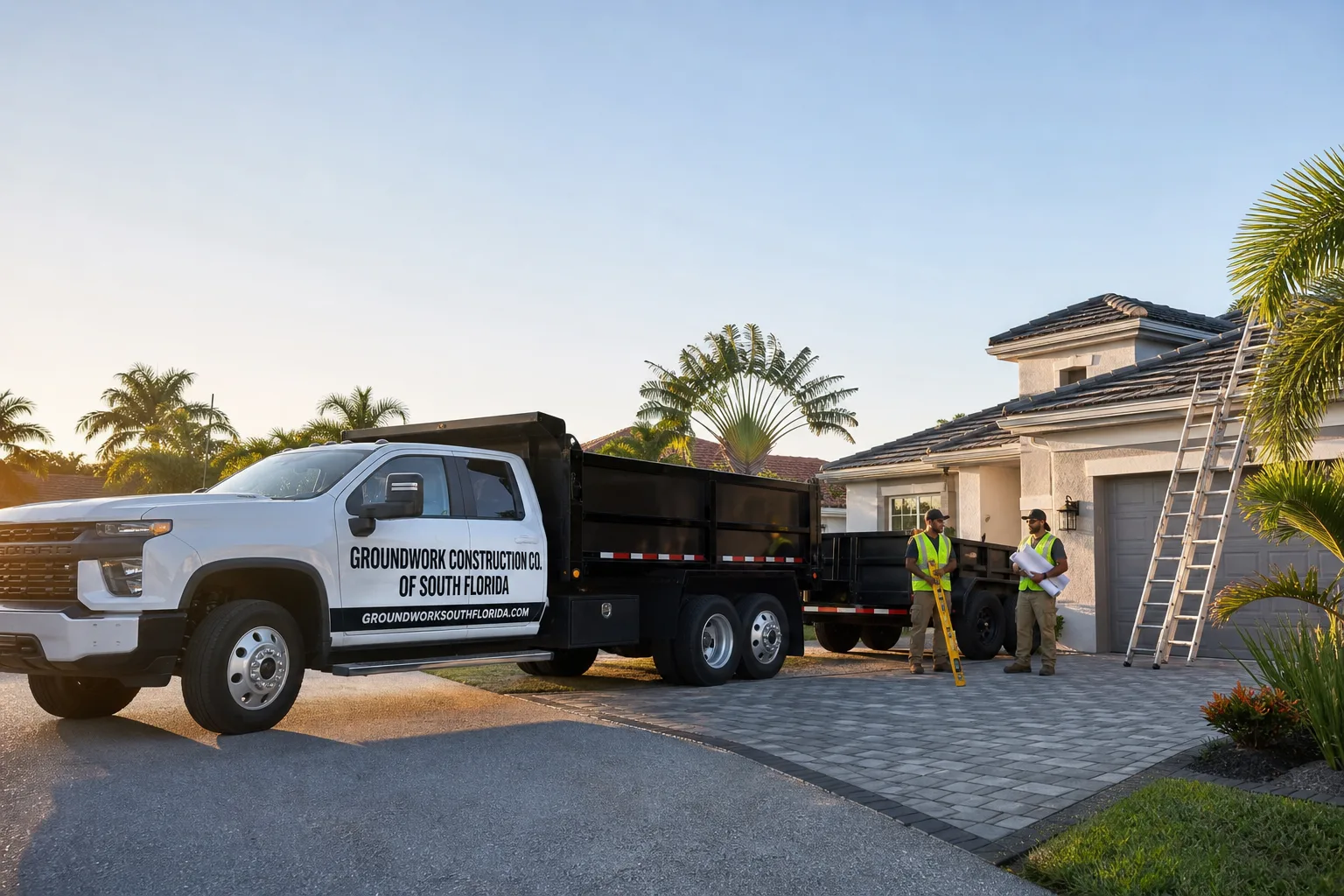
ADU Site Prep & Utilities in Country Club, FL - What It Actually Involves
ADU Site Prep & Utilities in Country Club, FL means clearing and grading your lot, trenching for water/sewer/electrical, pouring footers and slabs, and tying into existing municipal services before any walls go up. Most jobs here take 3 to 6 weeks depending on drainage conditions and permit turnaround. Call (844) 665-0162 for a free estimate - we’ll walk your property and give you a written scope with a real timeline.
How We Handle ADU Site Prep & Utilities From Ground Break to Final Utility Tie-In
Every ADU Site Prep & Utilities project in Country Club follows a five-stage sequence. Homeowners who understand the flow make faster decisions, and faster decisions keep crews moving.
Stage 1: Survey, utility locate, and site documentation (3-5 days). We pull existing as-builts from Miami-Dade utilities, mark underground lines, and shoot grades across your lot. You’ll decide whether to keep existing trees or hardscape features that fall inside the build zone. We also flag any overhead power lines that affect equipment access, which is common on the 80-foot lots typical of Country Club’s 1980s and 1990s subdivisions.
Stage 2: Demolition and rough clearing (2-4 days). This means removing sheds, old concrete pads, fences, and sometimes existing landscaping that sits where the ADU footprint will go. If we’re working near your main home’s slab, we saw-cut carefully to avoid undermining your existing foundation. Homeowners choose whether to salvage pavers or irrigation heads for reuse elsewhere on the property.
Stage 3: Rough grading and drainage shaping (3-5 days). Country Club’s porous Miami Limestone and high wet-season water table make this stage critical. We establish positive drainage away from both structures, often installing French drains or catch basins that weren’t needed when the original home was built. You’ll decide on surface water management: graded swale, underground drainage to the street, or retention on site if your HOA allows.
Stage 4: Trenching and utility rough-in (5-10 days). We open trenches for water, sewer, electrical, and sometimes gas. In Country Club, tying into existing municipal sewer typically means a 4-inch PVC lateral to the main line in the street or easement. Electrical service for a detached ADU usually requires a separate meter or sub-panel, which means coordination with FPL and Miami-Dade building inspections. Homeowners choose conduit burial depth and whether to future-proof with empty sleeves for data or EV charging.
Stage 5: Footer and slab pour, plus final utility connections (5-8 days). We form and pour footers to HVHZ standards, then the slab with vapor barrier and rebar per engineered plans. Final water and sewer taps happen after Miami-Dade pressure-tests the lines. You’ll do a walk-through with our superintendent before we call for the slab inspection. Once that passes, framing crews can start.
The Material and System Choices You’ll Make for ADU Site Prep & Utilities
Site prep and utilities aren’t just “dig and pour.” The specs you select affect durability, future flexibility, and final cost. Here’s what Country Club homeowners actually choose between:
- Slab type: monolithic vs. stem wall. Monolithic slabs pour footers and floor together, faster and cheaper ($3-$5 less per square foot in labor), but they offer less flexibility on sloped lots. Stem walls with elevated crawl space cost more upfront but protect against the seasonal water table rise we see in Country Club’s low-lying western lots. For ADUs with plumbing walls, stem walls simplify future repairs.
- Electrical service: 100-amp sub-panel vs. 200-amp standalone meter. A sub-panel fed from your main house works for smaller ADUs and avoids a second FPL account. A standalone meter suits rental units where you want tenants paying their own power, or if you’re planning EV charging or electric HVAC. Standalone adds $1,200-$2,800 for the meter base, conduit run, and FPL coordination.
- Water line material: PVC vs. PEX. PVC is code-standard for buried supply in Miami-Dade, rigid and proven. Some homeowners specify PEX for the interior stub-out for freeze flexibility, though freezes are rare here. PEX adds material cost but simplifies future interior modifications.
- Drainage strategy: gravity to street vs. pumped discharge. Gravity drainage through a 6-inch solid pipe to the curb is cheapest where grade allows. On flat lots common in Country Club’s older phases, a sump pump with battery backup handles water that can’t flow by gravity alone. Pumps add $800-$1,500 in equipment but prevent the standing water that undermines slabs and triggers HOA complaints.
- Vapor barrier and underslab insulation. A 10-mil polyethylene vapor barrier is standard. Upgrading to 15-mil or adding rigid foam insulation beneath the slab ($1.50-$3.00 per square foot) reduces condensation in air-conditioned ADUs and helps with energy compliance under Miami-Dade’s current energy code.
What ADU Site Prep & Utilities Costs in Country Club, FL
| Component | Typical Range |
|---|---|
| Site clearing and rough grading | $3,500 - $8,000 |
| Trenching and utility rough-in (water, sewer, electric) | $6,000 - $15,000 |
| Footers and monolithic slab (per sq ft) | $8 - $14 |
| Stem wall with elevated slab | $12 - $20 per sq ft |
| Drainage system (gravity or pumped) | $2,000 - $6,500 |
| Permits, inspections, utility coordination | $2,500 - $5,000 |
| Total ADU Site Prep & Utilities | $45,000 - $130,000 |
Five variables push your number within that range. Lot size and coverage matter most: a 400-square-foot ADU on a tight lot requires tighter equipment staging and more hand work. Existing conditions - old septic tanks, undocumented utility lines, or filled pools - add demo and disposal. Utility distance from your main house to the ADU pad: every extra ten feet of trench is more labor, pipe, and conduit. Material grade for the slab and drainage components. And permit scope: if your project triggers full HVHZ envelope upgrades on the primary home, inspections multiply and timelines stretch.
A written estimate from Groundwork includes all of the above line items, plus a contingency allowance for unknowns we flag during the site walk. It does not include landscaping restoration, irrigation repair, or HOA architectural review fees, which vary by community.
What Country Club’s Conditions Actually Mean for Your ADU Site Prep
Country Club isn’t a generic Miami-Dade address. The ZIP 33015 sits inside the High-Velocity Hurricane Zone, and that changes everything about how we prep and pour.
Most homes here are CBS tract construction from 1985 to 2005, built as planned subdivisions with active HOAs. Those HOAs add an architectural review layer on top of county permits. We’ve seen ARBs reject ADU placement for sight-line reasons or mandate specific fence screening between the main house and the unit. We handle ARB packet preparation as part of our pre-construction phase, including renderings and material boards, so you don’t get surprised by a denial after you’ve already paid for permits.
The wet-season water table is real. In May through October, we’ve hit groundwater at 18 inches on jobs near the western drainage canals. That doesn’t stop work, but it means dewatering during excavation, which adds a pump rental and sometimes a day or two to the schedule. We schedule critical below-grade work for drier months when possible, and we always design positive drainage into the finished grade because standing water in a Country Club backyard will draw both mosquitoes and HOA violation letters.
And the HVHZ code bite is genuine. Homeowners sometimes assume ADU Site Prep & Utilities is “just a slab and some pipes.” But if your primary home was built before 1994 and the ADU work touches the existing roofline, window locations, or structural connections, Miami-Dade can require current NOA-compliant materials and secondary water barriers on the main house. We identify that risk in our first site meeting, not after permits are filed.
Homeowners in Country Club often pair their ADU project with interior updates to the main house. If you’re expanding your footprint, you might also be updating the kitchen or adding a bathroom that the ADU occupants or your family will use. We handle Small & Partial Kitchen Remodels in Country Club and Full Bathroom Remodeling in Country Club under the same contract, with one crew sequence and one point of accountability.
Serving Country Club, FL - Our Local Coverage Area
We’re based in the Country Club area and know this community well. Use the map below to see our service coverage - if you’re nearby, we can almost certainly help.
Frequently Asked - ADU Site Prep & Utilities in Country Club
Most jobs run 3 to 6 weeks from breaking ground to passing the slab inspection. Wet-season groundwater, FPL meter coordination, and Miami-Dade inspection scheduling are the usual delays. Call (844) 665-0162 and we’ll give you a timeline based on your specific lot and the current permit queue.
Yes. Miami-Dade requires building permits for any ADU foundation, utility connection, or structural work, and most Country Club HOAs add an architectural review step before you can even apply. We prepare both packets simultaneously to avoid sequential delays.
Sometimes. If your main house’s sewer lateral and electrical panel have capacity and are positioned conveniently, we can tie in nearby. But most detached ADUs in Country Club need new dedicated lines from the street or a significant extension, which is why trenching and utility rough-in typically represents 25-35% of the total site prep budget.
An existing pad might save $4,000-$8,000 if it’s thick enough, properly reinforced, and positioned correctly for the ADU footprint. We still need to verify footer depth, test the slab for cracks or settlement, and confirm drainage falls. If the pad was poured for a shed without permits, it usually doesn’t meet ADU structural requirements.
Groundwork warranties the workmanship on drainage, utility connections, and concrete work. Specific material warranties come from the manufacturers - for example, PVC pipe and electrical conduit carry their own product guarantees. We’ll document what’s covered and for how long in your written contract before any work begins.
Ready to Talk Through Your Lot in Country Club?
ADU Site Prep & Utilities in Country Club has more moving parts than most homeowners expect - HVHZ compliance, HOA review, seasonal groundwater, and utility coordination all layered on top of the actual construction. We’ll walk your property, flag the specific constraints, and give you a written estimate with real numbers and a real sequence. Call (844) 665-0162 to schedule your free on-site consultation.
Written by Raymond Estevez, Owner at Groundwork Construction Co., serving Country Club and South Florida homeowners since our founding.