
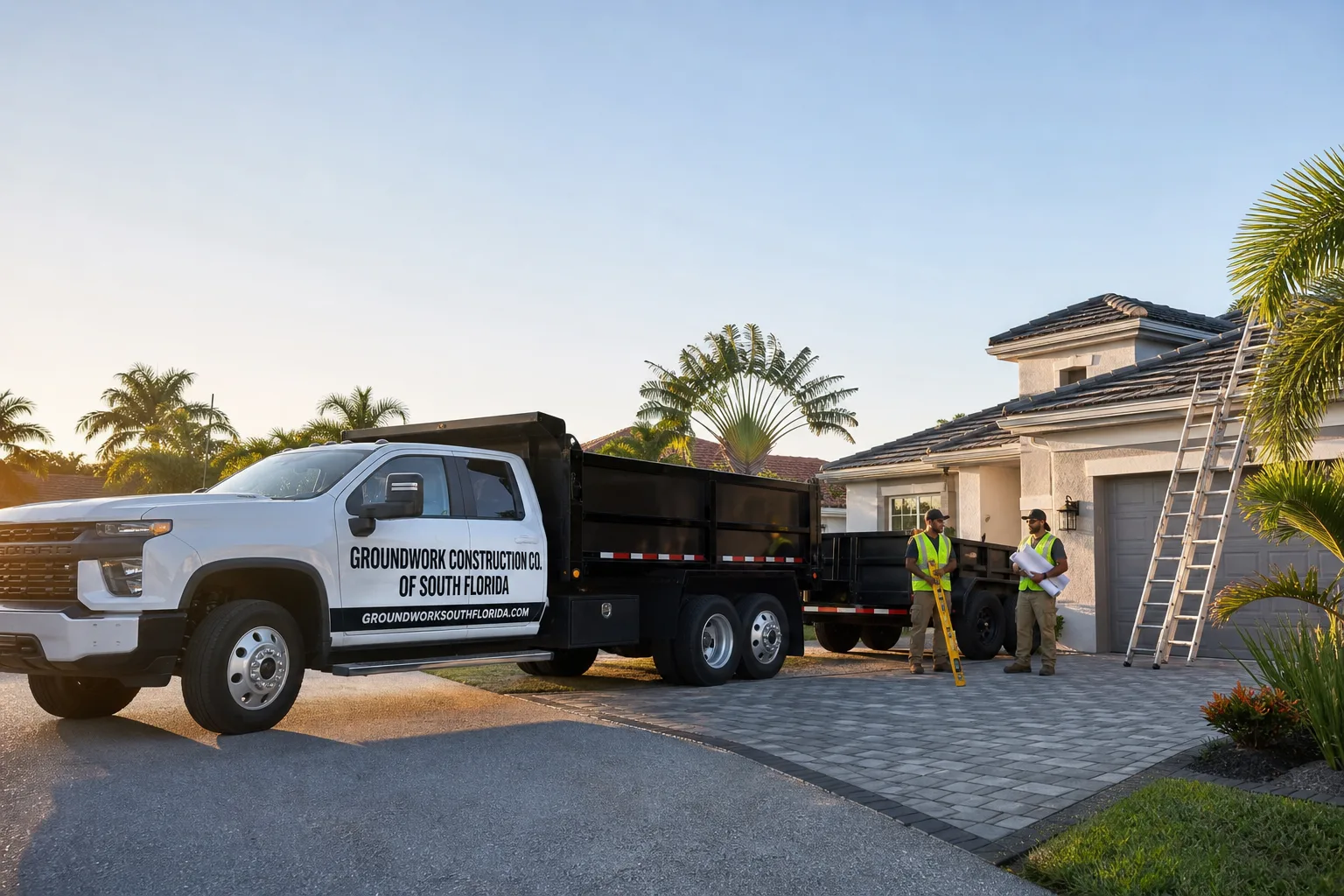
Asphalt Driveways & Resurfacing in Coral Gables - Cost, Timeline & What to Expect
Asphalt driveways & resurfacing in Coral Gables typically run $3,500-$9,000 for new paving and $2,500-$6,500 for resurfacing an existing driveway, with most projects completed in 2-4 days once permits clear. You’ll get the longest lifespan, 15-20 years, by addressing drainage and base prep upfront rather than skimming over failing substrate. Call (844) 665-0162 for a free on-site estimate and we’ll assess whether your existing surface is a candidate for resurfacing or needs full replacement.
How We Approach Asphalt Driveways & Resurfacing - Start to Finish
Every asphalt job we handle in Coral Gables follows a five-stage sequence. The homeowner makes real decisions at three of them, and skipping any stage is where premature cracking starts.
Stage 1: Site assessment and scope lock (Day 1, 1-2 hours on site)
We measure, photograph, and probe the existing surface and base. In Coral Gables, we’re especially watchful for root intrusion from heritage oaks and banyans, plus the shallow coral rock shelf that can appear just 8-14 inches below grade on older lots. You’ll decide here whether we’re resurfacing over sound base, doing partial-depth repair, or full removal and rebuild. We also flag whether your project triggers the Board of Architects review, which adds 3-6 weeks to the front end but cannot be bypassed for any exterior work visible from the public right-of-way.
Stage 2: Permitting and Board of Architects coordination (1-4 weeks, largely off-site)
For driveway work confined to your property and invisible behind a wall or hedge, standard building permits through Coral Gables may suffice. If the driveway face, approach, or any hardscape ties to the street-visible facade, Board of Architects approval is mandatory. We prepare the material palette submission, typically specifying dark asphalt to harmonize with Mediterranean Revival stucco and barrel-tile color schemes. You don’t pick colors here, you confirm the aesthetic direction so we can defend it in review.
Stage 3: Demolition and base prep (Day 1-2 of construction, weather dependent)
Full removals get hauled to Miami-Dade County’s North Dade Landfill or a certified C&D recycler. We then grade and compact the sub-base to 95% standard Proctor density, adding crushed concrete or limerock where the existing base has settled or washed out. In Coral Gables, we often encounter the original 1920s-1940s clay-tile sewer laterals running beneath or alongside the driveway; we mark these for protection or coordinate replacement if they’ve collapsed. Homeowner decision point: whether to add a geotextile fabric layer between sub-base and asphalt, which adds $400-$800 but extends life significantly on expansive clay or root-prone soils.
Stage 4: Paving or resurfacing (Day 2-3)
New installs receive 2.5-3 inches of compacted hot-mix asphalt in two lifts, with the binder course laid and compacted first, then the wearing course. Resurfacing adds 1.5-2 inches over a cleaned, tack-coated existing surface. We edge against existing concrete walks, paver borders, or landscape walls with a cold joint or expansion joint as appropriate. You choose the surface texture here: standard smooth-rolled for clean appearance, or a light broom finish for better wet traction on sloped approaches common in the Gables’ older section near Granada Boulevard.
Stage 5: Compaction, cure, and final inspection (Day 3-4)
Rollers complete compaction while the mix is still above 240°F. We then barricade the surface for 24-48 hours minimum cure before vehicle traffic. Coral Gables building inspectors verify grade, drainage flow away from structures, and permit compliance. We walk the final surface with you, noting the 12-month workmanship warranty and manufacturer material warranty coverage.
The Material and Spec Choices That Matter
Not all asphalt is the same, and the spec sheet changes how your driveway performs in South Florida’s UV load and afternoon cloudbursts.
- Mix type: Standard vs. polymer-modified - Standard hot-mix asphalt (AC-20 or AC-30 binder) handles typical residential loads at lower cost but softens more in peak summer heat. Polymer-modified mixes with SBS or EVA additives resist rutting and thermal cracking, adding 15-25% to material cost. We spec polymer for driveways with frequent commercial vehicle traffic or south-facing exposure that bakes the surface.
- Base depth and material - Minimum 6 inches of compacted limerock or recycled concrete base for residential; 8-10 inches if your Coral Gables home sits on former fill or muck near the Country Club Prado basin. Deeper base is the single biggest factor in preventing the alligator cracking we see on rushed jobs.
- Edge restraint - Concrete header boards, Belgian block, or paver soldier courses keep asphalt from crumbling at the perimeter. On historic homes where the Board of Architects requires visual continuity, we often integrate Tremron or Belgard paver bands that match adjacent walkways, tying the driveway into the broader hardscape design.
- Drainage integration - Trench drains, channel drains, or simple swales? Flat lots in Coral Gables’ southern grid, near Red Road and Sunset Drive, pond during summer storms. We design drainage into the base grade, not as an afterthought. French drains add $800-$2,200 depending on length and discharge point.
- Sealcoating schedule - New asphalt should cure 6-12 months before first sealcoat, then every 3-5 years. We don’t bundle sealcoating into the paving price because timing matters; we’ll quote it separately when the surface is ready.
What Asphalt Driveways & Resurfacing Costs in Coral Gables, FL
| Scope | Typical Range | Covers |
|---|---|---|
| New asphalt driveway (standard residential, 2-car) | $3,500-$6,500 | Removal, base, 2.5-3″ asphalt, compaction, basic edge |
| New asphalt driveway (premium spec, larger or sloped) | $5,500-$9,000 | Polymer mix, geotextile, integrated drainage, paver edge detail |
| Resurfacing over sound base | $2,500-$4,500 | Cleaning, tack coat, 1.5-2″ new wearing course |
| Partial rebuild (base repair + resurfacing) | $4,000-$7,500 | Excavate failed sections, recompact base, full resurfacing |
Five variables push your number within these ranges:
1. Existing surface condition - Alligator cracking, base failure, or root heave means removal and rebuild, not resurfacing. We probe with a core sample or rod to verify.
2. Driveway dimensions and shape - A straight 20×20 rectangle is efficient; curved approaches, radius turns into garages, or multiple parking pads add cutting and forming labor.
3. Access and protection requirements - Tight lots near Coral Gables’ Miracle Mile corridor may require smaller equipment, plywood track protection for existing pavers, or crane-set dumpsters, all adding labor hours.
4. Drainage and utility coordination - Relocating or protecting water lines, irrigation, or the clay-tile sewer laterals common in 1920s-1940s construction adds $500-$2,500 depending on depth and complexity.
5. Board of Architects and permit scope - Their review fees and the extended timeline are real costs, even if indirect. We quote permitting separately so you’re not surprised.
A written estimate from Groundwork includes all labor, materials, equipment, haul-off, and standard permits. It does not include Board of Architects filing fees (typically $300-$800), tree arborist reports if root barriers are needed, or sealcoating.
Why Coral Gables Changes How We Build Your Driveway
Coral Gables isn’t unincorporated Miami-Dade, and treating it like one is how contractors lose months to revision cycles.
The city’s Driveway & Pavers in Coral Gables context matters because any exterior surface visible from the street must harmonize with the 1920s Mediterranean Revival design code. The Board of Architects enforces this independently, and their approval timeline, 3-6 weeks, sits in front of standard permitting. We’ve learned to front-load the aesthetic package: dark, muted asphalt tones, compatible edge detailing, and documentation showing how the driveway relates to the home’s facade materials. This isn’t bureaucracy for its own sake; it’s what preserves the property values and neighborhood character that make the Gables distinctive.
The housing stock itself shapes our prep work. Original 1920s-1960s homes on oolite limestone foundations often have driveways poured or paved directly against coral rock outcroppings. We can’t blast or hammer without structural review, so we use diamond-blade saws and hydraulic splitting where necessary, slower but protective of the original masonry. The coral rock also drains differently than standard fill, so we design base sections to shed water laterally rather than relying on deep percolation.
Then there’s the tree canopy. The heritage-tree ordinance protects live oaks and banyans that have cracked more driveways than hurricanes. We coordinate with certified arborists for root mapping and barrier installation before any excavation. In the northern Gables, near Country Club Prado and the Biltmore area, we’ve seen root masses so extensive that we’ve redesigned driveway geometry to preserve a specimen tree, a constraint that simply doesn’t arise in newer, less mature neighborhoods.
Finally, the High-Velocity Hurricane Zone doesn’t directly govern asphalt thickness, but it does affect any structures the driveway ties into, carports, covered parking, or gate posts. We use HVHZ-rated hardware and connections where asphalt meets built elements, ensuring the whole assembly holds under design wind loads.
Our Coral Gables crew knows these layers because we’ve worked through them repeatedly. The same process in Coconut Grove or South Miami has different gatekeepers and different soil conditions.
Serving Coral Gables, FL - Our Local Coverage Area
We’re based in the Coral Gables area and know this community well. Use the map below to see our service coverage - if you’re nearby, we can almost certainly help.
Frequently Asked - Asphalt Driveways & Resurfacing in Coral Gables
Physical construction takes 2-4 days, but the full timeline in Coral Gables is typically 4-8 weeks because of Board of Architects review for any street-visible exterior work. We file the aesthetic package immediately after you approve the estimate so that review runs parallel to material procurement. Call (844) 665-0162 and we’ll confirm whether your specific driveway location triggers that layer.
Yes, virtually always. Standard building permits are required for any driveway work, and if the surface is visible from the public right-of-way, Board of Architects approval is mandatory under the city’s design code. We handle both filings as part of our project management. The dual approval adds time but cannot be skipped.
Resurfacing works only when the existing base is stable, drainage is functional, and surface cracking hasn’t progressed to alligator patterns or base failure. We verify with core samples or probing. In Coral Gables, root heave from protected oaks and banyans often undermines the base, making full rebuild necessary even when the surface looks merely weathered.
Resurfacing over sound base runs $2,500-$4,500, while full removal and rebuild typically costs $3,500-$9,000 depending on size and spec. The gap narrows when base repair, drainage, or tree protection is needed, at which point replacement usually makes more financial sense over the 15-20 year lifespan. We quote both paths when both are viable.
We provide a 12-month workmanship warranty covering installation defects, compaction issues, and edge failures. Material warranties from the asphalt producer cover manufacturing defects for 1-2 years depending on mix spec. Proper maintenance, sealcoating every 3-5 years and prompt crack filling, is required to keep both warranties valid. We document the maintenance schedule at project closeout.
Get Your Coral Gables Asphalt Driveway Estimate
We’ll walk your property, probe the existing surface, check for root and drainage issues, and deliver a written estimate with both resurfacing and replacement options if both apply. No pressure, no generic pricing. Call (844) 665-0162 to schedule your free on-site assessment for asphalt driveways & resurfacing in Coral Gables.
Written by Raymond Estevez, Owner at Groundwork Construction Co., serving Coral Gables and South Florida.