
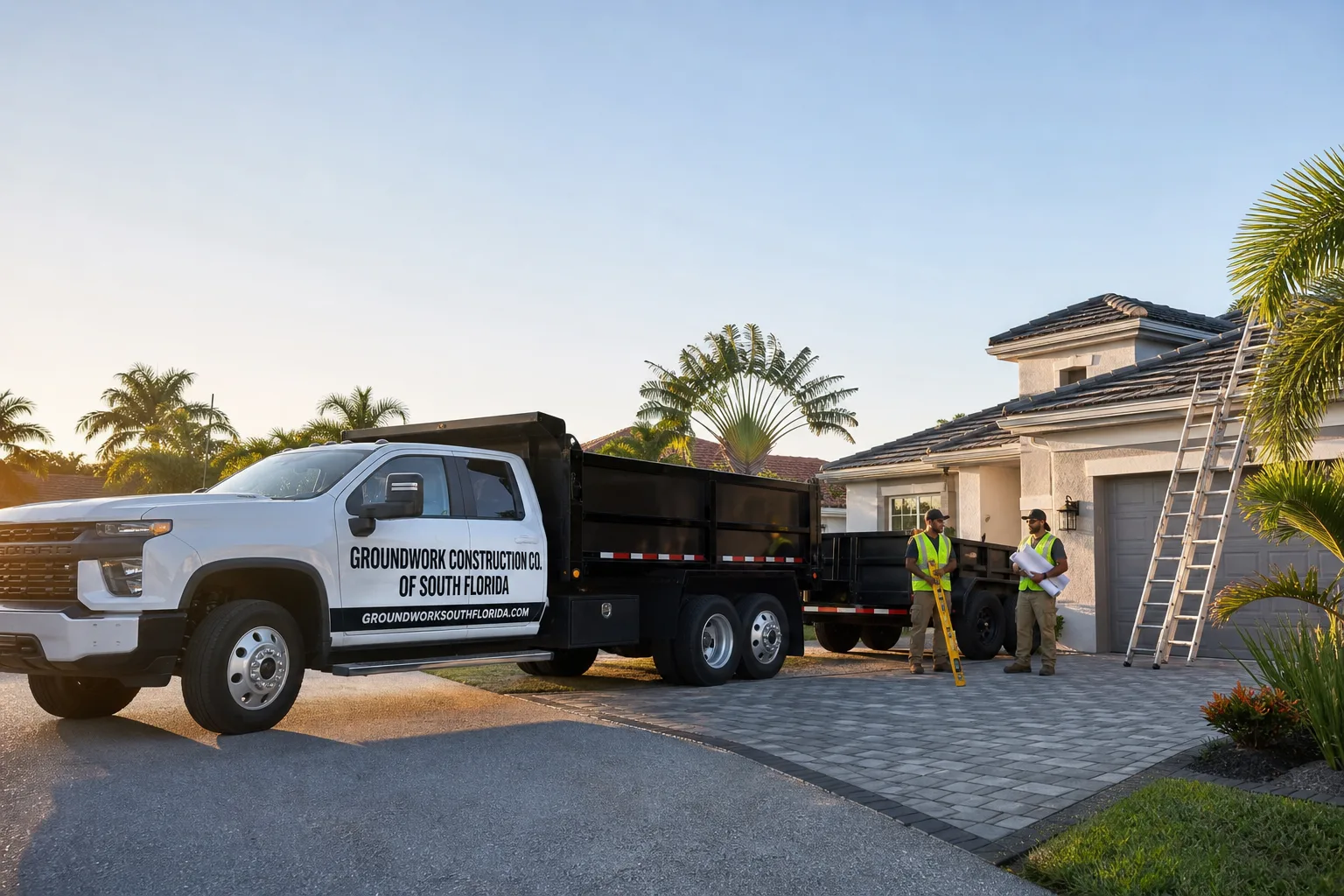
What a New Detached ADU Costs and Involves in Coconut Grove
A new detached ADU in Coconut Grove is a standalone secondary dwelling built from the ground up on your existing lot, typically ranging from 400 to 1,200 square feet, and most projects run between $90,000 and $220,000 depending on size, utility connections, and whether you choose prefab or stick-built construction. From permit pull to final inspection, expect 6 to 14 months in this market, with Miami-Dade’s dual compliance layer adding time that faster-track jurisdictions don’t face. Call (844) 665-0162 and we’ll walk your lot, check setback and tree constraints, and give you a written estimate with real numbers.
How We Build a New Detached ADU in Coconut Grove
We’ve learned that homeowners stay sane when they know what’s coming. Here’s the actual sequence we follow for every new detached ADU in Coconut Grove, with the decisions you’ll need to make at each stage.
Stage 1: Site feasibility and pre-design (2-4 weeks)
We walk your property with a surveyor’s eye, measuring setbacks, locating the drip lines of protected canopy trees, and flagging where Miami-Dade’s Coastal Construction Control Line restrictions apply if you’re bay-adjacent. You’ll decide: stick-built or prefab? We partner with Abodu, Dvele, Mighty Buildings, and Boxabl for clients who want a faster, factory-controlled build, or we design from scratch for odd-shaped lots or specific aesthetic requirements. This is also when we check whether your existing electrical service panel and sewer lateral can handle a second dwelling or need upgrading.
Stage 2: Design, permitting, and Historic Preservation Board (8-16 weeks)
Here’s where Coconut Grove diverges from every other Miami-Dade market. If your property sits in a designated historic district or your main house is a contributing structure, we prepare materials for the Historic Preservation Board showing that the ADU’s massing, materials, and roofline are compatible. Simultaneously, we submit to Miami-Dade Building for wind-load compliance under the High-Velocity Hurricane Zone code. You’ll choose exterior finishes now: James Hardie fiber-cement siding for durability against salt air, or stucco with acrylic finish if you’re matching a Mediterranean Revival main house. Roofing material gets locked in too, with GAF or CertainTeed shingles rated for HVHZ uplift pressures.
Stage 3: Site prep and foundation (3-6 weeks)
The Grove’s tree canopy turns simple excavation into hand work. When surface roots from mature banyans or mahoganies block equipment access, we bring in arborists for root-barrier installation and hand-dig footings to protect the tree’s critical zone. You’ll see us pour either a monolithic slab (faster, cost-controlled) or stem-wall foundation with elevated floor (better for flood-prone lots near the bay). Foundation type gets decided in Stage 1 but confirmed here once we hit soil.
Stage 4: Structure, MEP, and envelope (8-12 weeks)
Walls go up, rough plumbing and electrical go in, and we install impact-rated windows from Andersen, Pella, or CGI depending on your spec level. For the kitchenette, you’ll choose between KraftMaid or Wellborn cabinetry - both hold up in humid climates better than budget lines we’ve seen swell within two seasons. We rough in a mini-split HVAC system sized for the volume, not the square footage alone, because Coconut Grove’s dense canopy limits cross-ventilation compared to more open lots inland.
Stage 5: Finishes, final inspection, and certificate of occupancy (4-6 weeks)
Cambria or Silestone countertops go in, fixtures get set, and we run the full Miami-Dade inspection sequence: structural, electrical, plumbing, mechanical, and final. The certificate of occupancy is your green light to rent, house family, or use as workspace. We don’t disappear after CO - we do a 30-day walkthrough to catch any shrinkage cracks or trim movement as the structure settles through its first humid season.
The Build Options You’ll Actually Choose Between
- Prefab modular vs. stick-built on site: Prefab through our partners (Abodu, Dvele, Mighty Buildings, Boxabl) cuts 3-5 months off the timeline and locks pricing early, but you’re limited to their floor plans and dimensional modules. Stick-built gives you custom layout, higher ceilings, and materials matched to your main house, but costs 15-25% more and exposes you to weather delays during hurricane season.
- Foundation type: Monolithic slab runs $12-$18 per square foot in Coconut Grove’s conditions; stem-wall with elevated floor adds $8-$14 per square foot but buys you FEMA flood-zone compliance and protects against the groundwater we hit on bay-adjacent lots. If you’re in the 33114 ZIP near the water, we typically recommend elevation.
- Kitchenette spec level: A wet bar with mini-fridge and microwave drawer ($3,500-$6,000 installed) suits a rental unit or guest cottage. A full appliance package with induction cooktop, convection oven, and dishwasher ($8,000-$14,000) turns the ADU into genuine independent living for aging parents or long-term tenants.
- Utility connection strategy: Tapping existing sewer and water laterals costs $4,000-$8,000 if capacity allows; installing separate meters and a new sewer tap runs $12,000-$22,000 but gives you rental-income documentation and avoids main-house usage conflicts. We check Miami-Dade Water & Sewer capacity maps in Stage 1 so you’re not surprised.
- Exterior finish and roofing: James Hardie siding with 30-year paint warranty stands up to salt air and requires re-coating at year 12-15. Stucco with acrylic finish matches 1920s Mediterranean Revival architecture but needs crack repair after five to seven years of thermal cycling. Roofing: architectural shingles (GAF Timberline or CertainTeed Landmark) at the standard spec, or standing-seam metal for clients planning 30+ year ownership.
What a New Detached ADU Costs in Coconut Grove, FL
For a new detached ADU in Coconut Grove, most of our projects fall between $90,000 and $220,000. The median sits around $145,000 for an 800-square-foot, two-bedroom unit with mid-grade finishes and standard utility connections.
Five factors push you toward the low or high end:
- Size and bedroom count: A 400-square-foot studio with wet bath starts near $90,000. A 1,200-square-foot two-bedroom with full kitchen and stacked laundry pushes $220,000.
- Utility complexity: Tapping existing services keeps you low; new sewer tap, separate electrical service upgrade, or septic if you’re off municipal sewer pushes you high. We’ve seen $18,000 surprises when a 1950s main house has a 100-amp panel that can’t support an additional dwelling.
- Foundation and site conditions: Flat lot, no protected trees, dry soil: monolithic slab, minimal prep. Mature canopy requiring arborist reports, root barriers, and hand-dug footings: add $8,000-$15,000 before framing starts.
- Material grade: Wellborn cabinetry, Silestone countertops, and Simonton windows keep you mid-range. Moving to KraftMaid with custom modifications, Cambria countertops, and impact-rated Pella or Marvin windows adds 20-35% to the finishes budget.
- Permit scope and Historic Preservation Board: Straightforward Miami-Dade Building permit: $3,500-$6,000. HPB review with multiple revisions, materials board presentations, and compatibility studies: add $4,000-$8,000 in soft costs and 6-10 weeks.
Our written estimates include all labor, materials, permits, and inspections. What they don’t include: your survey (if current ones aren’t on file), tree-arborist reports for protected specimens, temporary relocation if you’re living in the main house during noisy phases, or utility company connection fees that Miami-Dade Water & Sewer bills separately.
Why Coconut Grove Changes Everything About This Job
No other Miami-Dade neighborhood makes a new detached ADU this specific. Coconut Grove contains some of Miami-Dade County’s oldest residential structures - including wood-frame Caribbean ‘Conch’ vernacular homes in the West Grove built by Bahamian settlers in the 1890s-1910s - meaning contractors must simultaneously satisfy Miami-Dade’s post-Hurricane Andrew high-velocity wind-load codes (among the strictest in the nation) AND navigate Historic Preservation Board approval for any exterior changes. This dual compliance burden, layered onto genuinely antique construction, is unlike anything required in neighboring Brickell, Coral Gables, or South Miami.
The housing stock itself spans roughly 130 years: late-19th-century Conch cottages with heart-pine framing, 1920s Mediterranean Revival estates with single-wythe masonry, mid-century modern homes on large wooded lots, and recent luxury infill. Many older structures have pre-code foundations that complicate both renovation and permitting under today’s Florida Building Code. When we build a new detached ADU behind a 1910 West Grove cottage or a 1935 Coral Way-area Mediterranean home, we’re not just adding square footage - we’re threading a modern, code-compliant dwelling onto a lot whose original infrastructure was never designed for it.
Biscayne Bay’s salt air accelerates corrosion on fasteners, steel lintels, and exposed reinforcing throughout the neighborhood, while the dense tropical tree canopy traps moisture against wood framing and masonry. Hurricane-season wind-uplift requirements are non-negotiable given the legacy of Andrew, and bayfront properties face additional CCCL setback restrictions that constrain where we can place the unit. The extraordinary canopy of protected old-growth banyans, mahogany, and gumbo limbo trees - many with surface root systems spanning 50+ feet - routinely forces us to hand-dig footings, reroute underground utilities, and obtain Miami-Dade tree removal or root-barrier permits before a single structural permit is pulled. Equipment access lanes that would be routine in Coral Gables or South Miami simply don’t exist on many Grove lots.
Homeowners often pair a new detached ADU with interior updates to the main house. If you’re considering a full Home Additions & ADU in Coconut Grove scope, we coordinate both projects under one timeline. Our Home Additions & ADU crew handles the structural and envelope work, then our interior specialists can tackle Kitchen Design & Layout in Coconut Grove or Backsplash, Tile & Flooring in Coconut Grove to bring the main house up to the same standard. One contractor, every phase - no handoffs to trades you’ve never met.
Serving Coconut Grove, FL - Our Local Coverage Area
We’re based in the Coconut Grove area and know this community well. Use the map below to see our service coverage - if you’re nearby, we can almost certainly help.
Frequently Asked - New Detached ADU in Coconut Grove
Most new detached ADU projects in Coconut Grove take 6 to 14 months from signed contract to certificate of occupancy, with 8-16 weeks of that consumed by Miami-Dade permitting and Historic Preservation Board review if your property is in a designated district. Prefab construction through our partners Abodu or Boxabl can compress the build phase by 3-5 months, but permitting timelines remain fixed by the jurisdiction. Call (844) 665-0162 and we’ll give you a realistic schedule based on your specific lot and compliance path.
Yes - every new detached ADU in Coconut Grove requires a Miami-Dade Building permit, and many properties also need Historic Preservation Board approval before exterior construction begins. If your lot is bay-adjacent, Coastal Construction Control Line setbacks may further restrict placement. We handle all submittals, but the dual compliance layer adds time that single-jurisdiction projects don’t face.
Sometimes, but rarely on homes built before 1980. A new detached ADU in Coconut Grove typically requires 100-200 amps of additional electrical service; if your main house has a 100-amp panel from the 1960s or 70s, you’ll need a service upgrade and new meter base. We verify capacity against Miami-Dade’s load calculations in Stage 1 so you’re not surprised mid-project.
The lowest-cost path is a 400-square-foot prefab studio with wet bath, tapping existing sewer and water laterals, on a flat lot with minimal tree interference - typically starting near $90,000. Every increase in size, bedroom count, kitchen spec, or site complexity moves the number up. We don’t recommend cutting corners on foundation or wind-load compliance; Miami-Dade inspectors won’t pass it, and hurricane exposure makes it a false economy.
Our workmanship warranty covers structural, electrical, plumbing, and mechanical systems for one year from certificate of occupancy, with a 30-day post-move-in walkthrough to catch settlement issues. Material warranties run longer: James Hardie siding carries a 30-year finish warranty, GAF and CertainTeed shingles have 25-50 year limited warranties depending on product line, and KraftMaid or Wellborn cabinetry carries lifetime limited warranties on drawer boxes and hinges. We pass all manufacturer documentation to you at closing.
Ready to Expand What’s Possible on Your Coconut Grove Lot?
We’ll walk your property, flag the tree and setback constraints that matter, and deliver a written estimate with real numbers for your new detached ADU in Coconut Grove. No pressure, no generic proposal - just a clear scope, honest timeline, and the material choices that fit your budget and your lot. Call (844) 665-0162 to schedule your free on-site consultation.
Written by Raymond Estevez, Owner at Groundwork Construction Co., serving Coconut Grove and South Florida with full-scope residential construction since our founding.