
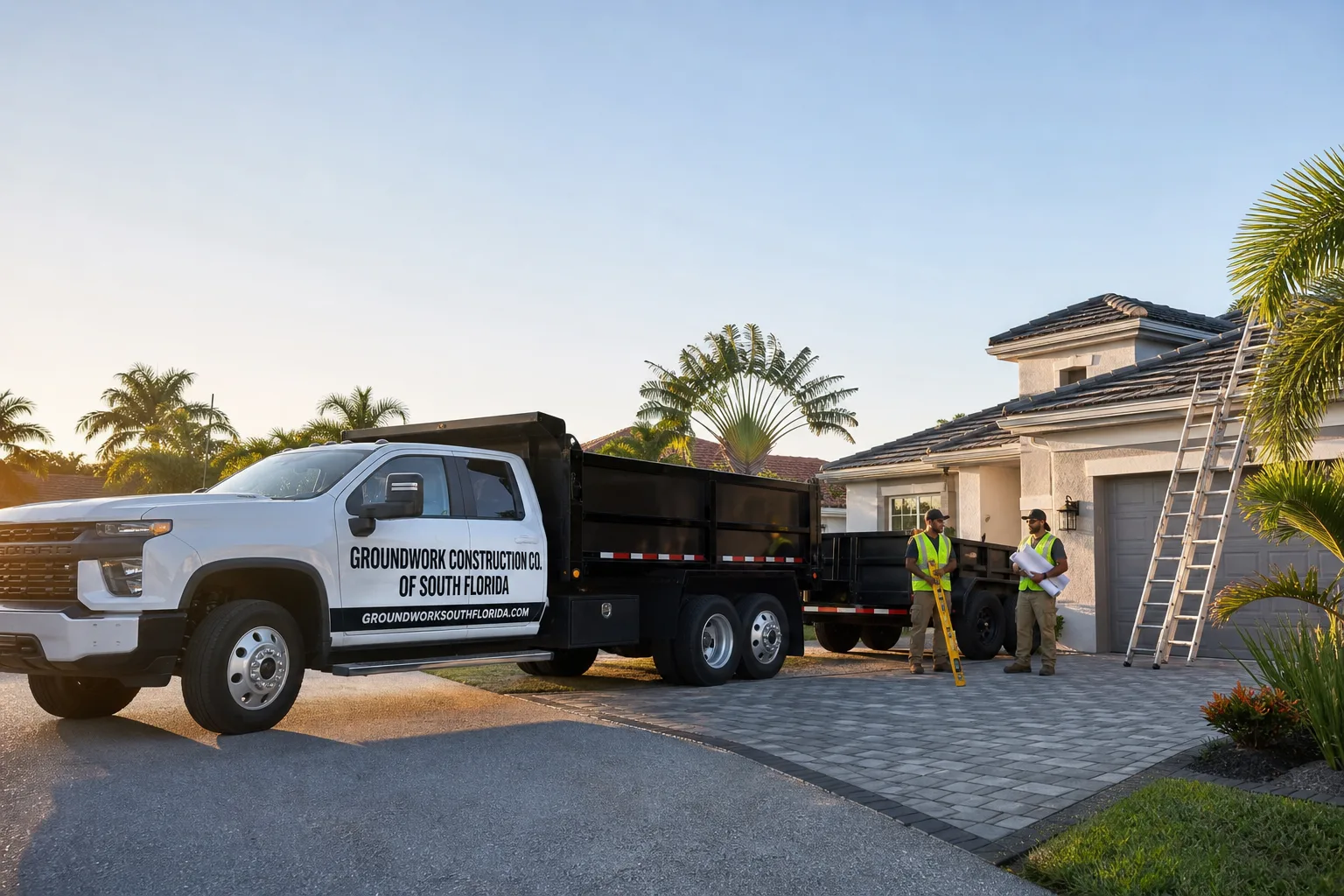
What a New Detached ADU Costs and Involves in South Miami
A new detached ADU in South Miami is a standalone living unit built on your property, separate from the main house, typically ranging from 400 to 1,200 square feet with a full kitchen, bath, bedroom, and independent utility connections. Most projects we manage here run $90,000-$220,000 and take 6 to 10 months from signed contract to certificate of occupancy, though South Miami’s dual-track permitting can add 4-8 weeks if tree surveys or variance hearings are triggered. Call (844) 665-0162 for a free on-site estimate and we’ll walk your lot the same week.
How We Build a New Detached ADU in South Miami
We’ve learned that homeowners sleep better when they know exactly what’s happening when. Here’s how we sequence a new detached ADU in South Miami, with the decisions you’ll need to make at each stage.
Stage 1: Site survey and arborist assessment (Weeks 1-3)
Before we draw anything, we walk your lot with a certified arborist to map every tree with a trunk diameter of 12 inches or greater at breast height. South Miami’s tree ordinance is unforgiving, and we’ve seen contractors skip this step only to have permits rejected months later. You’ll decide here whether to design around protected root zones or budget for mitigation fees, which can run $500-$3,000 per tree depending on species and caliper. We also photograph your existing electrical panel and main service line, since most post-war CBS homes in this area need a 200-amp upgrade to support a second dwelling.
Stage 2: Design development and permit submission (Weeks 4-10)
Our architect produces permit-ready drawings that comply with South Miami’s zoning, which allows detached ADUs on lots of 7,500 square feet or more with minimum 5-foot side and rear setbacks. You’ll choose between stick-built construction or a prefab unit from our partner brands like Abodu or Dvele during this window. Stick-built offers customization; prefab cuts 2-3 months off the build calendar. We submit simultaneously to South Miami’s building department and its tree board, running both tracks in parallel to avoid the delays that catch out-of-town contractors off guard.
Stage 3: Foundation and rough utilities (Weeks 11-16)
Once permits clear, we excavate for a monolithic slab or stem-wall foundation, depending on your finished floor elevation and the drainage grading we established during survey. South Miami’s chronic lot flooding during summer storms means we typically raise slab height 6-12 inches above existing grade and install French drains or catch basins tied to your stormwater system. You’ll approve the utility routing here, trenching for water, sewer, gas, and electrical service from your main house or a separate meter set, depending on what Miami-Dade Water and Sewer allows for your specific parcel.
Stage 4: Framing, envelope, and MEP rough-in (Weeks 17-24)
The structure goes up, followed by roof decking, HVHZ-rated impact windows and doors, and rough mechanical, electrical, and plumbing. We spec James Hardie siding on most South Miami ADUs for its moisture resistance and 30-year warranty in humid, salt-adjacent air. Your interior selections, cabinet layout, and fixture schedule are due by week 20 so we can order with lead times in mind.
Stage 5: Finishes, final inspection, and occupancy (Weeks 25-32)
Insulation, drywall, flooring, tile and backsplash, paint, and fixture installation. We schedule South Miami’s building inspector for rough and final visits, plus a separate tree-board compliance sign-off if any protected specimens were affected. You’ll do a punch walk with our project lead before we hand over keys and warranty documentation.
The Build Options You’ll Actually Decide Between
Every new detached ADU in South Miami forces a handful of real choices. Here’s where your money goes and what you trade:
- Stick-built vs. prefab: Traditional framing on your foundation gives you custom square footage and roofline, but you’re looking at 8-10 months total. Prefab units from Mighty Buildings or Boxabl arrive 80% complete and crane-set in a day, cutting build time to 4-6 months. The catch: you’re working within the manufacturer’s dimensional modules and finish palettes, and crane access in South Miami’s mature canopy can require temporary tree trimming with its own permit.
- Foundation type: Monolithic slab is cheapest and fastest, but on lots with poor drainage, a stem-wall with crawl space lets us adjust grade and run utilities without under-slab penetrations that can leak. Adds $8,000-$15,000.
- Impact windows and doors: Required by code in this HVHZ zone. We source from Andersen, Pella, or PGT depending on your budget and whether you want aluminum-clad wood aesthetics or vinyl impact-rated performance. The spread is roughly $15-$35 per square foot of opening.
- Kitchen and bath package: KraftMaid or Wellborn cabinetry with quartz counters from Cambria runs $12,000-$18,000 for a compact ADU kitchen. You can halve that with stock cabinetry and laminate tops, but in a rental unit the wear shows faster.
- Utility connection strategy: Tapping existing main house service is cheaper upfront but complicates metering if you plan to rent. Separate meters add $4,000-$8,000 in trenching and utility fees but give you clean landlord accounting.
What New Detached ADU Costs in South Miami, FL
| Component | Typical Range |
|---|---|
| Base construction (stick-built, 600 sq ft) | $90,000-$140,000 |
| Base construction (prefab, 600 sq ft) | $75,000-$120,000 |
| Foundation and site drainage | $12,000-$28,000 |
| Electrical service upgrade (200-amp) | $4,500-$8,500 |
| Tree survey, arborist report, mitigation | $2,500-$8,000 |
| Separate utility meters and trenching | $4,000-$12,000 |
| Impact windows and doors package | $8,000-$18,000 |
| Kitchen and bath finishes (mid-grade) | $15,000-$28,000 |
Five factors push any new detached ADU in South Miami toward the high or low end of these ranges:
1. Tree impact and mitigation. A clear rear lot with no protected species keeps you near $90,000. A single mature live oak with a 36-inch caliper inside the construction zone can add $6,000-$10,000 in mitigation and protective fencing.
2. Electrical service condition. Original 100-amp panels from the 1960s are standard in this area’s housing stock. Upgrading to 200 amps with a new meter base and underground service is almost always necessary and non-negotiable for permitting.
3. Drainage and grading. South Miami’s flat topography and undersized stormwater mains mean water pools. If we need to install a pump station or connect to a rear alley drainage easement, that’s engineering and excavation you didn’t budget for.
4. Finish material tier. The gap between stock vinyl flooring and engineered hardwood, or between laminate and Cambria quartz, can swing $15,000-$25,000 on a complete unit.
5. Prefab vs. stick-built delivery. Prefab saves labor months but may require crane rental ($3,500-$7,000) and temporary street closure permits on narrow residential lanes like those off Sunset Drive or Red Road.
Our written estimates itemize each of these categories. What we don’t include: your own landscaping restoration beyond basic sod, window treatments, or appliances, which we price as allowances you control.
What South Miami Homes Specifically Do to This Job
South Miami isn’t Coral Gables with its historic preservation board, and it isn’t unincorporated Kendall with Miami-Dade’s streamlined county process. It’s a 2.3-square-mile city with its own building department, its own code amendments, and an environmental overlay that treats every construction project as a potential threat to its urban forest. We’ve watched contractors from Fort Lauderdale and even Miami proper walk into this assuming standard Miami-Dade permitting, then stall out for months.
The housing stock here works against quick assumptions too. Those post-WWII CBS ranch homes on Sunset Drive, Red Road, and the grid between US-1 and SW 62nd Avenue were built with 6-inch concrete block walls, tie-beam roofs, and electrical panels that predate central air conditioning. When we design a new detached ADU behind one of these homes, we’re not just adding square footage, we’re often upgrading the main house’s infrastructure so the overall property meets current code. The flat or low-slope original roofs on these homes also mean we need to be careful about runoff patterns, since adding an impervious roof surface in the rear yard can trigger stormwater retention requirements that a sloped lot in Glenvar Heights or Kendall wouldn’t face.
Then there’s the canopy. A typical 50-by-100-foot lot in South Miami has three to five mature trees with protected status. We’ve had projects where the optimal ADU placement, for privacy and setback compliance, sat directly over a royal poinciana’s critical root zone. The city mandated a $4,200 mitigation payment and a protective fencing plan that shifted our foundation footprint by eight feet. That kind of adjustment, handled early, is manageable. Discovered after permit submission, it kills your timeline.
Our home additions & ADU crew knows these streets and these inspectors. We’ve built in South Miami enough to know which lots on SW 59th Street back up to alley easements that simplify utility trenching, and which blocks near Brewer Park sit low enough to need proactive drainage design before the first permit drawing.
Serving South Miami, FL - Our Local Coverage Area
We’re based in the South Miami area and know this community well. Use the map below to see our service coverage - if you’re nearby, we can almost certainly help.
Frequently Asked - New Detached ADU in South Miami
Most new detached ADU projects in South Miami take 6 to 10 months from contract to occupancy, with prefab builds running shorter and stick-built projects on tree-constrained lots running longer. South Miami’s separate tree-board review, which runs parallel to building permits, typically adds 3-6 weeks to what you’d see in unincorporated Miami-Dade. Call (844) 665-0162 and we’ll assess your specific lot timeline during a free walkthrough.
Yes, and you’ll need two: a building permit from South Miami’s own building department and, in nearly all cases, a tree-protection clearance from the city’s environmental board before construction can begin. Miami-Dade County permits do not apply here. Our team handles both submissions simultaneously to prevent the sequential delays that stall projects.
No, not if your home has an original 100-amp service, which is standard for South Miami’s 1940s-1970s housing stock. Miami-Dade HVHZ code requires sufficient capacity for the additional dwelling, and South Miami’s building department enforces this strictly. We identify panel condition during our initial site survey so this isn’t a surprise mid-project.
A garage conversion typically runs $30,000-$80,000 versus $90,000-$220,000 for a new detached ADU, but the two aren’t interchangeable. A detached unit gives you rental income potential with separate metering and privacy; a conversion sacrifices parking and may trigger different setback or parking replacement rules under South Miami zoning. We can walk both options when you call (844) 665-0162.
Our workmanship warranty covers structural, mechanical, and finish installation for a defined period from occupancy, while manufacturer warranties apply to specific products, James Hardie siding, KraftMaid cabinetry, and Cambria countertops each carry their own material warranties that transfer to you at closing. We document all warranty registrations and provide a single binder at handover so you’re not chasing paperwork later.
Ready to Expand What’s Possible on Your South Miami Lot?
A new detached ADU in South Miami is one of the few ways to add significant, rentable square footage in a market where land is fixed and zoning is tight. We’ll walk your property, flag the trees, assess your panel, and give you a written estimate with real numbers, not a range that balloons later. Call (844) 665-0162 to schedule your free on-site consultation. Raymond Estevez or a senior project lead will meet you there, answer your questions, and map out what your lot can actually support.
Written by Raymond Estevez, Owner at Groundwork Construction Co., serving South Miami and South Florida homeowners since our founding. Our Home Additions & ADU practice includes traditional stick-built and prefab construction through partners like Abodu, Dvele, Mighty Buildings, and Boxabl. Homeowners often pair a new detached ADU with interior work; see our Kitchen Design & Layout in South Miami if you’re also updating the main house.