
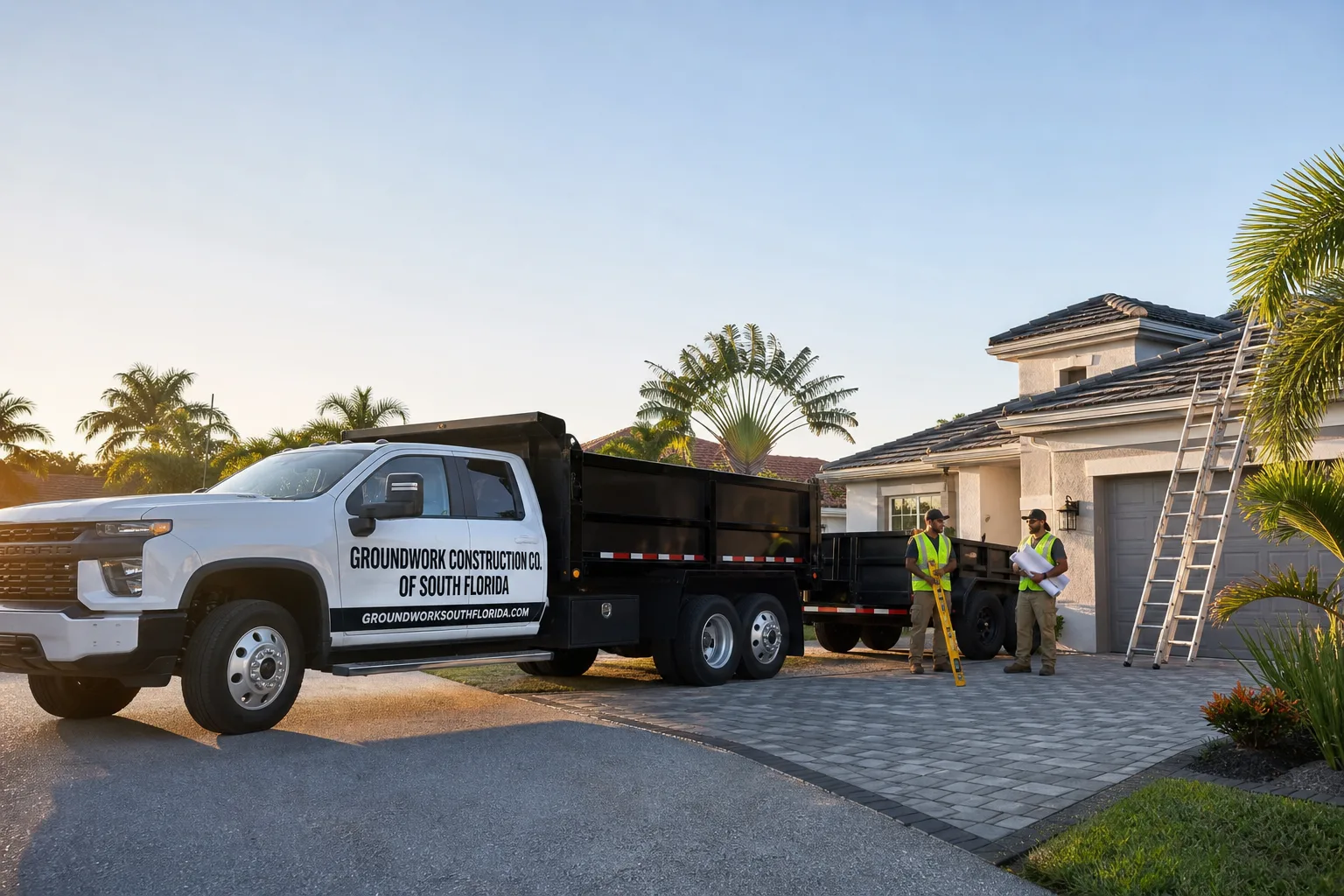
How Much Do Patios, Walkways & Pool Decks Cost in Miami Beach, FL?
Patios, walkways, and Driveway & Pavers in Miami Beach typically run $3,500-$11,000 for paver installations, with most residential projects completed in 3-7 business days depending on demolition needs and permit status. You’ll need Miami-Dade NOA-certified materials and a building permit for any work over 18 inches in height or within 5 feet of a seawall. Call (844) 665-0162 and we’ll walk your property with you, flag the elevation issues, and deliver a written estimate before we leave.
We’ve built outdoor hardscapes across every Miami Beach ZIP - 33139, 33141, 33154, 33109 - and the pattern is consistent: what looks like a straightforward patio or pool deck job on day one often reveals grade mismatches, salt-compromised subslabs, or flood-venting requirements that mainland crews miss. Here’s how we handle it.
How We Build Patios, Walkways & Pool Decks - Start to Finish
Day one is demolition and forensic prep. We pull the existing surface, but we don’t just haul it away. In Miami Beach, we’re looking for chloride-damaged rebar, water table intrusion, and the elevation gap between your original slab and the newly raised street grade. If your entrance or pool coping now sits 12-18 inches below the road after the city’s street-raising program, we document it. This stage takes 1-2 days. You’ll decide whether to match the new street level (often requiring a retaining wall or ramp) or maintain the original grade with proper drainage.
Days two through four are base and drainage. We excavate to 6-8 inches below finish grade, but in Miami Beach that often means dewatering. The water table here sits just a few feet down, so we use geotextile fabric, compacted limestone screenings, and perforated drainage pipe tied to your existing storm system or a new catch basin. You’ll choose your edge restraint style - concrete curb, aluminum edging, or soldier course pavers - and confirm the slope direction. Pool decks need 1/4 inch per foot away from the structure; walkways need positive drainage toward the street or a French drain.
Day five is layout and cuts. We dry-lay the field pattern, mark cuts around pool coping, columns, and existing plantings, then wet-cut on site. In historic South Beach properties, we’re often working around protected specimen trees or original Art Deco geometry that the Miami Beach Historic Preservation Board wants preserved. Cuts take a full day on complex layouts.
Days six and seven are setting, compaction, and joint sand. We set on a 1-inch bedding course of coarse concrete sand, run the plate compactor in two directions, then sweep polymeric sand into joints and activate with water. For pool decks, we use joint sand rated for chlorine and salt exposure. You’ll do the final walk with us, verify slope with a level, and sign off before we pull permits to final.
Permit closure runs parallel. Miami Beach Building Department requires inspection at rough grade and final for most hardscape work. We schedule both, meet the inspector, and handle corrections if needed. Most permits close within 10-14 days of final installation.
The Material Options You’ll Actually Choose Between
- Concrete pavers (Belgard, Unilock, Tremron, Techo-Bloc): The standard for Miami Beach pool decks. Run $8-$14 per square foot installed. Pros: Miami-Dade NOA wind-uplift ratings available, wide color range, individual unit replaceability if salt spalls a single paver. Cons: Joint sand needs reapplication every 2-3 years, surface can reach 120°F in direct sun. Best for: Homeowners who want proven hurricane-zone performance and don’t mind periodic maintenance.
- Porcelain pavers: Run $12-$20 per square foot installed. Pros: Near-zero water absorption (critical for salt-air environments), won’t stain from pool chemicals, available in large-format 24×24 and 24×48 sizes that minimize joints. Cons: Requires a mortar-set or pedestal system rather than sand-set, so subgrade must be perfect; cracked units are harder to replace than concrete pavers. Best for: Modern homes in North Beach (33141) or Mid-Beach where clean lines and minimal grout joints match the architecture.
- Natural stone (travertine, coral stone): Run $15-$28 per square foot installed. Pros: Stays cooler underfoot than concrete or porcelain, classic Miami aesthetic, coral stone is locally sourced. Cons: Porous - requires penetrating sealer every 18-24 months in salt air; travertine can spall if water freezes in surface voids (rare but possible in January cold snaps). Best for: South Beach (33139) historic properties where the Miami Beach Historic Preservation Board favors original material palettes.
- Poured concrete with textured overlay: Run $6-$10 per square foot installed. Pros: Monolithic surface, no weed growth in joints, can be formed to any shape. Cons: Cracks are inevitable in Miami Beach’s shifting sands and tidal soils; repairs are visible. Best for: Budget-focused projects where long-term perfection isn’t the priority.
- Decking adjacent to pool (composite or hardwood): Run $18-$35 per square foot installed. Pros: Warmer underfoot, integrates with modern landscape design. Cons: Composite can fade unevenly in UV; hardwood (ipe, cumaru) needs annual oiling and will gray. Neither carries Miami-Dade NOA ratings for structural wind resistance, so we use only for non-structural applications. Best for: Raised terraces or second-floor pool decks where weight and wind are engineered separately.
What Patios, Walkways & Pool Decks Cost in Miami Beach, FL
| Project Type | Size Range | Typical Investment |
|---|---|---|
| Walkway (front or side) | 150-400 sq ft | $3,500-$6,500 |
| Rear patio | 300-600 sq ft | $5,500-$9,500 |
| Pool deck (resurfacing) | 400-800 sq ft | $6,500-$11,000 |
| Pool deck + patio combination | 600-1,200 sq ft | $9,000-$16,000 |
Five factors push you to the high or low end of these ranges. First, existing demolition: a cracked concrete slab with rebar corrosion adds $1,500-$3,000 for removal and haul-off. Second, elevation reconciliation - if your property was built before the city’s street-raising program, we may need to install a retaining wall, steps, or ADA ramp to meet current grade, adding $2,000-$5,000. Third, material grade: porcelain and natural stone double the material cost versus standard concrete pavers. Fourth, plumbing or electrical relocation: moving a pool skimmer, deck jet, or landscape lighting conduit adds $800-$2,500 per line. Fifth, permit scope: Miami Beach requires full building permits with engineered drawings for work within 5 feet of a seawall or over 18 inches in height; simple sand-set walkways on grade need only a zoning review.
Our written estimates include demolition, base prep, materials, installation, drainage, permit fees, and final inspection. They do not include landscape restoration, tree relocation, or pool equipment upgrades unless specified. We price those separately so you’re not subsidizing work you don’t need.
What Miami Beach Specifically Does to This Job
Miami Beach is not a harder place to build - it’s a more specific place. The barrier island sits roughly 4 feet above sea level with salt water on both sides, and that chemistry gets into everything. We’ve opened pool decks in South Beach (33139) where the calcium chloride content in the sand base was high enough to draw moisture through the slab and effloresce the grout within 18 months. We now specify washed limestone screenings and vapor barriers as standard, not upgrades.
The city’s “Rising Above” infrastructure program has lifted road grades 1-2 feet across South Beach and parts of Mid-Beach. If your home was built in the 1950s-60s MiMo era, your original pool deck or walkway may now sit below the sidewalk. We see this constantly in North Beach (33141) along Collins Avenue corridors. The fix isn’t cosmetic - we install permeable paver systems with internal drainage, tie into city storm inlets where accessible, and document everything for permit compliance. Contractors who don’t know the street-raising history pour a new surface at old grade and create a bathtub that floods twice a month.
Then there’s the preservation layer. South Beach’s Art Deco structures fall under the Miami Beach Historic Preservation Board, which reviews any exterior alteration visible from the public right-of-way. We’ve had board members reject paver colors that clashed with original stucco palettes, or insist that walkway geometry mirror 1930s patterns. We build that review timeline into our schedule - typically 3-4 weeks - and we file the application ourselves. Homeowners who skip this step get stop-work orders.
Finally, the water table. Excavate 18 inches anywhere in Miami Beach and you’ll likely hit it. That rules out deep footer drains, buried electrical conduits without waterproof junction boxes, and any below-slab waterproofing that requires a dry work surface. We design for wet conditions from the start, not as an afterthought.
Serving Miami Beach, FL - Our Local Coverage Area
We’re serving Miami Beach, FL and know this community well. Use the map below to see our service coverage - if you’re nearby, we can almost certainly help.
Frequently Asked - Patios, Walkways & Pool Decks in Miami Beach
Most projects run 3-7 business days for installation, plus 2-4 weeks for permit approval if building permits are required. Historic Preservation Board review in South Beach adds another 3-4 weeks. We sequence demolition and prep to start immediately upon permit issuance so no time is lost. Call (844) 665-0162 and we’ll confirm your specific timeline after a site visit.
Yes, if the work exceeds 18 inches in height, is within 5 feet of a seawall, or involves structural retaining walls. Simple sand-set walkways on existing grade need only zoning review. Pool decks almost always require full building permits with Miami-Dade NOA-certified material documentation. We handle all filing and inspection scheduling.
Often yes, if the existing skimmer, returns, and deck jets are in functional locations. We cut pavers around fixed equipment and use expansion joints to isolate it. If your pool was built before 1990, we frequently find that original plumbing sits too shallow for modern code cover - then we recommend relocating it during the deck replacement rather than burying a future leak under new pavers.
Resurfacing with a paver overlay runs $6-$9 per square foot versus $8-$14 for full replacement, but it’s only viable if the existing concrete is structurally sound with no active rebar corrosion. In Miami Beach, we reject about 40% of overlay candidates after sounding the slab - salt-air spalling hides deeper damage. A written assessment costs nothing and saves you from paying twice.
We warranty workmanship for one year on all hardscape installations. Material warranties vary by manufacturer - Belgard and Unilock offer lifetime structural guarantees on pavers, while porcelain and natural stone carry product-specific terms. Our warranty covers settling, drainage failure, and joint sand loss due to installation factors. It does not cover damage from ground movement, tree root intrusion, or homeowner-applied sealers incompatible with the specified product. We document everything in your contract before work begins.
Ready to Start Your Miami Beach Outdoor Project?
We’ll walk your property, flag the elevation and drainage realities, and deliver a written estimate for patios, walkways, and pool decks that accounts for Miami Beach’s salt air, water table, and permit landscape - not a mainland template with your ZIP code swapped in. Call (844) 665-0162 to schedule your free on-site consultation. Raymond Estevez or a senior member of our team will meet you, measure, and outline the next steps before we leave.
Written by Raymond Estevez, Owner at Groundwork Construction Co., offering our Small & Partial Kitchen Remodels service in Miami Beach since our founding in Fort Lauderdale.