
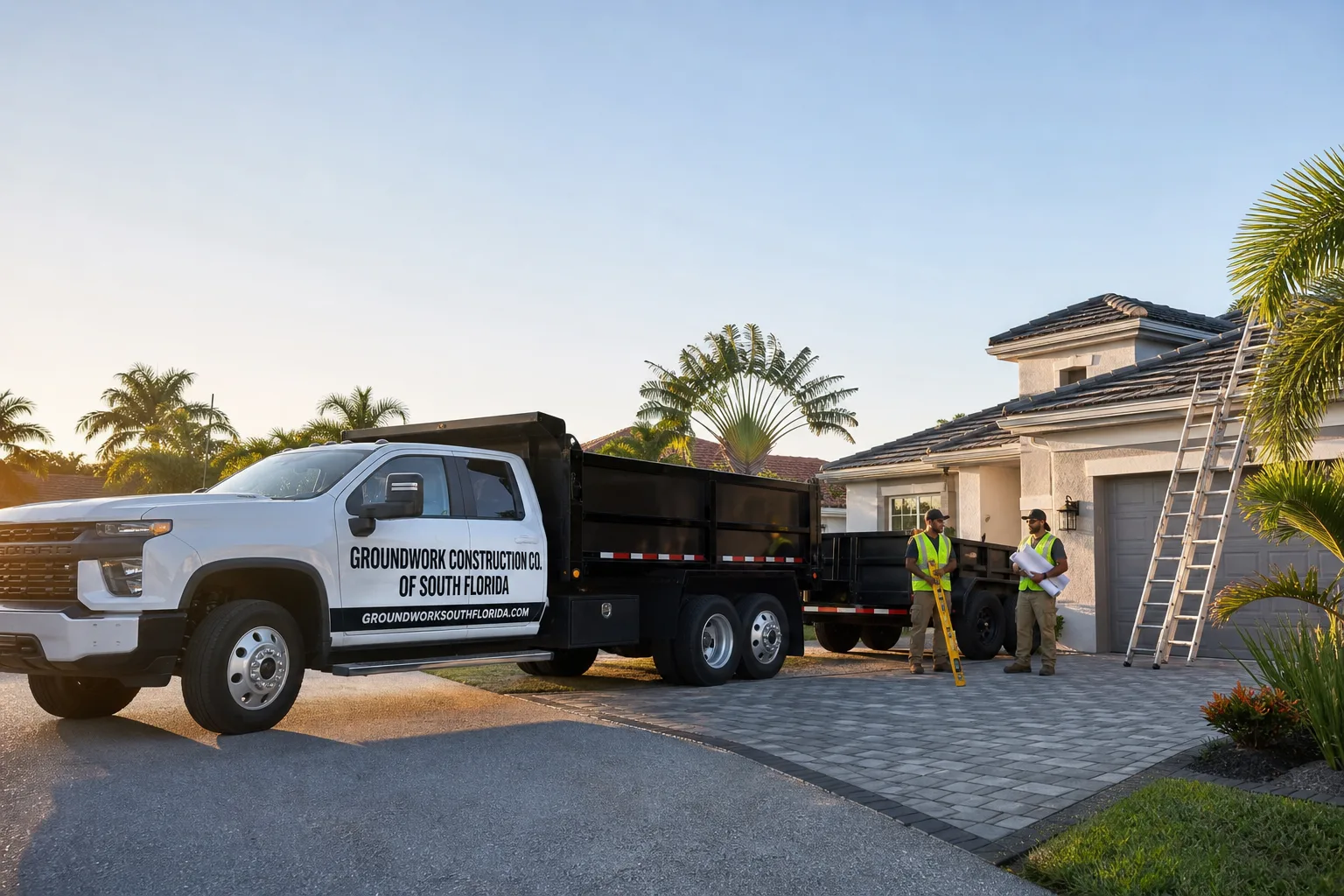
What Does Specialty Roofing Cost and Involve in Hollywood, FL?
Specialty roofing in Hollywood, FL covers non-standard installations including flat roofs, low-slope systems, green roofs, solar-integrated assemblies, and custom architectural profiles on homes where conventional shingles or tiles won’t perform. Most projects run 3-10 working days depending on complexity, with permits adding 5-10 business days upfront. In this market, specialty roofing typically ranges from $12,000 to $38,000. Call (844) 665-0162 for a free on-site estimate with itemized options.
How We Handle Specialty Roofing from First Call to Final Inspection
Every specialty roof we build in Hollywood follows a five-stage sequence. Here’s what actually happens, and what you’ll need to decide at each point.
Stage 1: Site assessment and scope lock (Day 1)
We walk the roof, measure every plane, and photograph existing conditions. For flat or low-slope work, we’re checking ponding patterns, parapet wall integrity, and whether the existing substrate is concrete, wood, or metal deck. You’ll decide at this stage whether you want us to proceed with core cuts to verify insulation depth, which adds $200-$400 but prevents change orders later. We also flag any HVHZ compliance gaps if you’re replacing an older system. This visit takes 90 minutes and yields a written estimate within 48 hours.
Stage 2: Material selection and permit submission (Days 2-10)
We source assemblies from our roofing partners - GAF, CertainTeed, Owens Corning, IKO, Atlas, Tamko, and Boral - but specialty work often pulls from their commercial or modified product lines rather than standard residential catalogs. For Hollywood’s flat-roof stock, we typically spec TPO or modified bitumen with tapered insulation; for green or solar-integrated systems, we coordinate with structural engineers early. You’ll choose membrane color (white for reflectivity, gray for aesthetics), insulation R-value, and whether to add a walkable surface or paver system. We submit to Broward County with Miami-Dade NOA documentation in hand, since Hollywood’s HVHZ status rejects standard Florida Product Approval alone.
Stage 3: Tear-off and substrate prep (Days 11-14)
Crews strip to deck, replace compromised plywood or concrete topping, and install hurricane tie-downs on pre-1992 CBS homes we encounter in 33023 and central Hollywood. If your home falls in this category, the re-nail schedule adds a day but satisfies the structural inspection that Broward now requires for any roof covering replacement. We also address chimney or vent flashings at this stage, since specialty membranes demand absolute substrate cleanliness.
Stage 4: Membrane and system installation (Days 15-20)
The crew lays insulation, adheres or mechanically fastens membrane per the NOA, and installs edge metal, drains, and penetrations. For TPO, we hot-air weld every seam; for modified bitumen, we torch-apply or cold-adhere depending on insurance and weather constraints. You’ll do a mid-install walk to confirm drain placement and any rooftop mechanical clearances. A Broward inspector visits before we cover anything critical.
Stage 5: Final inspection and documentation (Days 21-25)
We pull the certificate of completion, deliver your manufacturer warranty packet, and photograph the finished condition for your records. If your HOA requires specific aesthetic matching - common in Hollywood’s western planned communities - we submit those photos for their file. The whole sequence from signed contract to final sign-off typically spans 4-6 weeks, with weather and inspection scheduling the main variables.
The Specialty Roofing Options You’ll Actually Choose Between
Specialty roofing isn’t one product. Here are the real decisions Hollywood homeowners face, with the trade-offs we’ve observed across hundreds of Broward projects:
- TPO single-ply membrane: White reflective surface, welded seams, 15-20 year lifespan. Best for flat roofs with HVAC equipment where access matters. Lower material cost but requires skilled welders; repairs are straightforward. Not ideal for roofs with heavy foot traffic without additional protection.
- Modified bitumen (APP or SBS): Two-ply system with granulated cap sheet. More forgiving of imperfect substrates, better for low-slope transitions where shingles won’t work. APP is torch-applied, faster but weather-sensitive; SBS is cold-applied, safer for occupied buildings but slower. Slightly higher maintenance than TPO over time.
- Built-up roofing (BUR) with modified cap: Traditional 4-ply asphalt and felt with modern surface layer. The heaviest system, best for dead-level concrete decks common in 1960s Hollywood multi-family. Longest track record but messy installation; we rarely spec this for occupied single-family homes.
- Green or living roof assembly: Modular tray systems over waterproof membrane with drainage mat and root barrier. Adds R-value, stormwater retention, and significant weight - requires structural engineer sign-off on older CBS homes. Premium upfront, but Miami-Dade’s heat island mitigation incentives can offset costs. Best for homeowners planning long-term occupancy.
- Solar-integrated or cool-roof specialty systems: Membrane designed for panel attachment or with embedded reflective granules. Qualifies for Florida Power & Light rebates and some HOA solar mandates. Requires coordination with your solar installer on attachment points; we handle the roofing side, they handle electrical.
Most Hollywood flat-roof homeowners we work with in 33023 and 33024 land on TPO for its balance of cost, reflectivity, and warranty coverage. Homes near the Intracoastal or on the barrier island often need modified bitumen or a hybrid system for superior wind uplift resistance.
What Specialty Roofing Costs in Hollywood, FL
| Project Scope | Typical Range |
|---|---|
| Small flat roof (1,000-1,500 sq ft), TPO, standard insulation | $12,000-$18,000 |
| Mid-size low-slope (1,500-2,500 sq ft), modified bitumen or hybrid | $18,000-$28,000 |
| Large or complex specialty (2,500+ sq ft, green roof, solar-ready, or multi-level) | $28,000-$38,000 |
Five factors push your number up or down:
1. Existing roof condition: A single-layer tear-off with sound decking keeps you at the low end. Multiple layers, saturated insulation, or concrete spalling on pre-1970s homes adds $3,000-$8,000 in substrate work.
2. Structural upgrades required: Pre-1992 homes in Hollywood’s eastern neighborhoods often need hurricane tie-downs and deck re-nailing to meet current Broward structural inspection standards. Budget $1,500-$4,000 if your home falls in this category.
3. Material grade and warranty length: 15-year TPO vs. 20-year with enhanced thickness; modified bitumen with 10-year vs. 15-year manufacturer coverage. The jump typically costs 15-25% more.
4. Access and protection: Tight lots in central Hollywood, pool enclosures that can’t be damaged, or homes on the barrier island where crane placement is restricted by CCCL setbacks. Complex logistics add labor hours.
5. Permit scope and HOA coordination: Straight replacement permits run $400-$800 in Broward. If your project triggers a full plan review or your HOA requires architectural committee approval with sample submissions, add 1-2 weeks and $500-$1,500 in documentation costs.
Our written estimates include tear-off, disposal, substrate prep to code, membrane and insulation, flashings, permits, and final inspection. They do not include gutter replacement (unless specified), interior ceiling repair from pre-existing leaks, or structural engineering if required. We itemize everything so you know where your money goes.
What Hollywood’s Climate, Codes, and Housing Stock Do to This Job
Hollywood sits entirely within Florida’s High Velocity Hurricane Zone, a designation it shares only with Miami-Dade County. This isn’t bureaucratic trivia - it fundamentally changes what products we can specify and how they’re installed. Every roofing assembly must carry a Miami-Dade Notice of Acceptance with explicit HVHZ listing. Contractors unfamiliar with Broward’s permit desk, particularly those coming from Palm Beach County or Central Florida, routinely discover their preferred membrane or fastening schedule lacks this approval. We’ve seen projects stall three weeks while replacement materials are sourced. We verify NOA compliance before we quote, not after we pull the permit.
The city’s housing stock splits the work we see. In 33023 and central Hollywood, 1950s-1970s CBS homes with original flat or low-slope built-up roofing dominate. These roofs weren’t designed for modern HVAC loads or the reflective requirements of current Florida energy code. When we tear them off, we regularly find inadequate insulation, corroded fasteners from decades of salt-air exposure, and electrical panels that need relocation before we can seal the new membrane properly. The western ZIPs - 33024 through 33027 - bring newer tract homes with concrete tile that occasionally needs specialty low-slope tie-ins at additions or dormers. Two different construction eras, two different specialty roofing problems.
For homes on Hollywood’s barrier island in 33019, the Atlantic salt air accelerates corrosion of edge metal, fasteners, and any aluminum flashing. We spec stainless or hot-dip galvanized hardware as standard there, not as an upgrade. And if your property sits within the Coastal Construction Control Line, the Florida DEP permit layer adds time but protects your investment from future setback disputes. We’ve worked through this process on multiple oceanfront projects; the key is submitting complete documentation upfront rather than reacting to requests.
Many of our Hollywood clients are seasonal residents or retirees who leave homes unoccupied for months. For them, we emphasize roof systems with reliable long-term warranties and minimal maintenance schedules - TPO with 20-year coverage, or modified bitumen with annual inspection programs - so they’re not returning to surprises after a summer away. We’ve found that Sliding & Patio Doors in Hollywood often get upgraded in the same project cycle, since the same salt-air and HVHZ requirements apply, and homeowners want consistent storm protection across the whole envelope. Some also add Glass Railing Systems in Hollywood for balconies or rooftop terraces that complement their new specialty roof.
This work is part of our broader Roofing in Hollywood capability, and our Roofing crew coordinates directly with our window, door, and structural teams when a project spans multiple systems. We cover all of Hollywood and surrounding areas including Andover, Miramar, West Park, and West Hollywood.
Serving Hollywood, FL - Our Local Coverage Area
We’re based in the Hollywood area and know this community well. Use the map below to see our service coverage - if you’re nearby, we can almost certainly help.
Frequently Asked - Specialty Roofing in Hollywood
Most specialty roofing projects in Hollywood take 3-10 working days of actual construction, plus 5-10 business days for permitting and inspections. Pre-1992 homes needing structural tie-downs add 1-2 days. Call (844) 665-0162 and we’ll give you a timeline based on your specific roof geometry and permit history.
Yes. Broward County requires a roofing permit for any covering replacement, and Hollywood’s HVHZ status triggers additional structural inspection on older homes. We handle permit submission, NOA documentation, and inspection scheduling as part of our standard process. The permit fee is typically $400-$800 depending on project value.
Often yes, but it depends on curb height and membrane type. TPO and modified bitumen can be cut and flashed around existing curbs. If your HVAC sits on a rotted wood curb or your drains need relocation for proper slope, we’ll flag that during the site assessment and price it separately. We don’t bury surprises in the base quote.
Manufacturer warranties range from 10 to 20 years depending on membrane thickness and system type. TPO typically carries 15-20 years; modified bitumen 10-15. Our workmanship warranty covers installation defects for the same period. We register all warranties in your name and deliver the paperwork at final walkthrough, so you’re covered even if you sell the home.
Yes, generally 40-80% more than architectural shingle replacement for the same footprint. The materials cost more per square foot, the installation requires specialized crews and equipment, and the substrate prep is often more extensive on flat or low-slope systems. The trade-off is longevity on challenging roof geometries and compliance with Hollywood’s HVHZ requirements where standard shingles won’t perform. Call (844) 665-0162 for an exact quote - estimates are free.
Get Your Free Specialty Roofing Estimate in Hollywood
Call (844) 665-0162 to schedule a no-obligation site visit. We’ll assess your roof, explain which specialty system fits your home’s structure and your budget, and deliver a written estimate with itemized options within 48 hours. Raymond Estevez and our team have handled specialty roofing across Hollywood’s full range of housing stock, from 1960s CBS flat roofs to modern solar-ready assemblies. We’ll walk you through the HVHZ requirements upfront so there are no permit surprises.
Written by Raymond Estevez, Owner at Groundwork Construction Co., serving Hollywood since our founding in South Florida.