
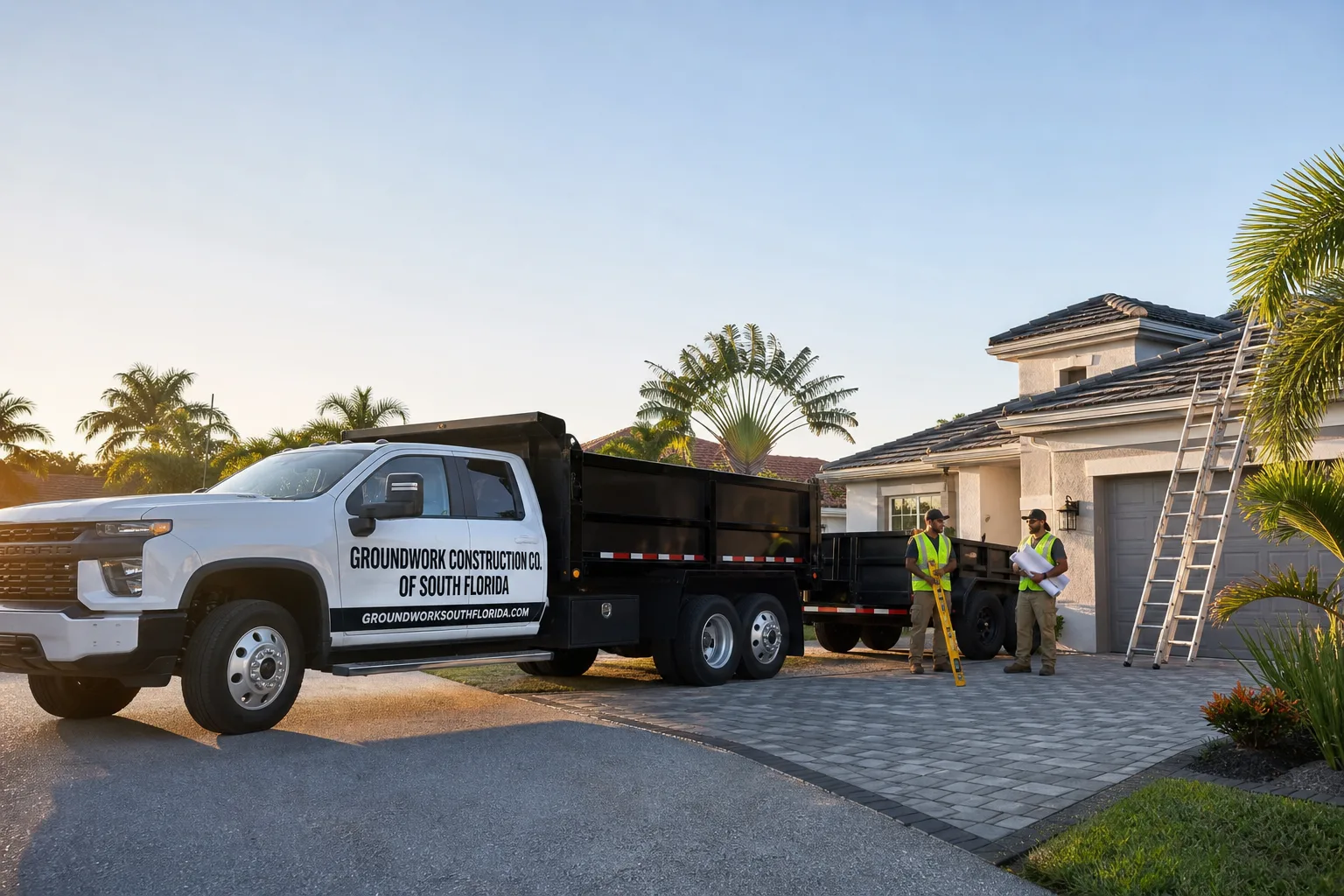
Tile Roofing in Coconut Creek: What It Costs and How Long It Takes
Roofing in Coconut Creek typically runs $8,000-$20,000 for a full replacement and $600-$2,500 for targeted repairs, with most residential projects completed in 3-7 business days depending on deck condition and material choice. We’re Groundwork Construction Co., and you can reach our roofing crew at (844) 665-0162 for a free on-site estimate that breaks down your specific roof geometry, underlayment condition, and tile options.
How We Handle a Tile Roof From Tear-Off to Final Inspection
Every tile roof we do in Coconut Creek follows a five-stage sequence. Homeowners who know the timeline make better decisions about material upgrades and temporary living arrangements, so here’s exactly how we work.
Stage 1: Deck and Underlayment Assessment (Day 1, 2-4 hours)
We start by removing a test section of tile in two or three areas, usually on the south and west exposures where Coconut Creek’s afternoon sun and wind-driven rain do the most damage. This tells us whether we’re looking at a simple re-tile over solid decking or a full tear-off with plywood replacement. You’ll decide at this stage whether to upgrade from standard 30-pound felt to a synthetic underlayment with a longer manufacturer warranty. That choice alone can add $800-$1,800 to the total but extends underlayment life from 20 years to 40+ in our humid climate.
Stage 2: Structural Repair and Deck Prep (Days 1-2, 4-8 hours)
If we find soft decking, corroded fasteners, or the all-too-common issue in 1970s-era Coconut Creek construction: original plywood that’s delaminated from decades of attic heat and moisture cycling. We cut out compromised sections, sister damaged rafters if needed, and install new CDX plywood to match existing thickness. Homes in Wynmoor Village and similar vintage communities sometimes need additional framing reinforcement where original construction didn’t account for the dead load of modern concrete tile profiles. This stage is where hidden costs live, so we photograph everything and get your approval before cutting a single board.
Stage 3: Underlayment and Flashing Installation (Days 2-3, 6-10 hours)
We roll out your chosen underlayment with full hot-mopped seams at valleys and penetrations, then install new copper or coated aluminum flashing at chimneys, wall transitions, and vent stacks. In Coconut Creek’s High-Velocity Hurricane Zone, we pay particular attention to drip edge fastening patterns and valley construction, both of which get extra scrutiny from Broward County inspectors. You’ll need to decide now if you want upgraded valley metal or standard W-valley, a $400-$700 difference that shows up first in wind-driven rain events.
Stage 4: Tile Layout and Installation (Days 3-6, 16-32 hours)
This is where the visual character gets locked in. We snap chalk lines for straight courses, cut tiles at ridges and hips with a wet saw, and set each piece to the manufacturer’s specified exposure and fastening pattern. Concrete barrel tile, flat S-tile, and clay profiles each have different layout logic and different wind-uplift ratings. A standard 2,000-square-foot roof in Coconut Creek takes 2-3 days of actual setting time, but we don’t rush the curing adhesive at hips and ridges, especially in summer humidity when thin-set can skin over too fast.
Stage 5: Cleanup, Magnetic Sweep, and Final Walk (Day 6-7, 2-3 hours)
We run a magnetic roller across the entire grounds, run gutters to clear debris, and do a final attic inspection for any fasteners that missed their mark. Then we schedule your Broward County roofing inspection, which in Coconut Creek typically happens within 48 hours for re-roof permits. We meet the inspector on-site to address any punch items immediately, so your certificate of completion isn’t held up.
The Tile Options You’ll Actually Choose Between
- Standard-weight concrete S-tile: The most common replacement tile in Coconut Creek, running $3.50-$5.50 per square foot installed. Good 30-year lifespan, Class A fire rating, and enough color variation to match most HOA palettes. The trade-off: it’s porous, so algae and mildew staining start showing within 5-7 years without periodic pressure washing. Best for homeowners who want reliable protection at moderate cost and don’t mind maintenance.
- Lightweight concrete flat tile: Runs $4.00-$6.50 per square foot installed. Lower profile than barrel tile, which matters in Coconut Creek’s wind zone because there’s less uplift surface for hurricane-force gusts. Some 1970s-era structures in Wynmoor and similar communities can’t take the dead load of standard tile without structural reinforcement, making lightweight profiles the only viable option without engineering. The trade-off: less distinctive curb appeal, and color fade is slightly more noticeable over time.
- Clay barrel tile (Spanish or Mission profile): $6.00-$9.00 per square foot installed, with genuine kiln-fired clay commanding the premium end. Impervious to moisture, algae-resistant, and proven to 75+ years in South Florida’s climate. The trade-off: weight. At 950-1,200 pounds per square, your roof structure needs to be verified by a structural engineer before permit submission, which adds $600-$1,200 and 1-2 weeks to the project. We only recommend clay when the structure is already adequate or when you’re doing a full structural remediation anyway.
- Composite/polymer simulated tile: $5.50-$8.00 per square foot installed. Products like Brava or DaVinci mimic clay or slate at roughly one-third the weight, with impact ratings that satisfy Miami-Dade and Broward County product approval lists. The trade-off: they’re newer to the market, so long-term color stability in UV is still being proven, and some HOAs in Coconut Creek’s planned communities haven’t updated their approved-materials lists to include them yet. We verify HOA acceptance before quoting.
- Underlayment upgrade (30# felt vs. synthetic vs. self-adhered): This decision is as important as the tile itself. Standard felt is code-minimum and cheapest upfront. Synthetic underlayment (Grace, Titanium, or similar) buys you tear resistance and longer exposure tolerance if tile damage happens in a storm. Self-adhered ice-and-water shield at valleys and eaves adds $900-$1,500 but is the only layer standing between you and a leak if wind rips tile at the most vulnerable transitions. In Coconut Creek’s hurricane exposure, we recommend at least the synthetic upgrade on every job.
What Tile Roofing Costs in Coconut Creek, FL
| Scope | Price Range | Typical Timeline |
|---|---|---|
| Tile roof repair (localized) | $600-$2,500 | 1 day |
| Partial re-tile (one slope/section) | $3,500-$7,500 | 2-3 days |
| Full tile roof replacement | $8,000-$20,000 | 5-7 days |
| Structural reinforcement + full replacement | $14,000-$28,000 | 10-14 days |
Five factors push your number within these ranges. First, roof size and complexity: a simple gable roof on a 1990s Coconut Creek single-family runs toward the low end; a multi-hip 1970s condo building with multiple penetrations pushes high. Second, deck condition: if we find delaminated plywood or corroded fasteners, replacement adds $2.50-$4.50 per square foot. Third, structural needs: homes that need engineered reinforcement for tile dead load or post-tension cable remediation (common in Wynmoor-era construction) can add $4,000-$10,000 before the first tile goes down. Fourth, material grade and profile: lightweight concrete saves on structure but costs more per square; clay commands a premium but lasts generations. Fifth, permit and inspection scope: Broward County charges by valuation, and re-roof permits on larger homes or those requiring structural drawings run higher.
A written estimate from Groundwork includes tear-off and disposal, deck repair up to 10% of surface area, underlayment, flashing, tile, and standard ridge/hip accessories. It does not include gutter replacement, skylight upgrades, or structural engineering if required, those are line-itemed separately so you’re not paying for what you don’t need.
What Coconut Creek’s Building Stock and Climate Do to This Job
Coconut Creek, FL presents a tile roofing market split between two distinct construction eras, and the job looks completely different depending on which one we’re standing on.
The eastern corridors and single-family neighborhoods built in the 1990s and 2000s, developments like those along Lyons Road and Coconut Creek Parkway, typically have conventional truss framing and asphalt shingle roofs now reaching replacement age. These are straightforward tile conversions: structure is usually adequate for standard concrete tile, permits move through Broward County on standard re-roof tracks, and HOAs in communities like Winston Park or Coconut Creek Ranch have well-established architectural review processes with approved color palettes already documented.
Then there’s Wynmoor Village and the concentrated 1970s-era condo stock, which is where Coconut Creek diverges from every nearby market. These buildings are concrete block construction with post-tensioned floor slabs, and the original roofing systems, often built-up flat or early shingle, are now failing simultaneously with the structural elements beneath them. Florida’s post-Surfside SB 4-D recertification law means any tile roofing project on these structures now triggers a broader structural evaluation. We’ve been called to tile re-roof jobs in Wynmoor that turned into slab remediation and tendon repair projects before a single roofing permit could be pulled. The tile work itself becomes the finish layer on a much larger capital improvement.
Climate factors matter too. Coconut Creek’s position in Broward’s High-Velocity Hurricane Zone means every tile roof must meet Florida Building Code wind-uplift requirements, typically achieved through foam adhesive at perimeters and mechanical fastening at hips and ridges. The city’s extremely high water table, sitting just a few feet below grade in many areas, doesn’t directly affect the roof but does mean any interior water intrusion from a failed tile system has nowhere to drain naturally, making underlayment quality and flashing precision more critical than in better-drained markets. And the salt-laden air from the Atlantic, even ten miles inland, accelerates corrosion on any exposed metal fasteners, which is why we specify stainless or hot-dip galvanized hardware on every Coconut Creek job, not standard electro-galvanized.
Permitting reality: Broward County handles Coconut Creek’s roofing permits, and the inspection queue moves faster for straightforward re-roofs than for jobs requiring structural drawings. We submit electronically and pull permits before demolition starts, so your project isn’t held up by administrative delays.
Serving Coconut Creek, FL - Our Local Coverage Area
We’re based in the Coconut Creek area and know this community well. Use the map below to see our service coverage - if you’re nearby, we can almost certainly help.
Frequently Asked - Tile Roofing in Coconut Creek
Most residential tile roof replacements in Coconut Creek take 5-7 business days from tear-off to final inspection, assuming standard deck conditions and no structural surprises. Wynmoor-era condo buildings or homes requiring engineered reinforcement can extend to 10-14 days. Call (844) 665-0162 and we’ll assess your specific structure and give you a firm timeline with your estimate.
Yes, Broward County requires a roofing permit for all tile roof replacements and most repairs exceeding one square (100 square feet). We handle permit submission, drawings, and inspection scheduling as part of our project management. The permit fee scales with job valuation and is itemized in your written estimate, so there are no surprises.
Usually yes, if your existing roof geometry is compatible with tile profile height. Standard plumbing vents get extended with matching boots; HVAC curbs and attic fans are reflashed in place. We only recommend relocating penetrations when they’re improperly clustered or when switching from a low-profile shingle to a high-profile barrel tile that creates clearance conflicts. We identify any relocation needs during the initial assessment, not mid-project.
Yes, typically 40-60% more upfront for comparable roof size. A standard architectural shingle replacement in Coconut Creek runs $8,000-$15,000, while concrete tile starts at $8,000 and climbs to $20,000 for complex roofs with premium materials. The return comes in lifespan, concrete tile routinely lasts 30-50 years versus 15-25 for shingle, and in resale value, particularly in communities with Mediterranean or Spanish architectural covenants where tile is essentially mandatory for aesthetic compliance.
Tile roofing warranties have two parts: the manufacturer’s material warranty, which runs 30-50 years depending on tile brand and profile, and our installation workmanship warranty, which covers flashing detail, fastening pattern, and underlayment application. We work with GAF, CertainTeed, Owens Corning, IKO, Atlas, Tamko, and Boral roofing systems, and each carries its own specific material coverage. We’ll walk you through the exact warranty terms for your selected product before you sign, not after.
Get a Free Tile Roofing Estimate in Coconut Creek
Call (844) 665-0162 to schedule a free on-site assessment for tile roofing in Coconut Creek. We’ll inspect your deck condition, measure your roof geometry, review your HOA requirements if applicable, and deliver a written estimate with material options from our full roofing portfolio. No deposit required to book, and we don’t start work until you’ve approved every line item.
Written by Raymond Estevez, Owner at Groundwork Construction Co., serving Coconut Creek and South Florida.