
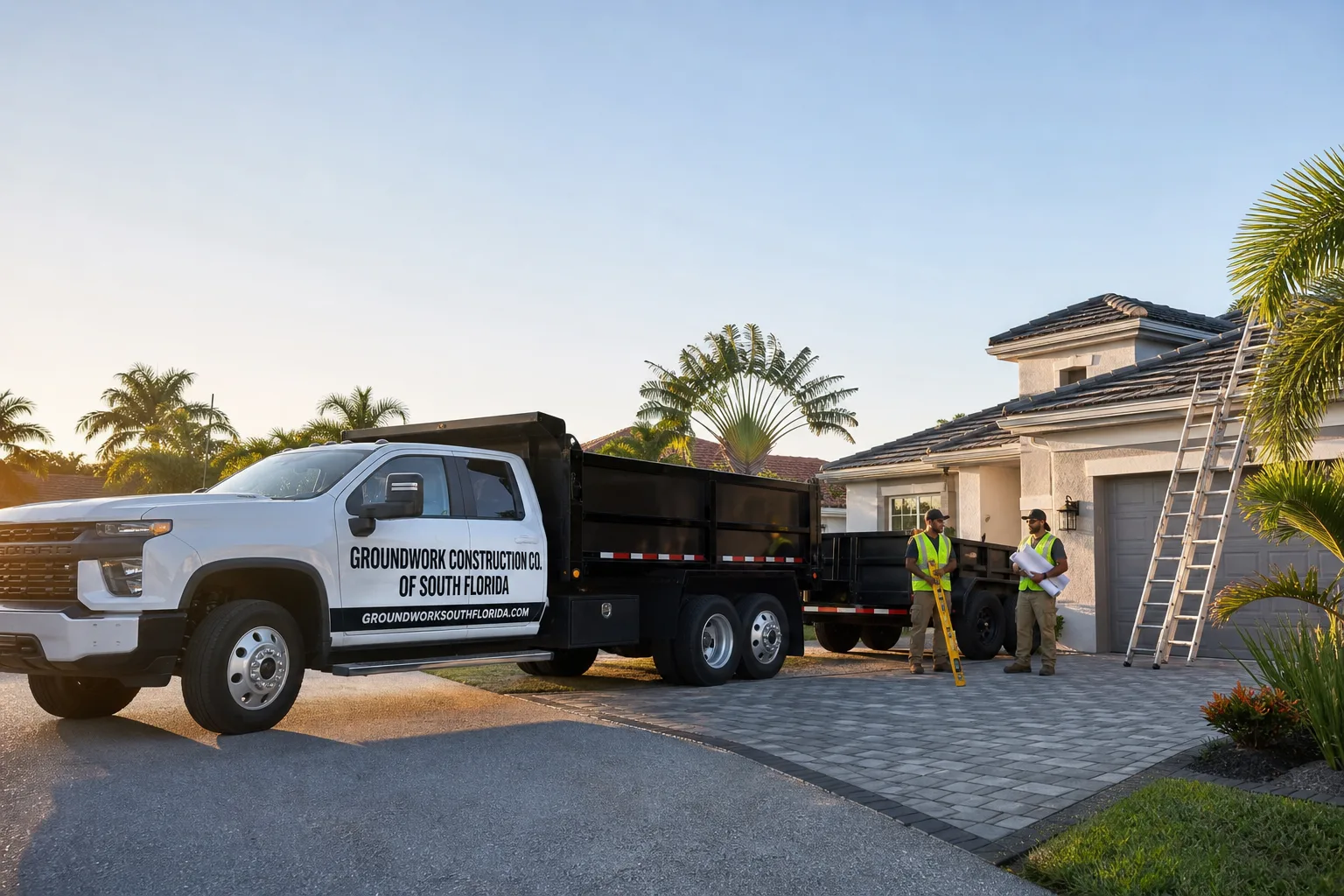
Tile Roofing in Country Club, FL - Timeline, Cost, and What HVHZ Compliance Means
Tile roofing in Country Club typically runs $8,000-$20,000 for a full replacement, with most projects taking 5-10 business days from permit approval to final inspection. Because Country Club sits inside Miami-Dade County’s High-Velocity Hurricane Zone, any tile roof work on pre-1994 homes frequently triggers mandatory code upgrades - secondary water barriers, Miami-Dade NOA-compliant underlayment, and enhanced fastening patterns - that extend both scope and timeline beyond what homeowners initially expect. Call (844) 665-0162 and we’ll walk you through exactly what your home’s build year means for the project.
How we handle a tile roofing project from start to finish
We’ve learned that tile roofing in Country Club rewards preparation more than speed. The HVHZ requirements here don’t forgive shortcuts, and the split between pre- and post-Andrew construction means we treat every job as potentially more complex than it first appears. Here’s how we actually work through it.
Stage 1: Site assessment and HVHZ scope verification (1-2 days)
We start on the roof, not at the desk. Our crew documents the existing tile type, underlayment condition, decking integrity, and - critically - the home’s original build year and any prior permits. For homes built 1985-1994, we flag the likelihood of mandatory code upgrades. You’ll decide at this stage whether to proceed with a full replacement or, if the decking and underlayment are in exceptional condition, a more limited retile. We photograph everything and deliver a written scope with two price tiers: standard replacement and code-upgrade replacement.
Stage 2: Material selection and NOA compliance check (2-3 days)
Tile roofing in Country Club requires Miami-Dade Notice of Acceptance (NOA) products - not every clay or concrete tile on the market qualifies. We present 2-3 NOA-compliant options, typically from our roofing partners like GAF, CertainTeed, or Boral, with samples you can set against your exterior paint and trim. You’ll choose tile profile (flat, S-tile, barrel), color, and whether to upgrade to a premium underlayment system. We submit the NOA documentation with your permit package to avoid inspection delays.
Stage 3: Permit submission and HOA architectural review (1-4 weeks)
Miami-Dade permitting for tile roofing moves faster when the packet is complete upfront. We handle the building permit, but most Country Club subdivisions require parallel HOA architectural review - a step that catches unprepared homeowners by surprise. We’ve worked with enough local associations to know their typical turnaround, and we coordinate both tracks so neither stalls the other. You’ll see the permit application and HOA submission materials before we file; no surprises.
Stage 4: Tear-off, deck repair, and system installation (3-7 days)
Demo day starts with full tile removal and underlayment strip-down to the decking. We inspect every sheet - soft spots, delamination, or prior leak damage are common in the 30-plus-year roofs we see around Country Club. Any decking replacement happens now, followed by secondary water barrier application (required on most re-roofs here), new underlayment, and tile installation to HVHZ fastening schedules. The crew works section by section so your home is never fully exposed overnight.
Stage 5: Inspection, cleanup, and documentation (1 day)
Miami-Dade requires a roofing inspection for tile installation - we schedule it, meet the inspector, and address any punch items same-day. We deliver your final packet: inspection sign-off, manufacturer warranty registration, and photos of the completed system. For homeowners who later sell, this documentation proves HVHZ compliance to buyers and insurers.
The tile choices you’ll actually decide between
Not all tile roofing performs the same in Country Club’s climate. The wet season humidity, salt-laden westerly breezes, and UV exposure near the Everglades edge matter. Here’s what we typically present:
- Clay tile (traditional S-profile or flat): Heaviest and longest-lasting - 50+ years when properly installed. Excellent color retention, but the weight (900-1,200 lbs per square) demands verified structural capacity, especially on pre-1994 homes where we may need engineering review. Premium price tier, but the lifecycle cost often wins for owners planning to stay 15-plus years.
- Concrete tile (flat or lightweight profile): More affordable upfront, with comparable wind ratings when NOA-compliant. Concrete absorbs more moisture than clay, so the underlayment system becomes the critical decision - we typically spec a double-layer or self-adhering membrane here. Good middle-ground choice for homeowners balancing budget with durability.
- Lightweight concrete or composite alternatives: Lower structural load (600-800 lbs per square) opens tile roofing to homes with marginal decking capacity. These products have improved significantly, but we limit recommendations to specific NOA-approved lines with proven track records in South Florida. Best for code-upgrade projects where structural reinforcement would otherwise blow the budget.
The underlayment decision matters as much as the tile. Standard felt deteriorates faster in our heat and humidity. We typically recommend a self-adhering, high-temp underlayment for Country Club - it costs more upfront, but we’ve seen too many premature failures where homeowners saved $800 and paid $4,000 five years later.
What tile roofing costs in Country Club, FL
| Project scope | Price range |
|---|---|
| Tile roof repair (localized) | $600-$2,500 |
| Full tile roof replacement | $8,000-$20,000 |
| Code-upgrade replacement (pre-1994 home) | $12,000-$24,000 |
Five factors push your number within or beyond these ranges:
- Home size and roof complexity: A simple gable roof on a 1,600-square-foot tract home runs toward the lower end. Multiple valleys, dormers, or a 2,400-plus-square-foot footprint add labor and material.
- Build year and code trigger: Pre-1994 homes requiring secondary water barrier, enhanced fastening, and potential decking reinforcement add $3,000-$6,000 to a standard replacement. This is the single biggest surprise for Country Club homeowners.
- Tile material grade: Standard concrete tile versus premium clay or imported profiles can swing material costs $2-$4 per square foot.
- Structural modifications: If engineering review reveals inadequate rafter or truss capacity for your chosen tile weight, reinforcement adds both cost and time.
- HOA and permit timing: Not a direct cost, but delays between HOA approval and permit issuance can push the project into wet season, when we may recommend waiting for optimal installation conditions.
A written estimate from us includes tile, underlayment, fasteners, decking repair up to 10% of roof area, permit fees, and inspection coordination. It does not include structural engineering (if required), full decking replacement beyond 10%, or interior repair from prior leaks - we flag these possibilities during assessment so you’re not ambushed.
What Country Club homes specifically do to this job
Country Club isn’t generic suburban Florida, and tile roofing here carries constraints you won’t find in Fort Lauderdale or Palm Beach County. The 33015 ZIP sits on porous Miami Limestone with that high seasonal water table - not directly relevant to the roof itself, but it shapes how we stage materials, protect your landscaping during delivery, and manage runoff during the tear-off. More critically, the HVHZ jurisdiction means your neighbor in Palm Springs North (Broward County) faces a simpler permit path for the same tile product.
The housing stock tells the story. Those CBS tract homes built 1987-1995 - you’ll see them clustered near the original Country Club of Miami golf course boundaries and along the grid streets west of NW 57th Avenue - often have original tile roofs now at end of life. When we assess these, we know to check for prior homeowner repairs that may not have pulled permits, because unpermitted work complicates the current permit application. The HOA layer adds another step: most subdivisions here were platted with architectural control committees, and we’ve learned which associations require color samples in person versus digital submission.
The failure mode we see most? Underlayment decay beneath intact tile. Homeowners assume the tile is the roof; in Country Club’s heat and humidity, the underlayment does the actual waterproofing, and it can fail while tiles look fine. We find this constantly on 1990s-era homes where original felt underlayment has become brittle. It’s why we never quote tile roofing without a full tear-off assessment - retiling over bad underlayment is throwing money away.
This work often connects to broader exterior projects. Homeowners tackling tile roofing in Country Club frequently pair it with Impact Windows & Doors in Country Club to complete their HVHZ envelope upgrade, or with Sliding & Patio Doors in Country Club for rear-yard access improvements that match the new roofline aesthetic. And if you’re considering a full exterior overhaul, our Roofing in Country Club page covers how tile fits into complete envelope replacement alongside siding, windows, and structural upgrades.
Groundwork serves Country Club from our Fort Lauderdale base, and our Roofing crew carries the full range of GAF, CertainTeed, Owens Corning, IKO, Atlas, Tamko, and Boral product lines - multiple manufacturer options so you’re not locked into whatever’s on the truck.
Serving Country Club, FL - Our Local Coverage Area
We’re based in the Country Club area and know this community well. Use the map below to see our service coverage - if you’re nearby, we can almost certainly help.
Frequently asked - Tile Roofing in Country Club
Most tile roofing projects take 5-10 business days of actual construction, plus 1-4 weeks for permitting and HOA approval. Pre-1994 homes requiring code upgrades add 2-3 days for enhanced underlayment and fastening work. Call (844) 665-0162 and we’ll estimate your specific timeline after a site visit - assessments are free.
Yes - Miami-Dade County requires a building permit for all tile roofing, and most Country Club HOAs add architectural review. Unpermitted roofing work here risks fines, insurance denial, and forced removal. We handle both permit and HOA coordination as part of our standard process.
Generally no - Miami-Dade HVHZ standards require full tear-off and inspection of the decking for re-roof permits, and we won’t warranty a project that skips this step. The underlayment beneath your existing tile is likely the actual failure point, and it can’t be properly replaced without removal. We assess this during our initial site visit.
Pre-1994 homes trigger mandatory code upgrades - secondary water barrier, enhanced fastening patterns, and Miami-Dade NOA product compliance - that post-1994 homes may avoid. These aren’t optional add-ons; they’re inspector requirements. We identify this possibility upfront so you’re not surprised mid-project.
Manufacturer material warranties range from 50 years (premium clay) to limited lifetime (certain concrete lines), with specific coverage varying by product tier. Our workmanship warranty covers installation quality for a defined period we specify in writing. We register all manufacturer warranties in your name - not ours - so coverage stays with the home if you sell.
Ready to talk through your tile roof?
Call (844) 665-0162 for a free on-site assessment in Country Club. Raymond Estevez or a senior project lead will walk your roof, check your build year and permit history, and deliver a written estimate with standard and code-upgrade pricing tiers within 48 hours. No deposit required to schedule, and we’ll coordinate HOA submission if your community requires it.
Written by Raymond Estevez, Owner at Groundwork Construction Co., serving Country Club and South Florida homeowners since our founding.