
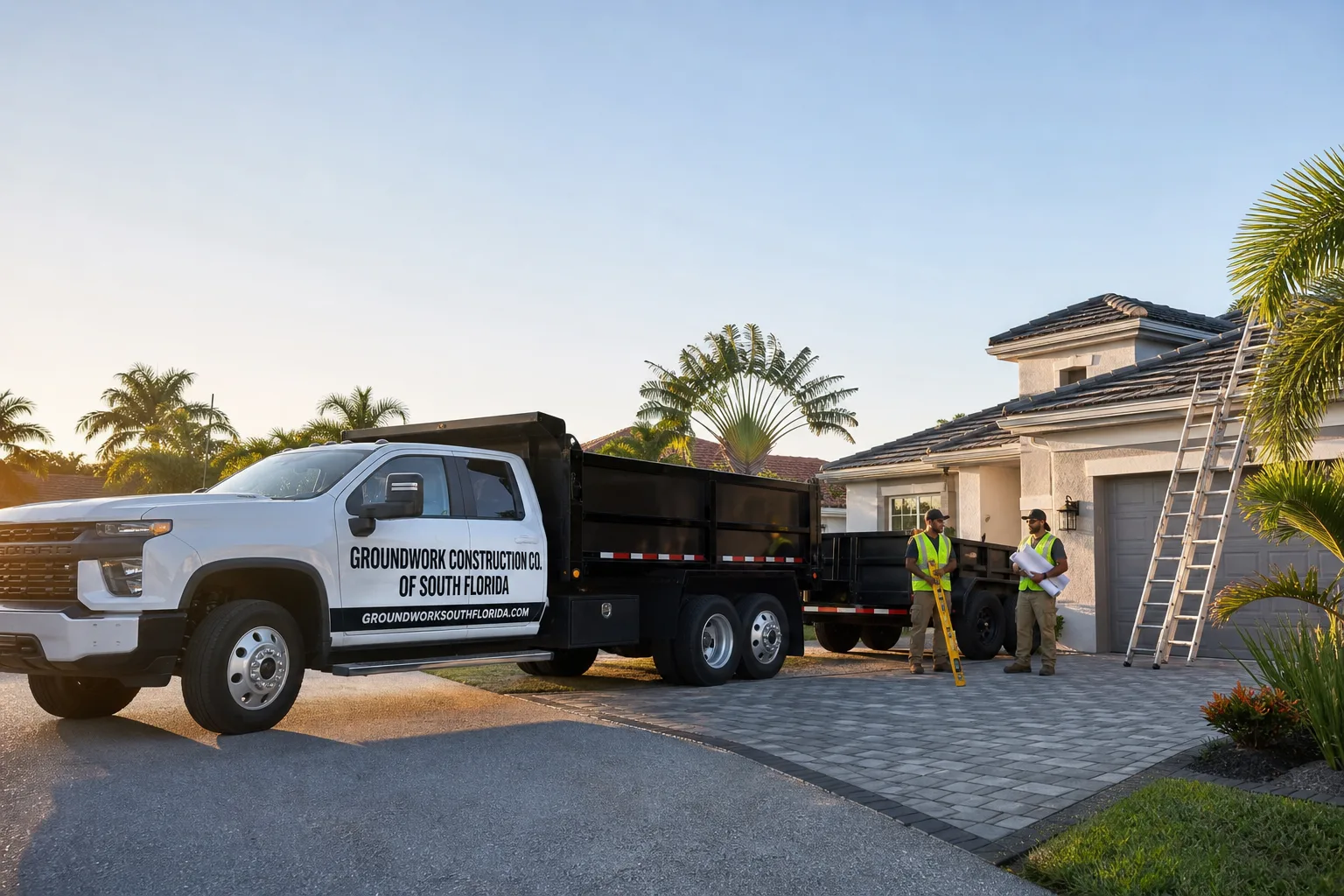
Tile Roofing in Lake Worth Corridor: Timeline, Cost, and What to Expect
Tile roofing in Lake Worth Corridor typically runs $8,000-$20,000 for a full replacement and takes 5-10 business days from permit approval to final inspection. Most homeowners choose clay or concrete tile for the 1950s-1970s concrete block homes that dominate this pocket of unincorporated Palm Beach County. Call (844) 665-0162 and we’ll walk your roof, check the decking condition, and give you a written estimate with line-item pricing before you commit.
How We Handle a Tile Roof from First Call to Final Nail
We’ve learned that tile roofing in Lake Worth Corridor rewards patience upfront and precision during execution. The county’s inspection schedule and the corridor’s aging housing stock mean rushing the early stages costs more later. Here’s how we sequence every job.
Stage 1: On-site assessment and decking evaluation (1-2 hours, day of call or next day)
We walk the roof with you, photograph every soft spot, cracked tile, and sign of moisture intrusion into the CBS walls below. On corridor homes built in the 1960s with original flat tar roofs later converted to tile pitch-overs, we often find the original decking was never upgraded for tile weight. You’ll decide here whether to scope a full tear-off or a recover, and whether you want us to open any suspect wall sections while we’re on the roof. We bring a moisture meter and a ladder tall enough for your eave height, no exceptions.
Stage 2: Permit pull and compliance check (5-15 business days)
Because Lake Worth Corridor is unincorporated Palm Beach County, every permit routes through the county building department in West Palm Beach, not any city hall. We submit your roof plans, engineer-signed wind-load calculations for the Florida Building Code’s high-velocity hurricane zone, and a notarized owner affidavit. If our pre-pull research flags an unpermitted carport conversion or room addition on your property, we flag it now. Palm Beach County inspectors will red-tag the whole job if they discover legacy unpermitted work mid-project. We’ve seen crews from Broward and Miami-Dade caught flat-footed by this. We won’t be.
Stage 3: Tear-off and structural prep (1-2 days)
We strip to decking, replace water-damaged plywood or oriented strand board, and install proper underlayment. For tile roofing, this means at minimum a self-adhered modified bitumen layer at valleys and penetrations, with a high-temp synthetic underlayment field. On homes where the original roof was flat built-up tar and someone later added a shallow pitch for tile without proper structural support, we may need to sister rafters or add collar ties. You’ll know before we cut.
Stage 4: Tile installation and flashing (3-5 days)
We set battens to the correct gauge for your tile profile, install valley metal and penetration flashings, and lay tile from eave to ridge. Clay barrel tile, flat concrete tile, and high-profile S-tile each demand different headlap and fastening patterns. We don’t guess. Our crew checks every third tile for proper embedment on the batten, and we photograph the finished field before the county inspector arrives.
Stage 5: Inspection and closeout (1-2 days)
Palm Beach County requires a mid-roof inspection after underlayment and a final after tile. We meet the inspector, address any punch items same-day, and hand you your permit closure letter, manufacturer warranty registration, and our workmanship guarantee. The whole sequence, from signed contract to final walk, typically spans 3-5 weeks in Lake Worth Corridor, with permitting consuming the largest chunk.
The Tile Choices That Actually Matter for Your Roof
Not every tile suits every home. Here are the decisions we walk homeowners through on Lake Worth Corridor jobs:
- Clay barrel tile vs. flat concrete tile: Clay runs heavier and pricier but carries a 50-year material warranty from most manufacturers and sheds wind-driven rain better during Palm Beach County’s summer deluges. Flat concrete costs less per square, weighs less, and suits lower-pitch roofs where barrel tile’s headlap would look squat. Clay fades gracefully; concrete weathers more visibly.
- Natural clay vs. ceramic-coated: Natural terracotta develops the patina you see on old Coral Gables estates. Ceramic-coated clay locks in color but can craze or spall if the coating application is thin. We source from manufacturers with Florida Product Approval numbers, not gray-market imports.
- Standard weight vs. lightweight: Lightweight concrete tile, around 600 pounds per square instead of 900+, lets you recover an existing roof without structural upgrades. The trade-off is brittleness underfoot and slightly shorter lifespan. On a 1960s CBS home with original 2×4 rafters at 24 inches on center, lightweight may be your only option without a full structural redesign.
- Color and profile: HOAs in Lake Worth Corridor’s pocket neighborhoods often restrict to earth tones and specific profiles. We pull your HOA docs during estimate prep so you don’t fall in love with a Spanish S-curve that the architectural committee rejects.
- Underlayment grade: The underlayment outlives the tile in Florida’s UV and heat. We spec a 30-year synthetic or self-adhered ice-and-water shield at valleys, not 15-pound felt. The cost difference is material, not labor, and it matters.
Our roofing crew carries samples from multiple manufacturers so you handle the actual product before ordering.
What Tile Roofing Costs in Lake Worth Corridor, FL
| Component | Price Range |
|---|---|
| Tile Roof Replacement (full) | $8,000 - $20,000 |
| Tile Roof Repair (localized) | $600 - $2,500 |
| Structural decking replacement | $1,500 - $4,500 |
| Upgraded underlayment package | $800 - $2,200 |
| Permit and inspection fees (Palm Beach County) | $400 - $900 |
Five variables push your number up or down. Roof size is obvious: a 1,000-square-foot roof on a 1950s corridor cottage runs toward the low end, while a 2,500-square-foot home with multiple valleys and hips climbs. Existing condition matters more here than in newer suburbs. We regularly open roofs and find the original flat tar deck rotted beneath a 1990s tile overlay, adding $2,000-$5,000 in unplanned structural repair. Material grade moves the needle: imported clay from Spain or Mexico costs double domestic concrete. Access and height affect labor hours; single-story homes with clear driveway access price lower than two-story jobs where we crane materials over a pool enclosure. Finally, code compliance surprises. If Palm Beach County requires us to document and upgrade unpermitted legacy construction before signing off the roof permit, that adds time and engineering cost.
Our written estimate itemizes tile, underlayment, labor, permit fees, and a contingency line for decking repair. It does not include tree trimming, gutter replacement, or interior drywall repair from pre-existing leaks. We mark those separately so you decide, not discover.
Why Lake Worth Corridor Homes Make Tile Roofing a Different Job
The corridor’s specific conditions shape every tile roof we install. Start with the housing stock: thousands of small CBS homes built between 1950 and 1975, many with original flat or low-slope built-up tar roofs, original jalousie windows, and carport conversions that were never permitted. When we pull a Palm Beach County permit for tile roofing on one of these properties, the county’s system cross-references the original 1962 footprint against current aerial imagery. Discrepancies trigger a compliance review.
We’ve stood on roofs on 10th Avenue South and South D Street where the back bedroom was clearly a 1980s carport conversion with no permit on file. The homeowner didn’t know. Palm Beach County’s inspector knew the moment he checked the property card. That job paused for three weeks while an engineer documented the existing footings, a structural plan brought the addition to current Florida Building Code, and the county issued a retroactive permit. The tile roofing itself was straightforward. The bureaucracy wasn’t.
Climate compounds the challenge. Lake Worth Corridor sits fully within Florida’s wind-borne debris region. Every tile must pass missile-impact testing and install to a specific uplift resistance. The humidity here doesn’t relent. Stucco cracks, moisture wicks into CBS walls, and roof leaks that would dry out in Arizona instead foster mold in wall cavities. Our tile installations include proper ventilation calculations and, where the existing structure allows, additional soffit and ridge venting to move air through the attic space.
And because this is unincorporated county, there’s no city building department to appeal to, no local official who knows your street. Every question routes through the county’s central office. We know the permit techs and the inspector rotation. That relationship saves our Lake Worth Corridor clients days, sometimes weeks.
Homeowners here often pair exterior envelope work. If you’re replacing windows while we do your roof, ask about Impact Windows & Doors in Lake Worth Corridor. For patio access upgrades, we also handle Sliding & Patio Doors in Lake Worth Corridor. One contractor, every phase.
Serving Lake Worth Corridor, FL - Our Local Coverage Area
We’re based in the Lake Worth Corridor area and know this community well. Use the map below to see our service coverage - if you’re nearby, we can almost certainly help.
Frequently Asked - Tile Roofing in Lake Worth Corridor
From signed contract to final inspection, expect 3-5 weeks. Permitting through Palm Beach County consumes 1-2 weeks; the physical work takes 5-10 business days depending on roof size and whether we uncover decking damage. Call (844) 665-0162 and we’ll give you a tighter timeline after seeing your roof.
Yes, absolutely. Lake Worth Corridor is unincorporated Palm Beach County, so every roofing permit routes through the county building department. We handle the application, engineer-signed wind-load calculations, and inspection scheduling. If your home has unpermitted additions, we’ll identify that before pulling the permit so you’re not surprised by a red tag.
We can work around existing gutters if they’re in good condition, though we recommend replacing aging galvanized gutters while the roof is open. Skylights are a different question. Old bubble skylights on corridor homes typically leak and lack impact ratings. We flag them during estimate and let you decide whether to replace, relocate, or omit.
Yes, typically 40-60% more upfront for materials and labor. Clay or concrete tile lasts 30-50 years versus 15-25 for architectural shingle in Florida’s UV exposure, and tile carries better wind ratings for the Florida Building Code’s high-velocity zone. Over a full ownership cycle, the cost difference narrows or reverses. We’ll run both numbers if you want to compare.
Manufacturer material warranties range from 30 years to limited lifetime depending on tile grade. Our workmanship warranty covers installation defects for a period we specify in writing. The manufacturer warranty requires registration within 30 days of completion and annual roof inspections to remain valid. We register it for you and show you what to watch for between inspections.
Ready to Talk Through Your Roof?
We’ll walk your Lake Worth Corridor property, check the decking, review your permit history, and give you a written estimate with line-item pricing for tile roofing that accounts for the real conditions we find. No deposit required to get on our schedule. Call (844) 665-0162 or request a callback through our site. Raymond Estevez or a senior estimator will meet you on-site, typically within 48 hours.
Written by Raymond Estevez, Owner at Groundwork Construction Co., serving Lake Worth Corridor and South Florida. Tile roofing is part of a full Roofing in Lake Worth Corridor program that includes material choices from GAF, CertainTeed, Owens Corning, and other leading manufacturers.