
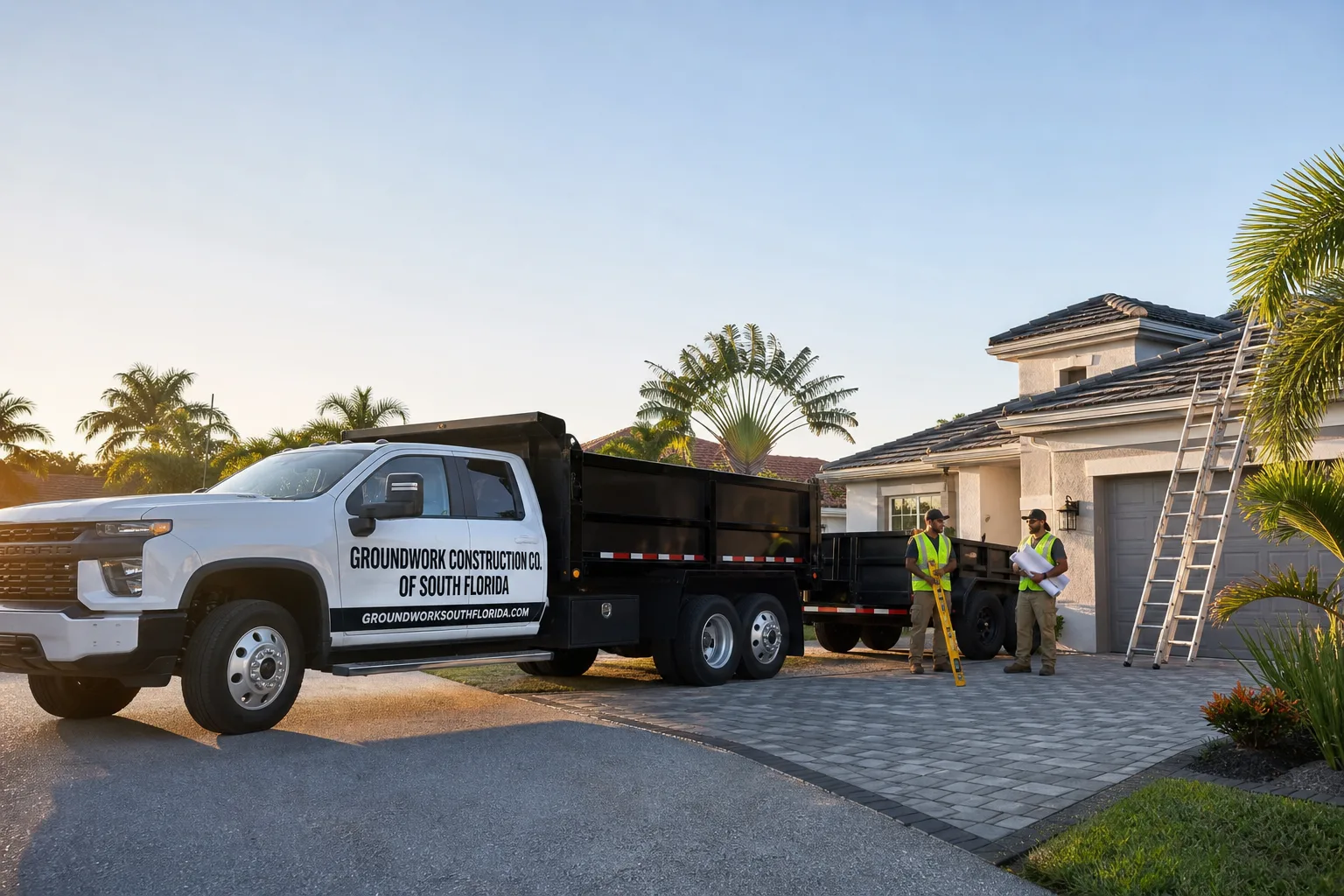
Paver Driveways in Country Club, FL: What to Expect, What to Pay
Paver driveway installation in Country Club typically runs $7,000-$18,000 for a standard residential driveway and takes 3-5 days from demo to final compaction. Most homeowners in the 33015 area can schedule an on-site evaluation within a week by calling (844) 665-0162. The job breaks into distinct stages, and knowing what happens at each one helps you avoid the surprises that turn a straightforward project into a budget headache.
How We Build a Paver Driveway - Start to Finish
We’ve installed paver driveways across Miami-Dade long enough to know that skipping a stage or rushing the base always shows up two rainy seasons later. Here’s how we actually do it, and where you’ll need to make decisions.
Stage 1: Demo and utility locate (Day 1)
We call 811 for utility marking 48 hours before we arrive, then remove the existing driveway surface - asphalt, concrete, or old pavers - and haul it off. In Country Club, we often find sprinkler lines running unexpectedly close to the apron or shallow electrical conduit from 1980s-era landscape lighting. If we hit it, we flag it immediately. You’ll decide now whether to reroute any irrigation that crosses the driveway path or cap it; rerouting adds roughly $400-$900 but prevents future repair trenches through your finished surface.
Stage 2: Excavation and drainage assessment (Day 1-2)
We cut to 8-10 inches below finish grade for vehicular loads, but in Country Club’s western pockets near the canal system, we sometimes hit saturated Miami Limestone within 18 inches of grade during wet-season months. When that happens, we install a French drain or slot drain tied to your stormwater system before the base goes in. Skipping this is how driveways heave after three Miami summers. You’ll approve the drainage plan here; it’s not optional if we recommend it.
Stage 3: Base installation and compaction (Day 2-3)
We lay DOT-approved crushed concrete or limestone aggregate in 4-inch lifts, compacting each layer to 98% Proctor density with a vibratory roller. This isn’t the place to save money with thinner base or hand-tamping. We bring in a plate compactor for edges and a roller for the field, then check grade with a laser to ensure 1% minimum slope away from the house. You’ll walk the base with us before we proceed; this is your last chance to adjust width or curve geometry without destroying finished work.
Stage 4: Edge restraint, bedding sand, and paver laying (Day 3-4)
We set concrete or aluminum edge restraints on a concrete haunch, screed 1 inch of coarse bedding sand, and lay pavers in your chosen pattern. Running bond, herringbone, and basketweave each handle vehicular loads differently; herringbone interlocks best for steep aprons or heavy trucks. We cut border pieces with a wet saw, not a splitter, for clean joints against existing walkways or garage slabs. You’ll make the final call on any field cuts around mature trees or utility boxes you chose to keep.
Stage 5: Compaction, joint sand, and sealant (Day 4-5)
We vibrate the finished surface to settle pavers into the bedding layer, sweep polymeric sand into joints, vibrate again, and activate the sand with a light water mist. The driveway is drivable after 24 hours, though we ask you to avoid sharp turning for 72 hours while the joint sand fully cures. We schedule a 30-day follow-up to check for settling or joint washout after the first heavy rains.
The Paver Choices You’ll Actually Decide Between
Not all pavers suit every driveway. Here’s what we present to Country Club homeowners, with the honest trade-offs:
- Standard concrete pavers (2⅜-inch thickness, basic color blends): The entry point at roughly $7,000-$10,000 for a typical two-car driveway. Hold up fine for passenger vehicles but can chip at edges if you regularly park a heavy truck or trailer. Color fades slightly over 8-10 years in South Florida UV. Best for budget-conscious homeowners who want the paver look without premium spend.
- Tumbled or beveled-edge pavers (same thickness, upgraded finish): Roughly $1,500-$3,000 more than standard. The antiqued surface hides minor staining from irrigation rust or leaf tannins, which matters in Country Club’s oak-canopied sections. Slightly softer edge profile reduces chipping. We recommend these when the driveway is a prominent visual element from the street.
- Permeable pavers (wider joints, open-graded base): Adds $2,500-$5,000 to the job but handles stormwater on-site, which helps with Miami-Dade’s increasingly strict impervious-surface calculations for larger lots. Required by some HOAs for expansions over certain square footage. The look is subtly different - larger joints, more textured surface - so we bring samples to your door before you commit.
- Clay brick pavers (genuine fired brick, not concrete simulant): $12,000-$18,000+ range. Unmatched color permanence and a formal aesthetic that suits the traditional architecture common in 1990s Country Club subdivisions. Higher initial cost, but 30+ year lifespan with minimal fading. We source from Belcrest, Pine Hall, or similar domestic manufacturers with proven South Florida performance records.
- Porcelain pavers (newer category, ¾-inch thickness over mortar bed): Not our default recommendation for vehicular use, but viable for motorcourt-style installations with minimal turning radius. Ultra-low water absorption, completely stain-proof. We mention it only because some homeowners ask after seeing European installations; for most Country Club driveways, we’d steer you back to 2⅜-inch concrete or clay.
Joint sand matters too. Standard mason’s sand washes out faster in our downpours. Polymeric sand costs more upfront but reduces weed growth and ant colonization - a real consideration on lots backing up to canal-edge vegetation.
What Paver Driveways Cost in Country Club, FL
| Scope | Price Range |
|---|---|
| Standard paver driveway (single car, ~400 sq ft) | $7,000-$10,500 |
| Standard paver driveway (two car, ~600 sq ft) | $9,500-$14,000 |
| Upgraded material or permeable system (two car) | $12,000-$18,000 |
| Additional drainage (French/slot drain) | $1,200-$3,500 |
| Irrigation rerouting | $400-$900 |
Five variables push your number up or down. Existing surface condition is the biggest: a crumbling asphalt driveway that’s already partially demoed by erosion costs less to remove than a thick, steel-reinforced concrete slab from the 1980s. Driveway dimensions and shape run second; every curve, radius, and non-rectangular corner adds cutting labor and waste factor. Material grade and pattern complexity accounts for the gap between standard running bond and a multi-size random pattern with soldier-course borders. Drainage requirements vary block by block in Country Club - we’ve done straightforward installs near the eastern edge and complex slot-drain systems within 200 yards of the L-31W canal where the water table sits high. HOA and permit timing doesn’t change material cost but affects project scheduling; some Country Club associations require 30-day architectural review before we can pull the Miami-Dade permit.
Our written estimates include demo, haul-off, base material and compaction, edge restraint, pavers, bedding sand, joint sand, and final compaction. They do not include permit fees (typically $350-$600 in Miami-Dade for driveway work), HOA application fees, or irrigation repair beyond simple capping. We line-item each so you see where the money goes.
What Country Club Homes Specifically Do to This Job
Country Club isn’t Broward County, and the difference matters for exterior work. Sitting inside Miami-Dade’s High-Velocity Hurricane Zone, this area operates under the strictest wind-load and water-management codes in the country. While a paver driveway doesn’t trigger roof-level HVHZ compliance, any project that alters the home’s drainage pattern or connects to stormwater infrastructure can trigger Miami-Dade Environmental Resources Management review if you’re within the canal setback zone.
The housing stock shapes our approach. Most homes here are CBS tract construction from 1985-2005, built as planned HOA subdivisions on former agricultural and wetland-edge land. Those HOAs still enforce deed restrictions with architectural review requirements for any exterior construction, including driveway replacement. We’ve worked with the Country Club Ranches, Country Club of Miami, and Lakes of the Meadow associations enough to know their submission requirements - color samples, dimensioned plans, material specifications - and we prepare the package so you don’t get bounced back for missing documentation.
The porous Miami Limestone and high water table create the failure modes we see most: heaving from hydrostatic pressure where drainage was skipped, joint sand washout from inadequate slope, and efflorescence on lighter-colored pavers where moisture migrates upward through the base. We design for these conditions because we’ve repaired driveways that didn’t.
Homeowners in Country Club often pair a paver driveway with larger property improvements. If you’re expanding your footprint, ADU Design & Permitting in Country Club or Garage Conversion ADU in Country Club may be on your radar, and we coordinate the hardscape and structural scopes so you’re not managing separate contractors. For the full range of exterior work we handle here, see Driveway & Pavers in Country Club, or explore our broader Driveway & Pavers capabilities and Country Club service area.
Serving Country Club, FL - Our Local Coverage Area
We’re based in the Country Club area and know this community well. Use the map below to see our service coverage - if you’re nearby, we can almost certainly help.
Frequently Asked - Paver Driveways in Country Club
Most paver driveway installations in Country Club take 3-5 business days from demo to final compaction, assuming no HOA or permit delays. Weather can push us back during peak wet season; we monitor the forecast and won’t excavate if heavy rain threatens base saturation. Call (844) 665-0162 to check current scheduling.
Yes, Miami-Dade County requires a building permit for driveway replacement that alters the existing surface material or drainage pattern. We handle the application, but your HOA may require separate architectural review first, which can add 2-4 weeks. We factor this into our project timeline so you’re not surprised.
Sometimes, if the lines run deep and outside the driveway footprint. More often, we find shallow irrigation crossing the apron or along the edges in Country Club’s older lots, and we recommend rerouting to avoid future repair trenches through your finished surface. We’ll show you exactly what we found during demo and let you decide.
A standard 2⅜-inch concrete paver in a simple running bond pattern, installed over proper base with polymeric sand joints, starts around $7,000 for a single-car driveway in Country Club. This isn’t the place to cut corners on base depth or compaction; the paver itself is the least expensive durable option. Call (844) 665-0162 for a free estimate on your specific dimensions.
We warranty our workmanship - base preparation, edge restraint, and installation - for five years. Paver manufacturers warranty their product against defect, typically 25 years to lifetime for quality concrete pavers and 50+ years for clay brick. The warranty doesn’t cover settling from undocumented utility work, tree root intrusion, or damage from heavy equipment exceeding residential loads.
Get Your Free On-Site Estimate for Paver Driveways in Country Club
We’ll walk your driveway, check drainage, flag any utility or HOA considerations specific to your lot, and deliver a written estimate with line-item pricing. No deposit required to schedule. Call (844) 665-0162 or submit a request through our site - we typically respond within one business day and can often evaluate your property within a week.
Written by Raymond Estevez, Owner at Groundwork Construction Co., serving Country Club and South Florida homeowners since 2014.